

Make $100 to $1,400 in 2 Hours: Work From Home for Women 45–65
Building recurring passive income after 50 with just two hours a day is realistic, and it does not require reinventing yourself. The 2-Hour Workflow approach works by building one income asset (a digital product, a subscription, a small service) once, then automating the delivery and repeating the parts that sell. Earnings vary widely by effort and method, but the range clients report following this system runs from $100 to $1,400 a day, and results depend on consistency, not luck.
TL;DR:Building a digital asset or subscription using the 2-Hour Workflow can generate between $100 and $1,400 daily, depending on effort and consistency.Starting costs are minimal, often under $50 initially, with most income streams requiring only basic tools like landing pages, email automation, and marketplaces.Earnings typically take three to nine months to stabilize, with steady growth focused on organic traffic, automated funnels, and repeated effort.Focusing on one income idea that matches your skills and interests yields better results than juggling multiple projects at once.Supplementary income through dividend stocks or ETFs can enhance overall cash flow but requires initial capital and should be paired with active methods.
Table of Contents
- Work From Home Over 50: Passive-Income Options That Fit Two Hours a Day
- The 2-Hour Workflow: A Daily and Weekly Plan
- What to Expect: Timeline, Earnings, and Startup Costs
- The Minimal Toolset: What to Set Up This Weekend
- How to Choose the Right Path and Avoid Costly Mistakes
- Evidence and Results Behind the 2-Hour Workflow
- Balancing Work and Life While Staying Motivated at 50+
- Updating Your Skills for Remote Work After 50
- Legal and Tax Considerations for Remote Workers Over 50
- Where to Find Support and Community Over 50
- A 90-Day Sprint: What Consistency Actually Looks Like
- Ready to Start Your Own 2-Hour Workflow?
- Sources
Work From Home Over 50: Passive-Income Options That Fit Two Hours a Day
You don’t need eight-hour workdays or a existing audience to start earning online. What you need is a method that matches the time you actually have. Here are the options that consistently work inside a two-hour daily window.
- Digital downloads and printables. Planners, templates, checklists. Startup cost is low (often under $50 for design software and a marketplace listing), and the required skill is basic layout work. Milestone: your first sale within 30 days on a platform like Etsy.
- Micro-courses. A single 45-minute video teaching one specific skill you already have. Startup cost is medium if you invest in decent recording software, low if you use your phone. Best for readers with a professional background they’ve never monetized.
- Evergreen email funnels with a lead magnet. A free guide that captures an email address, followed by a short automated sequence that sells a $27 to $97 product. This is one of the fastest ways to turn a small daily investment into repeatable sales, because the funnel keeps working after you build it.
- Stock-photo or design-asset licensing. If you already take good photos or design graphics, licensing them on marketplaces generates small recurring royalties. Low upfront cost, slow but compounding returns.
- Membership or microsubscription content. A small monthly fee for ongoing tips, templates, or community access. Best for readers who enjoy showing up consistently rather than creating one big product.
- Dividend income as a supplement. Dividend-paying stocks and dividend ETFs are a commonly recommended strategy for women over 50 who want predictable cash flow without selling assets. It requires capital rather than daily effort, so it works best paired with an active income method, not instead of one.
- Low-overhead services converted to subscriptions. Proofreading, bookkeeping, or design retainers billed monthly instead of per project. Best for experience-based readers who already have a marketable skill.
Low-tech readers should start with printables or a lead magnet funnel. Experience-based readers do better with micro-courses or subscription services. Readers with some savings to deploy can treat dividend investing as a complementary, lower-effort layer.
The 2-Hour Workflow: A Daily and Weekly Plan
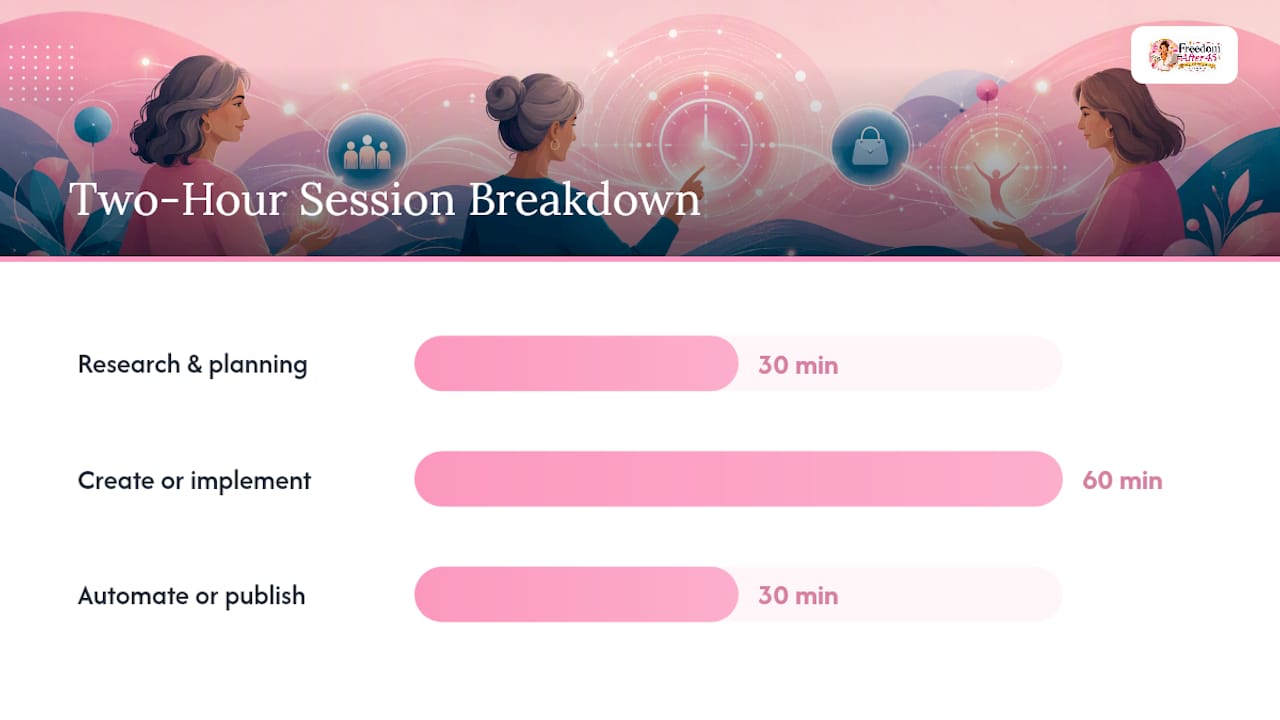
Two hours only works if they’re structured. Here’s the session breakdown that keeps the system moving without burning you out.
- First 30 minutes: research and planning. Check what’s selling in your niche, review yesterday’s numbers, and pick the single task that matters most today.
- Next 60 minutes: create or implement. Write the product copy, record a lesson, build the landing page section, or respond to the day’s customer messages. This block is protected. No email, no scrolling.
- Final 30 minutes: automate or publish. Schedule the email, publish the listing, set up the payment link, or send one outreach message to a potential partner.
The weekly rhythm compounds from there. Week one is for outlining your product and drafting a lead magnet. Week two is for building the landing page and writing your welcome email sequence. Weeks three through six focus on driving traffic, testing a small ad budget, reaching out to potential partners, and refining based on what actually converts.
Automation is what makes this sustainable past month one. A minimal, connected workflow that handles invoicing, delivery, and reminders automatically removes the repeated manual steps that eat up a solo operator’s time. Once your funnel and payment system run themselves, your two hours shift from creation to growth.
Pro Tip: Batch your content once a week instead of daily. Write three emails or design five templates in one sitting, then use the daily two-hour blocks purely for publishing and outreach. Micro-outsourcing small tasks (formatting, image resizing) for under $20 on a freelance marketplace buys back time for the work only you can do.
What to Expect: Timeline, Earnings, and Startup Costs
Nobody replaces a paycheck in week one, and anyone who promises that is lying to you. Here’s a more honest picture.
- 0 to 3 months: first sale for most digital products and services; this is the proving stage.
- 3 to 9 months: steady, if modest, recurring monthly income as your funnel and repeat customers build up.
- 9 to 18 months: the range where consistent operators report reaching daily income between $100 and $1,400, depending on the method, niche, and how consistently the two-hour system was run.
Conservative estimates assume slow, organic growth with no ad spend. Optimistic estimates assume some paid traffic testing and a product that resonates quickly. Dividend income sits apart from this timeline entirely: it’s slower to build meaningful returns but steadier once established, which is why it’s recommended alongside other conservative options rather than as a standalone plan.
Startup costs stay small if you keep the stack simple. Expect a basic website tool, a delivery platform, and maybe a small test ad budget. Early costs are best treated as an investment in a future income stream, not a gamble, especially when you start with one tool and expand only once it earns its keep.
The Minimal Toolset: What to Set Up This Weekend
You don’t need a technical background to launch this system in a weekend. You need five things and a Saturday afternoon.
- A simple landing page. A drag-and-drop builder works fine; no coding required.
- One delivery method. A marketplace like Etsy, or a simple file-delivery tool, depending on your product.
- One email tool. Something with automation built in, so your welcome sequence runs without you.
- Payment processing. A standard processor that connects directly to your landing page.
- Optional discovery platforms. Pinterest or a niche marketplace, depending on where your customers already spend time.
Cost tiers usually break down into three levels: a basic setup running close to free using trial tiers, a recommended setup in the $20 to $50 monthly range once you add email automation and a paid page builder, and optional add-ons like scheduling tools or premium templates layered in later. Nontechnical creators have built real income using tools no more complicated than Canva and Etsy, so resist the urge to over-invest in software before you’ve made your first sale. For anything outside your skill set, formatting, cover design, basic edits, outsourcing small tasks for under $50 is usually cheaper than the hours you’d spend learning it yourself.
How to Choose the Right Path and Avoid Costly Mistakes
Picking one idea and sticking with it beats juggling five half-finished projects. Use four criteria to decide.
- Skill fit. Does this use something you already know, or does it require learning a brand-new skill from scratch?
- Time to first sale. Some methods (printables, services) sell in weeks. Others (memberships, licensing) take longer to build traction.
- Upfront cost and risk. Match your starting method to what you can afford to lose if it doesn’t work on the first try.
- Joy and sustainability. If you dread the work, you won’t do it consistently enough for it to compound.
Before committing, ask yourself three questions: who exactly is my customer, where will they actually find me, and how will they pay me? If you can’t answer all three clearly, you’re not ready to launch yet.
Watch for red flags: platforms that own your entire customer list with no way to export it, business models that depend entirely on one traffic source, and anyone promising guaranteed income figures.
Pro Tip: Choosing one focused idea and testing it before adding a second consistently outperforms trying several methods at once, largely because split attention means nothing gets the repetition it needs to work.
Evidence and Results Behind the 2-Hour Workflow
Freedom After 45 built the 2-Hour Workflow specifically for women over 45 who want recurring income without needing an existing following, a product idea, or technical training… The program walks readers through the exact same build-once, automate, repeat structure outlined above, backed by video instruction, templates, and a support community.
Readers can review the full case studies and testimonials directly on the program’s landing page, where outcomes and workflow details are laid out step by step.
Balancing Work and Life While Staying Motivated at 50+
Two hours a day sounds manageable until life interrupts it, and it will. The women who stick with this longest treat their two hours like a doctor’s appointment: scheduled, protected, and non-negotiable, but never expanded to eat the rest of the day.
Motivation dips are normal, especially between week four and week eight, when the early excitement fades but the payoff hasn’t arrived yet. This is the point where most people quit, right before consistency would have paid off. Track weekly output instead of daily mood. Did you publish the email? Did you finish the template? Progress on the task matters more than how inspired you felt doing it.
Protect the boundary between “work” and “everything else” by ending your session with a hard stop, even mid-thought. Leaving a task slightly unfinished actually makes it easier to jump back in tomorrow, because your brain already knows where to pick up.
Celebrate small, boring wins: your first $10 sale, your first subscriber, your first five-star review. These moments feel small in isolation but they’re proof the system works, and proof is what keeps you going through the slower weeks. Pair your two-hour block with something you enjoy, coffee on the porch, a favorite playlist, so the work itself starts to feel less like a chore and more like a habit you protect.
Updating Your Skills for Remote Work After 50
You likely already have more relevant experience than you’re giving yourself credit for. Decades of managing a household budget, coordinating a team, training coworkers, or running a small side business translate directly into skills like project management, copywriting, and customer service. The reskilling most women over 50 actually need isn’t a full career pivot. It’s learning a handful of specific digital tools.
Start narrow. Pick the one skill your chosen income method actually requires and learn just that. If you’re building a micro-course, learn basic screen recording. If you’re selling printables, learn one design tool well rather than five poorly. Free tutorials on YouTube, short paid workshops, or the training built into a structured program like the 2-Hour Workflow all work, as long as you apply what you learn within days, not months.
Avoid the trap of endless learning without doing. Watching tutorials feels productive, but it isn’t income. Set a rule: for every hour of learning, spend at least two hours applying it to your actual project. Skills stick faster when there’s a real task attached to them.
Legal and Tax Considerations for Remote Workers Over 50
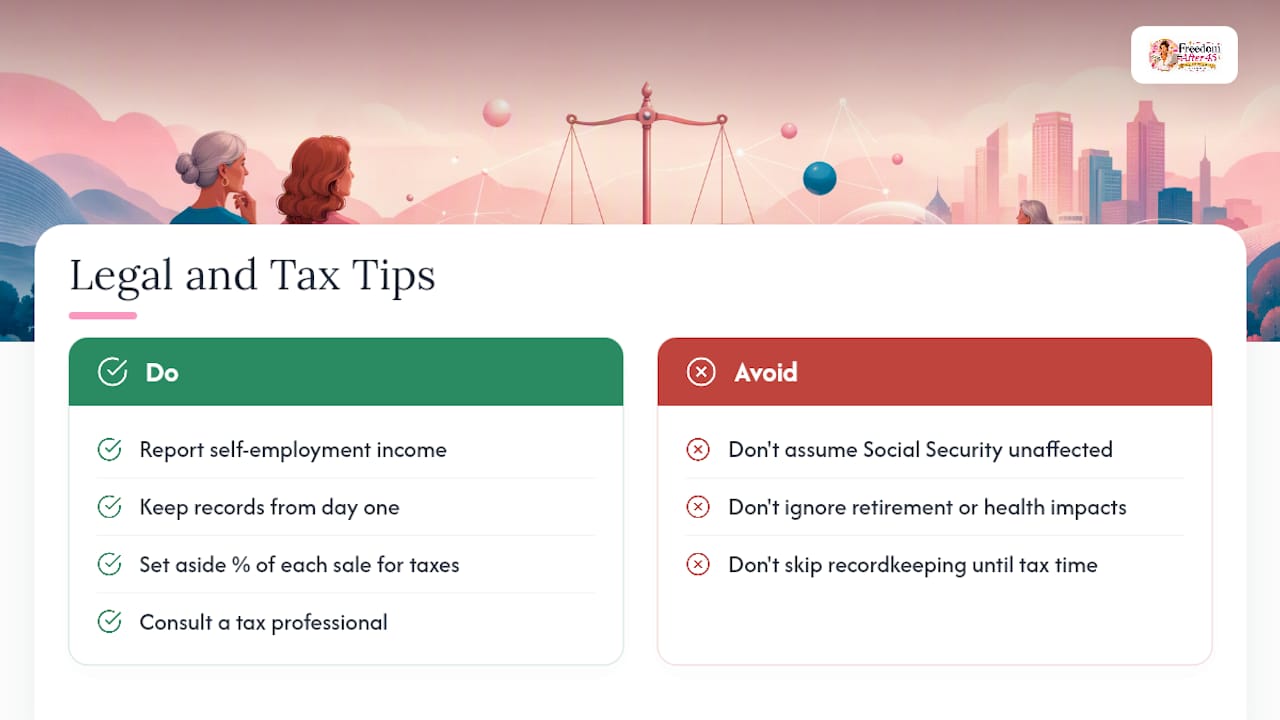
Income from a digital product or side business is taxable, and the rules differ depending on how you structure the work. If you’re selling as an individual without forming a business entity, that income typically counts as self-employment income and needs to be reported accordingly. Keep records from day one, every sale, every expense, rather than trying to reconstruct them at tax time.
Consider whether a simple business structure makes sense once income becomes consistent. Many home-based sellers start as sole proprietors and only consider forming an LLC once revenue reaches a level where liability protection or tax treatment makes the paperwork worthwhile. This decision depends on your specific state and income level, so a conversation with a tax professional or accountant familiar with small online businesses is worth the cost before you scale.
If you’re also drawing Social Security, additional income can affect your benefits depending on your age and how much you earn, so check your specific situation against current Social Security Administration rules rather than assuming a blanket answer. Retirement account contributions and health insurance costs may also shift once you have new income streams, particularly if you’re purchasing coverage independently rather than through an employer. None of this should stop you from starting, but build a simple habit of setting aside a percentage of every sale for taxes so the bill in April doesn’t come as a surprise.
Where to Find Support and Community Over 50
Working alone doesn’t mean working without support. Facebook groups built specifically for women over 50 building online income are active and often free to join, and they’re useful for troubleshooting technical questions or getting honest feedback on a product idea before you launch it. Local small business development centers, often run through community colleges, offer free or low-cost workshops on topics like basic bookkeeping and marketing.
Structured programs that include a built-in community, like the one included with the 2-Hour Workflow, solve a specific problem: isolation kills motivation faster than almost anything else. Having a group of peers at the same stage, dealing with the same doubts, makes the difference between quitting in week six and pushing through to month nine, when results typically start to show. Look for communities where people share actual numbers and actual setbacks, not just highlight reels. That honesty is what makes the advice usable.
A 90-Day Sprint: What Consistency Actually Looks Like
Week one was outlining a simple guide. Week four was a working landing page and my first three subscribers. By week nine, small daily sales started arriving on their own. The takeaway: nothing dramatic happened in any single session. The two hours, repeated without skipping, built the asset that eventually worked while I slept.
— Freedom After 45
Ready to Start Your Own 2-Hour Workflow?
If you’ve read this far, you already know the ideas work. What most people actually need isn’t more ideas, it’s a proven structure that removes the guesswork of what to do in each of those two hours. That’s exactly what the 2-Hour Workflow was built to do: a step-by-step blueprint, ready-made templates, real case studies, and a community of women doing this exact work right now, so you’re never staring at a blank screen wondering where to start.

Here’s how to take the next step:
- Preview the full course outline and see exactly what’s included.
- Review the case studies and testimonials from women who’ve completed the program.
- Visit the 2-Hour Workflow landing page to see current pricing and get started today.
The two hours you have this evening could be the first session of an asset that pays you long after you’ve stopped actively building it.
This article is general information, not a substitute for advice from a qualified financial advisor. Consult a qualified financial professional about your own circumstances before acting on anything here.
Sources
- Best passive income strategies for women over 50 who want to retire rich | Forbes
- Passive income ideas for women over 50 | Sixty and Me
- The real risks of starting an online business (and how to handle them) | Good Time to Start