

First Sales in 90 Days: No Inventory Business for Busy Adults
Yes, you can build a real business without buying or storing physical products, but the model has to match your time, skills, and cash. Services and digital products get you to first revenue fastest. Dropshipping and print-on-demand build a scalable storefront asset if you’re willing to test margins and vet suppliers. Affiliate marketing and lead generation pay off slowest but need the least operational work once set up. Every one of these is a real business requiring testing, margin discipline, and supplier management, not a shortcut.
TL;DR:Success depends on selecting the right model based on your time, skills, and capital, with dropshipping and print-on-demand offering faster initial revenue than affiliate marketing or lead generation.Building relationships with reliable suppliers by ordering samples and establishing backup options minimizes issues like stockouts and quality problems.Managing customer service proactively with clear expectations and automated updates is critical, as fulfillment and shipping control are limited in no-inventory models.Maintaining a strict financial and operational routine, including cash flow management, legal compliance, and a two-hour daily workflow, enables scalable and sustainable business growth.
Freedom After 45earningdaily.netBuild Your Two-Hour WorkflowFreedom After 45 offers a step-by-step blueprint for women over 45 seeking recurring income without relying on inventory or an existing following.Explore the 2-Hour Workflow
Table of Contents
- What Is a No Inventory Business and Why Choose One?
- Comparing the Main No Inventory Business Models
- How to Launch a No Inventory Business in 90 Days
- The Real Economics, Risks, and Failure Modes
- Tools, Platforms, and Suppliers Worth Vetting
- Legal and Compliance Basics You Cannot Skip
- Handling Customer Service Without Touching the Product
- Managing Cash Flow Without Physical Stock
- Freedom After 45’s Take: Running This on Two Hours a Day
- A Guided Path if You Want the Steps Laid Out for You
- Sources
- FAQ
What Is a No Inventory Business and Why Choose One?
A no inventory business is any company that sells products or services without buying stock upfront or storing it in a warehouse. Orders route to a supplier who ships directly to the customer, or the “product” is digital and delivered instantly with no shipping involved at all. This is the core mechanic behind dropshipping, print-on-demand, and every online business without stock model that has grown since Shopify and similar platforms made storefront setup nearly instant.
The appeal is obvious: you’re not tying up thousands of dollars in products that might not sell. You can test five ideas for the cost of testing one traditional retail concept. The tradeoff is control. You don’t own the fulfillment chain, so quality issues, shipping delays, and stockouts become someone else’s mistake landing on your customer’s doorstep.
Before picking a lane, weigh these factors:
- How many hours per day can you realistically commit, and for how many weeks before you need income?
- Do you want to build a sellable brand asset, or do you just want cash flow fast?
- Does your idea need visual branding (products, packaging) or is it purely informational?
- How much upfront capital can you risk on ads, samples, and software subscriptions?
Comparing the Main No Inventory Business Models
Six models dominate the inventory-free landscape, and each fits a different type of founder.
- Dropshipping. A supplier holds and ships the product; you run the storefront and marketing. It’s inventory-free because you never touch the goods, and Shopify’s own dropshipping guide walks through how order routing works between store and supplier. Best for people comfortable with paid ads and customer service volume. Margins commonly run in the high-30s to low-50s percent range once you strip out product cost and shipping, according to dropshipping operations data.
- Print-on-demand (POD). A supplier like Printful or Printify prints your design onto a shirt, mug, or poster only after a customer orders it. This suits creators who already have a design sense or a niche audience, and it’s the most brandable option since you control the artwork. Pairing POD items with a digital download raises average order value, a tactic Podbase highlights for stores trying to boost per-customer revenue.
- Digital products. Courses, templates, ebooks, and software have zero marginal cost per sale. This is the slowest to build but the most scalable long term, since one product can sell infinitely without a supplier relationship at all.
- Services and consulting. You sell your time or expertise directly. Fastest route to first dollar, but it caps your income to the hours you can personally deliver.
- Affiliate marketing. You promote other companies’ products for a commission. No fulfillment, no customer service, but you’re dependent on someone else’s product and payout terms.
- Lead generation. You capture and sell qualified leads to businesses (contractors, agencies, clinics). Comparisons of no-inventory business models rank lead gen alongside digital products as the most passive once the system runs.
Hybrids are common. Plenty of successful stores mix POD apparel with a digital guide, or run affiliate links inside a content site that also sells a course.
How to Launch a No Inventory Business in 90 Days
Pick your model using the criteria above, then move fast. A slow launch kills momentum faster than a bad niche does.
- Choose one narrow niche or offer. Resist the urge to sell “everything.” A store selling only ergonomic desk accessories will out-convert a general home goods store every time, because your ad copy and product photos can speak to one specific buyer.
- Run the margin test before spending a dollar on ads. Take your product cost, add average shipping, add platform transaction fees, then subtract from your planned retail price. What’s left is your gross margin. Dropshipping economics guidance suggests you want a minimum viable gross margin in the mid-to-high 30s percent before you scale paid marketing, because anything thinner gets eaten alive by customer acquisition cost.
- Build a minimal storefront or funnel. Shopify remains the standard for dropshipping and POD stores because of its app ecosystem; Gumroad or Etsy work well for digital products and handmade goods; Fulfillment by Amazon (FBA) suits sellers who want Amazon’s logistics network handling delivery for physical products they’ve sourced in bulk rather than drop-shipped.
- Vet suppliers using a three-tier stack. Line up a primary supplier for price and speed, a secondary backup for when the primary stalls, and one domestic emergency fulfiller who can ship fast if both fail. This structure, detailed in dropshipping operations research, is what separates stores that survive a supply hiccup from ones that lose customers over it.
- Launch a small, measured marketing test. Combine organic content (social posts, SEO pages) with a modest paid ad budget. Track your cost per acquisition (CAC) against the margin number from step two, then kill or scale based on that ratio, not gut feeling.
Pro Tip: Order a sample from every new supplier before you list their product. A five-dollar sample that arrives late or damaged just saved you from a hundred angry customer emails.
The Real Economics, Risks, and Failure Modes
The math is simple but unforgiving. Say you sell a product at $30. Product cost plus shipping runs $14. Platform and payment fees take roughly $1.50. Once you add a $6 CAC from paid ads, you’re down to $8.50 in real profit per order.
Well-run dropshipping operations commonly land gross margins between 38% and 52% after product cost and shipping, according to operations data from Ecommerce Times, and that range is the benchmark to test against before scaling ad spend.
Watch for these failure points:
- Supplier stockouts that leave you selling a product you can no longer ship.
- Quality inconsistency driving return rates high enough to erase your margin.
- Platform account suspensions (payment processors and ad accounts both carry this risk).
- Underestimating customer service volume, which eats the “passive” hours you thought you’d saved.
Calling this passive income is the single biggest misconception new operators carry into their first month. Industry analysts note that marketing hype around inventory-free models glosses over the daily grind of supplier communication, ad optimization, and customer messages. The businesses that last treat those tasks as non-negotiable operations work, not background noise.
Tools, Platforms, and Suppliers Worth Vetting
Most inventory-free businesses run on a small stack of platforms rather than custom-built software.
- Shopify remains the default storefront for dropshipping and POD, with an app marketplace covering everything from supplier syncing to review widgets, and its own platform documentation walks through setup.
- Printful and Printify handle print-on-demand production and shipping, integrating directly into your Shopify or Etsy store.
- Fulfillment by Amazon (FBA) works for sellers who buy inventory in bulk but want Amazon’s warehouses and Prime shipping handling delivery, a middle ground between full dropshipping and traditional retail.
- Gumroad and Etsy suit digital product creators and handmade or design-driven sellers who don’t need a full storefront build.
Before signing on with any supplier, run this checklist: order a sample, ask about stockout history over the past year, confirm average lead times in writing, read their return policy line by line, and identify a backup supplier before you list a single product. Automate what you can: order sync so you’re not manually forwarding every sale, tracking notifications so customers aren’t emailing to ask where their package is, and a clear fallback rule for when your primary supplier can’t fulfill.
Legal and Compliance Basics You Cannot Skip
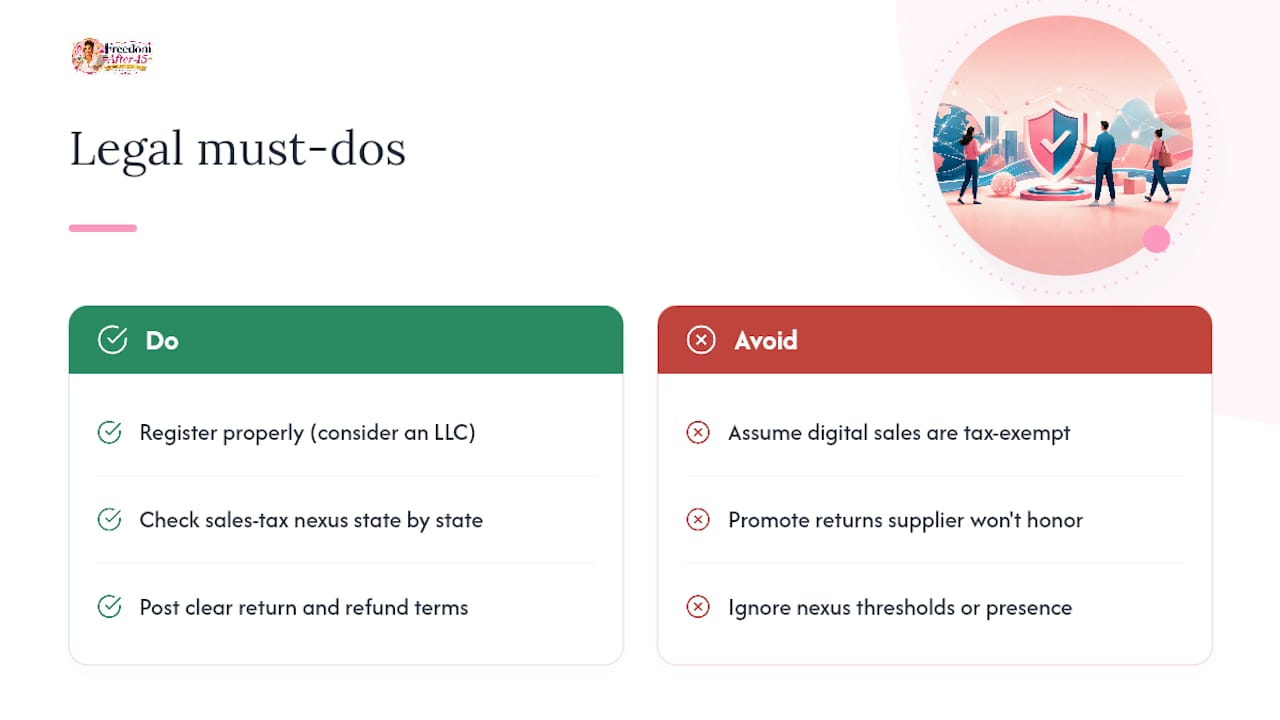
Registering your business correctly comes first. The Small Business Administration’s guidance on choosing a business structure walks through the difference between a sole proprietorship, LLC, and other structures, and which one limits your personal liability if a supplier issue turns into a customer dispute. Most solo no-inventory operators start as an LLC specifically because it separates personal assets from business liability without the paperwork load of a corporation.
Sales tax is where many new sellers stumble. If you’re drop-shipping physical goods, you likely owe sales tax in states where you have “nexus,” which can mean physical presence or, in many states, a revenue or transaction threshold. Digital products face their own patchwork of state tax rules, so check requirements state by state rather than assuming digital sales are automatically exempt.
Consumer protection law doesn’t bend for your business model. Customers are entitled to accurate product descriptions, honest shipping timelines, and a clear return policy, regardless of whether you ever touched the product yourself. Post your return and refund terms somewhere obvious on your storefront, and make sure they match what your supplier will actually honor. A generous return policy your supplier won’t back is a liability, not a selling point.
Handling Customer Service Without Touching the Product
Customer service gets harder, not easier, when you don’t control fulfillment. You’re the face of the transaction, but your supplier controls the shipping timeline, the packaging, and often the product quality.
Set expectations early. A shipping estimate on your product page that matches your supplier’s actual lead time prevents most complaint emails before they happen. When a package is delayed or arrives damaged, respond fast and take ownership of the fix, even though the mistake happened somewhere in a warehouse you’ve never seen. Customers don’t care whose fault it was; they care whether you solve it.
Build a simple response template library for the recurring issues: where’s my order, wrong size, damaged item, refund request. This cuts response time dramatically without making replies feel robotic, as long as you personalize the first line. Route tracking notifications through automated email or SMS so customers get updates without emailing you first, freeing your limited daily hours for the messages that actually need a human.
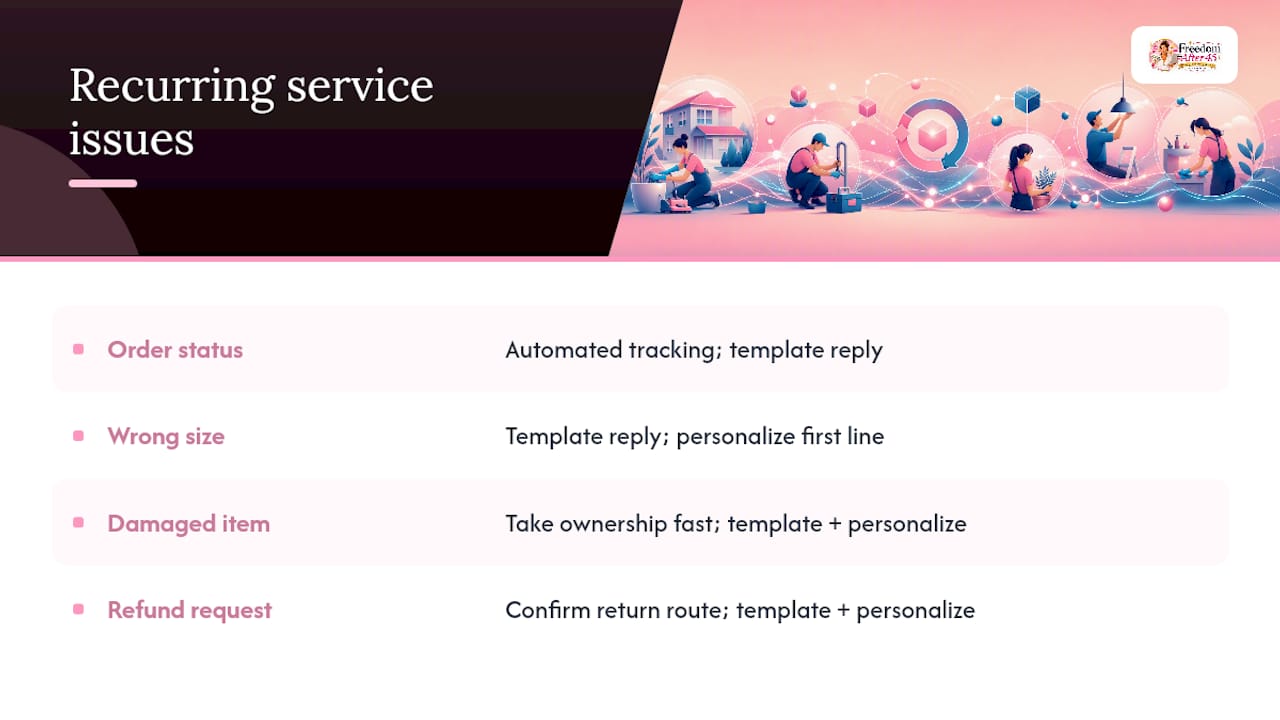
Returns deserve their own process. Decide upfront whether items route back to your supplier or to you, and confirm your supplier will actually accept returned goods before you promise customers they can send items back. A mismatch here is one of the fastest ways to lose money on a policy you never should have offered.
Managing Cash Flow Without Physical Stock
Cash flow in a no-inventory business looks different from traditional retail because you’re not sitting on unsold product, but that doesn’t mean cash flow takes care of itself.
Payment processors often hold funds for new merchant accounts, sometimes for weeks, while your ad spend and supplier costs hit immediately. Build a cash buffer covering at least a month of ad spend and subscription costs before you launch, so a processor hold doesn’t stall your ability to keep testing.
Track your numbers weekly, not monthly. CAC, gross margin per order, and refund rate are the three figures that tell you whether the business is healthy, and waiting thirty days to check them means you’ve already burned a month of bad spend if something’s off. Separate your business and personal accounts from day one; it makes tax time simpler and gives you an honest read on whether the business is actually profitable or just feels busy.
Reinvest early profit into testing, not lifestyle upgrades. The operators who scale past their first few months are the ones who plow early wins back into new product tests and better creative, rather than treating a good week as proof the model is finished being risky.
Freedom After 45’s Take: Running This on Two Hours a Day
A no-inventory business fits neatly into a two-hour daily block if you structure the time instead of letting it sprawl. A realistic day might look like: 20 minutes checking supplier stock and order status, 30 minutes answering customer messages, 40 minutes testing or adjusting an ad or listing, and the remainder on one content or outreach task.
The habit matters more than any single day’s output. The 2-Hour Workflow is designed around the idea that consistent, bounded daily action beats sporadic bursts of effort, and that a following or existing product is not required to start showing up for two focused hours. Set the expectation early that this is a business you operate, not a lottery ticket you buy.
— Freedom After 45
A Guided Path if You Want the Steps Laid Out for You
Everything above works if you’re willing to build your own system: choosing a model, testing margins, vetting suppliers, and figuring out marketing through trial and error. That’s the honest path, and plenty of people succeed on it. But if you’d rather follow a structured, step-by-step blueprint instead of piecing it together from scratch, that’s exactly what Freedom After 45 built the 2-Hour Workflow for.

The 2-Hour Workflow is a guided course and downloadable blueprint designed for people who want a clear daily system rather than a pile of scattered tactics. It includes video instructions, real case studies, and access to a support community, and it’s built specifically so you don’t need an existing social media following or a product of your own to get started. It fits readers who want the decisions made for them: which steps come first, what to test, and how to structure a two-hour daily commitment around it.
If the models and steps in this article make sense but you want them organized into a single guided path, check out the 2-Hour Workflow and see whether the structure fits how you want to work.
Sources
- How to Build a Profitable Dropshipping Operation from Scratch in 2026 – Ecommerce Times
- What Is Dropshipping and How Does It Work? (2026) - Shopify
- Choose a business structure | SBA
- Online Business With No Inventory: Real Models for 2026 - MarksInsights
FAQ
What can I sell without inventory?
You can sell services, digital products like courses or templates, print-on-demand goods, dropshipped physical products, and affiliate promotions, all without buying stock upfront. Each model routes fulfillment through a supplier or delivers digitally, so you never hold the product yourself.
What business makes $1000 a day?
No model guarantees a specific daily income, and any site promising a fixed dollar figure is overselling what these businesses actually deliver. Realistic outcomes depend on your niche, margin, and marketing execution, which is why testing margins before scaling ad spend matters more than chasing a headline number.
What business will boom in 2026?
Print-on-demand paired with digital add-ons, niche dropshipping in underserved categories, and lead generation for local service businesses are all showing steady demand, according to comparisons of current no-inventory models. No single model is guaranteed to boom, so match your choice to your skills rather than chasing a trend.
Do small businesses have to keep inventory?
No, plenty of legitimate small businesses run entirely inventory-free, using dropshipping, print-on-demand, or digital delivery instead of warehousing stock. The choice comes down to your business model and how much control over fulfillment quality you’re willing to trade for lower startup cost.
Do I need to register a business to start a no-inventory model?
Yes, most operators register as an LLC or sole proprietorship to separate personal and business liability, and the SBA’s guidance on business structures explains the differences. Registration requirements and tax obligations vary by state, so check your state’s rules before you launch.