

Avoid a 2028 IRMAA Surprise: Medicare and Side Income for Women 45+
Earning side income does not put your Medicare coverage at risk. What it can do is raise your Part B and Part D premiums through IRMAA, the income-related surcharge tied to your income from two years earlier. The immediate move is simple: estimate this year’s modified adjusted gross income (MAGI) now and check it against the IRMAA thresholds before you take on more work.
TL;DR:Most side income questions revolve around how it affects MAGI and IRMAA thresholds, not Medicare eligibility itself.Self-employment income can trigger higher premiums, but strategies like QBI deductions and retirement contributions help manage the impact.Large, one-time contracts pose a greater IRMAA risk than steady freelance work or part-time W-2 jobs, especially if they push income over thresholds.Planning ahead by estimating MAGI early, timing income, and making pretax contributions can prevent surprise premium increases two years later.For dual-eligible beneficiaries, even modest side income can affect Medicaid, requiring careful consultation with state programs before taking on new work.
Freedom After 45Build Side Income With Less OverwhelmFreedom After 45 offers a step-by-step 2-Hour Workflow for women over 45 seeking recurring income without traditional barriers.Explore the 2-Hour Workflow
Table of Contents
- How Medicare Premiums, IRMAA Tiers, and the Two-Year Lookback Work
- Self-Employment Tax, QBI, and How Side Income Changes Your MAGI
- Which Side Jobs Are Simplest for Medicare Recipients?
- How Do You Plan for Side Income Without Triggering IRMAA?
- Does Side Income Affect Medicare Savings Programs Like QMB or SLMB?
- Does It Matter Whether Your Extra Money Is Earned or Unearned?
- What Happens to Medicaid Coverage If You’re Dual Eligible?
- How Should You Plan Your Tax Filing Around Medicare and Side Income?
- How Do You Report Side Income to Avoid Surprise Premium Surcharges?
- What This Article Gets Right That Most Advice Misses
- A Side-Income Approach Built for Predictable, Manageable Earnings
- Sources
- FAQ
How Medicare Premiums, IRMAA Tiers, and the Two-Year Lookback Work
Medicare sets one standard premium for everyone, then adds a surcharge for people whose income crosses certain lines. For 2026, the standard Part B premium is $202.90 a month, with a $283 annual deductible. Part D carries its own baseline, a national base premium of $38.99, though what you actually pay depends on your plan.
IRMAA (Income-Related Monthly Adjustment Amount) stacks extra charges on top of both Part B and Part D once your MAGI crosses a threshold. The tiers step up in bands, so crossing a line by even a few hundred dollars can trigger the next surcharge level.
Quick fact: The 2026 baseline is a $202.90 Part B premium, a $283 Part B deductible, and a $38.99 Part D national base premium. IRMAA is added on top of these for higher earners.
The lookback is the part that catches people off guard. Medicare bases this year’s IRMAA on your tax return from two years ago, so a strong side-income year in 2026 could raise your premiums in 2028, long after that money is spent.
MAGI for this purpose includes:
- Wages and net self-employment income
- Taxable Social Security benefits
- Traditional IRA and 401(k) withdrawals
- Interest, dividends, and capital gains
The Social Security Administration sends a notice when it determines you owe IRMAA, and the surcharge gets deducted directly from your Social Security check or billed separately if you’re not yet collecting benefits. Either way, there’s no quiet ramp-up. It shows up as a lump adjustment tied to a tax year you may have already forgotten about.
Self-Employment Tax, QBI, and How Side Income Changes Your MAGI
Every dollar of freelance or consulting income does not hit your MAGI the same way a W-2 dollar does, and that difference matters when you’re trying to stay under an IRMAA threshold.
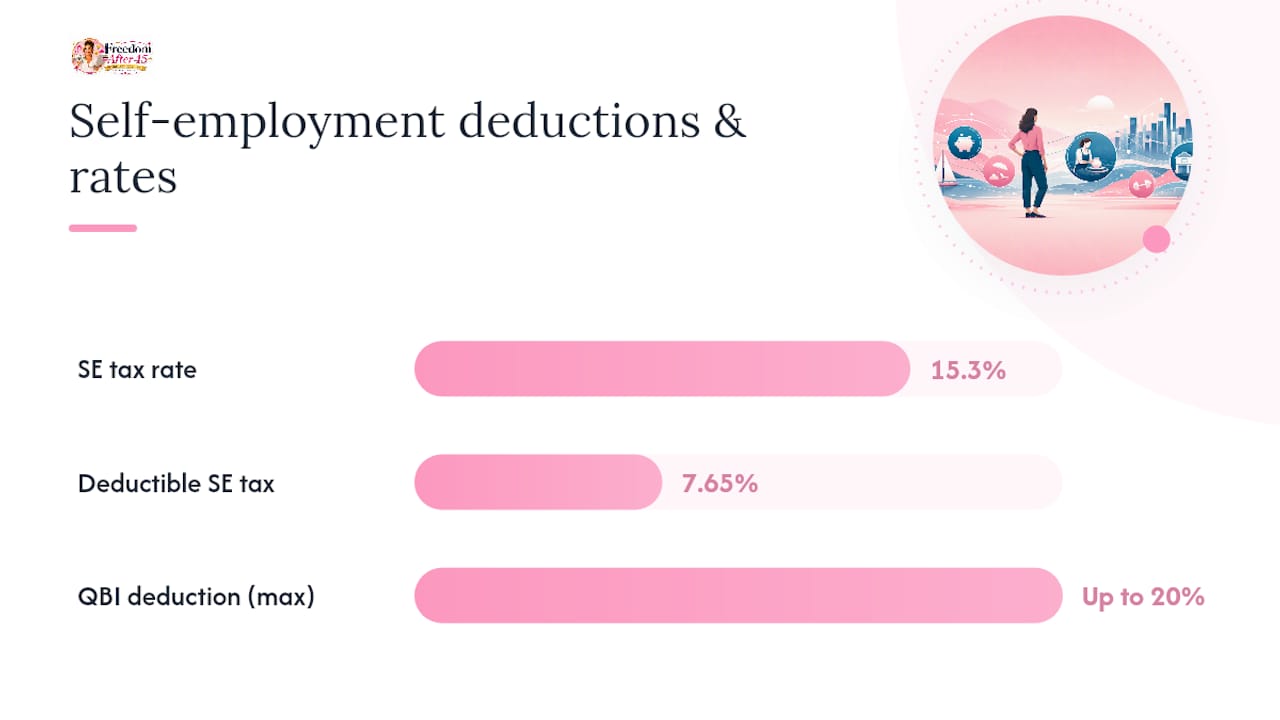
Self-employment income triggers self-employment tax at 15.3% of net earnings, covering both the Social Security and Medicare portions that an employer would normally split with you. The good news: half of that self-employment tax is deductible on Form 1040, which lowers your taxable income before MAGI is even calculated.
Many side businesses also qualify for the 20% Qualified Business Income (QBI) deduction, which shrinks taxable business income for eligible pass-through activity like consulting, freelance writing, or selling digital products. That deduction can be the difference between staying under an IRMAA line and tipping over it.
Pretax retirement contributions are another lever. Money put into a solo 401(k) or SEP-IRA reduces your current taxable income, which flows directly into a lower MAGI two years later.
- Self-employment tax: 15.3% of net earnings, half deductible
- QBI deduction: up to 20% off qualifying business income
- Solo 401(k) or SEP-IRA contributions: reduce taxable income now
One distinction trips people up constantly: earned income (wages, freelance pay) counts toward MAGI the same way investment income does. Rental income and capital gains follow different rules depending on how they’re structured. Treat every dollar of self-employment income as MAGI unless a tax preparer tells you otherwise.
Pro Tip: If you’re close to a threshold, run the math on a solo 401(k) contribution before year-end. Moving $5,000 into a retirement account can sometimes be the exact amount that keeps you in a lower IRMAA tier two years from now.
Which Side Jobs Are Simplest for Medicare Recipients?
Not all side income is created equal when Medicare is part of the picture. Some options keep your finances predictable. Others introduce extra decisions you didn’t ask for.
- 1099 and self-employment work (consulting, freelance writing, virtual tutoring, selling digital downloads) is the cleanest category. There’s no employer health plan to coordinate with, and you control when income lands, which makes MAGI easier to forecast.
- W-2 part-time roles introduce a wrinkle: employer size. If the employer has 20 or more employees, you may be able to delay certain Medicare enrollment decisions while covered by that plan. Employers with fewer than 20 employees make Medicare primary regardless, and dropping Part B to rely on a small employer’s plan is a common, costly mistake.
- One-time large contracts deserve the most caution, since a single big payout can jump you a full IRMAA tier even if your income the rest of the year was modest.
Scenario A: You pick up a steady $500-a-month freelance gig. That’s $6,000 a year, unlikely to push most retirees near a threshold, and easy to plan around since it repeats predictably.
Scenario B: A one-time consulting project pays $20,000. Case reporting has documented situations where a gig of roughly this size pushed a retiree into a higher IRMAA bracket, adding a surcharge that ate into a meaningful share of what the project actually paid. Before accepting a project like that, run the numbers first.
Pro Tip: Ask whether a large project can be split across two tax years. Getting half the payment in December and half in January can keep both years under a threshold instead of pushing one year over.
How Do You Plan for Side Income Without Triggering IRMAA?
A little arithmetic now beats a surprise notice two years from now. Here’s the order to work through it.
- Project your MAGI. List expected W-2 wages, net self-employment income, taxable Social Security, and any planned IRA or 401(k) withdrawals. Add them up and compare the total against the current IRMAA thresholds.
- Adjust timing if you’re close to a line. Deferring a payment into January, splitting a big project across two years, or holding off on an IRA withdrawal can keep you under a tier.
- Use pretax tools deliberately. Solo 401(k) and SEP-IRA contributions lower this year’s taxable income. If you’re 70½ or older, a Qualified Charitable Distribution from an IRA can also reduce MAGI while supporting a cause you care about.
- Request IRMAA reconsideration if your income drops. A life-changing event, like reduced side work, retirement, or the loss of a spouse, qualifies you to ask the Social Security Administration for a new decision rather than paying based on outdated numbers.
Before filing, bring a tax preparer three things: your projected MAGI, your filing status, and the deferral options you’re actually eligible for. That conversation is far cheaper than an IRMAA surprise.
- Estimate MAGI early in the year, not in April
- Know your exact threshold before accepting new work
- File Form SSA-44 if a life event has lowered your income
Does Side Income Affect Medicare Savings Programs Like QMB or SLMB?
Yes, and this is where the stakes get higher than a premium bump. Medicare Savings Programs, including the Qualified Medicare Beneficiary (QMB) and Specified Low-Income Medicare Beneficiary (SLMB) programs, use strict income and asset limits that vary by state. Unlike IRMAA, which only raises what you pay, losing eligibility for one of these programs can mean losing help with premiums, deductibles, and coinsurance altogether.
These programs typically look at monthly income, not the MAGI figure IRMAA uses, and the thresholds sit close to the federal poverty level. A side gig that adds even a modest, steady amount each month can push someone from qualifying to not qualifying, especially for SLMB, which has a narrower income band than QMB.
If you currently rely on a Medicare Savings Program, check your state’s exact income limits before committing to recurring side work. A one-time project might not affect annual eligibility redetermination the way it affects IRMAA, but a new steady monthly income stream almost certainly will. Contact your state Medicaid office or a local State Health Insurance Assistance Program (SHIP) counselor before you commit to ongoing gig work if you’re currently enrolled in one of these programs. The stakes here are different from IRMAA. IRMAA costs you more. Losing a Savings Program can cost you coverage you’re depending on.
Does It Matter Whether Your Extra Money Is Earned or Unearned?
Both earned income (wages, freelance pay, consulting fees) and unearned income (interest, dividends, capital gains, rental income in most structures) feed into the MAGI calculation that determines your IRMAA tier. Medicare does not treat a freelance paycheck differently from investment income when it comes to premium surcharges.
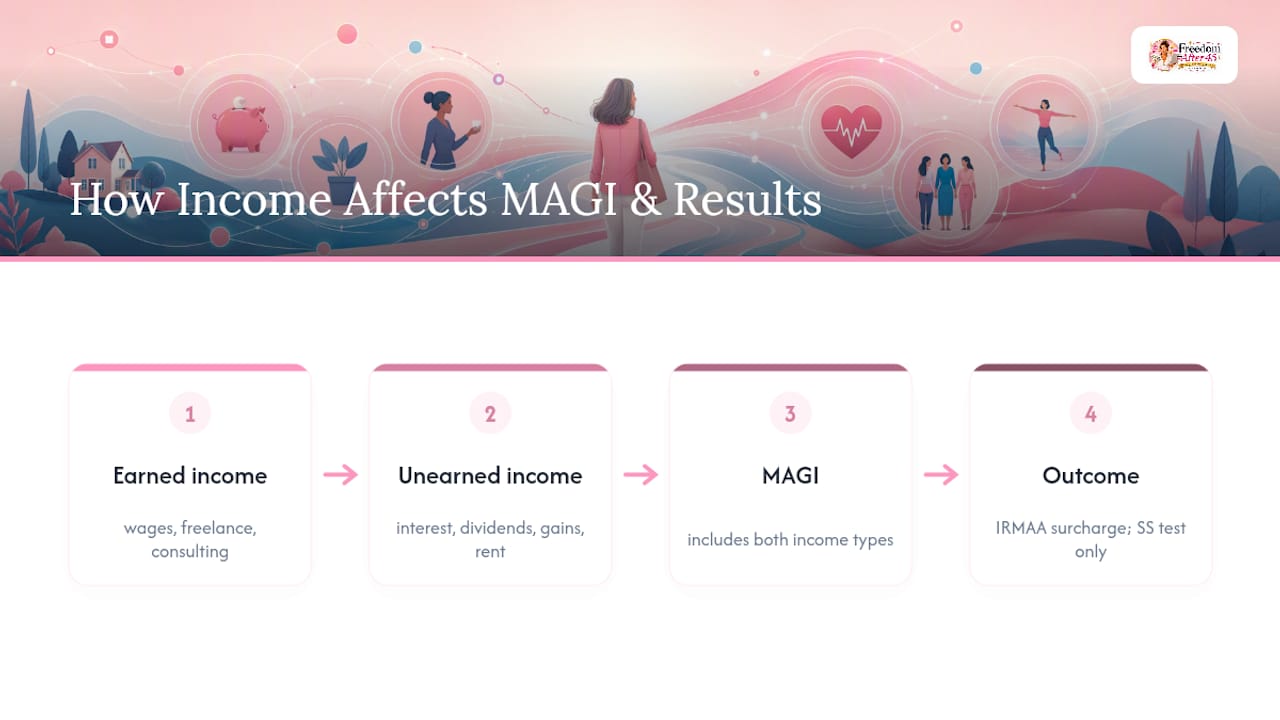
Where the two diverge is on the Social Security side. Earned income above certain limits can temporarily reduce Social Security benefits if you haven’t reached full retirement age, and it can also make more of your Social Security benefit taxable. Extra earnings interact with both Social Security taxation and Medicare premiums simultaneously, which means a side job can hit you on two fronts in the same tax year: a temporary benefit reduction now, and an IRMAA surcharge two years later.
Unearned income skips the Social Security earnings test entirely, since that test only applies to wages and self-employment income. But it counts fully toward MAGI, so a good year in a taxable brokerage account can raise your Medicare premiums just as easily as a good year of freelance work. If you’re weighing whether to take on a paying project or simply let investments ride, remember that both paths lead to the same IRMAA calculation. Only one of them also risks a Social Security earnings-test reduction.
What Happens to Medicaid Coverage If You’re Dual Eligible?
If you qualify for both Medicare and Medicaid, side income puts more at stake than it does for Medicare-only beneficiaries. Medicaid eligibility rules vary significantly by state, and most states use much lower income thresholds than Medicare Savings Programs, often tied closely to the federal poverty level with limited earned-income disregards.
Dual-eligible beneficiaries typically fall into “full” or “partial” dual status, and side income can shift someone from one category to the other, or out of Medicaid entirely, well before it affects Medicare premiums at all. Because Medicaid redeterminations happen on a state-specific schedule, sometimes annually and sometimes more often, a new income stream can trigger a review faster than you’d expect.
The safest approach if you’re dual eligible: call your state Medicaid office or a SHIP counselor before starting any recurring side income, not after. Ask specifically how earned income is treated under your state’s disregard rules, since many states exclude a portion of earned income from the calculation in ways that don’t apply to unearned income. That distinction can be the reason a small freelance gig is fine while a similarly sized withdrawal from savings is not.
How Should You Plan Your Tax Filing Around Medicare and Side Income?
Side income changes your tax filing obligations in ways that ripple forward into Medicare costs two years later, so filing accurately matters more than it might for someone without Medicare in the picture.
Self-employment income above $400 in net earnings requires you to file a Schedule C and Schedule SE, and if you expect to owe more than $1,000 in tax for the year, the IRS generally expects quarterly estimated payments rather than one lump sum in April. Skipping estimated payments can trigger underpayment penalties on top of whatever your final tax bill turns out to be.
Keep a simple running log of your side income and expenses throughout the year rather than reconstructing it at tax time. This makes your MAGI projection more accurate, which in turn makes your IRMAA forecast more reliable. Because IRMAA is based on the MAGI reported on your actual tax return, any deduction you’re entitled to, self-employment tax deduction, QBI deduction, retirement contributions, needs to actually appear on that return to count. A deduction you forgot to claim doesn’t lower your IRMAA even if it would have.
File on time, claim every deduction you qualify for, and treat your tax return as the document that quietly sets your Medicare premium two years from now.
How Do You Report Side Income to Avoid Surprise Premium Surcharges?
You don’t report side income directly to Social Security for IRMAA purposes. The IRS does that automatically, since Social Security pulls your MAGI figure from the tax return the IRS already has on file. The real risk is not underreporting to SSA. It’s filing your taxes late, filing them inaccurately, or missing deductions that would have kept your MAGI lower.
Where SSA reporting does matter is on the appeals side. If you’ve had a life-changing event, retirement, reduced hours, marriage, divorce, or the loss of a spouse, and your current income no longer matches what the two-year-old tax return shows, you file Form SSA-44 to request an updated IRMAA decision. Trying to preemptively “explain” a side gig to SSA before it shows up on a tax return accomplishes nothing. SSA works from the return, not from a phone call.
The one reporting habit worth building: if you take a large one-time project, calculate the likely IRMAA impact before you accept it, not after the surcharge notice arrives two years later. That’s the only real defense against an unpleasant surprise, since by the time SSA notifies you, the tax year in question is already closed.
What This Article Gets Right That Most Advice Misses
Most retirement content treats “Medicare and side income” as a scary headline instead of a math problem. It isn’t. The actual risk is narrow: cross a specific MAGI threshold, and you pay more for Part B and Part D two years later. That’s it. Coverage itself never disappears.
Where conventional advice falls short is in treating every dollar of extra income the same. A steady $500-a-month freelance gig behaves completely differently from a $20,000 one-time contract, yet most articles lump them together under vague warnings to “be careful.” The tiered, cliff-like structure of IRMAA means timing and structure matter more than the total amount earned in a year.
The priority for most women 45 and older weighing a side hustle should be projecting MAGI before saying yes to a big project, not after. This guidance is based around exactly this kind of low-complexity, time-bounded approach, because predictable income is easier to plan around than a single large payout that shows up once and complicates your taxes for two years.
— Freedom After 45
A Side-Income Approach Built for Predictable, Manageable Earnings
If the math above told you anything, it’s that predictable, modest income is far easier to plan around than one big unpredictable payout. This gap is addressed by a step-by-step blueprint designed specifically for women 45 and older who want to build steady income without needing an existing social media following, a product to sell, or hours of daily effort.

A system built around a consistent two-hour daily commitment rather than one massive project naturally produces the kind of steady, forecastable income that’s simple to weigh against IRMAA thresholds each year. No guessing whether one big contract just bumped you into a higher premium tier. If you want a closer look at how the 2-Hour Workflow blueprint works, the course landing page walks through the full step-by-step system and how to get started.
This article is general information, not a substitute for advice from a qualified financial advisor. Consult a qualified financial professional about your own circumstances before acting on anything here.
Sources
- 2026 Medicare Part B premiums and deductibles (CMS fact sheet)
- Medicare
- Self-employment tax: Social Security and Medicare taxes (IRS)
- Money
FAQ
Will a side job cause me to lose Medicare?
No. Medicare eligibility is based on age and work history, not current income, so a side job never causes you to lose coverage. The real risk is a higher Part B or Part D premium through IRMAA if your income crosses a threshold.
How far back does Medicare look at my income for IRMAA?
Medicare uses your tax return from two years earlier to set this year’s IRMAA surcharge. Income you earn in 2026 affects your premiums in 2028, not immediately.
Can I lower my MAGI after a high-income year?
You cannot change a past tax return, but pretax retirement contributions, QBI deductions, and timing future income differently can lower MAGI in future years. If your income has genuinely dropped since that tax return, you can file for IRMAA reconsideration through the Social Security Administration.
Does self-employment income get taxed differently than a side job as an employee?
Yes. Self-employment income carries a 15.3% self-employment tax covering Social Security and Medicare, with half deductible on your return, while W-2 income splits that tax with an employer automatically.
What is the 2-Hour Workflow, and how much does it cost?
The 2-Hour Workflow is Freedom After 45’s step-by-step blueprint for building manageable side income in about two hours a day, aimed at women 45 and older. Current pricing is available on the course landing page.