

Keep Your Social Security and Hustle: 2026 U.S. $24,480 Limit
Yes, you can run a side hustle while collecting Social Security, but 2026 earnings limits decide whether the SSA withholds part of your check. If you’re under full retirement age, the cap is $24,480; in your FRA year, the earnings limit is higher as set by the SSA. SSI recipients face entirely different rules. Start by checking your FRA and recent earnings record at my Social Security before you take on new work.
TL;DR:Earnings limits for under full retirement age in 2026 are $24,480 without withholding, with $1 withheld for every $2 over the limit.Once reaching full retirement age, there is no earnings limit, allowing unlimited income without benefit withholding.Self-employment income counts fully toward the earnings test and can boost future benefits by replacing low-earning years if managed wisely.Workers nearing FRA should track their income carefully, as earning above limits results in benefit withholding that can be later credited back through benefit adjustment.SSI recipients face stricter limits, losing $1 of benefits for every $2 earned over $65 per month, with specific rules for income exclusions.
Table of Contents
- What Are the 2026 Social Security Earnings Limits for Side Hustles?
- How Does the Earnings Test Actually Work?
- Does Self-Employment Income Change the Math?
- Which Side Hustles Fit Retirees on a Budget of Time and Energy?
- How Do You Check Your Record and Report New Income?
- Why Freedom After 45 Sees This Differently Than Most Retirement Advice
- A Low-Time Option Worth Comparing
- Where to Verify These Rules Yourself
- Sources
What Are the 2026 Social Security Earnings Limits for Side Hustles?
Whether your side hustle costs you any benefits comes down to your age and how much you make. The Social Security Administration’s 2026 rules set two separate thresholds depending on where you stand relative to full retirement age.
- Under FRA all year: Earn up to $24,480 penalty-free. Above that, SSA withholds $1 for every $2 over the limit.
- Reaching FRA in 2026: Earn up to $65,160 before your FRA month, penalty-free. Above that, SSA withholds $1 for every $3, and only earnings before the month you hit FRA count.
- After FRA: No limit at all. Work and earn as much as you want.
- SSI recipients: A different formula applies entirely, cutting benefits $1 for every $2 earned over the first $65 a month, with additional exclusions under SSI work incentives.
Quick math: Earn $30,000 while under FRA, and you’re $5,520 over the limit. That means SSA withholds $2,760 from your benefits, roughly a month and a half of checks for the average retiree.
How Does the Earnings Test Actually Work?
SSA only counts earned income for the test: wages, bonuses, and net self-employment earnings. It excludes pensions, investment income, annuities, IRA distributions, and interest. That distinction trips people up constantly. A retiree living off dividends and a small rental property has zero “earnings” for this test, no matter how much cash flows in.
Here’s how the withholding plays out in practice:
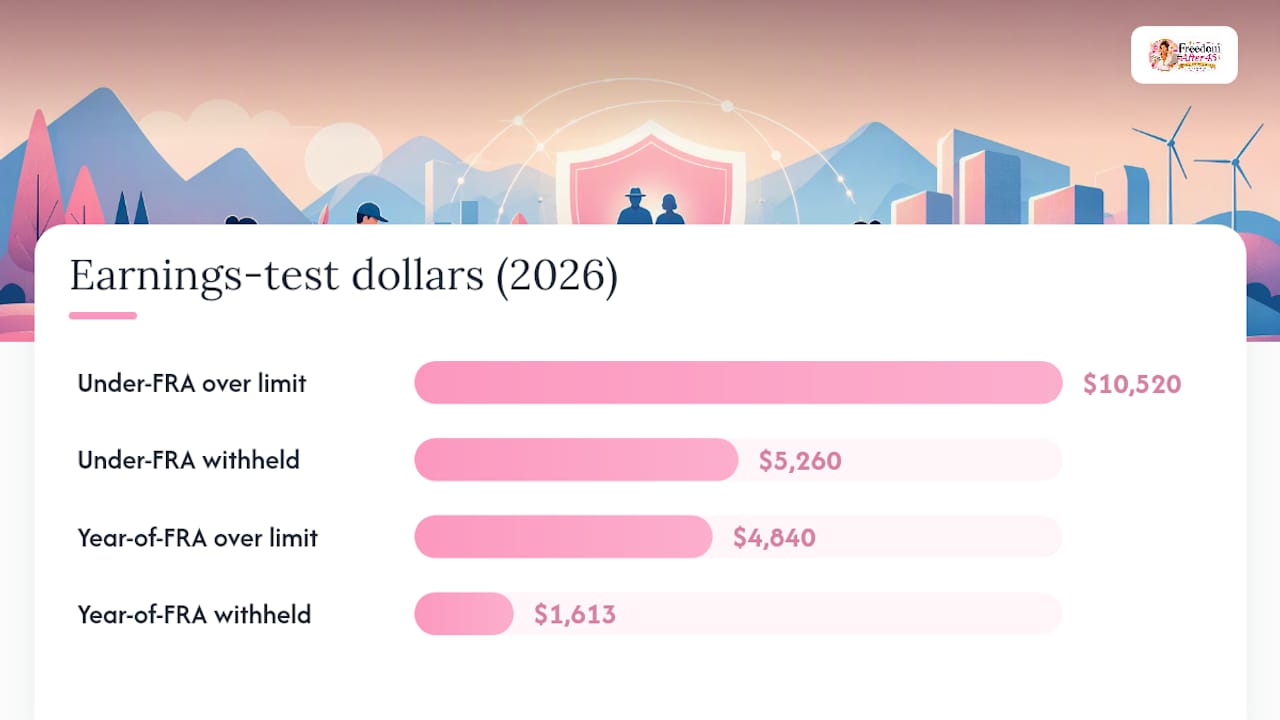
- Under-FRA retiree: You collect $20,000 a year in Social Security and earn $35,000 from consulting. You’re $10,520 over the $24,480 limit, so SSA withholds $5,260, about half a year’s worth of payments for some retirees.
- Year-of-FRA retiree: You turn 67 in August 2026 and earn $70,000 before that month. You’re $4,840 over the $65,160 limit, and SSA withholds $1,613 (one dollar for every three over).
- After the withholding: Once you hit FRA, SSA recalculates your benefit and credits back the withheld months by raising your future monthly payment. The money isn’t gone. It’s deferred.
Pro Tip: Log into your my Social Security account every few months and run the retirement estimator. It shows your FRA to the month and flags whether your current earnings pace is on track to trigger withholding.
Does Self-Employment Income Change the Math?
Self-employment income counts toward the earnings test the same way wages do, but it also carries self-employment tax, roughly 15.3% covering both Social Security and Medicare. You get to deduct half of that on your tax return, which softens the hit.
The upside is bigger than it looks. If a side hustle replaces a low or zero-earning year in your 35-year benefit calculation, your Average Indexed Monthly Earnings (AIME) and Primary Insurance Amount (PIA) can rise permanently. One case highlighted by 24/7 Wall St. showed a 58-year-old adding $14,000 in lifetime Social Security value simply by replacing weak earning years with self-employment income late in her career.
Paying self-employment tax now can function like a forced deposit into your own future benefit. For someone with several thin earning years on the books, that tax isn’t dead weight. It’s buying a permanent raise on every future check.
If you want to shelter some of that self-employment income for retirement without touching your Social Security credits, a Solo 401(k) or SEP IRA lets you save pretax dollars while your net earnings still count fully toward SSA’s record.
Which Side Hustles Fit Retirees on a Budget of Time and Energy?
Not every side hustle plays nicely with benefit rules, and not every one suits aging joints or a fixed schedule. Here’s what tends to work, with realistic pay ranges based on BLS occupational data and common freelance rates.
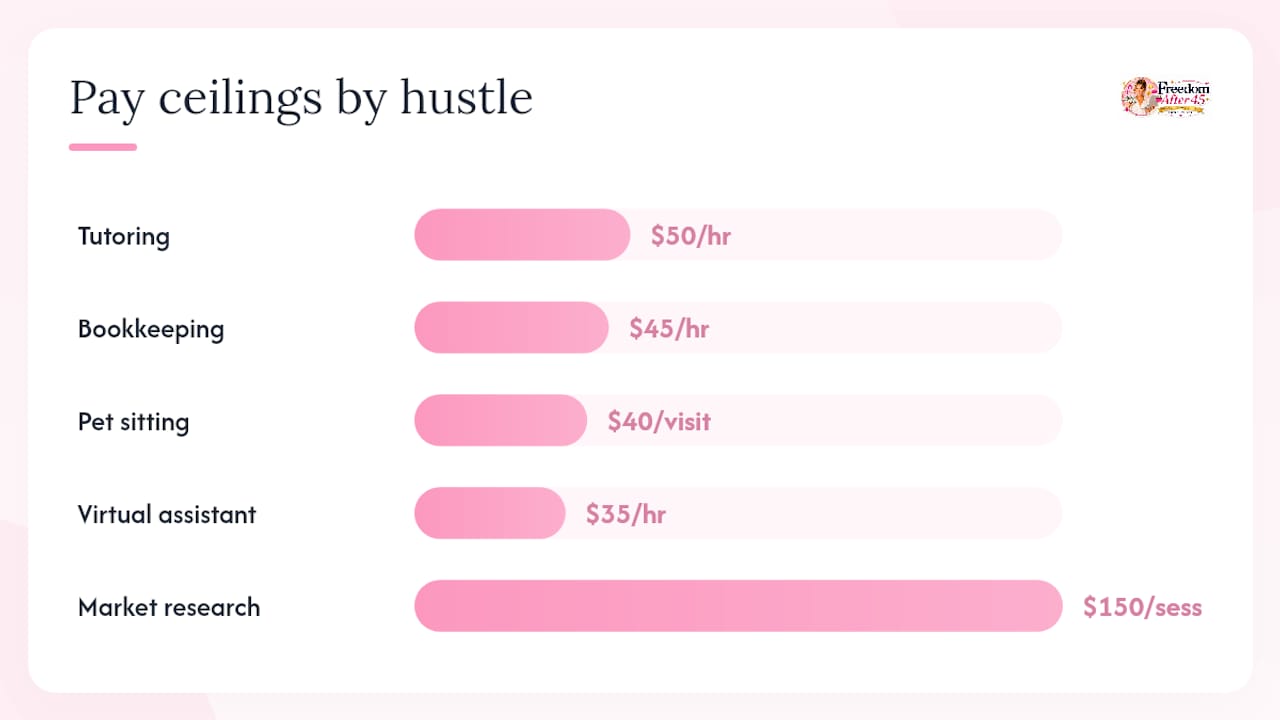
- Tutoring: $20 to $50 an hour, usually reported as self-employment income; rarely pushes people over the under-FRA limit unless done full-time.
- Bookkeeping for small businesses: $25 to $45 an hour, self-employment income; steady clients can add up fast, so track hours closely.
- Pet sitting or boarding: $15 to $40 per visit or overnight, self-employment; seasonal spikes (holidays) can bump a quarter’s earnings unexpectedly.
- Virtual assistant or freelance admin work: $18 to $35 an hour, usually self-employment; flexible and low physical demand.
- Paid market research or mock juror panels: $50 to $150 per session, typically reported as miscellaneous or self-employment income; sporadic, so it rarely trips the annual limit alone.
- Renting a spare room or parking space: Rental income generally does not count as earnings for the Social Security test, though it may still affect SSI eligibility differently.
Pro Tip: Keep a simple spreadsheet with gross income, expenses, and net earnings for every side hustle. SSA cares about net self-employment income, not gross receipts, and a clean record prevents disputes later.
SSI recipients should confirm their specific work-incentive exclusions before starting anything, since the $65-a-month threshold is far tighter than the retirement earnings test.
How Do You Check Your Record and Report New Income?
Getting this right takes four steps, not guesswork.
- Pull your earnings record and FRA. Log into my Social Security to confirm your exact full retirement age and review your lifetime earnings history for gaps a side hustle could fill.
- Estimate your annual net earnings. Subtract legitimate business expenses from gross income, then compare that number to the $24,480 or $65,160 threshold that applies to you.
- Report changes the right way. Update wage or self-employment estimates through your my Social Security account, or call SSA directly if your income shifts significantly mid-year.
- Set aside tax money. Earmark roughly 15% to 25% of net side-hustle income for self-employment tax and possible income tax on Social Security benefits, and loop in a CPA if your total income nears the provisional-income thresholds for benefit taxation.
Why Freedom After 45 Sees This Differently Than Most Retirement Advice
Most retirement content treats a side hustle as a math problem to avoid: don’t earn too much, don’t trigger withholding, don’t rock the boat. We think that framing gets it backwards for a lot of people. If a modest side hustle replaces a weak earning year and permanently raises your monthly benefit, a little short-term withholding can be the smarter trade, not a mistake to dodge.
The real skill isn’t avoiding the earnings test. It’s picking a hustle you can measure, track, and adjust before SSA does the adjusting for you.
— Freedom After 45
A Low-Time Option Worth Comparing
Tutoring, bookkeeping, and pet sitting all work, but they demand set hours and, often, a local client base. If you want something that fits inside a tighter, more predictable time window, Freedom After 45 built the 2-Hour Workflow specifically for that gap.

The Workflow is a step-by-step blueprint showing women over 45 how to generate daily passive income, without needing an existing social media following or a product of their own, using roughly two hours a day. That structure matters here for a practical reason: a predictable, capped daily commitment makes it far easier to estimate your annual net earnings ahead of time and check them against the 2026 thresholds before you get surprised by a withholding notice. If you’re near full retirement age, you can also use that predictability to plan a ramp-up for the year when your limit jumps to $65,160 or disappears entirely. Take a look at the 2-Hour Workflow blueprint and see whether a fixed, low-time income system fits your situation better than an hourly gig with unpredictable swings.
Where to Verify These Rules Yourself
Confirm your own numbers directly with the SSA rather than taking any article’s word for it, including this one.
- Receiving benefits while working for exact 2026 thresholds
- SSA FAQ on working and retirement benefits
- SSI Work Incentives summary
- Cost-of-Living Adjustment (COLA) notices for annual benefit updates
This article is general information, not a substitute for advice from a qualified financial advisor. Consult a qualified financial professional about your own circumstances before acting on anything here.