

Real Passive Income Success Stories: What the Numbers Show
Real passive income success stories tend to cluster in a believable range: most report somewhere between $1,000 and $20,000 a month, built from one or two income streams that took six months to nine years to mature. The highest earners stack several streams together. One entrepreneur reported averaging $14,000 a month across seven passive channels, including Etsy sales, a blog, rental property, and stock appreciation.
The stories that hold up to scrutiny share a few traits: a specific stream, a documented timeline, and an honest account of the work it took before the money became “passive” at all.
- Rental real estate: cash flow from tenants, often built through buy/rehab/refinance cycles
- Digital products and Etsy shops: one-time creation, repeat sales
- Resale and retail arbitrage: buying undervalued goods, reselling for margin
- Creator funnels and evergreen courses: a single product sold on autopilot for years
The pattern to watch: every verified story took months of unpaid setup before the income became passive, and most took over a year to reach four figures a month.
Key Takeaways
Passive income success stories consistently show that real income takes months of unpaid setup work before it becomes recurring and low-maintenance.
| Point | Details |
|---|---|
| Expect a real ramp-up | Even the strongest case studies took 9 months to 9 years before income felt “passive.” |
| Choose one stream first | Stacking seven streams, like the $14,000/month example, came after mastering one. |
| Financing accelerates real estate | BRRRR cycles and private financing helped one investor reach $20,000/month cash flow in 9 years. |
| Test cheaply before scaling | A $27 pilot product became a six-figure funnel only after validation and automation. |
| Structured programs shorten the curve | Freedom After 45’s 2-Hour Workflow packages the validate-then-scale process into a guided daily system. |
Table of Contents
- Passive Income Success Stories From Four Different Paths
- What Do These Passive Income Case Studies Have In Common?
- How Can You Replicate a Passive Income Success Story?
- How Freedom After 45 Applies These Lessons
- Where These Passive Income Stories Come From
- Why Most Passive Income Advice Misses the Point
- Start Your Own Passive Income Path With a Proven Framework
- Sources
Passive Income Success Stories From Four Different Paths
Real numbers matter more than motivational language here. These four case studies span the main categories readers ask about, each with a documented timeline and a specific tactic that moved it from side project to recurring revenue.
- The Etsy-and-blog stack. One entrepreneur built $14,000 a month in passive income across seven separate income sources. The Etsy shop, her single biggest lever, did not become meaningful until roughly nine months after launch. Before that point, it was mostly product testing and listing optimization with little to show for it. The lesson isn’t “Etsy is a goldmine.” It’s that one channel, run consistently for the better part of a year, can eventually outperform the other six combined.
- The buy/rehab/refinance real estate portfolio. A real estate investor profiled by BiggerPockets spent nine years assembling 17 properties and 39 rental units, reaching roughly $20,000 a month in cash flow. The scaling tactic wasn’t bank loans alone. Private financing and BRRRR cycles, buy, rehab, rent, refinance, repeat, let him pull capital back out of each deal to fund the next one without waiting years to save a new down payment. Real estate investors interviewed elsewhere describe similar tactics: family joint ventures, seller financing, and private lines of credit that keep a portfolio growing when traditional lending tightens up.
- The side hustle that outgrew the garage. An SBA-documented success story tracks a small product-design business that started as a side project and scaled into a full-time livelihood over several years of steady growth. What separated it from the thousands of side hustles that stall was reinvestment and outside support. The founder used community partnerships and technical assistance programs, training in bookkeeping and marketing, to professionalize what had been an informal operation.
- The $27 product that became a six-figure funnel. Gillian Perkins built a digital product business that now clears roughly $100,000 a year, starting from a single $27 offer. The path there wasn’t one lucky launch. It involved testing multiple product ideas, watching which one actually sold, and then investing the real work into building an evergreen sales funnel around the winner, automating delivery, email sequences, and follow-up offers so the product kept selling without a live launch every time.
That sentiment echoes across nearly every profile of successful side-hustlers turned entrepreneurs: the visible win is the tip of a much longer, quieter process.
What Do These Passive Income Case Studies Have In Common?
Strip away the specific products and properties, and four patterns repeat across every one of these passive income case studies.
Nothing here was passive at the start. The Etsy shop took nine months of unpaid listing work. The rental portfolio took nine years of deal-hunting, rehab management, and refinancing paperwork. Journalists covering viral business successes note the same thing: a UK entrepreneur who built a fast-growing ice cream brand had spent years on unseen groundwork, manufacturing, supply chains, and team-building, before the public “overnight success” moment. What looks passive in year three was active almost daily in year one.
Timelines cluster into two bands. Digital products and resale businesses tend to show meaningful income in 6 to 18 months. Real estate and larger physical asset plays tend to run 3 to 9 years before cash flow becomes substantial. Knowing which band your chosen stream falls into changes how you should judge your own progress at month six.
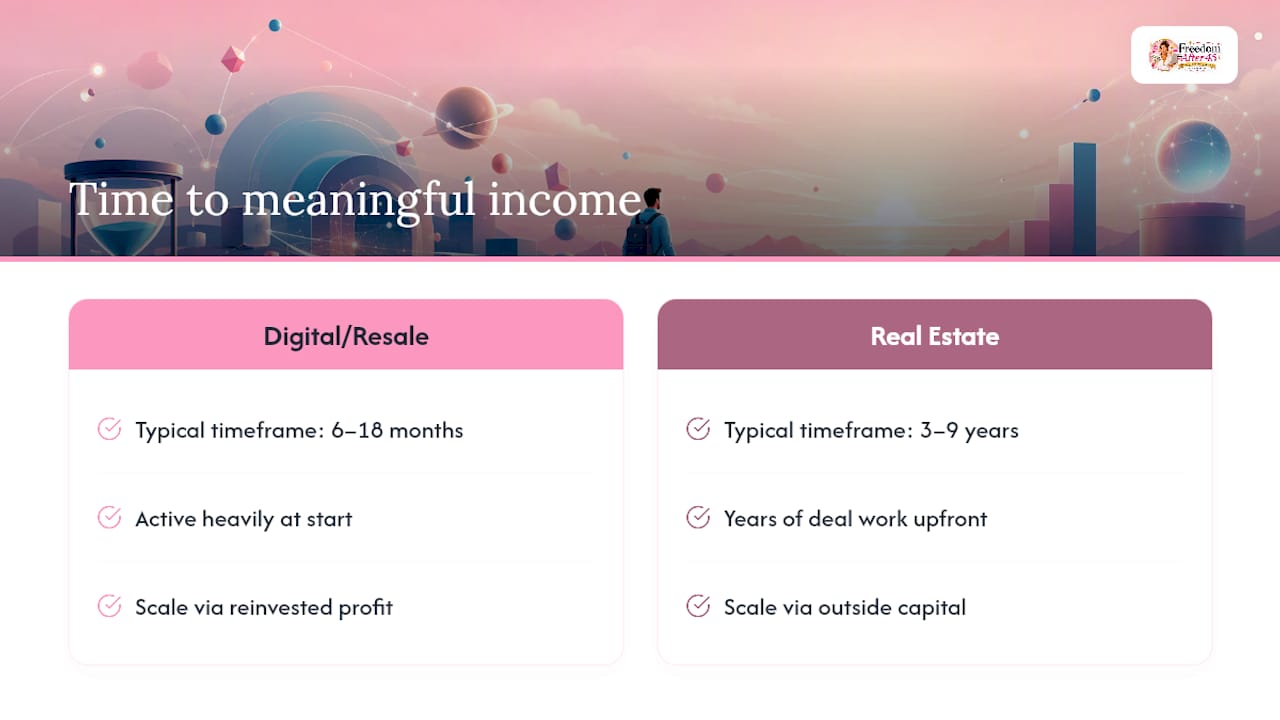
Scaling almost always relies on outside capital or reinvested profit, not personal savings alone: private financing, family joint ventures, seller financing, or simply plowing early profits back into inventory and ads.
The real risks are predictable. Spreading effort across too many unproven ideas at once, skipping validation before building a full system, and overleveraging on debt before cash flow is confirmed all show up repeatedly in the stories that stalled rather than scaled.
Pro Tip: Pick one income stream and give it a real test period, at least 90 days for digital products, a full deal cycle for real estate, before judging whether it’s working. Most of these stories would have looked like failures at the two-month mark.
Community and peer support consistently shortened the learning curve in these accounts. Practitioners who joined structured groups around evergreen product building tended to reach profitability faster than those working alone, largely because they skipped mistakes someone else had already made.

How Can You Replicate a Passive Income Success Story?
You don’t need to copy a case study exactly. You need to run the same four-stage process at a smaller scale.
- Pick a path that fits your time, cash, and risk tolerance. Digital products need almost no upfront cash but real time investment. Resale needs modest capital and a few hours a week. Real estate needs the most capital but can be financed creatively.
- Run a minimum viable test before committing further. That might mean a $27 pilot digital product, five items listed for resale to gauge demand, or one rental property with cash flow tracked for six full months before buying a second.
- Build the repeatable system once the test works. This is where automation, email sequences, listing templates, property management routines, replaces the manual hustle from stage one.
- Scale with reinvestment, not guesswork. Track one or two simple metrics (net cash flow, cost per sale, repeat customer rate) and watch for red flags: rising acquisition costs, thinning margins, or debt outpacing cash flow.
| Point | Details |
|---|---|
| Test before you build | Validate cheaply (a $27 offer, five resale listings) before investing in a full system. |
| Match the path to your timeline | Digital and resale streams often pay off in months; real estate usually takes years. |
| Fund growth deliberately | Use reinvestment, private financing, or partnerships instead of waiting to self-fund everything. |
| Watch for overextension | Too many unproven streams at once is a more common failure point than picking the “wrong” one. |
How Freedom After 45 Applies These Lessons
It’s designed specifically for women over 45 who want a structured path rather than a pieced-together strategy.
- A step-by-step blueprint that removes the guesswork of picking a first stream
- Video instruction paired with real case studies, not abstract theory
- A community component, echoing the peer-support advantage seen in the digital-product and side-hustle stories above
- Reports of thousands of families having gone through the program
Results vary by effort, timeline, and market conditions, the same variability shown in every case study above, so treat any single testimonial as a data point, not a guarantee, and do your own due diligence before committing money or time.
Where These Passive Income Stories Come From
- CNBC: $14,000/month passive income breakdown
- BiggerPockets: 9-year, $20K/month deal diary
- SBA: side hustle turned full-time success story
- Money4Wealth: $27 product to $100K/year
- Freedom After 45: the 2-Hour Workflow
Why Most Passive Income Advice Misses the Point
Most content on this topic sells the destination and skips the drive. The conventional advice, “find your passion, build multiple streams, let the money roll in”, ignores that every case study here started with a single stream run consistently for a long, unglamorous stretch before anything compounded.
What’s overrated: chasing seven income streams from day one. The $14,000-a-month entrepreneur didn’t start there. She built the Etsy shop for nine months before adding anything else. Diversification is a stage-two move, not a stage-one strategy.
What’s underrated: picking a system with the guesswork already removed. Every successful story here eventually adopted some kind of structured process, a funnel, a refinancing cycle, a bookkeeping system, rather than improvising indefinitely. That’s the real argument for something like the 2-Hour Workflow: not that it replaces the work, but that it removes the trial-and-error most of these case studies spent their first year on.
Prioritize one validated stream over five untested ideas. That single decision separates the stories that reached $1,000 a month from the ones that never got past the spreadsheet.
— Freedom After 45
Start Your Own Passive Income Path With a Proven Framework
Every case study above shares one expensive commodity: time spent figuring out what actually works before anything paid off. Freedom After 45’s 2-Hour Workflow exists to compress that trial-and-error into a guided system you can follow in two hours a day, without needing an existing following or a product already built.

It’s built specifically for women over 45 who want a realistic, documented path rather than another vague course promising overnight results. The blueprint walks through the same validate-then-scale sequence seen in the Etsy shop and the $27-product funnel above, minus months of guessing which idea to test first. Thousands of families have already gone through the program, and the step-by-step format is designed to prevent the overwhelm that stalls most people at the planning stage.
If the idea of testing a small, repeatable income system in two hours a day appeals to you more than juggling seven unproven ideas at once, explore the 2-Hour Workflow and see whether the blueprint fits where you’re starting from.
This article is general information, not a substitute for advice from a qualified financial advisor. Consult a qualified financial professional about your own circumstances before acting on anything here.
Sources
- Self-made millionaire who makes $14,000 a month in passive income: My best side hustle advice
- Deal Diary: 9 Years, 39 Doors, and $20K a Month in Cash Flow—Here’s How
- Side hustle turned full time
- How I Turned One $27 Digital Product Into $100K/Year — Gillian Perkins