

You Can Make Money Without Selling Anything
Yes, you can make money without selling a single product, and the fastest routes are freelancing your skills, monetizing content through ads and affiliate links, and building a simple digital product or membership. Pick one method, expect a slow first few weeks, and only add a second stream once the first one produces steady income.
TL;DR:Freelancing provides immediate cash flow with payments often received within one to three weeks, suitable for those with marketable skills needing quick income.Affiliate marketing and content creation require weeks to months to generate significant revenue and demand ongoing effort to build traffic or an audience.Diversifying income streams by combining methods like freelancing, content, and asset renting reduces platform dependence and enhances financial stability.Building a consistent income usually takes three to six months, with persistent effort needed to see meaningful and reliable results.Following a structured plan and focusing on one method for at least 90 days improves chances of sustainable success over rushing into multiple streams simultaneously.
Table of Contents
- 10 Ways to Make Money Without Selling and What Each One Really Pays
- How Do You Choose the Right Method and Build a Starter Plan?
- How Fast Should You Expect Results, and How Do You Protect Multiple Income Streams?
- What Does the Evidence Say About the 2-Hour Workflow?
- What Most Advice on This Topic Gets Wrong
- Want a Structured System Instead of Building One Yourself?
- Sources
10 Ways to Make Money Without Selling and What Each One Really Pays
Most guides to earning income without traditional sales collapse into the same short list. Shopify and SoFi both point to a consistent set of methods that don’t require moving inventory or pitching a product, and the differences come down to how fast they pay and how much setup they demand.
Here’s what each one actually looks like in practice, ranked roughly by how quickly you’ll see money.
- Freelancing and services. Writing, bookkeeping, virtual assistance, graphic design, and tutoring all convert hours into invoices immediately. Startup cost is close to zero if you already have the skill. First payment often lands within one to three weeks. Early earnings usually run $200 to $800 a week depending on your rate and hours. This fits best if you need cash now and have a marketable skill you can package into a service.
- Affiliate marketing. You write content, embed product links, and earn a commission when someone buys through your link, without ever handling the sale yourself. Startup cost is low (a domain and hosting run $50 to $150 a year), but the timeline stretches to weeks or months before the first commission clears. This suits people who enjoy writing or reviewing and don’t mind delayed gratification.
- Display advertising. Once a blog or channel has consistent traffic, ad networks pay you per thousand views with almost no ongoing labor. The catch is the traffic requirement. Shopify’s monetization guide notes this works best as a secondary stream layered on top of content you’re already producing for another reason.
- Online courses and workshops. If you have expertise, package it once and sell access repeatedly. The upfront work (recording, editing, building a simple checkout) can take 20 to 40 hours, but each sale afterward requires little additional labor. Best for people with a specific, teachable skill and some patience for the setup phase.
- Memberships and patronage. Platforms like Patreon or Buy Me a Coffee let a smaller, engaged audience pay you small recurring amounts. This works only after you’ve built some trust with an audience, so it’s rarely a starting point. It’s a strong second stream once you already publish content regularly.
- Self-publishing. Ebooks and short guides on Kindle Direct Publishing generate royalties long after the writing is done. SellerApp’s research on non-inventory Amazon income shows many creators earn little to nothing in the first three months, see small wins by months four to six, and reach meaningful income by months seven to twelve, if they keep publishing.
- Content platforms. YouTube, Twitch, and podcasting monetize through ad revenue, sponsorships, and platform payouts. These demand consistent output and real audience growth before the money shows up. It’s the slowest-starting method on this list, but also the one with the highest ceiling once it works.
- Gig and local task work. TaskRabbit, pet sitting, moving help, and similar local gigs pay same-day or same-week. There’s no real startup cost beyond a background check or a profile setup. This is the fastest path to cash on this entire list, in exchange for actively trading hours for dollars.
- Renting assets you already own. Airbnb for a spare room, Turo for an underused car. You’re monetizing something sitting idle rather than your labor or a product. Effort ranges from occasional (a spare room) to frequent (guest turnover, car maintenance).
- Paid research, cash-back apps, and gift-card resale. Survey platforms and user-testing gigs pay small amounts per task, useful for quick pocket money but not a real income plan. Gift-card exchange services offer something more interesting for immediate liquidity: some platforms pay up to about 92% of a card’s value for high-demand retailers, turning an unused card into near-instant cash.
The common thread across all ten: something upfront, whether time, a skill, or an idle asset, gets converted into money without you ever pitching a product to a stranger.
How Do You Choose the Right Method and Build a Starter Plan?
The right method depends on four things: how much time you have each week, how much cash you can risk, what skills you already have, and how urgently you need income. Someone who needs rent money in two weeks should not start a YouTube channel. Someone with steady income and two spare hours a night has room to build something slower and bigger.
Run yourself through a quick grid. If you need money in under 30 days and have a marketable skill, freelancing wins. If you have six months of runway and enjoy writing, content and affiliate income make more sense. If you have savings you’re not touching and want something closer to hands-off, a course or membership pays off later but costs more time upfront.
A 30-day plan for service-based income:
- Week 1: List your skill on two platforms and write a short portfolio page.
- Week 2: Send 15 to 20 direct outreach messages to potential clients, not job-board applications.
- Week 3: Close your first paid gig, even at a lower rate than you want.
- Week 4: Ask that client for a referral or testimonial, then raise your rate for the next one.
A 90-day plan for audience-based income looks slower by design: month one is publishing consistently (two to three pieces a week) with basic on-page SEO, month two is adding your first monetization layer (affiliate links or an ad network), and month three is measuring which content actually drives traffic and doubling down on it.
For tools, spend $0 to $50 on a domain and basic hosting if you’re going the content route, and $0 if you’re freelancing off an existing platform. Skip anything charging you $200 or more before you’ve earned a dollar.

Pro Tip: Watch for three red flags before you commit time or money: requests for a large upfront “training fee,” pressure to recruit others beneath you for a commission, or any pitch that suggests borrowing money to get started. Legitimate income methods never require debt to begin.
How Fast Should You Expect Results, and How Do You Protect Multiple Income Streams?
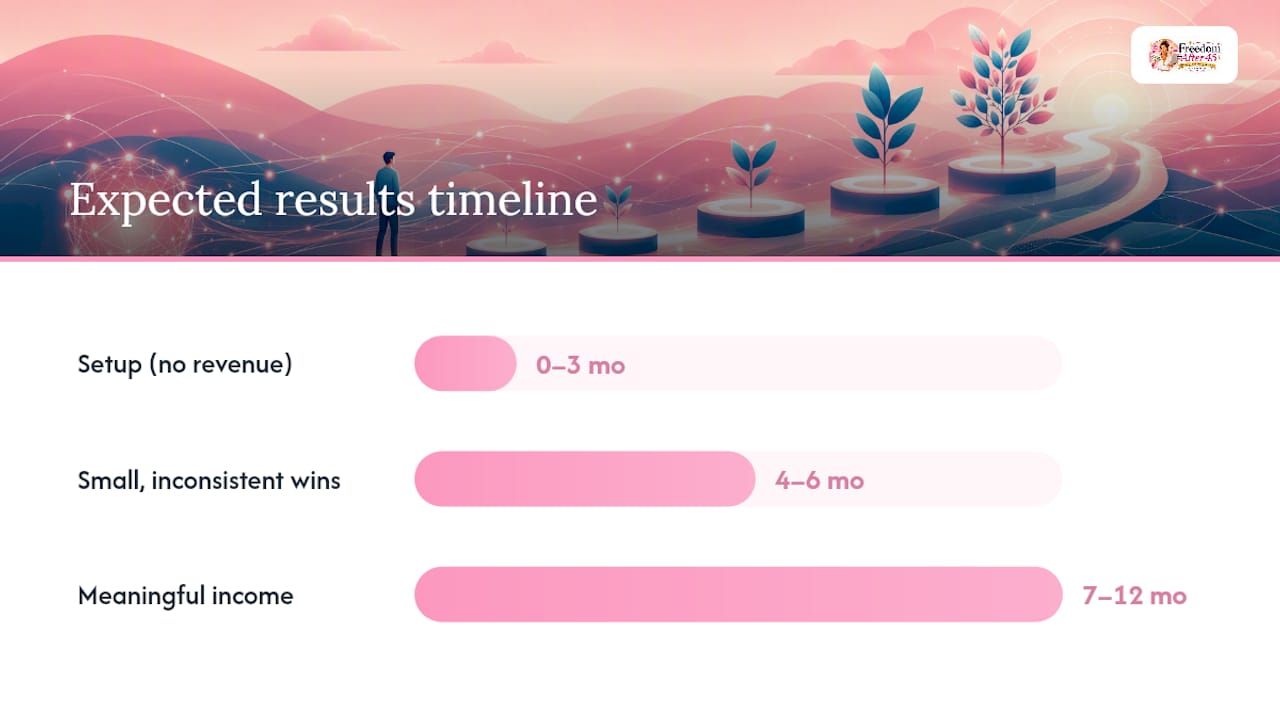
Expect months zero to three to be mostly setup with little or no revenue. Coursera’s research on passive income confirms this front-loaded pattern: real income tends to arrive only after a stretch of unpaid, active groundwork. Months four to six usually bring small, inconsistent wins. Months seven through twelve are when persistent creators start seeing income that actually feels meaningful.
Stacking works because each stream covers a different weakness in the others:
- A blog can layer display ads, affiliate links, and a self-published ebook on the same traffic.
- Freelancing income can fund the slow build of a course, which can later support a membership.
- One person’s stack might combine fast cash (gigs) with slow-building assets (content).
Diversification also protects you from platform risk. Shopify’s guidance on avoiding single-point dependence is blunt: build an email list you own, because a platform can change its algorithm or terms overnight and erase income tied to one source. Track hours invested against revenue earned weekly, not daily, since daily numbers bounce too much to mean anything.
What Does the Evidence Say About the 2-Hour Workflow?
Freedom After 45 built the 2-Hour Workflow around a specific promise: a structured, two-hour daily commitment designed to produce recurring income, with reported outcomes for users ranging between $100 and $1,400 a day depending on consistency and stage.
It’s built for women over 45 who have two hours a day and a willingness to follow a system rather than improvise one.
What Most Advice on This Topic Gets Wrong
Most articles on non-sales income treat every method as equally accessible, when the honest difference is patience, not difficulty. Freelancing and gig work reward action; content and digital products reward waiting.
The bigger mistake is choosing based on income potential instead of fit. A method that pays well but requires eighteen months of unpaid content creation is worse for most people than a method that pays modestly but consistently from week one. Start with what matches your actual time and risk tolerance, not what looks best on a screenshot.
If there’s one thing worth prioritizing first, it’s this: pick a single method, run it for 90 days with one metric you track weekly, and resist the urge to add a second stream before the first one proves itself. Stacking works. Stacking too early just splits your attention across nothing.
— Freedom After 45
Want a Structured System Instead of Building One Yourself?
Everything above works if you’re willing to test, adjust, and figure out your own process through trial and error. If you’d rather follow a system that’s already mapped out, the 2-Hour Workflow gives you a step-by-step blueprint instead of a blank page.

The course includes video instruction, real case studies, and community access, built around a two-hour daily commitment rather than a full-time overhaul. It fits women over 45 who want recurring income without needing an existing audience, a product to sell, or years of trial and error to find what works. After joining, you get immediate access to the full workflow and onboarding steps that walk you through setting up your first income stream day one. If a guided path sounds better than building your own from scratch, you can explore the 2-Hour Workflow and see whether it fits your two hours a day.
Sources
- Coursera — Passive income article
- Shopify — Monetize a website: 9 ways without selling products
- SellerApp — Make money on Amazon without selling
- Advance America — exchange gift cards (need money)