

Women 45+: Make $5 to $20 Daily Passive Income in 2 Hours
Daily passive income is money that lands in your account regularly from a system you built once, whether that’s a rental listing, a dividend portfolio, or a digital product on autopilot. Realistic targets run in bands: $5 to $20 a day for a first small stream, $50 to $100 a day once a system matures, and $100 or more once you’re running two or three streams together. Getting there takes real upfront work, often months, and no legitimate method pays guaranteed daily returns.
TL;DR:Building multiple passive streams can generate $50 to over $100 daily, but reaching this level typically requires months of upfront effort and diversification.Low-capital ideas like cashback rewards and space rentals can produce small daily income quickly, while higher-capital options like rental properties or online businesses take longer to mature.Effective planning involves rating income methods based on startup cost, skill match, and time to payout, then focusing on one primary and one backup approach.Consistent recordkeeping, separate bank accounts, and tax awareness are essential as income grows beyond modest thresholds, especially for managing passive versus active income.Success depends on a manageable two-hour daily effort, with structured programs like the 2-Hour Workflow offering a tested blueprint for women over 45 to generate daily income efficiently.
Table of Contents
- 15 Daily Passive Income Ideas Ranked by Startup Cost
- How Do You Choose the Right Method and Actually Start?
- How Long Does It Really Take to Reach Daily Payouts?
- What Do Taxes and Recordkeeping Look Like?
- Your First Week: A Daily Passive Income Checklist
- Why the Two-Hour Ceiling Matters More Than People Think
- Get the 2-Hour Workflow Blueprint
- Where to Learn More
- Sources
15 Daily Passive Income Ideas Ranked by Startup Cost
Not every idea on this list pays out literally every 24 hours. Some post daily receipts to a dashboard (affiliate sales, vending machine coin counts); others pay monthly or quarterly but can be averaged into a daily figure once you’re tracking cash flow properly. Either way, the goal is the same: build something once, then watch small deposits accumulate with minimal ongoing effort.
Low-capital, low-skill options
These require under $500 to start and no specialized training. They’re the fastest way to test whether a passive income habit sticks.
- Cash-back and rewards stacking. Apps and cards that return 2% to 6% on routine spending won’t make you rich, but they convert money you’re already spending into a small daily credit. Startup cost: $0. First daily receipts: immediate, though amounts are tiny until you optimize categories. First action: audit your last month of spending and match categories to the highest-paying reward card you already qualify for.
- Micro-rentals of space you own. Renting a driveway, garage, or storage nook through peer-to-peer listing platforms can bring in $50 to $300 a month with almost no maintenance. Startup cost: near $0. Timeline to first payment: 1 to 3 weeks after listing. First action: photograph the space and list it on two platforms simultaneously to see which gets traction.
- Vending machines in a fixed location. A single machine with a solid location contract can clear $50 to $200 a month after restocking costs. Startup cost: $1,500 to $3,000 for a used machine plus initial inventory. Timeline: 60 to 90 days to find a location and reach steady sales. First action: call three local businesses (gyms, laundromats, auto shops) about placement terms.
- Print-on-demand micro-shop. You design once, a supplier prints and ships, and profit lands per order. Startup cost: under $100 for design tools. Timeline to first sale: 30 to 60 days if you’re also driving traffic. First action: build 10 designs around one specific niche audience rather than a generic catalog.
- Affiliate content with SEO. Written guides or comparison pages that rank in search and link to products earn commissions on autopilot once published. Startup cost: $0 to $200 for hosting and a domain. Timeline: 4 to 9 months before search traffic becomes meaningful, per the staged progression financial educators commonly describe for online income systems. First action: pick one narrow topic and publish five in-depth pages before worrying about volume.
Moderate-capital, moderate-skill options
These need $1,000 to $25,000 and some financial literacy, but the payouts are more predictable once set up.
- Dividend and bond ladders. Staggering payout dates across dividend stocks or bonds smooths a monthly income into something closer to weekly or even daily cash flow. Startup cost: $5,000 minimum to get meaningful diversification. Timeline: immediate income, but growing it to a daily-equivalent amount takes years of reinvestment. First action: open a brokerage account and research quarterly-payer stocks with staggered ex-dividend dates.
- High-yield savings and cash management accounts. Not glamorous, but interest accrues daily even if it pays out monthly. Startup cost: whatever you can deposit. Timeline: interest starts accruing the day you fund the account. First action: compare current annual percentage yields across two or three online banks before moving your emergency fund.
- Real estate investment trusts (REITs). REITs let you collect rental-style income without owning property directly, and many pay monthly distributions. Startup cost: as little as $500 through a brokerage. Timeline: first distribution typically within 30 to 90 days of purchase. First action: check a REIT’s distribution history for at least three years before buying.
- Short-term rental arbitrage. Renting a property specifically to sublease it on short-term platforms can generate daily-equivalent income faster than owning, since you skip the down payment. Startup cost: $2,000 to $5,000 for furnishing and deposits. Timeline: 60 to 120 days to get bookings flowing. First action: run the numbers on one specific property against local short-term rental regulations before signing a lease.
- Peer-to-peer lending, approached cautiously. Returns can beat savings accounts, but default risk is real and payouts are irregular. Startup cost: $1,000 minimum spread across many loans. Timeline: payments trickle in monthly starting almost immediately, though total return isn’t clear for 12 to 36 months. First action: spread any initial investment across at least 50 individual loans to blunt default risk.
Higher-capital options
These need $10,000 or more but tend to produce the most stable, largest daily-equivalent income once running.
- Rental property ownership. The classic passive income vehicle: Investopedia and the IRS both note that net rental income where you don’t materially manage the property is typically treated as passive for tax purposes. Startup cost: $20,000+ for a down payment. Timeline: rent starts the month a tenant moves in, but true cash-flow positivity often takes a year of adjustment. First action: run a real cash-flow projection including vacancy and maintenance reserves before making an offer.
- Solar or land leasing. Leasing rooftop or acreage to a solar developer or cell tower company pays a fixed annual or monthly fee with virtually no ongoing work. Startup cost: $0 if you already own the land. Timeline: 6 to 18 months from signed lease to first payment due to permitting. First action: contact a leasing broker to check if your property qualifies.
- Niche equipment rentals. Renting out specialized gear (trailers, pressure washers, party equipment) through rental marketplaces can produce $20 to $150 per rental with low overhead. Startup cost: $500 to $5,000 depending on the equipment. Timeline: 30 to 60 days to build a rental history and reviews. First action: list one piece of equipment you already own before buying anything new.
- Buying a small automated online business. Marketplaces sell existing print-on-demand shops, content sites, or apps with established revenue. Startup cost: often $5,000 to $50,000, priced at a multiple of monthly profit. Timeline: income starts on day one of ownership, assuming the business transfers cleanly. First action: request 12 months of verified revenue and traffic data before making an offer.
- Digital product bundles with resale rights. Licensing arrangements let you sell digital products you didn’t create yourself, which speeds up launch time considerably. Startup cost: $50 to $500 for a license. Quality and refund policies vary widely across sellers, so vet carefully before committing. First action: buy one license, test the product yourself, and check the refund terms before reselling it.
How Do You Choose the Right Method and Actually Start?
Pick based on four honest inputs: how much time you have daily, how much capital you can risk without losing sleep, what skills you already have, and how much tax complexity you’re willing to manage. A rental property and an affiliate content site solve the same problem (daily income) but demand almost opposite resources.
A simple scoring method works well here. Rate each idea you’re considering from 1 to 5 on four factors: startup cost (5 = very low), time to first payout (5 = fast), skill match (5 = you already have it), and volatility tolerance required (5 = you’re comfortable with swings). Add the scores. Whatever totals highest is your primary method; the second-highest becomes your backup, since diversifying across at least two streams protects you if one underperforms.
Here’s a 2-hour-per-day plan that maps to that choice:
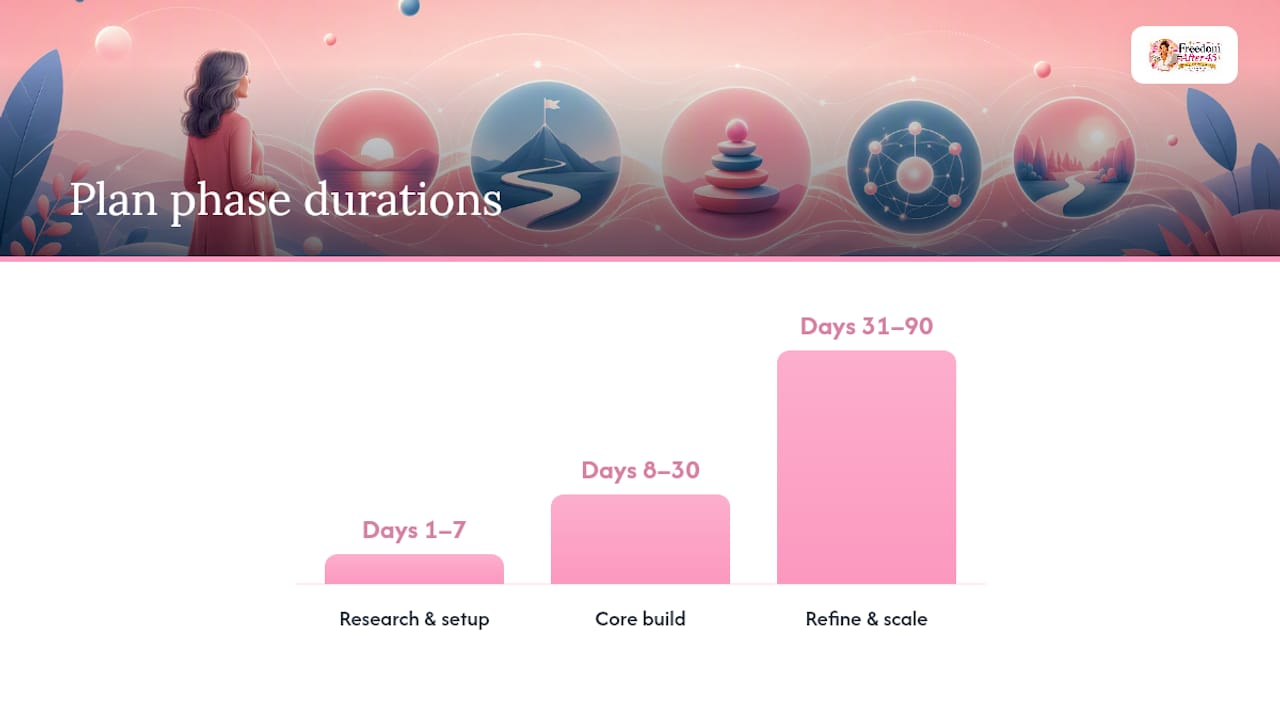
- Days 1 to 7: Research and commit to one primary method and one backup. Set up the account, license, or listing infrastructure you need (brokerage account, rental platform profile, domain and hosting). Spend at least 30 minutes of each session on whichever channel drives visibility, whether that’s a listing description, an SEO-optimized page, or an email signup form.
- Days 8 to 30: Execute the core build: publish content, list inventory, fund the account, or place the equipment. Track every action in a simple spreadsheet. By day 30, you should have your first small receipt, even if it’s just a few dollars.
- Days 31 to 90: Refine based on what’s actually converting. Double down on whatever channel produced income and cut what didn’t. By day 90, aim for consistent (even if small) daily-equivalent income and a clear sense of whether your backup method deserves more attention.
Pro Tip: Whatever method you choose, spend part of every single session on visibility, whether that’s search optimization, an email list, or platform reviews. Traffic and audience compound quietly in the background, and the methods that scale fastest almost always started building an audience on day one instead of week twelve.
How Long Does It Really Take to Reach Daily Payouts?
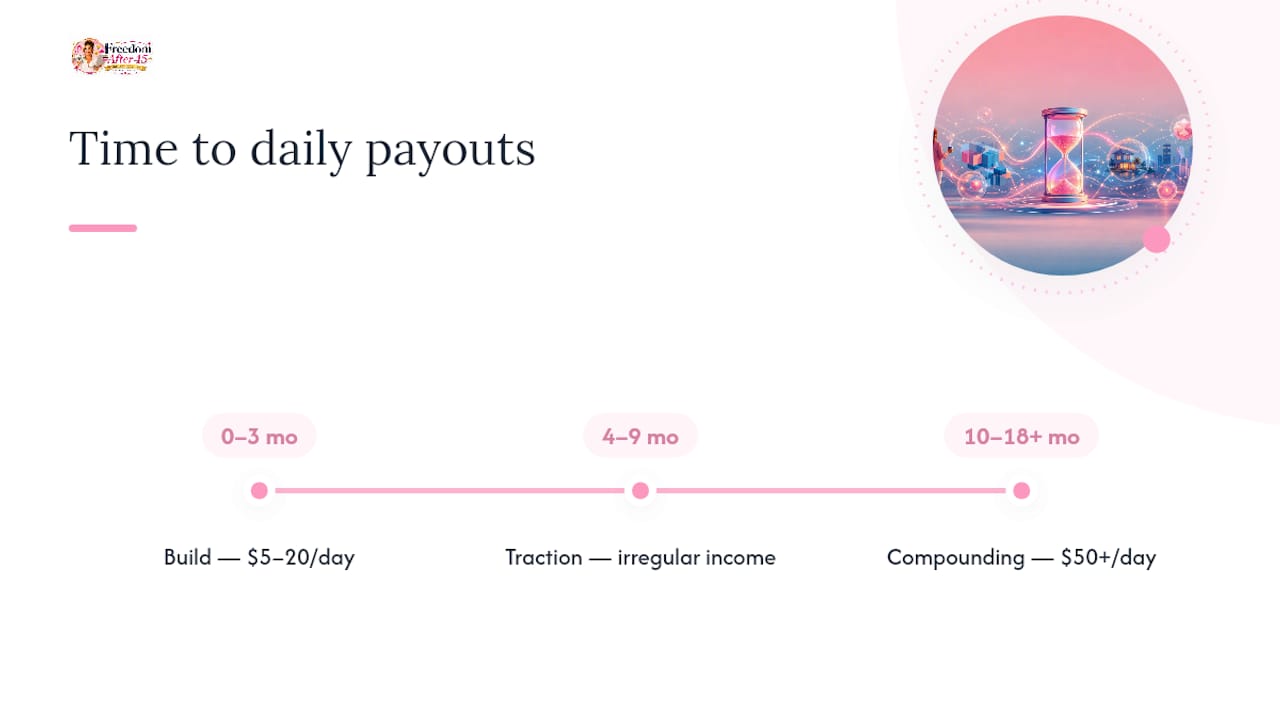
Expect three rough stages. Months zero through three are for building: setting up accounts, publishing initial content, buying your first asset, or listing your first rental. Months four through nine typically bring traction, meaning irregular but real income starts showing up. Months ten through eighteen and beyond is where compounding kicks in, and income becomes more predictable, according to the staged timeline financial educators commonly cite for online income systems.
Earnings bands follow a similar logic. The $5 to $20 a day range usually comes from a single early-stage stream, like a fresh affiliate site or one rental listing. The $50 to $100 a day range typically requires either a mature single stream (a seasoned REIT position, an established short-term rental) or two to three smaller streams running together. Beyond $100 a day generally means multiple diversified streams or one larger asset like a paid-off rental property or a purchased online business. Practical playbooks that combine quick income, scalable digital products, and investments tend to reach the $100-a-day mark faster than relying on any single investment alone.
What the research shows: Financial educators consistently describe passive income as a long-term destination built by reallocating time and capital into scalable assets, not a same-week outcome. Fidelity explicitly warns against treating any promise of guaranteed daily returns as legitimate. No diversified, well-run stream removes risk entirely, and spreading your effort across two or three methods protects you when one underperforms.
What Do Taxes and Recordkeeping Look Like?
The IRS draws real lines between income types, and they matter for what you owe. IRS Publication 925 covers passive activity rules, generally applying to income from rental real estate or businesses where you don’t materially participate. Portfolio income, like most dividends and interest, follows different rules. Active income, including most affiliate commissions and gig-style earnings, is often taxed as ordinary or self-employment income.
If your side income grows past a modest threshold, you may owe self-employment tax and need to make estimated quarterly payments rather than waiting until April. IRS Topic No. 559 covers those estimated tax rules in plain terms.
Keep this simple monthly checklist:
- Open a separate bank account for any income stream you’re serious about, even a small one.
- Save every invoice, receipt, and 1099 form as it arrives, not at tax time.
- Tally income and expenses monthly rather than annually, so surprises show up early.
- Set aside 25% to 30% of net passive income for taxes if you’re not sure of your bracket.
- Bring in a tax professional once any single stream clears roughly $5,000 a year or once you’re managing three or more streams.
Your First Week: A Daily Passive Income Checklist
Start simple, then build momentum:
- Score your top three ideas from Section 2 using the four-factor method from Section 3, and pick a primary and a backup.
- Block two hours daily on your calendar for the next 30 days, non-negotiable.
- Set a 30-day goal (first receipt, no matter how small) and a 90-day goal (a specific dollar-per-day target based on the bands above).
- Track three numbers weekly: total receipts, conversion rate (visitors to buyers, or applications to approvals), and traffic or lead volume.
- If you want a structured path instead of building the plan yourself, look into a guided program like Freedom After 45’s 2-Hour Workflow.
Why the Two-Hour Ceiling Matters More Than People Think
Most advice about passive income skips the part that actually determines whether someone sticks with it: the daily time commitment has to be small enough to survive a bad week. Freedom After 45 built the 2-Hour Workflow around that exact constraint, because women over 45 juggling careers, aging parents, or grandkids don’t have four spare hours a day to test an idea. They have two, if that.
The conventional wisdom says you need a following, a product, or serious capital before passive income becomes real. That’s backwards for most people starting today. What actually matters is a repeatable system you can run in two hours, applied consistently for months, not a bigger time budget applied for two weeks before burnout hits. The thousands of families who’ve gone through the 2-Hour Workflow blueprint didn’t succeed because they found more hours. They succeeded because the system fit the hours they already had.
— Freedom After 45
Get the 2-Hour Workflow Blueprint
You don’t have to piece together fifteen different ideas on your own. Freedom After 45’s 2-Hour Workflow gives you a single, structured path: no existing following required, no product to invent, just a step-by-step blueprint built specifically for women over 45 who want daily income without a second full-time job.

The program includes video walkthroughs, real case studies, and access to a community of people running the same system, so you’re never troubleshooting alone. It’s built for someone who has two hours a day, wants a system rather than a scattered list of ideas, and would rather follow a tested blueprint than build one from scratch through trial and error. If you’re ready to stop researching and start building, start the 2-Hour Workflow today and see the full plan for yourself.
Where to Learn More
For tax rules specific to passive versus active income, IRS Publication 925 and IRS Topic No. 559 are the authoritative starting points. Investopedia’s overview of passive income and Fidelity’s passive income guide both offer solid grounding on definitions and realistic timelines. For where to safely hold cash from any new income stream, Fdic explains deposit protections. For a guided, step-by-step implementation, visit Freedom After 45.
This article is general information, not a substitute for advice from a qualified financial advisor. Consult a qualified financial professional about your own circumstances before acting on anything here.
Sources
- Investopedia — What is passive income?
- IRS Publication 925 (Passive Activity and At-Risk Rules)
- Fidelity — Passive income ideas