

Beginner Friendly Passive Income In 90 Days: No Experience, Tax Smart
Beginner-friendly passive income means picking one low-cost, low-skill method, such as a high-yield savings account or a single digital product, and giving it 90 days before judging results. The single best first move for most people is opening a high-yield savings account today, since it takes ten minutes and starts paying immediately. Expect small numbers at first, often $50 to $300 a month in early income, not a paycheck replacement.
TL;DR:Starting with a high-yield savings account or I-Bonds offers near-zero risk and can generate around $50 to $300 monthly in early passive income.Digital products, stock photography, or affiliate marketing are viable options for those with time but limited capital, earning modest initial returns over several months.Most passive income streams require upfront effort, with significant results typically appearing after three to twelve months, emphasizing patience and consistency.Tax obligations exist on passive income, with platforms issuing 1099 forms once thresholds are crossed and tracking expenses and income carefully saving money later.Focus on one resource category, set a 90-day goal, and track progress diligently, as persistence through the slow middle months is key to building sustainable income.
Table of Contents
- What Counts as Beginner-Friendly Passive Income?
- Top Beginner-Friendly Passive Income Ideas
- How to Pick Your First Passive Income Stream
- What Kind of Timeline Should Beginners Expect?
- Do You Owe Taxes on Passive Income?
- Your 90-Day Starter Plan
- Why the 2-Hour Workflow Fits Beginners Who Are Short on Time
- The 2-Hour Workflow: A Faster Path Once You’ve Tested the Basics
- A Note on Starting Small and Staying Consistent
- Sources
What Counts as Beginner-Friendly Passive Income?
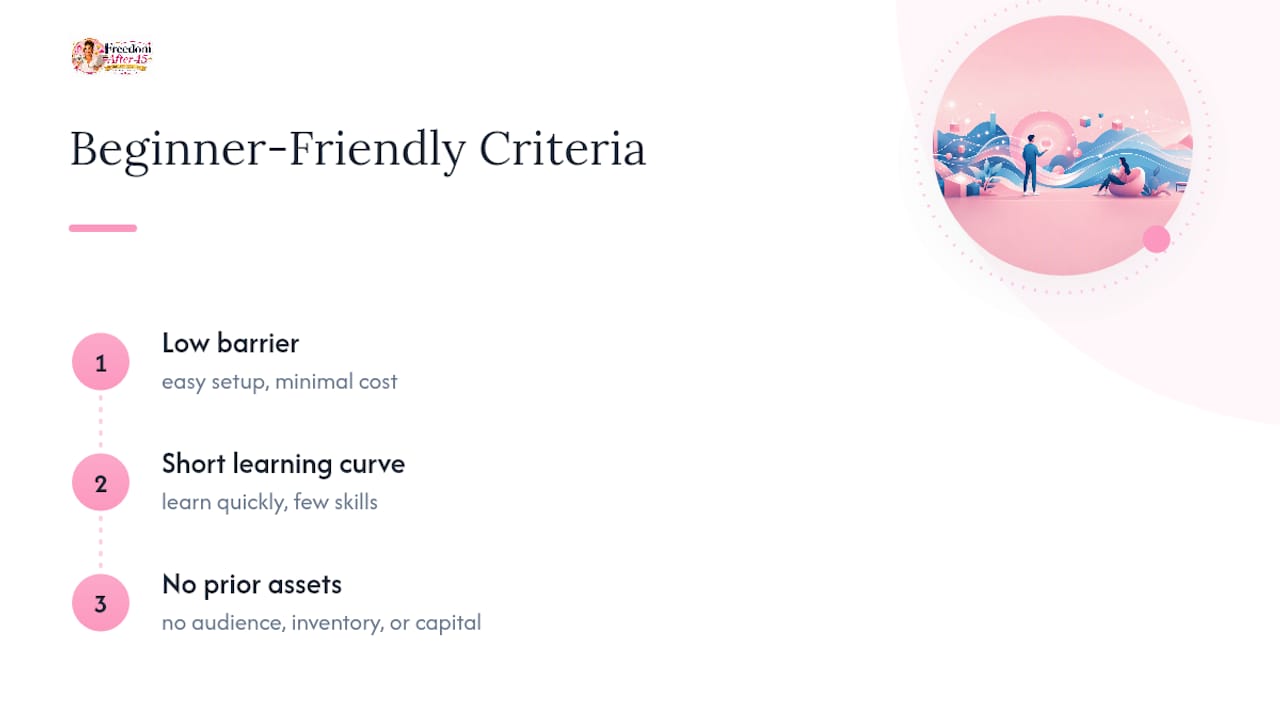
Passive income confuses people because almost nothing is truly passive at the start. Every method on this list demands upfront work: setting up an account, writing a product description, taking photos, or filling out a form. What makes something “beginner-friendly” is not the absence of effort. It’s a low barrier to entry, a short learning curve, and no need for existing assets like a large social media following, a warehouse of inventory, or tens of thousands of dollars sitting in a brokerage account.
Coursera’s overview of passive income makes this point directly: building passive income typically requires real effort or capital up front, even when the payoff arrives later with less ongoing work. The honest version of “passive” is “front-loaded.” You work hard for a few weeks or months, then the income trickles in with minimal maintenance. That’s a very different promise than “set it and forget it,” and beginners who understand the difference stick around longer than those chasing overnight results.
Top Beginner-Friendly Passive Income Ideas
The ideas below are grouped by what you actually have to offer: spare cash, spare time, an underused asset, or a knack for creating something once and selling it repeatedly. Pick from the category that matches your situation, not the one that sounds the most exciting.
Money-based ideas (you have some cash to put to work)
- High-yield savings accounts (HYSA). A savings account at an online bank that pays substantially more interest than a traditional bank. Startup cost: $0, often no minimum deposit. Time to first earnings: interest posts monthly, so you’ll see a deposit within 30 days. Realistic beginner earnings: modest, scaling with your balance, but it’s risk-free growth on cash that would otherwise sit idle. These accounts are covered by FDIC deposit insurance up to $250,000 per depositor, per bank, which is why this is the lowest-risk starting point on this entire list.
- Series I Savings Bonds (I-Bonds). A U.S. Treasury-backed bond that adjusts its rate twice a year to keep pace with inflation. Startup cost: $25 minimum through TreasuryDirect. Time to first earnings: bonds accrue interest monthly, but you can’t cash out for 12 months. Realistic beginner earnings: steady and government-guaranteed, capped at a $10,000 annual purchase limit per person, according to IRS guidance on passive activity and Treasury-backed instruments.
- Dividend-paying index ETFs. Exchange-traded funds, similar to Vanguard-style funds, that pool many dividend-paying companies into one investment. Startup cost: as little as $1 to $100 through most brokerage apps. Time to first earnings: dividends usually pay quarterly. Realistic beginner earnings: small on a modest balance, but the real value is long-term compounding rather than quick payouts.
- Real Estate Investment Trusts (REITs). A REIT lets you own a slice of commercial or residential real estate without buying property yourself. Startup cost: often under $100 through a brokerage account. Time to first earnings: quarterly or monthly distributions. Realistic beginner earnings: REITs are legally required to distribute at least 90% of their taxable income as dividends, which makes payouts fairly predictable once you’re invested.
Time and skill-based ideas (you have hours, not dollars)
- Print-on-demand (POD) products. You design a graphic once, upload it to a POD platform, and the platform handles printing, shipping, and customer service every time someone orders. Startup cost: $0 to $50 for design software. Time to first earnings: your first sale could come in days or take months, depending on how much you promote it. Realistic beginner earnings: often in the same modest range as other creator income, per Superfast Finance’s beginner earnings data, with most of the growth coming after month six.
- Stock photography. Upload photos you already take to a stock photo marketplace and earn a small royalty every time someone licenses one. Startup cost: $0 if you have a smartphone camera. Time to first earnings: 30 to 90 days after your first batch gets approved. Realistic beginner earnings: modest per download, but a large, evergreen library builds recurring checks over years.
Creator-based ideas (you can teach or explain something)
- Digital products (templates, guides, courses). You build something once, a spreadsheet template, a planner, a short guide, and sell it repeatedly through a marketplace like Gumroad or Etsy. Startup cost: $0 to $20 for hosting fees. Time to first earnings: your first sale can happen within days of listing if you price it right. Realistic beginner earnings: a widely cited creator-economy figure puts median monthly digital product income around $127 for beginners, according to Superfast Finance’s roundup of realistic 2026 earnings, with top performers earning far more once they build an audience.
- Affiliate marketing. You recommend a product using a tracked link, and you earn a commission when someone buys through it. Startup cost: $0 if you use free platforms like a blog or YouTube channel. Time to first earnings: often 60 to 90 days while search engines or algorithms discover your content. Realistic beginner earnings: highly variable and usually slow to start, which is why it pairs well with a digital product rather than standing alone.
Asset-based ideas (you already own something you can rent)
- Renting out unused items or space. A spare room, a parking spot, or even tools you own can generate income through rental marketplaces. Startup cost: usually $0 since you already own the asset. Time to first earnings: as fast as your first booking. Realistic beginner earnings: depends heavily on location and demand, but it requires almost no new skill to start.
Pro Tip: Don’t spread your first $200 and first ten hours across four ideas. Pick one, commit to it for a full quarter, and resist the urge to jump ship the moment week two feels slow.
A quick gut check on where to start:
- Have cash but no time? Start with a HYSA or I-Bonds this week.
- Have time but no cash? Start with stock photos or a digital product.
- Have a skill you can explain simply? Build one digital product around it.
- Own something sitting idle (a room, a tool, a car)? Look at rental marketplaces before building anything from scratch.
How to Pick Your First Passive Income Stream
Most beginners fail not because they picked a bad idea, but because they picked an idea that didn’t match their actual resources. Before committing, map yourself honestly against three variables: time available per week, cash available to invest or spend, and existing skills you could teach or package.
Ask yourself these questions before you commit to anything:
- Can I explain this idea to a friend in one sentence without using jargon?
- What does the platform or provider actually take as a fee or cut?
- How long until I see my first dollar, and can I stay patient that long?
- If this fails completely, did I lose money I needed for something else?
- Does this require an audience I don’t have yet?
Red flags that should make you walk away immediately:
- Any “guaranteed” return on an investment. Nothing is guaranteed except FDIC-insured deposits up to the coverage limit.
- Upfront fees larger than $100 before you’ve earned a single dollar.
- Pressure to recruit other people rather than sell a product or service.
- Vague explanations of how the money is actually generated.
A short checklist to work through before you start:
- [ ] I’ve picked one idea from one resource category (money, time, skill, or asset).
- [ ] I know the exact startup cost and I can afford to lose it.
- [ ] I’ve set a 90-day checkpoint, not a 90-day deadline for success.
- [ ] I’ve written down where I’ll track income and expenses.
What Kind of Timeline Should Beginners Expect?
The first three months rarely produce meaningful income. Months zero to three are foundation work: opening accounts, publishing your first product, or taking your first rental booking. Months three to twelve are where consistency starts compounding, particularly for digital products and affiliate content that search engines need time to index and rank.
A time-rich beginner with no capital, someone building stock photos or a digital template on evenings and weekends, tends to see slower early traction than a capital-rich beginner who drops $5,000 into I-Bonds or a HYSA and earns from day one. Neither path is wrong. They just compound differently.
Credible estimates place many beginners in the $50 to $300 monthly range during their early months across side hustles and passive streams alike. Reinvesting those first checks, buying more I-Bonds, promoting your digital product, or adding a second stream, is what turns a slow first year into real momentum by year two or three.
Do You Owe Taxes on Passive Income?
Yes, and the IRS treats passive income differently depending on the source. The IRS defines passive activities as trade or business activities where you don’t materially participate, plus most rental activities, and these classifications affect how losses and income get reported for tax purposes.
A few essentials to keep in mind:
- If you expect to owe $1,000 or more in tax for the year from self-reported income, you likely need to make quarterly estimated tax payments rather than waiting until April.
- Marketplaces and platforms may issue you a 1099 form once your earnings cross reporting thresholds. Keep every one of them.
- Track income and expenses monthly, not annually. Reconstructing a year of small transactions in March is miserable.
- Once your passive income streams multiply, a tax professional usually pays for themselves in deductions you’d otherwise miss.
On the safety side, remember that HYSA deposits carry FDIC insurance up to $250,000 per depositor, per bank, and I-Bonds cap at $10,000 in annual purchases per person through TreasuryDirect. Both protections matter more once your balances grow beyond pocket change.
Your 90-Day Starter Plan
Ninety days is long enough to learn whether an idea actually works for you, and short enough to keep you motivated. Here’s how to structure it.
- Month 1: Build the foundation. Choose one idea from the categories above. Open the necessary account, whether that’s a brokerage app, a TreasuryDirect account, or a seller account on a digital marketplace. Create your first basic asset: a listing, a product, a photo set, or your first deposit.
- Month 2: Launch and track. Publish your product or make your first deposit. Automate whatever the platform allows, recurring transfers, automatic reinvestment, scheduled posts. Start a simple spreadsheet tracking dollars in, dollars earned, and hours spent.
- Month 3: Optimize and decide. Review your first real numbers. Adjust pricing, descriptions, or account settings based on what’s working. Decide whether to double down on this one stream or add a second stream from a different resource category.
Pro Tip: Use a free spreadsheet or a budgeting app you already have, not a new paid tool, to track your first 90 days. Adding software complexity before you’ve earned your first dollar is a common way beginners lose momentum.
Why the 2-Hour Workflow Fits Beginners Who Are Short on Time
Most beginner passive income advice assumes you already have a following, a product, or hours of free time to experiment. Freedom After 45 built its 2-Hour Workflow blueprint around a different assumption: that a woman starting from zero, with no existing audience and no product idea, can still build a working income stream in structured daily sessions.
The method suits women over 45 who are managing a job, a household, or caregiving and simply cannot spend twenty hours a week testing ideas. It works through step-by-step video instruction, real case studies, and a support community, rather than a stack of theory you have to translate into action yourself. Thousands of families have used the framework to move from zero income streams to their first recurring earnings, without the trial-and-error most beginners go through alone.
The 2-Hour Workflow: A Faster Path Once You’ve Tested the Basics
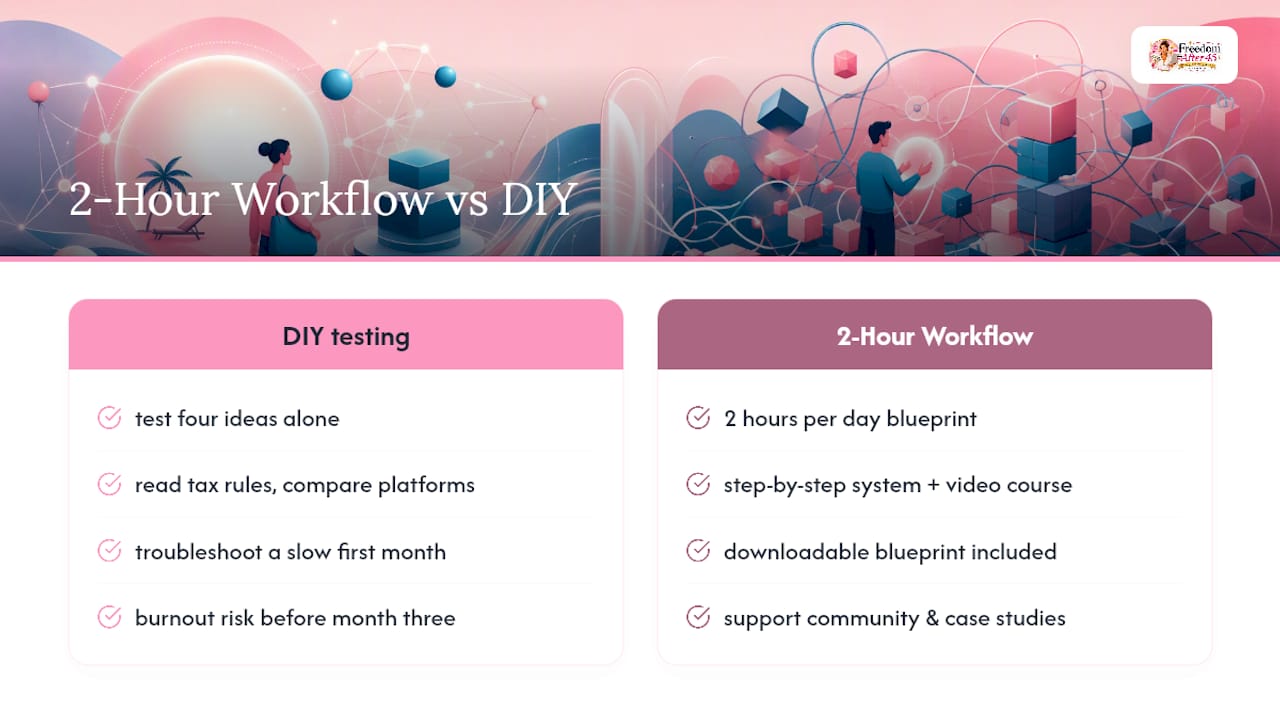
Everything above works. A HYSA, a digital product, an I-Bond ladder, they’re all legitimate ways to build the beginning of a passive income base, and trying one of them costs you nothing but time. But testing four different ideas on your own, reading tax rules, comparing platforms, and troubleshooting a slow first month is exactly the kind of trial-and-error that burns out a lot of beginners before month three even ends.
Freedom After 45’s 2-Hour Workflow condenses that guesswork into a single blueprint: two hours a day, a step-by-step system, and a community of women who’ve already been through the early stumbles. Buyers get the full video course, the downloadable blueprint, and access to a support community, plus real case studies from women who started with no following and no product of their own. It’s built specifically for women over 45 who want daily income in the realistic $100 to $1,400 range without spending months piecing together strategy from scattered advice.
If you’d rather test the free ideas above first, that’s a reasonable place to start. When you’re ready for a structured, guided path instead of building one from scratch, see how the 2-Hour Workflow works and decide if it fits your situation.
A Note on Starting Small and Staying Consistent
The hardest part of passive income isn’t picking the right idea. It’s sitting through the boring middle stretch where you’ve done the work and the payoff hasn’t shown up yet. Every stream on this list has that stretch, whether it’s the 90 days before a digital product gets its first real sale or the first year of a HYSA balance that barely moves the needle.
Track your numbers weekly, even when they’re small. A $12 payout in your second month isn’t nothing. It’s proof the mechanism works, and mechanisms that work at $12 tend to work at $200 once you feed them more time or money. Treat your first quarter as a learning lab, not a verdict on whether passive income is for you.
Give one idea a genuine 90 days before switching. Then try the plan above and see where your own numbers land.
— Freedom After 45