

2 Hours a Day: Active vs Passive Income for Busy, Low Capital Earners
Active income is money you earn by trading time or effort for pay, like a paycheck, a freelance invoice, or a commission. Passive income is money that keeps arriving from an asset or system you built earlier, like rental payments, dividends, or royalties, with little day-to-day labor. Neither wins outright. The smartest approach uses active income to fund and stabilize your life while you build passive streams on the side, shifting the balance as your circumstances change.
TL;DR:Building passive income requires a significant upfront effort and often capital, with timelines stretching over months or years before meaningful returns appear.Diversifying income sources and reopening a focus on active income first helps reduce risk and provides stable funding for passive ventures.Continuous oversight and updates are necessary for passive streams like rental properties and digital products, which prevents misconceptions of effortless earning.Proper tax classification and recordkeeping are crucial to avoid legal issues, especially regarding material participation rules affecting deductions.Starting small, validating demand, and gradually scaling passive income projects improve chances of long-term success without risking debt or neglecting fundamental financial safety nets.
Freedom After 45Build Passive Income in Two HoursFreedom After 45 shares a step-by-step 2-Hour Workflow for women over 45 seeking recurring income without traditional barriers.Explore the 2-Hour Workflow
Table of Contents
- Active vs Passive Income at a Glance
- What Is Active Income?
- What Is Passive Income, Really?
- What Actually Separates the Two
- What Real Scenarios Actually Look Like
- How to Start Building Passive Income From Where You Are
- Where People Get This Wrong
- The IRS Material Participation Test, Explained Simply
- A Simple Framework for Combining Both
- Freedom After 45’s Take on Building Both
- A Structured Next Step If You Want One
- Sources
Active vs Passive Income at a Glance
Before you decide where to put your energy, it helps to see the tradeoffs side by side.
- Effort: Active income requires ongoing work; passive income requires upfront work, then lighter maintenance.
- Startup cost: Active income needs little to no capital; passive income often needs money, time, or both before it pays anything.
- Timeline: Active income pays immediately; passive income can take months or years to produce meaningful returns.
- Tax treatment: Active income is taxed at ordinary rates; some passive income, like qualified dividends, gets preferential tax treatment, while rental income has its own reporting rules.
- Examples: Active includes wages, freelancing, and commissions; passive includes dividends, rental income, and royalties. Many people run both at once.
What Is Active Income?
Active income definition, in plain terms: it’s pay you receive in exchange for direct labor or a service, and it stops the moment you stop working. Salaries, hourly wages, freelance contracts, gig work, and sales commissions all fall into this bucket. The IRS material participation framework also treats income from a business you actively run, hands-on, as active income for tax purposes, distinct from a business you merely invest in.
Active income sources matter because they’re the foundation everything else gets built on. A steady paycheck lets you cover fixed expenses, build an emergency fund, and pay down debt without touching investments. Once those basics are handled, active income becomes seed capital: the freelance check that funds your first index fund purchase, the overtime pay that becomes a rental property down payment. Without active income first, most passive income strategies never get off the ground. It’s the fuel, not the destination.
What Is Passive Income, Really?
Passive income is money generated by an asset or a system that doesn’t require your direct daily labor to keep functioning, though it almost always requires labor to set up. The IRS defines passive activities narrowly: rental activities and trade or business activities where you don’t materially participate. In practical, everyday terms, it means dividends, interest, rental income, royalties, income from digital products, and REIT distributions.
Here’s where the myth breaks down. Fidelity’s learning center is blunt about it: most passive streams need continuing oversight. Rental properties bring tenant calls and repairs. Digital products need updates and customer support. Dividend portfolios need periodic rebalancing. None of it is “earning while you sleep” in the literal sense advertisers use. It’s more accurate to call it earning with a lower, but not zero, ongoing time cost.
What Actually Separates the Two
Four factors decide which income type fits your situation best, and they interact more than people expect.
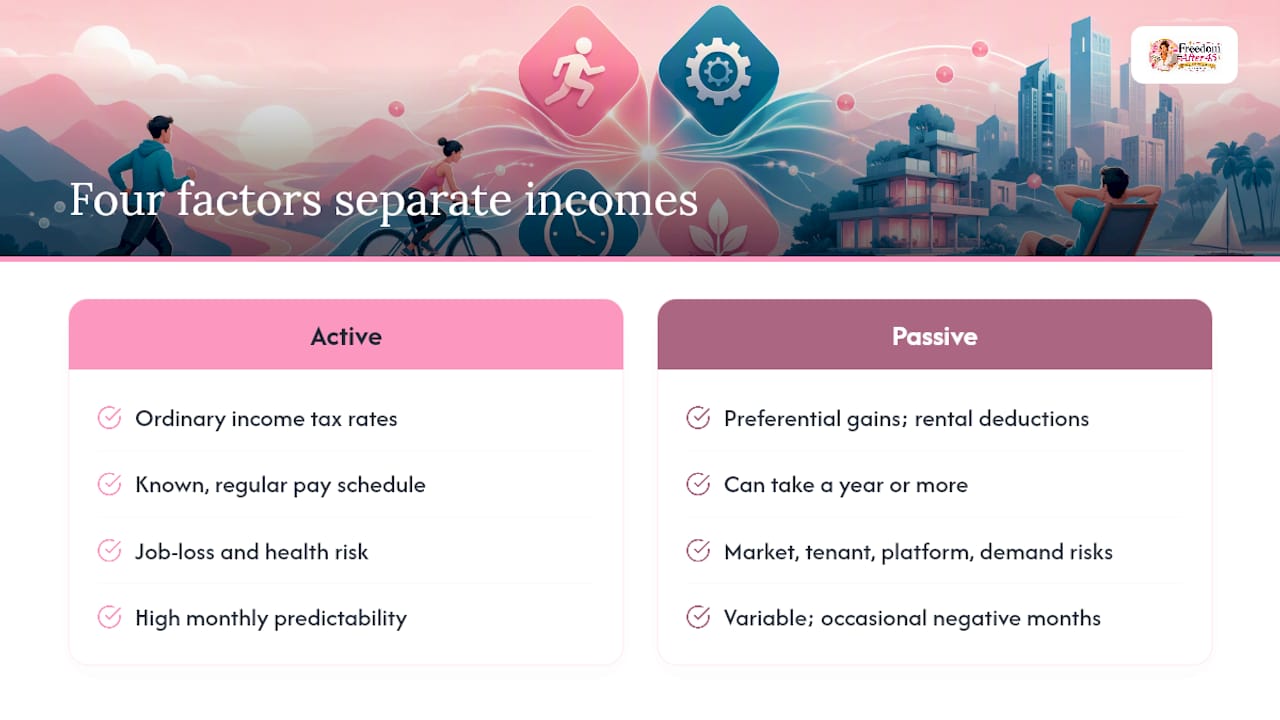
Tax treatment is the first divide. Wages and freelance income get taxed at ordinary income rates, while some investment income, like long-term capital gains and qualified dividends, gets preferential rates. Rental income sits in its own category, with depreciation and expense deductions that can offset what you owe.
Timeline is the second. Active income pays on a known schedule; passive income can take a year or more before it produces a consistent monthly figure worth counting on.
A note on risk: No income type is risk-free. Active income carries job-loss and health risk. Passive income carries market risk, tenant risk, platform risk, and product-demand risk. Financial guidance from U.S. News consistently points to combining both as the way to reduce dependence on any single risk source.
Predictability shapes how you budget month to month. A salary lets you plan with confidence. A rental property might net you $400 one month and negative $600 the next after a repair bill, which is why diversifying across a few passive streams matters more than betting everything on one.
What Real Scenarios Actually Look Like
Numbers vary too much to promise outcomes, but the patterns are consistent enough to plan around.
Freelance contracting: Someone picks up freelance writing or bookkeeping on evenings and weekends. It stays active income, dollar for hour, but it scales as reputation and rates grow, and it often becomes the funding source for the next two examples.
Rental property: Buying a single rental unit typically means a down payment, closing costs, and either the time to self-manage or roughly 8 to 10% of monthly rent paid to a property manager. Self-managed properties often require significant active involvement in the early period, especially during tenant turnover.
Digital products: Someone with an existing skill, like a spreadsheet template, a guide, or an online course, builds something once and sells it repeatedly. Coursera’s research on passive income ideas points to this as one of the lower-cost entry paths since it needs skill and time more than capital, though first sales often take weeks or months of promotion before momentum builds.
How to Start Building Passive Income From Where You Are
Your starting resources, not your ambition, should decide your first move.
- Assess your cash, skills, and time honestly. Someone with two hours a day and no spare capital needs a different plan than someone with $20,000 and a slow evening schedule.
- Match the approach to your resources. Low-capital paths include high-yield savings accounts, digital templates or guides, renting out spare space, and affiliate marketing. Moderate-to-high-capital paths include dividend investing, index funds, REITs, and rental property, all of which reward patience over speed.
- Validate before you build. Test whether people actually want what you’re planning to sell or rent before investing real money.
- Launch a minimal version. A short guide instead of a full course, one rental unit instead of three.
- Measure, then scale. Reinvest what works, cut what doesn’t, and expand gradually instead of all at once.
Pro Tip: Track your first passive income attempt for 90 days before judging it. Most streams look unimpressive in month one and only start showing a real pattern by month three.
Where People Get This Wrong
The biggest misconception is thinking passive means finished. It rarely does. Even a simple dividend portfolio needs periodic review, and a digital product needs updates as tools and expectations change.
The second-biggest mistake is financing speculative passive ventures with debt. Borrowing against a home to fund a rental property or a business you don’t fully understand turns a diversification move into a concentrated bet. Ramsey Solutions advises building an emergency fund and paying down high-interest debt before chasing passive streams that carry real risk.
The third trap is sloppy recordkeeping. Mixing personal and business expenses, skipping mileage logs, or ignoring 1099s creates tax headaches that a few minutes of tracking each week would have avoided.
The IRS Material Participation Test, Explained Simply
Material participation determines whether the IRS treats your involvement in a business or rental activity as active or passive, and it changes what you can deduct. Broadly, you materially participate if you work more than 500 hours a year on the activity, or if you do substantially all the work yourself, among several other qualifying tests.
Classification affects loss treatment directly. Passive losses can usually only offset passive income, not your wages, which surprises people who expected a rental loss to reduce their overall tax bill. Real estate professionals who meet specific hour thresholds get different treatment entirely.
Keep a simple time log for any borderline activity, save every receipt tied to the venture, and bring a tax professional into the conversation once a passive project starts generating real money. The cost of an hour with a CPA is small next to the cost of a misclassified deduction.
A Simple Framework for Combining Both
Sequence matters more than most people realize. Pay off high-interest debt first, since few passive investments outperform an 18% credit card rate reliably. Build a three-to-six-month emergency fund next, funded entirely by active income. Only then move into conservative investments like index funds or high-yield savings, and finally into scalable passive projects like rental property or digital products once you have both capital and a buffer.
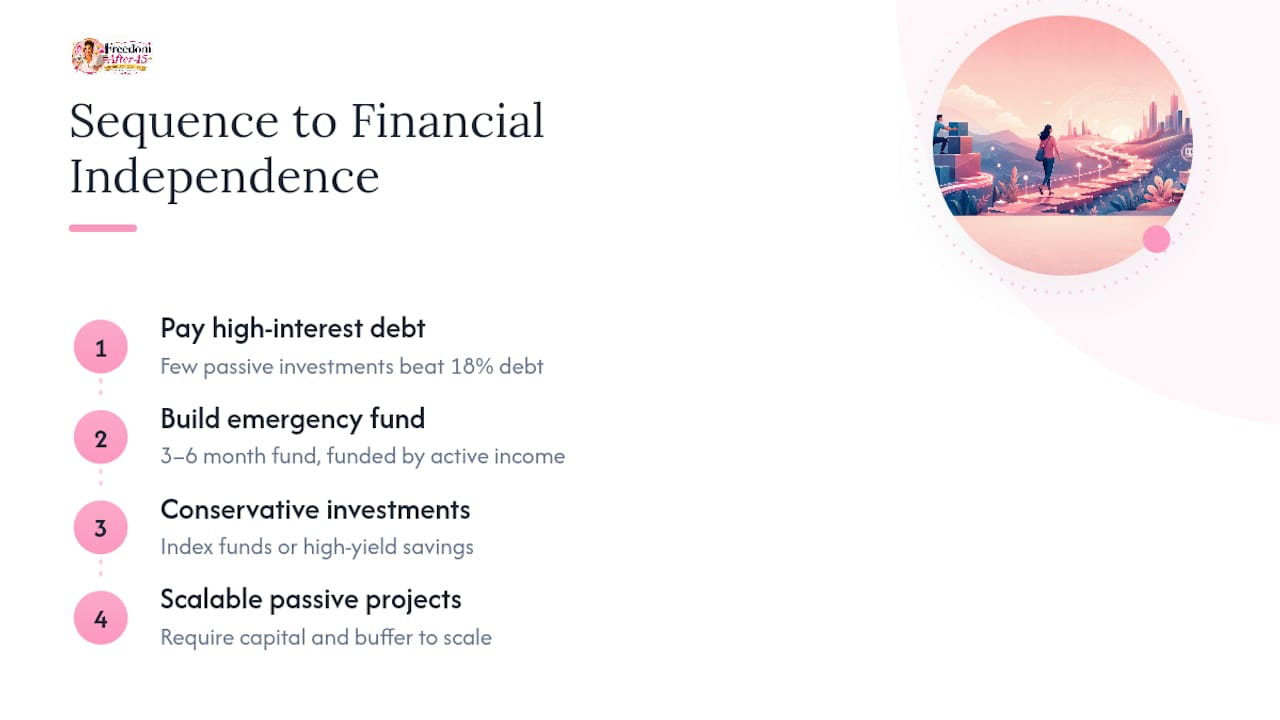
A workable rule of thumb: keep active income covering your fixed costs for as long as possible, and let passive income build slowly on top rather than replacing your paycheck prematurely.
Freedom After 45’s Take on Building Both
A 2-Hour Workflow can help women over 45 who don’t have spare capital or a following, just two hours a day and a willingness to follow a structured system. The workflow, templates, and community mirror the low-capital paths covered above: validate small, build a minimal version, then scale what works. It’s not about replacing active income overnight. It’s about building a second stream methodically, alongside the work you’re already doing.
— Freedom After 45
A Structured Next Step If You Want One
Everything in this article, from validating an idea to sequencing your first investment, works whether you build it yourself with a spreadsheet and patience, or follow a guided system that removes the guesswork of where to start.

That’s the gap Freedom After 45 fills. The 2-Hour Workflow gives you a step-by-step blueprint, ready-made templates, and a community of women building the same kind of second income stream, all without needing an existing following or a product idea of your own. If the freelance-to-passive path or the digital-product path outlined above sounds right for your two hours a day, check out the 2-Hour Workflow and see whether the structure fits how you want to spend your time.
This article is general information, not a substitute for advice from a qualified financial advisor. Consult a qualified financial professional about your own circumstances before acting on anything here.