

Why Students Overlook Online Income Potential
Students overlook online income potential primarily because they misunderstand what it actually takes: not a laptop and free time, but an entrepreneurial mindset, consistent skill building, and months of patient effort. The gap between expectation and reality is wide. Fragmented student schedules of 30–90 minute blocks between classes make sustained work feel impossible. Psychological traps like comparison bias and the employee mindset push students to quit before results appear. This article cuts through the noise and explains exactly why students miss this opportunity, and what it takes to actually capture it.
Why students overlook online income potential
Students misunderstand online income the same way they misunderstand a new skill: they expect results before they have earned them. The core problem is not a lack of opportunity. Online income failures most often result from treating online earnings as a shortcut rather than a professional growth path requiring marketing, communication, and persistence.
The phrase “online income potential” is the informal way students describe what economists and career researchers call alternative digital revenue streams. These include freelancing, content creation, online tutoring, affiliate marketing, and digital product sales. Each requires a different skill set and timeline. Students tend to lump them together, which creates confusion about what is realistic and what is hype.

The most damaging misconception is that online income is passive from day one. Real passive income is built on months or years of active work. Students who skip that foundation quit early and conclude the whole category is a scam.
What practical barriers stop students from earning online?
Students face three concrete obstacles: limited time, no startup capital, and weak digital skills.
Student schedules typically offer only 30–90 minute windows between classes, not the full work shifts that most online income tutorials assume. That fragmentation makes it hard to build momentum on tasks like content creation or client outreach, which reward longer, focused sessions.
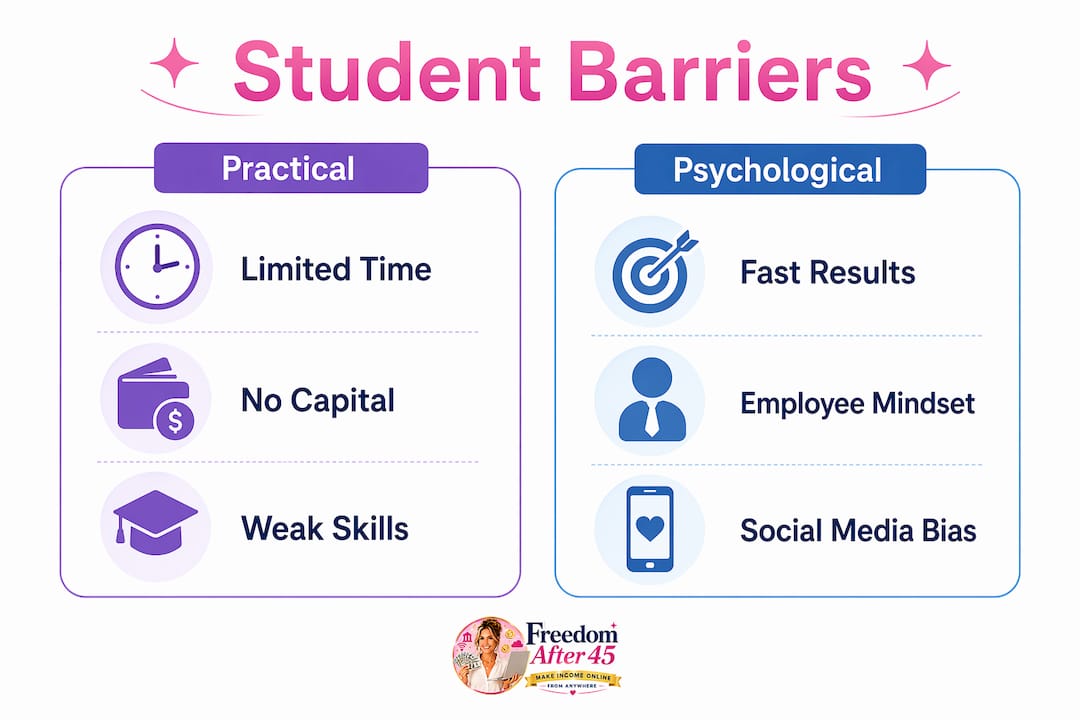
Startup capital is another wall. Most students cannot afford paid advertising, premium software subscriptions, or inventory for e-commerce. This rules out several popular income models before they even begin.
Digital skill gaps compound the problem. Content creation, SEO, email marketing, and social media strategy are learnable, but they take time. Students who have never run a campaign or written a sales page face a steep learning curve with no guarantee of early income.
The good news is that some models fit student constraints well:
- Online tutoring pays $15–$55 per hour and requires no capital, no degree, and no audience. A student who knows calculus or speaks a second language can start within a week.
- Freelance writing or graphic design can begin with free tools and a simple portfolio page.
- Virtual assistance requires organizational skills most students already have.
Pro Tip: Start with the skill you already use in class. If you write well, pitch one freelance article. If you tutor friends for free, charge the next one $20. Apply first, refine later.
Why do psychological biases cause students to quit early?
Mindset is the single biggest reason students abandon online income attempts. The pattern is predictable and well documented.
“Students often fail not because they lack talent, but because they expect guaranteed rewards before they have built the skills to earn them.” This is the employee mindset applied to entrepreneurship, and it almost always leads to early quitting.
The employee mindset expects a direct exchange: effort in, paycheck out, on a fixed schedule. Entrepreneurial income does not work that way. Early weeks often produce nothing. That silence feels like failure, but it is actually the normal learning phase.
The Proximity Fallacy makes this worse. Social media surfaces the highlight reels of creators who earn $10,000 a month, but hides the 18 months of zero-income posts that came before it. Students who compare their week one to someone else’s year three experience feel immediate discouragement. That discouragement triggers method-switching.
Method-switching is the death spiral of online income attempts. A student tries affiliate marketing for three weeks, sees no sales, switches to dropshipping, sees no sales, tries YouTube, and quits. Each switch resets the learning curve. Comparison bias drives this cycle more than any other factor.
The four behaviors that break this cycle:
- Commit to one method for at least 90 days before evaluating results.
- Track inputs, not outputs. Count hours worked and skills learned, not dollars earned, in the first month.
- Limit social media consumption of income influencers during the early phase.
- Find one peer or mentor who is six months ahead of you, not six years.
Pro Tip: Write down your method and your 90-day goal on paper. Put it somewhere visible. Students who externalize their commitment are far less likely to switch methods impulsively.
How long does it actually take to earn real income online?
The honest answer is longer than most students expect, and shorter than most failures believe.
Realistic online business models for beginners require 12–24 months of consistent effort to reach $2,000–$5,000 in monthly income. That timeline assumes 1,000–3,000 hours of applied work. “Quit your job in 90 days” claims represent less than 1% of actual outcomes.
| Income model | Typical success rate | Time to consistent income |
|---|---|---|
| Service businesses (freelancing, tutoring) | 20–40% | 3–9 months |
| Dropshipping / e-commerce | 5–10% | 12–24 months |
| Content creation (YouTube, blogging) | Under 5% in year one | 12–36 months |
| Affiliate marketing | Varies widely | 6–18 months |
Service businesses win for students because the success rate is highest and the startup cost is lowest. A student who tutors, writes, or designs for clients builds income and a professional reputation at the same time.
Starting in the first year of college is the single most leveraged decision a student can make. By junior year, the compounding window closes. A student who begins building skills and a client base in year one has two to three years of compounding reputation before graduation. That is a meaningful head start on any career path.
What strategies actually work for students building online income?
The students who succeed share one behavior: they apply knowledge immediately instead of collecting it.
Course hoarding is the most common trap. A student buys three online courses, watches 40 hours of tutorials, and never sends a single pitch or publishes a single post. Passive consumption creates the feeling of progress without producing any. Real advancement requires applying skills to small, real-world problems from day one.
Practical behaviors that build momentum:
- Do the smallest possible version of your idea today. Write one 500-word article. Send one cold email. Create one tutoring listing. Small actions build the habit and produce real feedback.
- Build trust before scaling. Charge less than you think you are worth at first. Deliver more than promised. One five-star review is worth more than a polished website with no social proof.
- Track your wins, however small. A student who earns $47 in their first month has proof the model works. That proof is motivating. Students who ignore small wins lose momentum fast.
- Protect your one method. When a new “opportunity” appears on your feed, write it down and revisit it in 90 days. Do not act on it now.
Online income success is slow, unglamorous, and rarely worth posting about in the early months. That reality is exactly why most students quit. The ones who stay consistent are the ones who eventually have something worth posting.
Pro Tip: Set a weekly “output quota” instead of an income goal. Commit to sending five pitches, publishing two posts, or completing two tutoring sessions per week. Output is controllable. Income is not, especially early on.
Key Takeaways
Students miss online income opportunities most often because of mindset gaps and unrealistic timelines, not a lack of talent or access.
| Point | Details |
|---|---|
| Mindset is the primary barrier | The employee mindset causes students to quit before the learning phase produces income. |
| Fragmented time is manageable | 30–90 minute windows work best for service models like tutoring or freelancing. |
| Timelines are longer than advertised | Consistent online income typically takes 12–24 months and 1,000–3,000 hours of applied work. |
| Starting early compounds results | Beginning in year one of college gives students two to three years of skill and reputation building before graduation. |
| Application beats consumption | Sending one pitch beats watching ten tutorials. Real progress requires doing, not just learning. |
The mindset shift most students never make
From my perspective at Freedom After 45, the pattern I see most often is not laziness or lack of ability. It is a fundamental misread of what online income actually is.
Students treat it like a vending machine: insert effort, receive money. When the money does not appear in week two, they assume the machine is broken. What they miss is that the machine takes 6–18 months to calibrate. Every hour of work in that period is building the mechanism, not feeding it.
The students who succeed are not smarter or more talented. They are simply willing to accept slow, boring progress for longer than everyone else. They also start earlier. A student who begins building an online income stream in their first semester has a structural advantage that no amount of talent can replicate later.
The most honest thing I can tell you is this: online income is real, but it is not fast. It rewards people who treat it like a skill, not a lottery ticket. The sooner you accept that, the sooner you stop quitting and start compounding.
— Freedom After 45
A practical system for students ready to start
Students who understand the barriers are already ahead of most. The next step is having a system that fits real constraints: limited time, no existing audience, and no startup capital.

Freedom After 45 built the 2-Hour Workflow specifically for people who need a structured, repeatable process without the noise of get-rich-quick promises. The system works in short daily sessions, requires no prior following or product, and focuses on building real, compounding income from day one. Thousands of people have used it to generate consistent daily income without quitting their studies or their jobs. If you are ready to stop researching and start applying, this is the place to begin.
FAQ
Why do students avoid online work despite the opportunity?
Students avoid online work because they expect fast results and quit during the slow early phase. The employee mindset, comparison bias, and fragmented schedules all reinforce early dropout.
What is the most realistic online income model for a student?
Service businesses like online tutoring and freelancing have success rates of 20–40% and require no startup capital, making them the most accessible starting point for students.
How long does it take a student to earn consistent income online?
Most beginners need 12–24 months of consistent effort and 1,000–3,000 hours of applied work to reach $2,000–$5,000 per month in online income.
What is course hoarding and why does it hurt students?
Course hoarding means consuming tutorials without applying them. It creates the feeling of progress while producing no real income or skill development.
When should a student start building online income?
Starting in year one of college is the most leveraged decision a student can make. Waiting until junior or senior year closes the compounding window for skill and reputation building.