

How Side Income Becomes Primary Income: A 2026 Guide
Side income becomes primary income when it consistently replaces at least 50–75% of your current take-home pay for three or more consecutive months, backed by a cash reserve of 6–12 months of living expenses. This transition is not a single moment. It is a process that typically takes 18 to 24 months and requires income consistency, financial runway, and diversified revenue sources. Only 23% of individuals maintain full-time independent income beyond two years. That number tells you this shift demands planning, not just ambition. Freedom After 45 has helped thousands of women over 45 build exactly this kind of structured, repeatable income.
How side income becomes primary income: the financial milestones that matter
The most common mistake people make is treating a good month as a green light. Side income becomes a reliable primary income only when it clears specific financial thresholds, not just once, but repeatedly.
The core benchmarks are straightforward:
- Consistent income threshold: Your side income should cover 50–75% of your current take-home pay for at least three consecutive months.
- Cash reserve: Maintain a liquid savings buffer equal to 6–12 months of living expenses before you quit your day job.
- Rolling average check: Use a six-month rolling income average, not a single peak month, to assess your true earning baseline.
- Tax and expense accounting: Factor in self-employment taxes, business costs, and health insurance before calculating what you actually net.
The 50–75% threshold exists for a practical reason. Once you leave your job, you reclaim 40 or more hours per week. That time accelerates growth, which means you do not need to fully replace your salary before making the move. You need enough to survive while you scale.
Pro Tip: Track your side income in a separate bank account from day one. This makes your rolling average calculation clean and removes the temptation to spend business revenue on personal expenses.
A six-month rolling average is the most reliable readiness signal. One exceptional month distorts the picture. Six months of data shows a real trend.
What income stream diversification does for your stability
Relying on one client or one platform is the fastest way to fail this transition. Successful transitions require at least three independent income streams, with no single stream accounting for more than 60% of total revenue.
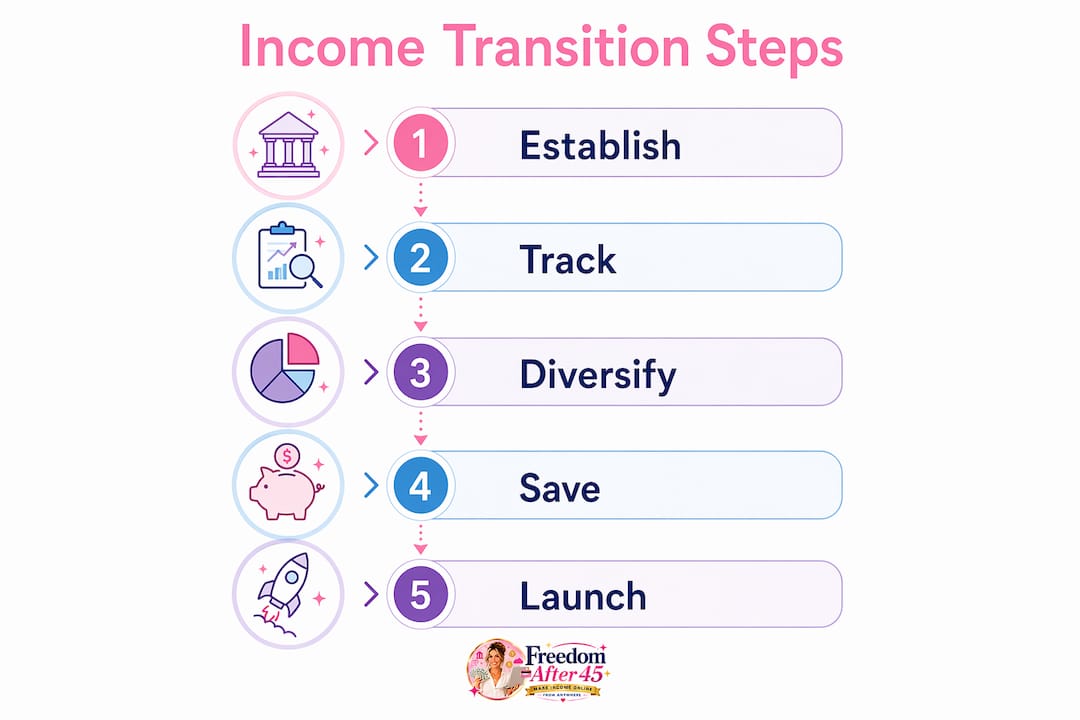
Here is why that 60% cap matters. If your top income source disappears, a platform changes its algorithm, or a client cancels, you still have two other streams covering the rest. Without that cap, one disruption can collapse your entire income.
Strong income stream combinations for this transition include:
- Freelancing or consulting: Direct service work that pays immediately and scales with your rates.
- Digital products: Ebooks, templates, or online courses that generate revenue without trading time for money.
- Affiliate marketing: Commissions earned by recommending products or services your audience already needs.
Each of these streams behaves differently. Freelancing income is active and predictable. Digital product income is passive and variable. Affiliate income sits in between. That mix is exactly what creates stability.
Pro Tip: Build your passive streams while you still have your day job income as a safety net. Launching a digital product or affiliate channel takes time to gain traction. Starting early means those streams are already producing by the time you make the transition.

Time management across multiple streams is where most people struggle. The solution is batching: dedicate specific days or time blocks to each stream rather than switching between them constantly. Burnout comes from context-switching, not from working hard.
What pitfalls derail the transition and how to avoid them
The data on failed transitions points to one pattern above all others. Research shows that 73% of failed transitions were linked to quitting after an exceptional one-time month. A single big month feels like proof. It is not.
Income consistency over at least six months is the real proof. A single spike, whether from a viral post, a one-time project, or a seasonal surge, does not reflect your sustainable earning power. Treat it as a bonus, not a baseline.
The other major pitfalls follow a clear pattern:
- Underpricing your services. Charging below market rates feels safe but creates a ceiling. Raising rates is harder once clients expect low prices.
- Ignoring the psychological shift. Leaving a stable paycheck triggers real anxiety. Budget for that emotionally, not just financially.
- Skipping professional pricing. Your rates must account for lost employer benefits, not just your time. Charge more than you think you should.
- Poor time boundaries. Without a schedule, side income work bleeds into every hour. Set fixed working blocks and protect them.
“Time management is the critical success differentiator. Setting realistic schedules to balance your current job with your side work is not optional. It is the discipline that separates people who make it from people who burn out before they get there.” — Josh Jones, Kapitus, via Inc.
At a certain income level, your day job stops being a safety net and starts being a growth limiter. Every hour spent at a job is an hour you cannot spend expanding your side income. Recognizing that inflection point is part of the transition.
How to calculate your true income needs before you quit
Most people underestimate what they actually need to earn. The number is not your take-home pay. It is your take-home pay multiplied by 1.5 to 2, to account for taxes, benefits, and business costs.
Here is the breakdown:
| Cost category | What to include |
|---|---|
| Self-employment tax | 15.3% on top of income tax obligations |
| Health insurance | Full premium cost, no employer subsidy |
| Retirement savings | SEP IRA or Solo 401(k) contributions |
| Business expenses | Software, tools, marketing, and equipment |
| Personal living costs | Rent, food, utilities, and debt payments |
Self-employment tax adds 15.3% on top of your regular income tax. That alone surprises most people. Add health insurance premiums, which can run several hundred dollars per month without an employer covering part of the cost, and the real income target climbs fast.
The 1.5x to 2x multiplier is not conservative. It is realistic income planning that accounts for income volatility, slow months, and unexpected expenses. Aiming for exactly your current salary leaves no margin.
Pro Tip: Save 25–30% of every dollar your side income generates, starting now. This covers your quarterly estimated tax payments and builds your reserve simultaneously. Keeping a separate business account makes this automatic.
Charging above your current hourly rate is not greed. It is math. Your rates must compensate for the benefits you no longer receive, including paid time off, employer retirement contributions, and health coverage. Charging more is how you maintain the same lifestyle on independent income.
Key Takeaways
Side income becomes sustainable primary income only when consistent revenue, a cash reserve, and diversified streams are all in place before you quit your day job.
| Point | Details |
|---|---|
| Income consistency threshold | Side income must cover 50–75% of take-home pay for at least 3 consecutive months. |
| Cash reserve requirement | Maintain 6–12 months of liquid savings before leaving your job. |
| Diversify income streams | Build at least 3 streams with no single source exceeding 60% of total revenue. |
| True income target | Multiply your monthly expenses by 1.5 to 2 to account for taxes, benefits, and business costs. |
| Avoid premature quitting | Use a 6-month rolling average, not a single big month, to judge readiness. |
What I have learned watching this transition up close
The financial math is the easier part. The harder part is the identity shift.
Most people who struggle with this transition are not struggling because the income is not there. They are struggling because they have spent decades measuring their worth by a job title and a paycheck that arrives on schedule. Letting go of that certainty is genuinely difficult, and pretending otherwise does not help anyone.
What I have seen work, consistently, is treating the transition as a business decision rather than an emotional leap. That means setting a specific income target, a specific savings number, and a specific date range. Not “when it feels right.” A real date tied to real numbers.
The income variability in the early months is real. Some months will be strong. Others will be thin. The people who make it through are the ones who saved aggressively during the strong months instead of spending up to their new income level. Reinvesting a portion of every good month back into the business, whether that means better tools, more marketing, or new skills, compounds faster than most people expect.
The other thing I would tell anyone at this stage: raise your rates before you quit, not after. It is far easier to price correctly while you still have a salary backing you up. Once the pressure is on, discounting feels tempting, and that is exactly the wrong move.
— Freedom After 45
A structured path to full-time online income
Building a sustainable income from side work requires more than good ideas. It requires a repeatable system that fits into real life, not a 12-hour grind.

Freedom After 45 was built for exactly this. The 2-Hour Workflow gives you a step-by-step blueprint for generating daily online income, without needing a social media following, an existing product, or prior experience. Women over 45 are using it to build income streams that range from $100 to $1,400 per day, working just two hours a day. If you are serious about making your side income your primary income, this is the system that removes the guesswork and replaces it with a proven process.
FAQ
How long does it take to turn side income into full-time income?
The average transition takes 18 to 24 months. Only 23% of people sustain full-time independent income beyond two years, which is why financial preparation matters as much as income growth.
What income level should I reach before quitting my job?
Your side income should consistently cover 50–75% of your current take-home pay for at least three consecutive months, backed by a 6–12 month cash reserve.
How many income streams do I need for a stable transition?
At least three independent income streams, with no single stream exceeding 60% of your total revenue. This reduces the risk of one disruption collapsing your entire income.
What taxes do I owe as a self-employed person?
Self-employment tax is 15.3% on top of your regular income tax obligations. Set aside 25–30% of every payment to cover quarterly estimated taxes and avoid a large bill at year end.
When does a day job start limiting income growth?
Once your side income reaches a level where time is the main constraint, every hour at your job is an hour you cannot spend growing your independent income. That is the signal that the transition is overdue.