

Why Most People Avoid Online Income: Key Barriers
Fear, not lack of opportunity, is the primary reason why most people avoid online income. Between 80% and 95% of individuals who attempt to earn online fail within the first year due to inconsistent effort and poor business model fit. That number is not a reflection of the opportunity being broken. It reflects how powerfully psychological and practical barriers shape behavior before a single dollar is earned. Understanding those barriers is the first step toward doing something about them.
Why most people avoid online income: the psychology behind it
Avoidance of online income is not laziness. It is a predictable response to two well-documented psychological forces: loss aversion and present bias. Loss aversion causes people to feel the pain of a potential loss more intensely than the pleasure of an equivalent gain. Present bias causes the brain to overvalue immediate comfort and undervalue long-term financial rewards, making the effort of starting feel not worth it.
The avoidance goes deeper than conscious thought. Financial avoidance is a nervous system response, as clinical therapist Andrea A. Smith explains. The amygdala, the brain’s threat detection center, treats financial uncertainty the same way it treats physical danger. The result is procrastination, distraction, and a strong pull toward familiar routines, all of which feel rational in the moment.

Women face an additional layer of pressure. Societal conditioning around money, risk, and visibility creates a specific pattern that explains why women avoid online income out of fear more often than men. Fear of making money is tied to concerns about judgment, changing relationships, and stepping outside culturally assigned roles. These are not abstract worries. They are real emotional weights that shape daily decisions.
Professionals face a different version of the same problem. Experienced professionals often avoid online income because entering beginner territory threatens their established identity and reputation. A senior manager or specialist who has spent decades building credibility does not want to be seen stumbling through a learning curve in public. That hesitation is risk management, not inability.
- Loss aversion makes potential losses feel twice as painful as equivalent gains feel good.
- Present bias causes people to choose comfort now over financial freedom later.
- The amygdala treats financial uncertainty as a physical threat, triggering avoidance.
- Women face societal pressure that ties money and visibility to social risk.
- Professionals protect their reputation by avoiding public beginner mistakes.
Pro Tip: Name the specific fear before trying to overcome it. “I am afraid of looking foolish online” is a workable problem. “I am just not ready” is not.
Why do most people quit before online income gets real?
The most common reason people quit is not failure. It is impatience. Most sustainable online business models require 6 to 18 months of consistent, unglamorous work before meaningful financial returns appear. That timeline is not a warning. It is simply how skill-based income works. The problem is that most people expect visible results within weeks.
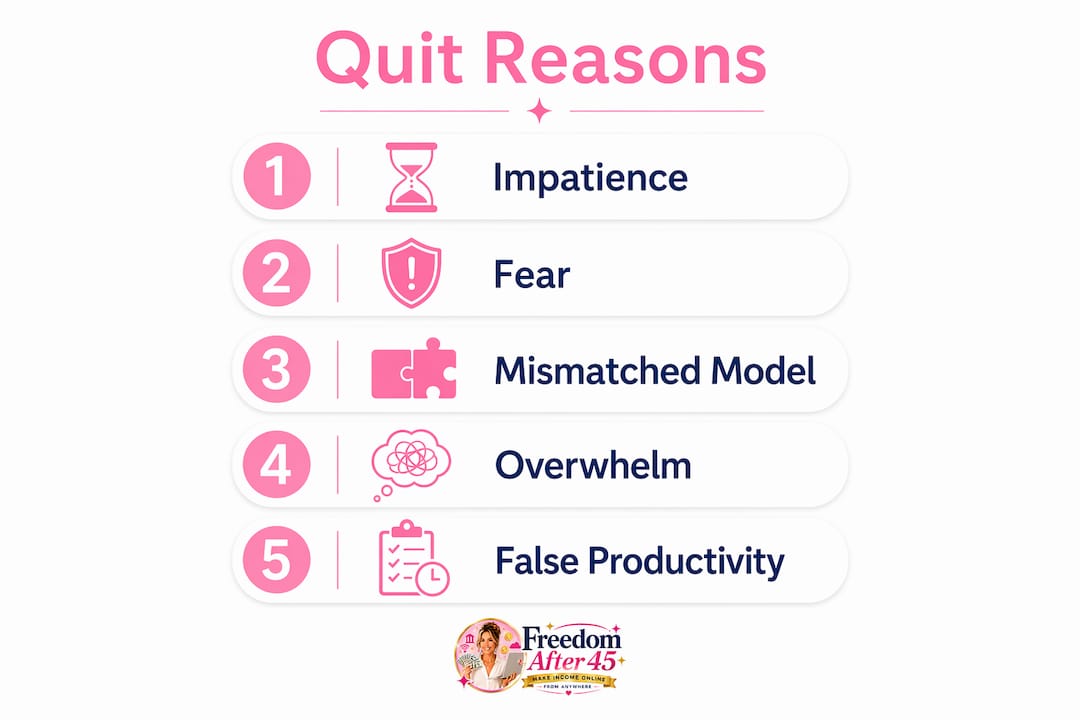
The critical drop-off zone is what practitioners call the “quiet period.” Most beginners quit during the 3 to 12 month window before momentum begins, because they interpret the absence of early results as proof that the method does not work. The timing is brutal. Growth in online income is rarely linear. It tends to be flat for months, then accelerates sharply. Most people leave right before the curve turns upward.
Several specific traps accelerate early quitting:
- Chasing shiny objects. Switching methods every few weeks resets the learning curve each time. No approach gets enough time to prove itself.
- Lacking a traffic strategy. Building a product, a blog, or a service without a clear plan for how people will find it is the single most common structural mistake.
- Comparing against unrealistic timelines. Social media highlights six-figure months without showing the 14 months of zero that came before them.
- Measuring the wrong metrics. Tracking follower counts instead of revenue-generating actions creates a false sense of progress or failure.
- Skipping fundamentals. The online business ecosystem encourages endless course buying and mindset work over focused execution on sales psychology and cash flow.
The fifth trap is particularly damaging because it feels productive. Buying another course, attending another webinar, and refining a business plan all create the sensation of forward motion. None of them generate income until paired with consistent, public-facing action.
Statistic to remember: The 80–95% failure rate in online income is not random. It clusters almost entirely in the first 12 months, among people who stopped before the quiet period ended.
How does personality mismatch cause burnout and avoidance?
Most popular online income advice assumes the person reading it is extroverted, comfortable with public self-promotion, and willing to build a personal brand through high-volume social media content. That assumption eliminates a large portion of the population before they even start. Online business advice often assumes extroverted, sales-driven personalities, which alienates introverts and those who value privacy, causing burnout and avoidance.
The mismatch creates a specific pattern. A person who values privacy reads advice telling them to post daily videos, build a personal brand, and cold-message strangers. They try it for two weeks, feel deeply uncomfortable, and stop. They do not conclude that the specific tactic was wrong for them. They conclude that online income is not for them. That is a costly generalization based on a poor strategy fit.
- High-volume social media content creation burns out privacy-oriented people quickly.
- Cold outreach and direct sales tactics feel invasive to introverts, causing avoidance.
- Public personal branding conflicts with professional identities people have spent years building.
- Perpetual preparation, buying courses, and refining plans without executing, becomes a comfortable substitute for action.
The alternative is not to force an extroverted approach. It is to find models that match how a person actually operates. Written content, email-based businesses, digital products, and affiliate structures all allow for meaningful income without requiring a performer’s personality. The key is recognizing that strategy mismatch is a solvable problem, not a character flaw.
Pro Tip: Before choosing an online income method, ask yourself: “Could I do this consistently for 12 months without it feeling like a performance?” If the honest answer is no, choose a different method.
What practical steps actually overcome the fear of starting?
The most effective way to overcome fear of online income is to reduce the size of the first decision. Fear grows when the commitment feels total and irreversible. Shrinking the initial action shrinks the fear proportionally.
- Choose one method and commit to it for at least six months. Affiliate marketing, digital products, freelance writing, and email-based businesses are all legitimate paths. Pick one based on your strengths, not on what promises the fastest results.
- Build a measurable system from week one. Track the specific actions that lead to income, such as content published, emails sent, and offers made, rather than tracking outcomes like revenue or traffic. Outcomes lag behind actions by months.
- Create small early wins deliberately. Earning $10 online for the first time is not trivial. It proves the mechanism works. That proof is worth more than any motivational content because it is personal evidence.
- Align the business model with your actual lifestyle. A person with two hours per day available needs a different model than someone with eight. Freedom After 45 is built around exactly this principle: a 2-hour daily workflow that generates real income without requiring a full-time schedule or prior experience.
- Treat the quiet period as a feature, not a bug. The 6 to 18 month ramp-up filters out people who are not serious. Staying in during that period is itself a competitive advantage.
Scam saturation also plays a role in why people distrust online income opportunities. The internet is full of exaggerated claims, which makes legitimate slower-growing paths look suspicious by comparison. The defense against this is specificity: look for methods with clear mechanics, real testimonials, and no promises of overnight results.
Key Takeaways
Fear and misaligned expectations, not lack of ability, are the primary reasons people avoid building online income.
| Point | Details |
|---|---|
| Psychology drives avoidance | Loss aversion and present bias cause people to choose immediate comfort over long-term financial gain. |
| The quiet period is real | Most people quit during the 3–12 month window right before meaningful growth begins. |
| Personality mismatch causes burnout | Strategies built for extroverts alienate introverts and privacy-valuing people, leading to early dropout. |
| Small wins build real confidence | Earning a small amount early proves the model works and reduces fear more than any motivational content. |
| Scam saturation creates distrust | Legitimate slow-growth paths get dismissed because they sit next to exaggerated claims in the same space. |
What I have learned from watching people stop just short of success
The pattern I see most often is not dramatic failure. It is quiet stopping. Someone spends three months building something real, sees no significant results yet, and concludes the whole thing was a mistake. They walk away from a process that was working, just not fast enough to feel like it was working.
The emotional pressure behind that decision is real and understandable. Societal expectations, especially for women over 45, create a narrow window for what counts as a “reasonable” financial risk. Stepping outside that window requires tolerating discomfort that most people around you will not validate. Your family may be skeptical. Your friends may not understand what you are building. That isolation is part of the cost of doing something new.
What actually separates people who build online income from those who do not is not talent or technical skill. It is the willingness to stay in the quiet period long enough for the work to compound. Mindset adjustments matter, but only when they are paired with consistent, specific action. Inspiration without a repeatable system produces motivation that fades by Thursday.
The people I have seen succeed are not the most confident or the most experienced. They are the ones who treated early discomfort as information rather than as a verdict. That shift in interpretation changes everything.
— Freedom After 45
A proven workflow for women ready to move past fear
Knowing why the fear exists is useful. Having a system that works around it is better. Freedom After 45 was built specifically for women over 45 who want real daily income without needing a large social following, a product, or a full-time schedule.

The 2-Hour Workflow at earningdaily.net teaches you how to earn 100% profit online daily using a step-by-step blueprint that thousands of families have already used to build consistent income. It is designed for people who are starting from zero, value their privacy, and need a model that fits around real life. No performance required. No prior experience needed. Just a clear system and two hours a day.
FAQ
Why do most people fail at online income?
Between 80% and 95% of people attempting online income fail due to inconsistent effort and poor business model fit. Most quit during the first 3–12 months, right before growth accelerates.
How long does it take to make real money online?
Most legitimate online income models require 6 to 18 months of consistent work before meaningful financial returns appear. Early results are typically small and slow, which is normal.
Why do women specifically fear starting online income?
Women face societal pressures that link money, visibility, and risk to social consequences, including judgment and changing relationships. These fears are real and well-documented, not a sign of weakness.
Is online income a scam?
Scam saturation in the online space creates justified skepticism, but legitimate paths exist. The key distinction is that real methods have clear mechanics, no overnight promises, and verifiable results.
What is the best first step to overcome fear of online income?
Choose one method aligned with your strengths and commit to it for at least six months. Track your actions, not your outcomes, and treat your first small earning as proof the model works.