

What Is a Recurring Daily Income Stream?
A recurring daily income stream is income earned on a repeating schedule with daily or near-daily payouts, generated through subscriptions, memberships, or platforms designed for frequent payments. The formal industry term for the underlying mechanism is recurring revenue, defined as contractual, scheduled payments collected automatically through stored billing methods. What makes this concept powerful for individuals seeking financial freedom is the combination of two things: a business model that generates repeat payments and a payout structure that delivers cash frequently. Platforms like Stripe, PayPal, and gig apps such as DoorDash and Uber have made both sides of that equation accessible to anyone willing to put in the initial work. Freedom After 45 was built around exactly this idea: that ordinary people can create reliable daily cash flow without a product, a following, or a finance degree.
What is a recurring daily income stream, exactly?
A recurring daily income stream combines two distinct concepts that are often confused: recurring revenue and daily payout frequency. Understanding the difference between them is the foundation of building something that actually works.
Recurring revenue is predictable income earned on a repeating schedule under an active subscription or contract. The key word is contractual. A customer agrees to pay on a fixed schedule, and an automated billing system collects that payment without you chasing anyone down. This is what separates a subscription business from a store that happens to have loyal repeat buyers.
Daily income, on the other hand, refers to the payout cadence, meaning how often money actually lands in your account. These two things are separate by design, but they can be combined. A freelancer using Upwork can complete micro-tasks and request same-day payment. A creator selling a digital membership on Patreon collects monthly subscription fees but can withdraw earnings daily. The business model and the payout frequency are independent levers you control.
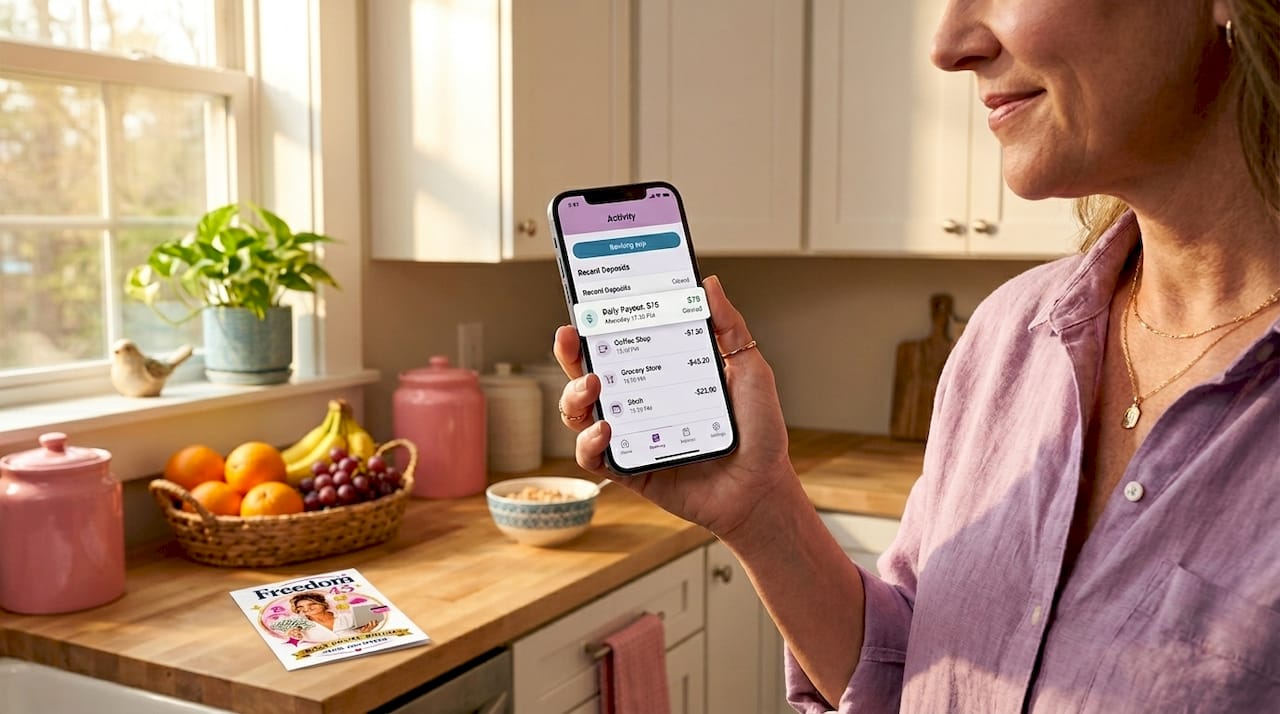
The practical takeaway: you do not need a traditional subscription business to experience daily cash flow. You need a model that generates repeat demand and a payment platform that releases funds frequently.
How does recurring income differ from one-off and reoccurring income?
Most people treat “recurring” and “reoccurring” as the same word. They are not, and the distinction has real financial consequences.
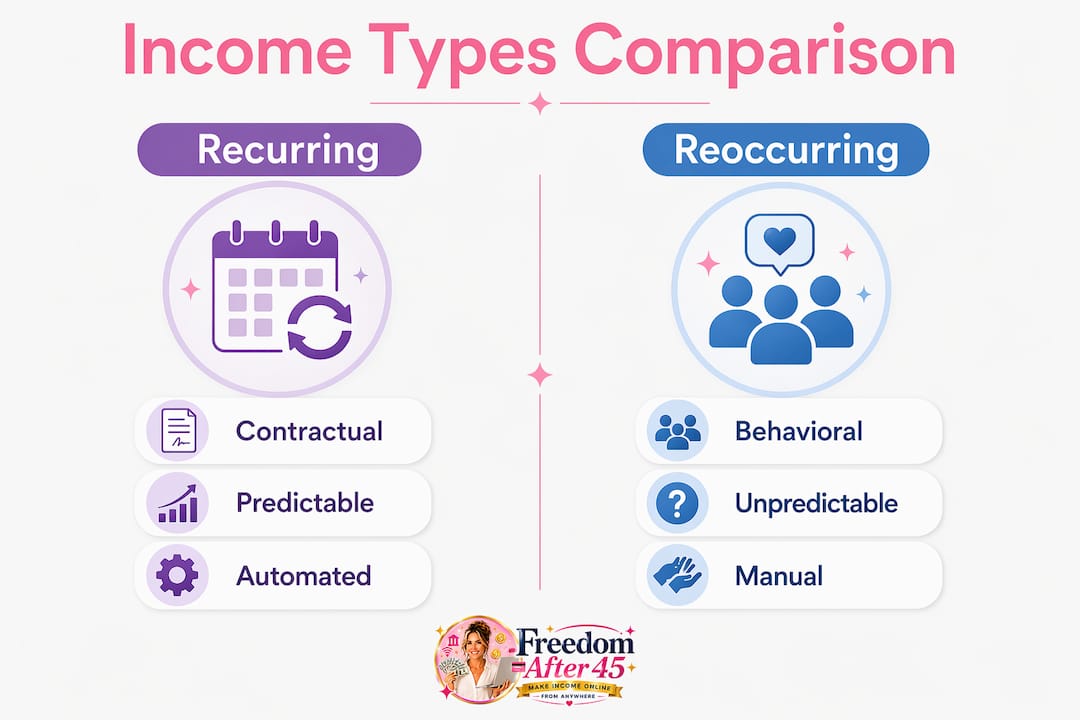
Recurring income is contractual. A customer signs up for a monthly software plan, a fitness membership, or a weekly meal kit delivery. The payment happens automatically on a fixed date. True recurring revenue involves scheduled payments that enable reliable income forecasting, unlike variable reoccurring behavior. You can predict next month’s revenue with reasonable accuracy.
Reoccurring income is behavioral. A customer buys from you repeatedly, but there is no contract and no automatic billing. They might come back next month or they might not. An Etsy shop with loyal buyers generates reoccurring income, not recurring income. The difference matters enormously when you are trying to plan your finances.
One-off income is a single transaction with no expectation of repeat payment. A freelance project, a garage sale, a one-time consulting call. High effort, low compounding value.
| Income Type | Contract | Predictability | Example |
|---|---|---|---|
| Recurring | Yes | High | SaaS subscription, membership site |
| Reoccurring | No | Medium | Repeat Etsy buyer, loyal coffee shop customer |
| One-off | No | None | Single freelance project, one-time sale |
Pro Tip: If you want to convert reoccurring buyers into recurring revenue, offer a subscription option at checkout. Even a small discount for committing to a monthly plan shifts unpredictable repeat behavior into contractual, forecastable income.
The operational difference is also significant. Recurring income runs on automation. Reoccurring income requires you to keep showing up and re-earning the sale every time.
How can you create daily or near-daily cash flow?
Building daily income opportunities does not require a complex business. Several proven models deliver frequent payouts with relatively low startup barriers.
- Gig and delivery platforms. Apps like DoorDash, Instacart, and Uber offer instant or next-day payouts for flexible work schedules. This is the fastest path to literal daily income, though it trades time for money rather than building a scalable asset.
- Subscription and membership models. Platforms like Patreon, Substack, and Teachable let you charge weekly or monthly fees for content, coaching, or community access. You create the product once and earn repeated payments as customers stay subscribed. The payout frequency depends on the platform, but most allow frequent withdrawals.
- Digital products with recurring licensing. Selling templates, presets, or software tools through platforms like Gumroad or Lemon Squeezy can generate daily sales with zero inventory. Pair this with an affiliate program and your buyers become your sales force.
- Micro-tasking and freelance work. Sites like Fiverr and Upwork allow quick payment release on completed work. Stacking multiple small projects daily creates a cash flow pattern that feels like daily income even without a formal subscription model.
- Dividend and interest income. iShares and similar investment platforms note that income investing strategies create recurring income through dividends and bond interest. This is less entrepreneurial and requires capital upfront, but it compounds over time.
Pro Tip: Combine a fast-payout gig for immediate daily cash with a subscription product you build in parallel. The gig covers your short-term needs while the subscription compounds into a scalable asset over months.
The most durable daily income models are the ones that separate your time from your earnings. Gig work pays daily but scales poorly. Subscriptions scale well but pay less frequently. The smart move is to use both strategically.
What operational challenges should you plan for?
Setting up a recurring income model is the easy part. Keeping it running and growing is where most people underestimate the work required.
- Retention is your primary metric. Daily reliable income depends on retention and automation more than high signup volume. One hundred subscribers who stay for a year are worth far more than five hundred who cancel after a month. Focus your energy on delivering consistent value, not just acquiring new customers.
- Failed payments destroy more revenue than you think. Collected recurring revenue can differ significantly from billed revenue due to failed payments. A card expires, a bank flags a charge, a customer’s account runs low. Implementing automatic retry logic through tools like Stripe’s Smart Retries or Chargebee’s dunning management recovers a meaningful percentage of that lost revenue without any new customer acquisition.
- Align your offer with an ongoing need. The most profitable recurring income offerings align with ongoing customer needs and straightforward onboarding. A one-time problem gets solved once. An ongoing problem gets paid for every month. Ask yourself: does my customer need this next month as much as they need it today?
- Automate billing and delivery from day one. Manual invoicing and manual delivery are the enemies of scale. Tools like Stripe, Recurly, and ThriveCart handle billing automatically. Platforms like Kajabi and Podia deliver digital content without your involvement. The goal is a system that earns while you sleep.
- Set realistic expectations for the ramp-up period. Most subscription models take three to six months to generate meaningful daily cash flow. Plan for that gap. Use gig work or freelance income to cover expenses while your recurring base grows.
Pro Tip: Review your churn rate monthly, not quarterly. A 5% monthly churn rate means you lose more than half your subscribers in a year. Catching that early and fixing the underlying value gap saves the business.
How to start building your recurring income stream today
The barrier to starting is lower than most people assume. These steps are ordered by speed to first dollar.
- Start with a fast-payout gig. Sign up for DoorDash, TaskRabbit, or Instacart this week. This creates immediate daily cash flow while you build something more scalable in the background.
- Identify one repeatable skill or piece of knowledge. What do people ask you for help with regularly? That is your subscription product. It could be a weekly newsletter, a monthly coaching call, or a template library.
- Choose a billing platform. Stripe and PayPal handle subscriptions for free until you earn revenue. Patreon and Substack take a percentage but handle everything including hosting, billing, and delivery.
- Build a simple onboarding experience. The first 48 hours after a customer subscribes determine whether they stay. Send a welcome email, deliver immediate value, and make the next step obvious.
- Set a 90-day cash flow target. Define what daily income means to you specifically. Is it $50 a day? $200? Work backward from that number to understand how many subscribers or gig hours you need.
| Starting Method | Time to First Payment | Scalability | Upfront Cost |
|---|---|---|---|
| Gig app (DoorDash, Instacart) | Same day | Low | None |
| Freelance micro-tasks (Fiverr) | 1 to 3 days | Medium | None |
| Digital subscription (Patreon) | 1 to 4 weeks | High | Low |
| Digital product (Gumroad) | Days to weeks | High | Low |
The pattern across every successful daily income model is the same: start fast, systematize early, and optimize for retention over acquisition.
Key takeaways
A recurring daily income stream works best when you combine a contractual subscription model with a fast-payout platform or gig source, then automate billing and retention from the start.
| Point | Details |
|---|---|
| Recurring vs. reoccurring | Recurring income is contractual and automated; reoccurring income is behavioral and unpredictable. |
| Daily payout mechanics | Gig apps like DoorDash and Instacart pay daily; subscription platforms allow frequent withdrawals. |
| Retention over acquisition | Keeping existing subscribers active generates more revenue than constantly signing up new ones. |
| Failed payment recovery | Automatic retry tools like Stripe Smart Retries recover lost revenue without new customer costs. |
| Low-barrier starting point | Gig work provides immediate daily cash while a subscription model builds in the background. |
The uncomfortable truth about “daily income” that most guides skip
Here is what I have seen consistently at Freedom After 45: most people who chase daily income focus entirely on the payout frequency and ignore the business model underneath it. They sign up for three gig apps, earn $80 on day one, and call it a recurring income stream. It is not. It is a job with a flexible schedule.
A real recurring daily income stream requires a system that generates demand without your constant presence. That takes longer to build than a week, and it requires you to solve a problem people will keep paying to have solved. The subscription economy has proven this works at every scale, from solo creators on Substack earning $3,000 a month to SaaS companies valued at billions.
The misconception I push back on hardest is the idea that passive income means zero effort. What it actually means is front-loaded effort. You work hard once to build the system, then you work consistently to maintain retention and improve the offer. The daily income part comes after that foundation is solid.
What I respect about the Freedom After 45 approach is that it does not pretend otherwise. The 2-Hour Workflow is not a magic button. It is a structured method for doing the right work in the right order so the system compounds over time. That is the honest version of daily recurring income, and it is the only version that lasts.
— Freedom After 45
Start building your daily income system with Freedom After 45
If you have read this far, you already understand more about recurring income than most people who try to build it. The next step is putting a working system in place.

Freedom After 45 offers a 2-Hour Workflow blueprint built specifically for people who want to generate $100 to $1,400 in daily online profit without a product, a social media following, or prior experience. The program walks you through each step in order, from choosing your model to automating your billing and delivery. Thousands of families have already used this system to move from financial stress to consistent daily cash flow. The method is designed for real people with real schedules, not full-time entrepreneurs with unlimited hours.
FAQ
What is a recurring daily income stream in simple terms?
A recurring daily income stream is money earned on a repeating schedule with frequent or daily payouts, typically through subscriptions, memberships, or gig platforms that release funds quickly. The income repeats because of a contractual or systematic payment model, not just customer habit.
How is recurring income different from passive income?
Passive income is money earned with little continuous effort after an upfront investment, such as rental property or digital products. Recurring income is specifically structured around scheduled, repeating payments. All passive income can become recurring, but not all recurring income is passive.
Which platforms pay daily for gig work?
DoorDash, Instacart, Uber, and TaskRabbit all offer instant or next-day deposit options for completed work. These platforms are the fastest way to generate literal daily income without building a subscription model first.
How many subscribers do I need to earn $100 a day from a subscription?
At a $10 monthly subscription price, you need roughly 300 active subscribers to average $100 per day. Reducing churn and recovering failed payments through tools like Stripe Smart Retries directly increases that number without adding new customers.
Can I build a recurring income stream with no money upfront?
Yes. Platforms like Patreon, Substack, and Fiverr charge no upfront fees and take a percentage of revenue only after you earn. Gig apps like DoorDash require no investment beyond a vehicle and a smartphone, making them genuinely zero-cost entry points to daily income.