

What Is a Daily Income Workflow? A Practical Guide
A daily income workflow is a structured routine that breaks your workday into purposeful blocks to systematically generate, track, and manage income. Unlike a general to-do list, this system treats income production as a repeatable process with defined phases, timing, and financial rules. Tools like Make.com and Buffer, financial frameworks like the three-bucket cash method, and time-blocking techniques all play a role. Freedom After 45 built its entire 2-Hour Workflow blueprint around this concept, and thousands of women over 45 have used it to create consistent daily income without needing a product, a following, or prior experience.
What is a daily income workflow and why does it matter?
A daily income workflow is a deliberate daily routine that converts income goals into specific, repeatable actions. The key word is repeatable. Most people approach income generation reactively, working on whatever feels urgent. A workflow flips that. It assigns each type of work to a defined time block, so income-producing tasks get protected time every single day.
The practical benefit is significant. When you follow a structured income workflow process, you reduce decision fatigue, avoid context-switching, and make progress on revenue-generating work before the day gets away from you. Effective income management starts with knowing exactly what you will do, when, and why.

This matters especially for people in the 35–65 age range who are building income streams alongside existing responsibilities. A workflow does not require 8-hour days. It requires intention and sequence. The structure itself does the heavy lifting.
What are the core components of an effective daily income workflow?
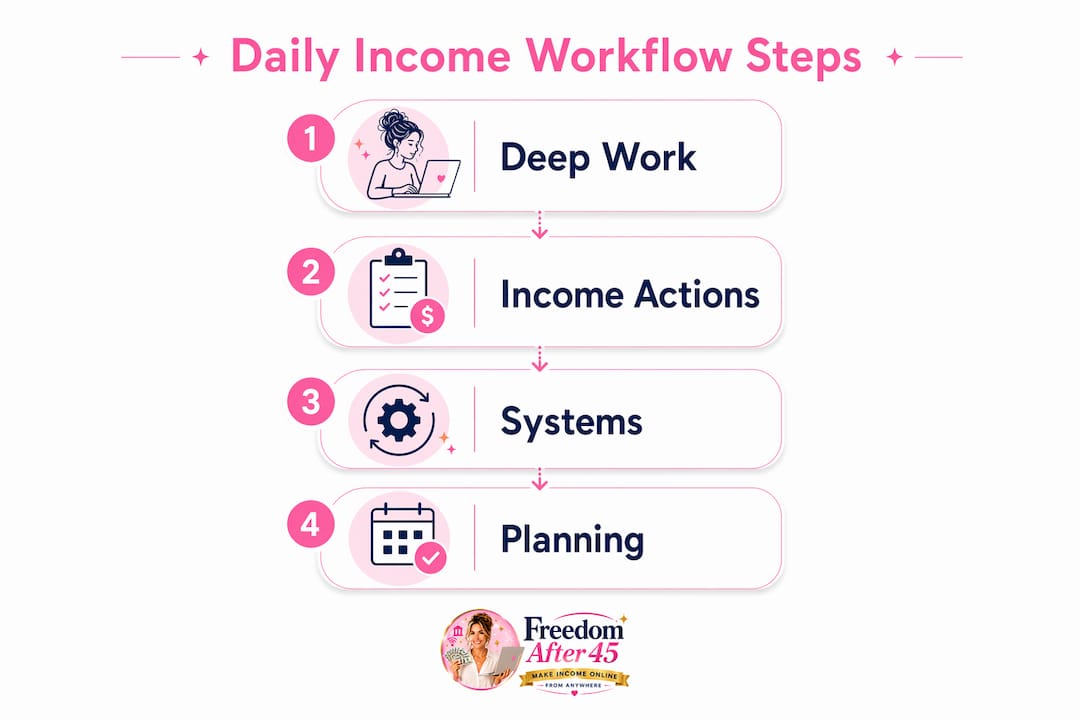
A well-structured daily workflow organizes your day into four main blocks. Each block has a specific purpose, and the sequence matters as much as the timing.
- Deep Work (approximately 90 minutes). This is your highest-focus block. You write, create, build, or solve problems that require your full attention. Schedule this block during your peak energy window, typically morning for most people.
- Income-Producing Actions (60–90 minutes). This block covers tasks that directly generate revenue: publishing content, sending outreach emails, completing client deliverables, or posting affiliate promotions. No research, no tutorials, no busywork during this window.
- Systems and Optimization (45–60 minutes). This is where you check analytics, respond to messages, update your tools, and handle the operational side of your income streams. It keeps the machine running without letting it eat your creative time.
- Planning (approximately 30 minutes). End your day by reviewing what happened and setting tomorrow’s priorities. This 30-minute block prevents the “where do I start?” paralysis that kills momentum.
The sequence is not arbitrary. Deep work comes first because it requires the most mental energy. Income actions follow while you are still sharp. Systems work handles itself in the afternoon. Planning closes the loop.
Pro Tip: Identify your personal peak energy window by tracking your focus quality for one week. Most people have a 90-minute window of peak clarity. Guard it for deep work only, and your output will improve noticeably.
Not every task happens every day. Creative output, admin, and marketing have different energy and timing needs. Weekly reconciliations and periodic planning sessions maintain consistency without burning you out. The workflow accommodates this naturally when you build it with cadence in mind.
How can automation tools support your daily income workflow?
Automation removes the manual assembly work that wastes your first hour every morning. A scheduled scenario in Make.com runs at 6 AM and delivers a single daily briefing via Slack or email. That briefing pulls together your calendar events, task list, revenue snapshots, and social media queue into one place.
The result is concrete. Automation eliminates 20–30 minutes of manual prep and context-switching before your day even starts. Those minutes compound. Over a month, that is roughly 10 hours returned to income-producing work.
Here is how to build a basic automated daily digest:
- Connect your calendar. Pull in the day’s appointments so you know your available blocks before you start.
- Add your task manager. Tools like Todoist or Notion can feed your top priorities directly into the briefing.
- Include a revenue snapshot. Connect your payment platform (Stripe, PayPal, or a similar tool) to show yesterday’s earnings and current totals.
- Attach your social queue. Buffer or a similar scheduling tool shows what content is going out today, so you do not need to log in separately.
- Set the delivery time. Schedule the briefing 15–30 minutes before your deep work block starts. You read it once, then close it and work.
Automated daily briefs consolidate all of this into one format, delivered on schedule before work starts. The cognitive benefit is real. You enter your deep work block already oriented, not scrambling to remember what you were doing yesterday.
Pro Tip: Start with just two data sources in your automated brief, your calendar and your revenue snapshot. Add more only after the habit is solid. Complexity kills consistency.
The most common pitfall is over-engineering the automation before you have a stable workflow. Build the routine first, then automate the parts that are already working.
What financial management strategies enhance the daily income workflow?
Daily financial planning is not optional when your income is irregular. The three-bucket approach is the most practical system for managing cash flow as an independent earner.
| Bucket | Purpose | Typical Allocation |
|---|---|---|
| Operating | Day-to-day business expenses | Remaining after other splits |
| Taxes and Reserve | Tax obligations and emergency buffer | 25–30% of each deposit |
| Owner Pay | Your personal income | Fixed monthly transfer |
On every deposit, a fixed percentage goes immediately to taxes and reserves. The remainder stays in operating. On the first of each month, a fixed salary amount transfers to your personal account. This creates the feeling of a paycheck even when your income varies week to week.
The safe-to-spend calculation is the daily financial habit that ties this together. You look at your operating balance, subtract upcoming obligations for the next 14 days, and the remainder is what you can actually spend. This prevents the common mistake of spending a large deposit before realizing a big expense is coming.
A separate income buffer account smooths out feast-or-famine cycles. Sales go to business checking first. After the tax split, the remainder flows into the buffer. Your fixed salary draws from the buffer, not directly from sales. This means a slow week does not immediately affect your personal finances.
Practical daily income tracking tips for this system:
- Check your operating balance every morning during your systems block.
- Run a 14-day cash runway calculation every Monday.
- Never spend from a deposit before completing the bucket split.
- Review your owner pay amount quarterly and adjust based on average monthly revenue.
Clear divisions between cleared cash, obligations, and reserves allow accurate safe-to-spend calculations. This is not complex accounting. It is a simple discipline that removes the anxiety of not knowing where you stand.
How does income timing affect your daily workflow?
Income you see today is almost always the result of work you did days, weeks, or months ago. Affiliate commissions and digital product sales appearing in your account today come from content you published earlier. This is one of the most important things to understand about daily income strategies.
The practical implication is that your workflow must serve two separate goals at the same time. You are managing current income while building future income. These are different tasks, and mixing them without structure leads to inefficiency.
The workflow distinction that matters most is between income events and pipeline inputs:
- Income events are tasks tied to money arriving now: fulfilling orders, responding to buyer inquiries, posting promotions to an existing audience.
- Pipeline inputs are tasks that build future income: writing new content, growing an email list, testing a new offer, building an affiliate relationship.
Both belong in your daily workflow. Income events typically fit in the income-producing actions block. Pipeline inputs belong in deep work. When you time-block both deliberately, you avoid the trap of only doing one or the other.
Motivation is easier to maintain when you understand this timing dynamic. A quiet revenue day does not mean the work is not working. It means the pipeline inputs from last week have not converted yet. Tracking both types of activity separately gives you a clearer picture of your actual progress.
Key Takeaways
A daily income workflow works because it separates high-value creation time from operational tasks, pairs that structure with automated briefings, and protects income stability through disciplined cash allocation.
| Point | Details |
|---|---|
| Four-block structure | Organize each day into deep work, income actions, systems, and planning for consistent output. |
| Automation saves time | Tools like Make.com eliminate 20–30 minutes of morning admin and speed up your start. |
| Three-bucket cash method | Split every deposit into operating, taxes/reserve, and owner pay to manage irregular income. |
| Income timing awareness | Today’s revenue reflects past work; balance pipeline-building with income realization daily. |
| Safe-to-spend discipline | Calculate available cash against 14-day obligations every week to avoid cash shortfalls. |
What I have learned building daily income workflows
The biggest mistake I see is treating the workflow as a schedule rather than a system. A schedule tells you when to work. A system tells you what kind of work to do and why it belongs in that slot. That distinction changes everything.
Most people who struggle with daily income strategies are not lazy. They are unfocused. They spend their best morning hours on email, social media, or research, and then wonder why their income is not growing. The workflow fixes this by making income-producing actions non-negotiable before anything else gets attention.
Automation is where I see the biggest return for the least effort. Spending 2 hours setting up a Make.com briefing scenario pays back that time within the first week. The mental clarity of starting your day already oriented, rather than piecing together your priorities from five different apps, is genuinely underrated.
The financial discipline piece is the one most people skip, and it is the one that creates the most stress. Irregular income feels chaotic until you build the bucket system. Once you do, a slow week stops feeling like a crisis. You know exactly where you stand, and that confidence changes how you work.
My honest advice: start with the four-block structure for two weeks before adding automation or financial systems. Get the rhythm right first. Then layer in the tools. The workflow should fit your life, not the other way around.
— Freedom After 45
A proven system for building your daily income workflow
Freedom After 45 built the 2-Hour Workflow blueprint specifically for women over 45 who want structured, repeatable daily income without needing a product, a large following, or prior experience. The program covers the four-block workflow structure, automation setup, and cash flow management in a step-by-step format that removes the guesswork.

Thousands of families have used this system to create consistent daily income ranging from $100 to $1,400 per day with just two hours of focused work. The 2-Hour Workflow is designed to be accessible from day one, with no technical background required. If you are ready to build a daily income process that actually holds up over time, this is where to start.
FAQ
What is a daily income workflow in simple terms?
A daily income workflow is a structured routine that divides your workday into specific blocks for creation, income-producing tasks, systems management, and planning. It turns income goals into repeatable daily actions rather than random effort.
How long does a daily income workflow take each day?
The core four-block structure runs approximately 4–5 hours total, covering deep work, income actions, systems, and planning. Freedom After 45’s 2-Hour Workflow compresses the highest-impact elements into a focused two-hour daily commitment.
What tools do I need to automate my daily income workflow?
Make.com handles automated daily briefings by pulling calendar, task, revenue, and social data into one morning digest. Buffer manages social media scheduling, and a simple three-account bank setup handles cash flow management.
How do I manage irregular income with a daily workflow?
Split every deposit into three buckets: operating expenses, taxes and reserves (25–30%), and owner pay. Transfer a fixed salary to your personal account on the first of each month to create income stability regardless of weekly fluctuations.
Why does my daily income not reflect today’s work?
Affiliate commissions and digital product sales typically reflect content or outreach completed days or weeks earlier. Your daily workflow must balance pipeline-building tasks that create future income with income events that manage current revenue.