

What Does Passive Income Mean for Students?
Passive income is money earned with little to no daily effort after an upfront investment of time, money, or both. For students, understanding passive income means recognizing a fundamental difference from active income: you stop trading hours for dollars. Instead, you build an asset once and collect returns repeatedly. That distinction matters enormously when your schedule is already packed with classes, assignments, and part-time work. Passive income gives students a financial buffer and a head start on long-term wealth building that most people don’t attempt until their 30s or 40s.
What does passive income mean for students, exactly?
Passive income is defined by the IRS and financial professionals as earnings from a trade or business in which the earner does not materially participate on a regular basis. In plain terms, it means money that flows in without requiring your constant attention. Active income stops the moment you stop working. Passive income keeps arriving whether you are studying for finals or sleeping.
The key distinction students often miss is that passive income requires upfront effort during ideation, creation, and setup phases. That effort is front-loaded, not eliminated. A student who spends three weekends building a set of study guides and uploading them to a digital marketplace has done the hard work. After that, every sale generates income without additional labor.

Residual income is a related but different concept. Residual income refers to discretionary funds left after meeting financial obligations, while passive income refers specifically to asset returns. Students who understand this difference prioritize building income-generating assets first, then enjoy the residual cash flow those assets produce.
What are common passive income ideas for students?
Students have more options than most realize. The best starting points combine low capital requirements with skills already developed in an academic setting.
Investment-based streams:
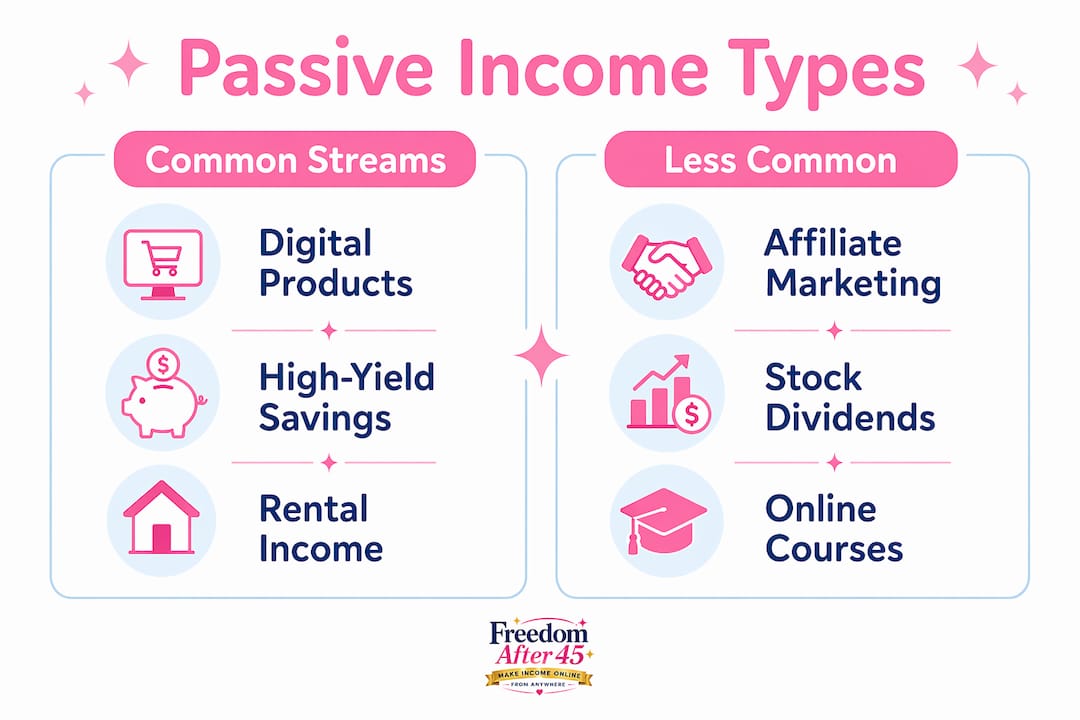
- High-yield savings accounts (HYSAs): HYSAs offer 4–5% returns with opening deposits as low as $1 and can be set up online in under 20 minutes. This is the most passive option available. Money sits, earns interest, and requires zero maintenance.
- Dividend investing: Zero-minimum brokerage accounts through platforms like Fidelity or Robinhood let students start investing in dividend-paying stocks without any upfront capital requirement. Starting early compounds returns over time.
Digital asset streams:
- Selling digital products: Study notes, course templates, flashcard decks, and e-books sell well on platforms like Etsy and Gumroad. Niche-focused assets outperform generic ones. A study guide tailored to a specific college course sells far better than a generic “how to study” PDF.
- Affiliate marketing: Students with a blog, YouTube channel, or social media presence can earn commissions by linking to products they already use. The income is semi-passive because content needs occasional updates, but a well-ranked post can generate commissions for years.
- Content creation: YouTube and podcast content can earn ad revenue and sponsorships over time. This is semi-passive at best. Videos and episodes require production effort, but older content continues earning long after publication.
What students typically skip: Rental income is a legitimate passive income stream, but it requires property ownership or subletting arrangements that most students cannot access. It is worth knowing about for future planning, not immediate action.
How much can students realistically earn, and what effort is involved?
Monthly passive income for students ranges from $100 to $5,000 depending on the method chosen and the scale built over time. That range is wide because the effort and timeline vary dramatically by approach. A student earning $100 per month from a HYSA and a few digital product sales is not in the same category as someone running a monetized YouTube channel with 50,000 subscribers.
Passive income exists on a spectrum, not as a binary state. A high-yield savings account is nearly fully passive once funded. Digital products sit in the middle: they require creation upfront and periodic maintenance such as SEO updates and product refreshes to sustain sales. Content creation sits closer to the active end until an audience is established. Students often underestimate the maintenance workload compared to the initial creation phase. That gap between expectation and reality is where most beginners quit.
Building niche authority or a consistent audience typically takes several months of consistent effort. A student who starts a digital product store in september and expects significant income by october will be disappointed. One who commits to consistent uploads or product additions for six months has a realistic shot at meaningful recurring revenue.
Pro Tip: Track your time investment per income stream for the first 90 days. This tells you your effective hourly rate and helps you decide which stream deserves more attention.
How can students start building passive income with little capital?
Starting with one product, one platform, and one audience is the most effective approach for busy students. Spreading effort across five platforms simultaneously produces weak results on all of them. Focus compounds faster than diversification at the beginning.
Here is a practical starting sequence:
- Audit your existing assets. Review your lecture notes, past assignments, templates, and study systems. These are already created and can be packaged into sellable digital products with minimal additional work.
- Choose one platform. Etsy works well for visual templates and study guides. Gumroad suits e-books and digital downloads. Pick one and learn it fully before adding another.
- Open a HYSA or brokerage account. A HYSA takes under 20 minutes to open online. Deposit whatever you can, even $25. The habit of saving into a yield-bearing account matters more than the initial amount.
- Set a 90-day goal. Aim for your first $50 in passive income within 90 days. That target is achievable and builds the confidence to scale.
- Plan for taxes from day one. Passive income taxes are not withheld automatically, and practitioners recommend setting aside 20–30% of earnings into a separate savings account. A surprise tax bill in april can wipe out months of progress.
- Integrate the work into your existing schedule. Experts recommend building passive income activities into academic routines rather than treating them as separate projects. Spend 30 minutes after your Tuesday lecture updating your Etsy listings. Consistency beats intensity.
Pro Tip: Niche-focused digital content outperforms broad generic assets. A study guide for “Organic Chemistry 101 at large state universities” will outsell a generic “chemistry notes” PDF every time.
What are the real benefits and challenges of passive income for students?
Benefits:
- Financial buffer: Passive income diversifies earnings beyond traditional wages and reduces financial stress during slow periods, unexpected expenses, or between jobs.
- Time freedom: Once a stream is established, it generates income without requiring your presence. That frees up hours for studying, internships, or rest.
- Long-term wealth building: Starting at 20 instead of 35 gives passive income streams 15 extra years to compound. The math on that difference is significant.
- Skill development: Building a digital product or affiliate site teaches marketing, writing, SEO, and financial management. These skills pay dividends in any career.
Challenges:
- Delayed gratification: Most passive income streams take months to produce meaningful returns. Students who expect fast results drop out before the income materializes.
- Upfront effort: The “passive” label is misleading for beginners. Every stream requires real work to build.
- Maintenance requirements: Digital products need updates. Affiliate links go stale. Investment accounts need monitoring. None of these are set-and-forget forever.
- Tax complexity: Setting aside a dedicated tax fund is not optional. Ignoring taxes on passive income creates financial problems that undo the benefits.
The biggest misconception students carry is that passive income is a get-rich-quick path. It is not. Passive income is a financial buffer, not a lottery ticket. Students who treat it as a slow, steady wealth-building tool succeed. Those who expect overnight results burn out and quit.
Key Takeaways
Passive income for students is a real, accessible wealth-building tool that requires upfront effort, consistent maintenance, and realistic expectations to produce lasting results.
| Point | Details |
|---|---|
| Core definition | Passive income is earned after upfront work or investment, not from ongoing daily labor. |
| Best starting points | HYSAs, digital product sales, and dividend investing suit students with limited capital. |
| Realistic earnings | Monthly returns range from $100 to $5,000 depending on method, scale, and time invested. |
| Tax planning is required | Set aside 20–30% of passive earnings in a separate account to cover tax liabilities. |
| Focus beats diversification | Starting with one product and one platform produces better results than spreading thin. |
Why I tell students to start before they feel ready
The most common mistake I see students make is waiting until conditions are perfect. They want more time, more money, or more knowledge before they begin. That wait costs them years of compounding.
The students who build real passive income streams start messy. Their first digital product is imperfect. Their first affiliate post gets minimal traffic. None of that matters as much as the fact that they started. Focusing on one method aligned with your skills and your existing academic routine is more effective than chasing every new opportunity.
Patience is the actual skill being tested here. A student who posts one digital product per month for a year has 12 assets working for them. A student who spent that same year planning and researching has zero. The mental benefit of earning your first $50 passively is also real. It changes how you think about money and work in a way that no finance textbook can replicate.
Start with what you already have. Build one thing. Give it 90 days before judging the results. That is the honest advice I wish more students received before they burned out chasing passive income myths.
— Freedom After 45
A proven workflow for students ready to earn daily
Building passive income as a student gets easier when you follow a tested system rather than figuring it out alone.

Freedom After 45 offers a 2-hour daily workflow designed to help anyone generate consistent online income without needing a large following, existing products, or prior experience. The step-by-step blueprint has helped thousands of people build real recurring income by committing just two focused hours per day. For students who want a clear, repeatable process rather than scattered advice, this program delivers exactly that. The method is built for people with limited time and no existing platform, which makes it a natural fit for students at any stage of their passive income journey.
FAQ
What does passive income mean for a student?
Passive income for a student means earning money from an asset or system built once, such as a digital product or investment account, without requiring daily active work to maintain those earnings.
How much passive income can a student realistically make?
Students can realistically earn between $100 and $5,000 per month depending on the method and scale, with most beginners starting closer to the lower end after several months of consistent effort.
What is the easiest passive income stream for students to start?
A high-yield savings account is the easiest starting point, offering 4–5% annual returns with deposits as low as $1 and setup completed online in under 20 minutes.
Do students have to pay taxes on passive income?
Taxes on passive income are not withheld automatically, so students should set aside 20–30% of earnings in a separate account to cover tax liabilities at filing time.
How long does it take to build passive income as a student?
Building a meaningful passive income stream typically takes several months of consistent effort. Most students see their first real returns within 3–6 months of focused, regular work on a single method.