

What Does Bootstrapping Online Income Mean for You?
Bootstrapping online income is defined as building an internet-based business using only your own money, time, and early revenue, with no outside investors or loans involved. The term comes from the old phrase “pulling yourself up by your bootstraps,” and in business it means exactly that: you fund your own growth. Bootstrapped companies reach profitability in 18 months on average, compared to 4.2 years for venture-backed startups. That gap is not a coincidence. When you have no investor to fall back on, you focus on revenue from day one. For adults aged 30–60 looking to build supplemental income without betting the house, this model is one of the most practical paths available.
What does bootstrapping online income mean in practice?
Bootstrapping online income means you start with what you have and grow from what you earn. No pitch decks. No waiting for approval. You use personal savings, free tools, and your own skills to get the first dollar in the door, then reinvest that dollar to build something bigger. The core principle is self-sufficiency: every decision stays yours because no investor holds equity over your head.
Three mechanics define how bootstrapping works in practice:
- Sweat equity: You trade time for money early on, doing work yourself instead of hiring out.
- Revenue reinvestment: Profits go back into the business to fund the next stage of growth.
- Lean operations: You cut every cost that does not directly generate income.
Avoiding external capital builds resilience and agility from day one. That agility matters most when the market shifts and you need to pivot without asking a board for permission.
What are the common bootstrapping strategies for online income?
The most reliable path starts with services, then shifts to products. Services generate cash fast. Products generate cash while you sleep.

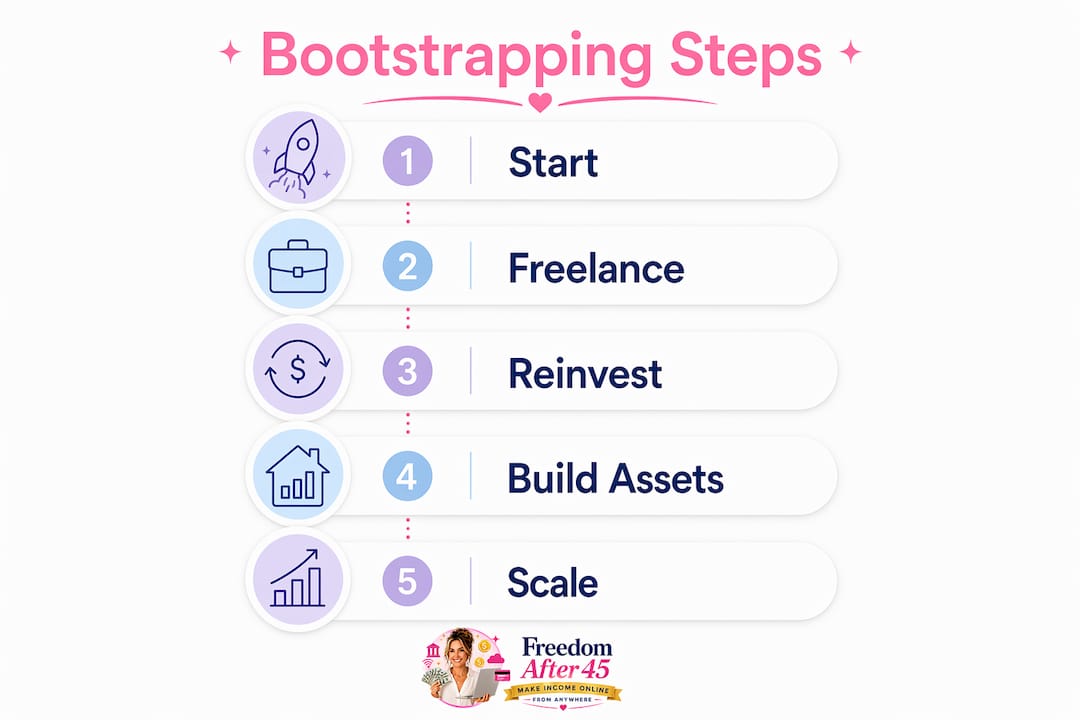
Start with freelancing to create immediate cash flow
Service income often begins in 2–4 weeks, while passive content income takes 6–12 months to develop. That timeline difference is critical. Freelancing gives you real money to reinvest before you have built anything to sell. Skills like writing, graphic design, bookkeeping, social media management, and virtual assistance all convert quickly into paying clients. You do not need a website or a brand to start. A profile on a freelancing platform and one strong sample of your work is enough.
Build passive income assets with reinvested profits
Once freelance income covers your basics, you redirect a portion into building digital assets. These include niche blogs, online courses, digital templates, and print-on-demand products. Combining active and passive income builds durable, scalable revenue streams over time. The freelance work funds the product creation. The product eventually reduces your dependence on hourly work.
Pro Tip: Pick one service skill and one digital product niche that overlap. If you write blog posts for clients, your first digital product could be a blog post template pack. You already know the market because you work in it daily.
How can you bootstrap with minimal startup costs?
The goal is to spend as little as possible before you have confirmed that people will pay for what you offer. Successful bootstrappers limit initial investment to $0–$100 using free tools and building minimum viable products for niche problems. A minimum viable product, or MVP, is the simplest version of your offer that still solves a real problem.
Here is a practical sequence to follow:
- Identify a specific niche problem. Generic offers fail. “I help busy moms organize their finances” beats “I help people with money.”
- Build a simple landing page. Free tools like Carrd or Google Sites work for this. Describe your offer and add a signup or buy button.
- Validate before you build. If fewer than 3% of visitors convert on your landing page, pivot before investing more time or money.
- Pre-sell your product. Offer it at a discount before it is finished. Real purchases confirm real demand.
- Build only what sold. Develop the full product after you have paying customers, not before.
The biggest mistake new bootstrappers make is spending money on branding, logos, and advanced features before a single customer has paid them. A polished brand does not validate a business. A paying customer does.
Pro Tip: Use free tiers of tools like Canva, Mailchimp, and Google Workspace to run your entire operation in the early months. Upgrade only when a specific paid feature directly solves a problem you are actively hitting.
What financial and time investments does bootstrapping require?
Bootstrapping is not free. It costs time, and time has real value. Bootstrapping requires 10–20 hours weekly in the initial phase, with consistent effort outperforming sporadic bursts every time. If you are working a full-time job, that means early mornings, evenings, or weekends. The schedule is demanding, but it is manageable when you protect those hours deliberately.
On the money side, the picture is more nuanced than most “start for free” headlines suggest:
- Realistic monthly costs: Early-stage software and hosting typically run $500–$2,000 per month until cash flow stabilizes. This covers tools for email marketing, website hosting, payment processing, and basic design.
- The negative working capital cycle: Collecting customer payments before paying suppliers reduces reliance on your personal savings. Subscription models and pre-sales make this possible from the start.
- Sweat equity as capital: Every hour you spend building, writing, or marketing is capital you are putting into the business. Track it. It keeps you honest about the real cost of what you are building.
Setting clear milestones helps. Aim for your first $500 in monthly revenue before expanding your tool stack. Aim for $2,000 before hiring any help. These thresholds keep spending tied to actual growth.
How can you scale and sustain bootstrapped online income?
Scaling a bootstrapped business means doing more of what already works, not adding complexity. The four levers that matter most are iteration, pricing, diversification, and automation.
- Iterate based on customer feedback. Your first product will not be your best product. Customers tell you exactly what to fix if you ask them. A product that improves steadily over six months builds loyalty that no marketing budget can buy.
- Raise prices as your reputation grows. The pricing sweet spot for solo digital product founders is $79–$149 per month for subscription offers. Moving from $29 to $99 with the same number of customers triples your revenue without adding a single new sale.
- Diversify between active and passive income. A mix of freelance retainers, digital product sales, and affiliate income creates stability. If one stream dips, the others hold.
- Use AI tools for repetitive tasks. AI writing assistants, scheduling tools, and chatbots handle routine work so you can focus on product quality and client relationships.
| Growth lever | What it does | When to apply it |
|---|---|---|
| Price increase | Raises revenue per customer | After consistent positive feedback |
| Product iteration | Improves retention and referrals | Every 60–90 days based on reviews |
| Income diversification | Reduces single-stream risk | Once primary stream hits $1,000/month |
| AI and automation | Frees time for high-value work | As soon as repetitive tasks appear |
Scaling cautiously is a feature of bootstrapping, not a flaw. Businesses that grow on their own cash flow rarely overextend. That discipline is what makes them last.
Key Takeaways
Bootstrapping online income works because it forces revenue focus, preserves full ownership, and builds a business that sustains itself without outside capital.
| Point | Details |
|---|---|
| Definition is clear | Bootstrapping means building with your own money, time, and early revenue, with no investors. |
| Start with services | Freelancing generates income in 2–4 weeks and funds your first digital product. |
| Validate before building | If landing page conversions fall below 3%, pivot the offer before investing further. |
| Expect real costs | Budget $500–$2,000 per month for tools until your cash flow covers operations. |
| Scale through pricing | Raising prices and diversifying income streams grows revenue without adding hours. |
Why bootstrapping builds better businesses than most people expect
Bootstrapping gets a bad reputation for being slow. After watching hundreds of people build online income from scratch, I think that reputation is wrong. Slow is not the same as weak. Bootstrapped businesses are built on real customer demand, not projected demand. Every feature exists because a paying customer asked for it. Every dollar spent has to justify itself.
The discipline that bootstrapping forces is the same discipline that keeps businesses alive when markets shift. Founders who raised money and burned through it often wish they had started leaner. Founders who bootstrapped rarely say they wish they had taken outside money earlier.
The hardest part is not the money. It is the patience. Most people quit in month three because the results feel invisible. The income is building, but it has not compounded yet. The ones who stay consistent through that window are the ones who end up with something real. Combining freelance income with product creation is the fastest path I have seen to getting through that window without burning out or going broke.
— Freedom After 45
A proven workflow for building your bootstrapped income
Freedom After 45 was built for exactly this situation: you have skills, you have a few hours a day, and you want real income without taking on debt or giving up control.

The 2-Hour Workflow at earningdaily.net teaches you how to earn 100% profit online daily by committing just two hours a day to a structured, step-by-step system. No social media following required. No existing product needed. The program has already helped thousands of families generate consistent daily income ranging from $100 to $1,400. If you are ready to put bootstrapping principles into a repeatable daily practice, this is where to start.
FAQ
What does bootstrapping online income mean?
Bootstrapping online income means building an internet-based business using only your own savings, time, and early revenue, without taking loans or outside investment. You maintain full ownership and reinvest profits to grow.
How long does it take to earn income when bootstrapping?
Service-based income like freelancing typically starts within 2–4 weeks. Passive income streams such as digital products or content usually take 6–12 months to generate consistent revenue.
How much money do I need to start bootstrapping online?
Most bootstrappers start with $0–$100 using free tools, but realistic monthly operating costs run $500–$2,000 until cash flow stabilizes. Pre-selling your product before building it reduces this risk significantly.
Is bootstrapping better than getting a business loan?
Bootstrapping preserves full ownership and forces revenue focus from day one. Bootstrapped companies reach profitability in 18 months on average, compared to 4.2 years for externally funded startups, making it the faster path to self-sustaining income for most solo founders.
What is the biggest mistake bootstrappers make?
The most common mistake is scaling before validating product-market fit. Build a landing page, measure conversions, and collect real payments before investing significant time or money into a full product.