

Passive Income and Family Financial Freedom: 2026 Guide
Passive income is money earned with minimal ongoing effort after an initial investment of time or capital, and it is the most reliable path to family financial freedom for anyone over 40. Unlike active income, which stops the moment you stop working, passive income continues generating returns whether you are at your child’s soccer game or caring for an aging parent. Over 4.5 million stay-at-home parents in the US already earn $500–$3,000 per month through online income streams, working just 10–20 hours weekly. The Freedom After 45 community proves daily that this kind of income is not reserved for the wealthy or the tech-savvy.
What are the best passive income streams for families?
The best passive income streams for families over 40 fall into four categories: digital products, dividend investing, real estate assets, and rental of existing property or equipment. Each category carries a different startup cost, time commitment, and income ceiling. Choosing the right mix depends on what you already own, what skills you have, and how much capital you can deploy.
Digital products include e-books, online courses, printables, and templates. The upfront work is significant, but once created, a digital product sells indefinitely with no inventory cost. A retired teacher, for example, can package 20 years of lesson plans into a downloadable curriculum and sell it on platforms like Etsy or Gumroad.

Dividend investing means buying shares in companies that pay regular cash distributions. A portfolio of dividend-paying stocks or index funds generates quarterly income without any active management. The trade-off is that building a meaningful dividend stream requires capital, which makes it a better medium-term play than an immediate income source.
Real estate remains one of the most proven wealth-building tools for families. Rental properties generate monthly cash flow, but they require upfront capital and occasional management. Real estate investment trusts (REITs) offer a lower-barrier alternative, letting families invest in property portfolios through a standard brokerage account.
Existing assets are the most overlooked starting point. Families regularly miss income opportunities sitting in their own homes, including spare bedrooms, parking spaces, storage areas, and equipment like cameras or tools. Renting these out requires almost no upfront capital and can generate meaningful supplemental income within weeks.
Pro Tip: Before spending money on new investments, audit what you already own. A spare room listed on a short-term rental platform can generate $500–$1,500 per month in many US markets.
| Income stream | Startup effort | Time to first income | Potential monthly income |
|---|---|---|---|
| Digital products | High (creation phase) | 4–8 weeks | $200–$3,000 |
| Dividend investing | Low (capital required) | Immediate after purchase | Varies by portfolio size |
| Rental property | High (capital + setup) | 30–60 days | $500–$2,500 per unit |
| Existing asset rental | Low | 1–2 weeks | $200–$1,500 |
| Online workflows | Moderate | 2–4 weeks | $100–$1,400 daily |
How do you build passive income around family obligations?
Building passive income while managing a household, a job, and family responsibilities requires a structured approach, not willpower. The first step is knowing your exact monthly cost of living. Reviewing three months of bank statements takes roughly two hours and gives you a precise baseline. That number becomes your target. You are not guessing at how much passive income you need. You know.
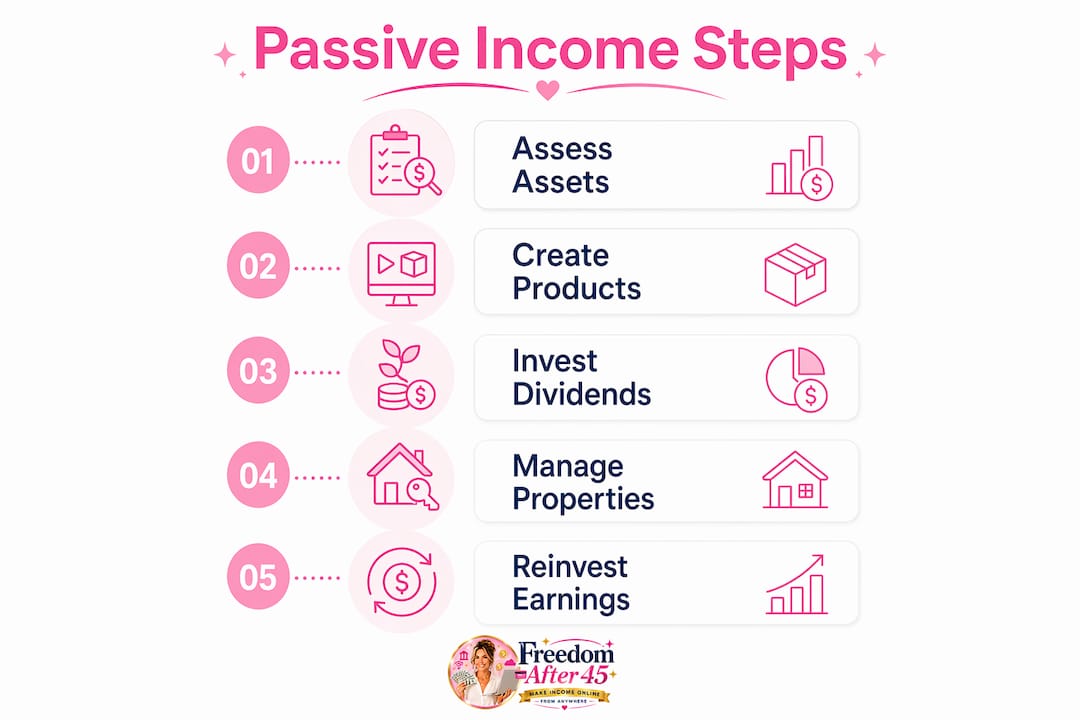
True financial independence arrives when passive income covers 100% of living expenses, a milestone that typically takes 10–15 years of consistent investing. An interim goal of covering 25–50% of expenses within 5–7 years is both realistic and motivating. Breaking a 15-year goal into annual milestones makes the process feel manageable rather than abstract.
Scheduling matters as much as strategy. The 30-minute rule for busy parents involves committing 30 minutes three times per week to building digital assets. That consistency compounds over time without burning you out. Asynchronous work models, where you create content or manage investments outside of peak family hours, fit naturally around school pickups and evening routines.
Here is a practical sequence for building passive income as a family:
- Calculate your baseline. Pull three months of bank statements and add up every recurring expense, including external obligations like elder care or remittances.
- Set a 12-month income target. Aim to replace 10–15% of your active income with passive sources in year one.
- Choose one stream to start. Pick the option that matches your current assets and skills. Do not split attention across five ideas at once.
- Commit to a weekly schedule. Use the 30-minute rule or block two hours on weekend mornings. Protect that time like a meeting.
- Reinvest early returns. Every dollar earned in year one should go back into building the income stream, not into spending.
- Review quarterly. Adjust your approach based on what is actually generating income versus what is consuming time without returns.
Pro Tip: Use your active income as the funding engine for passive investments. Redirect a fixed percentage of each paycheck, even $100 per month, into a dividend account or digital product development fund.
Families who include external obligations like elder care and remittances in their financial planning avoid the false security of hitting a target that does not actually cover their real costs. This is a critical and commonly skipped step.
What mistakes undermine passive income growth for families?
The most damaging mistake families make is spending passive income the moment it arrives. Passive income requires front-loaded work and disciplined reinvestment to compound into real wealth. Without a pre-decided plan for where income goes, lifestyle inflation consumes the gains before they can build.
Lifestyle inflation during the passive income transition is a documented pattern. A family that earns an extra $800 per month and immediately upgrades their car payment has not moved closer to financial freedom. They have moved sideways. The income must be treated as an investment asset, not a spending bonus, especially in the first three years.
Tax erosion is the second major threat. Without a family wealth management structure, passive income from dividends, rentals, and digital sales can face significant tax liability. A tax professional who specializes in self-employed or investment income is not a luxury at this stage. The cost of that advice is almost always less than the tax savings it generates.
Debt-driven approaches to building passive income consistently backfire. Financial experts warn that borrowing money to fund passive income ventures adds risk without adding stability. The only reliable foundation is active income deployed gradually and deliberately into income-generating assets.
The top five mistakes families make, and how to avoid them:
- Chasing fast returns. Any scheme promising immediate high returns with no effort is a trap. Real passive income builds slowly and compounds over years.
- Skipping the baseline calculation. Without knowing your actual monthly costs, you cannot set a meaningful income target.
- Spreading too thin. Starting three income streams at once means none of them get enough attention to grow. Start with one.
- Ignoring taxes. Passive income is taxable. Plan for it from day one, or a surprise tax bill will erase months of progress.
- Spending before reinvesting. Pre-decide what percentage of passive income gets reinvested. Automate it if possible.
Pro Tip: Write down your reinvestment rule before you earn your first dollar of passive income. “I will reinvest 80% of all passive income for the first two years” is a decision you make once and follow automatically.
How does passive income fit into a family budget?
The role of passive income in a family budget is to progressively replace the income that depends on your time. Active income pays the bills today. Passive income funds the life you want in five, ten, and fifteen years. Treating passive income as a separate budget category, not a windfall, is what separates families who build wealth from those who stay stuck.
A practical framework allocates passive income across three buckets: reinvestment (50%), family goals (30%), and buffer savings (20%). The reinvestment bucket feeds the income stream itself. The family goals bucket covers things like college savings, a vacation fund, or a home renovation. The buffer bucket builds a reserve that reduces financial stress and prevents you from liquidating investments during emergencies.
| Budget category | Allocation | Purpose |
|---|---|---|
| Reinvestment | 50% | Grow the passive income stream |
| Family goals | 30% | College fund, travel, home improvements |
| Buffer savings | 20% | Emergency reserve, reduce financial stress |
Passive income also creates lifestyle choices that active income alone cannot. When your rental income or digital product sales cover your mortgage payment, you can take a lower-stress job, reduce your hours, or take an unpaid month off without financial panic. That flexibility is the real definition of financial freedom for most families.
Pro Tip: Review your passive income allocation every six months. As income grows, shift more toward family goals and less toward reinvestment. The balance changes as your streams mature.
Key Takeaways
Passive income builds family financial freedom by replacing active income gradually, requiring disciplined reinvestment, a clear baseline, and one focused income stream at a time.
| Point | Details |
|---|---|
| Know your baseline first | Pull three months of bank statements to set a precise monthly cost-of-living target. |
| Start with existing assets | Spare rooms, equipment, and skills generate income with little or no upfront capital. |
| Use the 30-minute rule | Commit 30 minutes three times per week to build income streams without burning out. |
| Reinvest before you spend | Pre-decide to reinvest at least 50% of passive income for the first two years. |
| Plan for taxes from day one | Passive income is taxable; a qualified tax advisor protects your gains from the start. |
What I have learned about passive income and family life
Most articles about building passive income treat it like a math problem. Hit the right number, follow the right steps, and freedom arrives on schedule. The reality is messier and more human than that.
The families I have seen succeed with passive income share one trait: they stopped waiting for the perfect moment. They did not wait until the kids were older, until they had more savings, or until they felt ready. They started with what they had, even when that was just a spare room and two free hours on Saturday mornings.
The mindset shift that matters most is separating your identity from your job. Many people over 45 have spent two decades defining themselves by their career. Passive income asks you to think differently. Your income does not have to come from your labor. It can come from an asset you built or own. That shift feels uncomfortable at first. It becomes liberating quickly.
Patience is not optional. The first year of building passive income rarely feels like progress. Returns are small, the work feels disproportionate to the reward, and doubt creeps in. The families who push through that first year almost always report that year two looks completely different. Compounding is real, but it requires time to show up.
Balance matters too. Passive income should serve your family, not consume it. If building an income stream means missing dinners, skipping weekends, and running on empty, you are trading one form of time-for-money for another. The goal is more freedom, not a different kind of exhaustion.
— Freedom After 45
A proven workflow for earning daily profit online
Families who want a structured starting point do not need to build everything from scratch.

Freedom After 45 offers a 2-hour daily workflow designed specifically for women over 45 who want to generate $100–$1,400 per day in online profit without needing a social media following, an existing product, or technical skills. The program is step-by-step, built around real family schedules, and has already helped thousands of families create meaningful recurring income. If you are ready to move from planning to earning, the workflow gives you a clear, repeatable process to follow from day one.
FAQ
What is passive income and why does it matter for families?
Passive income is money earned from assets or systems that generate returns without continuous active work. For families over 40, it creates financial independence by reducing reliance on a single job or salary.
How long does it take to achieve financial freedom through passive income?
True financial independence typically takes 10–15 years of consistent investing, with a realistic interim goal of covering 25–50% of living expenses within 5–7 years.
What is the easiest passive income stream for busy parents to start?
Renting existing assets like a spare room, parking space, or equipment requires almost no startup capital and can generate income within one to two weeks of listing.
How much time does building passive income actually require?
The 30-minute rule shows that committing 30 minutes three times per week to building digital assets is enough to create compounding progress without disrupting family life.
Should families use debt to fund passive income investments?
No. Financial experts recommend funding passive income investments from active income only. Debt adds financial risk and undermines the stability that passive income is meant to create.