

Online Income for Students: What You Need to Know
Most students searching for ways to earn money online hit the same wall. They expect quick cash, discover it’s more complicated than YouTube ads suggest, and quit before they earn a dollar. What is online income for students, really? It’s a spectrum of flexible earning opportunities, from short microtasks to high-skill freelance services, that can be structured around a class schedule and scaled over time. This guide cuts through the noise so you can pick the right method, understand the tax basics, and build income that actually sticks.
Table of Contents
- Key takeaways
- What online income actually means for students
- Practical methods that actually fit a college schedule
- How online earnings help cover student living costs
- Tax basics every student earner needs to understand
- Building income that scales without tanking your grades
- My honest take on student online income
- Ready to build a real income around your schedule?
- FAQ
Key takeaways
| Point | Details |
|---|---|
| Online income has many forms | Methods range from gig apps and tutoring to digital products, each with different time and skill demands. |
| Active vs. passive matters | Freelancing generates faster cash; passive products take months but earn without constant hours. |
| Schedule alignment is critical | Choosing methods that fit your class load prevents burnout and protects your GPA. |
| Tax obligations start at $400 | Self-employment income above $400 requires IRS filing; plan ahead to avoid surprises. |
| Ramp time is real | Most meaningful income takes 3 to 6 months to build. Start early, not during finals. |
What online income actually means for students
The phrase “online income” gets tossed around loosely, but the industry term you’ll encounter in financial and career contexts is remote self-employment or independent contracting. Those terms cover everything from selling a $5 Fiverr gig to running a $3,000 monthly social media management account from your dorm room.
Here’s the spectrum, from lowest barrier to highest earning potential:
- Microtasks: Short paid tasks on platforms like Amazon Mechanical Turk or Clickworker. Pay is low ($5 to $10 per hour) but requires zero experience.
- Freelancing: Writing, graphic design, coding, video editing, or virtual assistant work sold through platforms like Upwork or Fiverr. Rates scale with skill and reputation.
- Online tutoring: One of the highest-return options for students. Tutoring in high-demand subjects can reach $50 to $100 per hour, generating $600 to $1,500 monthly working fewer than 15 hours a week.
- Digital product sales: Selling templates, study guides, or preset packs. Requires upfront work but earns passively after launch.
- Content creation: YouTube, TikTok, or a blog monetized through ads or sponsorships. Long ramp time, high ceiling.
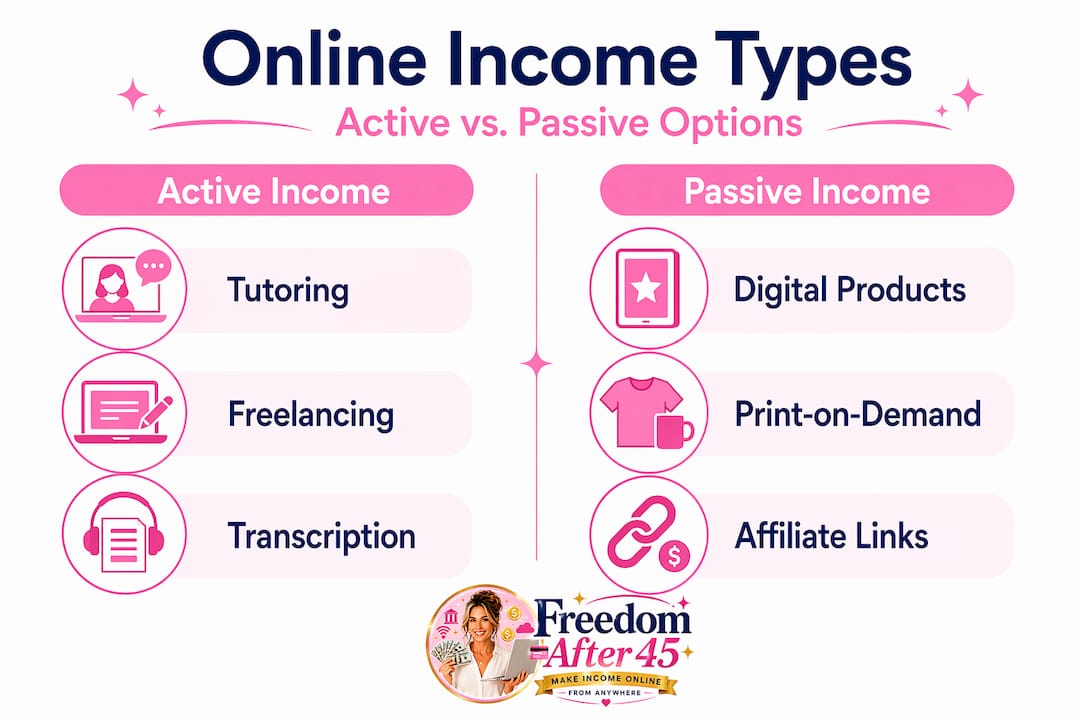
The distinction between active and passive income matters more than most students realize. Active income pays you per hour or per task. Passive income, like a digital download store, earns while you sleep but takes weeks or months to set up. Neither is better. They serve different financial situations.
Side hustles suitable for students typically involve tutoring, transcription, virtual assistant work, and proofreading because all four require minimal startup cost and fit around unpredictable schedules.
Pro Tip: Before choosing any method, list your top three skills, your available weekly hours, and whether you need income now or in three months. That combination narrows the field faster than any listicle will.
Practical methods that actually fit a college schedule
Time is the real constraint. You don’t have 40 hours a week. You have gaps between classes, evenings before deadlines, and long weekends. The methods below are ranked by how quickly you can generate your first dollar.
| Method | Estimated hourly rate | Time to first payment | Weekly hours needed |
|---|---|---|---|
| Freelance writing | $15 to $50 | 1 to 2 weeks | 5 to 10 hrs |
| Online tutoring | $20 to $100 | 1 to 3 weeks | 4 to 8 hrs |
| Gig apps (TaskRabbit, etc.) | $12 to $25 | 1 to 7 days | Flexible |
| Social media management | $300 to $500/month/client | 2 to 4 weeks | 5 to 8 hrs |
| Digital product sales | Passive after launch | 1 to 3 months | 10 hrs upfront |
Freelancing platforms encourage students to build portfolios through projects that fit around coursework, with no commute and full schedule control. That flexibility is the actual product these platforms sell to you, not just to clients.
Social media management deserves a closer look because it’s underused by students. Entry-level packages start at $300 to $500 per month per client. Land two clients managing Instagram and Facebook for local businesses, and you’re looking at $600 to $1,000 monthly for roughly 10 hours of work per week. If you’re already spending time on social platforms, this is a low-lift translation of existing behavior into income.
A few things to keep in mind about balancing all of this:
- Block income-work hours on your calendar the same way you block class time. Treat them as non-negotiable.
- Front-load income work early in the semester when academic pressure is lower.
- Avoid accepting more gig work than you can deliver. One late delivery on Fiverr tanks your rating and your income.
Pro Tip: When you land your first tutoring or freelance client, ask for a recurring weekly slot instead of one-off sessions. Predictable income from a regular schedule beats chasing new clients every week.
How online earnings help cover student living costs
Students often underestimate how much their living costs add up outside of tuition. Cost of Attendance (COA) includes tuition, housing, food, transportation, and personal expenses. Student loan funds that remain after tuition can technically be used for those living expenses, but that adds to the debt load you’ll carry after graduation.

This is where online income changes the math. Even $500 a month covers most grocery budgets. Eight hundred dollars covers rent contributions in shared housing markets. You’re not replacing a full salary. You’re reducing the amount you borrow, which compounds favorably over years of loan repayment.
| Monthly expense | Average student cost | Online income offset potential |
|---|---|---|
| Groceries | $300 to $400 | Covered by 4 to 6 tutoring hours |
| Transportation | $100 to $150 | Covered by one social media client |
| Personal/misc | $200 to $300 | Covered by 10 to 15 freelance hours |
| Rent contribution | $400 to $800 | Requires 2 to 3 regular clients |
Integrating online income with aid strategies creates a more stable financial picture than relying on either loans or earnings alone. Think of your monthly budget in three buckets: guaranteed aid, reliable online income, and discretionary spending. When you know which costs each bucket covers, irregular income months feel less stressful.
Tax basics every student earner needs to understand
This is the section most income guides skip or butcher. Here’s what you actually need to know.
The IRS does not care that you’re a student. Once your net self-employment income hits $400, you’re required to file. Specifically:
- Schedule C reports your business income and any deductible expenses (software, equipment, internet costs you can allocate to work).
- Schedule SE calculates your self-employment tax at 15.3%, which covers Social Security and Medicare. Employees split this with employers. You pay the full amount.
- The standard deduction still applies. Most students won’t owe much actual income tax, but the self-employment tax is separate and real.
One thing students consistently miss: the difference between hobby income and business income. If the IRS classifies your earnings as a hobby rather than a business, you cannot deduct expenses against that income. Running a legitimate business means keeping records, having a profit motive, and operating consistently.
Students should verify their self-employment classification before assuming their 1099-NEC income is automatically classified one way. This matters because misclassification can trigger penalties.
Pro Tip: Set aside 25% to 30% of every online payment you receive into a separate savings account labeled “taxes.” It feels aggressive, but it will never leave you scrambling in April.
Building income that scales without tanking your grades
Most students treat online income as reactive. A bill comes up, they scramble for gig work, they exhaust themselves, and their grades slip. The students who sustain it long-term treat it like a simple system instead.
Here’s a practical framework for doing that:
- Audit your available hours honestly. Map out your week with classes, study time, sleep, and social commitments. The gaps are your working hours. Most students find 8 to 15 realistic hours weekly.
- Choose one primary method for the first semester. Trying two or three methods at once splits your attention and delays the reputation-building that drives income growth on any platform.
- Set a three-month income target, not a monthly one. Most methods need 3 to 6 months to reach meaningful earnings. Evaluating them after four weeks is a false negative.
- Add a second income stream only after the first is stable. Tutoring four to six regular students, combined with one social media client, can produce $600 to $3,000 monthly with manageable weekly hours.
- Schedule a monthly income review. Look at what you earned, what you spent time on, and what’s worth dropping. Treat it like a 30-minute business meeting with yourself.
- Protect your academic performance as a non-negotiable. Your degree increases your long-term earning ceiling. No amount of short-term gig income outweighs a damaged GPA in a competitive field.
The skill-to-demand match is also worth repeating here. Flexible scheduling alone won’t produce results if the method doesn’t connect your actual skills to something people will pay for. A biology student tutoring pre-med content earns far more per hour than the same student doing data entry.
My honest take on student online income
I’ve watched a lot of people start the online income path expecting a shortcut and discover it’s actually a skill-building path in disguise. That’s not a disappointment. That’s the point.
In my experience, the students who succeed fastest are the ones who stop asking “what can I do to make money?” and start asking “what do I already know that someone else needs?” That reframe changes everything. A student who has passed organic chemistry is sitting on a high-value tutoring service. A student in a graphic design program can build a freelance portfolio using class projects they’ve already created.
What I’ve found consistently is that the first 60 days feel slow and unrewarding. The platforms feel competitive, the client communication feels awkward, and the income feels embarrassingly small. Push through that window and something shifts. You get your first repeat client. You raise your rate. You realize you’ve built something that didn’t exist six months ago.
The tax side catches more students off guard than anything else. Set aside money from day one. Don’t wait until you “see if this works.” It will work, and April will arrive faster than you expect.
The students who burn out share one common trait. They never connected their income method to a skill they genuinely found interesting. You’ll spend enough hours on this that boredom is a real risk. Pick something you’d do for a client you liked even on a hard week.
— Freedom After 45
Ready to build a real income around your schedule?
If this guide helped you understand the landscape, the next step is putting a structure around it. Freedom After 45 built the 2-Hour Workflow specifically for people who can’t afford to spend all day grinding on income attempts. The system shows you how to generate consistent daily profit by working smarter within a defined two-hour block, with no product, no following, and no prior experience required.

Thousands of people have used this blueprint to move from financial stress to financial stability. The same principles apply whether you’re a student covering rent or someone building toward long-term freedom. If you have two hours and the willingness to follow a proven process, this is where the next step lives.
FAQ
What is online income for students?
Online income for students refers to money earned through internet-based work such as freelancing, tutoring, digital product sales, or gig platforms. It’s flexible by design, allowing students to work around class schedules without a traditional employer.
How much can a student realistically earn online?
Entry-level remote work typically pays $5 to $15 per hour, while tutoring high-demand subjects can reach $50 to $100 per hour. Students working 10 to 15 hours weekly can reasonably target $600 to $1,500 monthly within a few months.
Do students have to pay taxes on online income?
Yes. Any net self-employment income over $400 requires filing IRS Schedule C and Schedule SE. Students are subject to a 15.3% self-employment tax on top of regular income tax obligations, regardless of their student status.
How long does it take to start earning online?
Gig apps and freelancing platforms can generate the first payment within days or weeks. Passive income methods like digital products typically take one to three months before meaningful earnings appear. Most methods need three to six months to build stable income.
Which online income method is best for busy students?
Online tutoring offers the best balance of hourly rate and schedule flexibility for most students. Social media management is a strong second option for students with creative skills, since it often pays $300 to $500 per client per month for roughly five to eight hours of weekly work.