

Online Income and Student Life Balance: 2026 Guide
Online income is defined as any earnings generated through digital platforms that students use to supplement financial aid, build skills, and reduce reliance on family support. The role of online income in student life balance is to provide flexible earning opportunities that complement academic goals rather than compete with them. Students in 2026 face rising costs, and tools like QuickBooks Self-Employed and Grammarly have made managing online work more accessible than ever. The maximum Pell Grant is $7,395 for the 2025–26 academic year. That figure still leaves most students with a significant funding gap that online income can help close.
How does the role of online income in student life balance actually work?
The core principle is simple: online income works best when it fills the gaps in your schedule, not when it takes over your schedule. Students who treat online work as a primary obligation quickly find their grades and mental health suffering. The goal is a structure where academics come first and earning fits around them.
Economic pressures globally have pushed more students toward online gigs in 2026, with currency depreciation and rising living costs driving participation. This trend is real and growing. The risk is that students jump in without a plan and end up burning out before the semester ends.

Online income strategies that work for students share three traits. They are flexible enough to pause during finals. They generate income without requiring a fixed schedule. They build skills that transfer directly to a resume or portfolio. Freelance writing, tutoring on platforms like Chegg or Wyzant, and selling digital products on Etsy or Gumroad all fit this profile.
How can students manage time and energy without burning out?
Time management for students earning online is not about squeezing more hours out of the day. It is about protecting the hours that matter most and working smarter in the ones that remain.
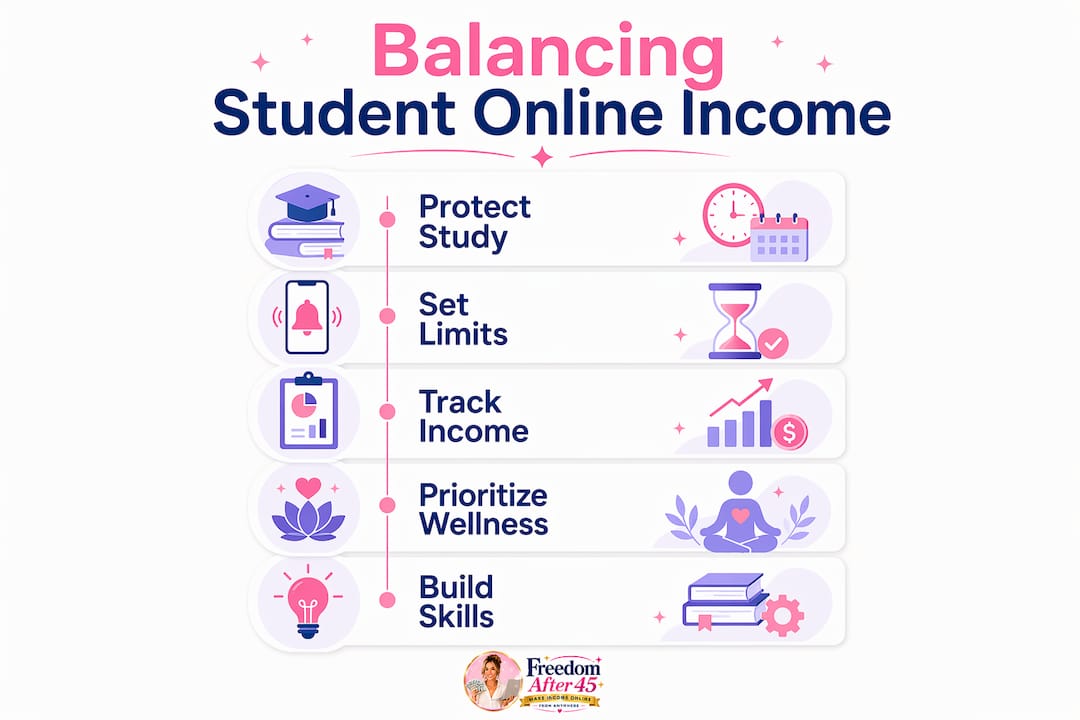
Treating class and study time as non-negotiable and scheduling online work in flexible periods leads to sustainable productivity. This means blocking your class schedule, assignment deadlines, and study sessions first. Online work gets whatever is left.
The energy window concept takes this further. Your brain does not perform equally at all hours. Most people have a peak focus window of three to five hours per day where deep work is genuinely productive. Scheduling demanding online tasks, like writing a client report or coding a project, inside that window produces better results in less time. Scheduling low-effort tasks like answering emails or updating a spreadsheet outside that window wastes nothing.
Here is what a practical weekly structure looks like for a student earning online:
- Fixed blocks: Classes, labs, and scheduled study sessions are locked in first
- Peak energy slots: Use your two to three best focus hours for high-value online work
- Buffer time: Leave at least one full day per week with no online work commitments
- Recovery time: Sleep, exercise, and social time are not optional. They protect your output quality
Pro Tip: Set a hard weekly cap on online work hours before the semester starts. Fifteen hours per week is a reasonable ceiling for a full-time student. Adjust it each semester based on your course load, not your income goals.
The biggest mistake students make is monetizing every free hour. A free Saturday afternoon is not automatically an opportunity to earn. Rest is productive. Students who ignore this end up less effective at both studying and working.
What financial and business responsibilities come with earning online?
Earning online as a student is not just a side hustle. Past a certain threshold, it becomes a business with real financial obligations.
Crossing $1,000 per month in online income marks a shift in tax and bookkeeping responsibilities. At that level, you are effectively operating as a self-employed individual. The IRS does not care that you are a student.
Here are the four financial steps every student online earner should take:
- Open a separate bank account for all online income. Mixing personal and business money creates accounting chaos at tax time.
- Set aside 25–30% of every deposit for taxes. Students often miss the $600 1099-K threshold and get hit with unexpected tax bills. Do not let that happen to you.
- Track every expense using an app like QuickBooks Self-Employed or Wave. Subscriptions, equipment, and software you use for work are deductible.
- Build a financial buffer. A 6–12 month expense reserve is the recommended standard for online earners, compared to the conventional three to six months. Online income is irregular. Your buffer needs to reflect that.
“Financial independence requires stable income covering essentials, including emergencies. Sporadic freelance income is not enough.” This distinction matters enormously for students who believe a few good months of freelancing means they are financially independent.
The difference between earning income and achieving student financial independence is reliability. A month where you earn $2,000 on Fiverr followed by a month where you earn $200 is not financial independence. It is financial volatility. Building toward independence means creating income streams that are consistent enough to cover rent, food, and tuition without family backup.
What strategies help students integrate online income without sacrificing wellness?
The students who sustain online income through four years of college share one habit: they treat consistency as more valuable than intensity. Earning $300 every month for twelve months beats earning $1,500 in one month and burning out for the next three.
Practical integration strategies include:
- Plan around the academic calendar. Scale back online work during midterms and finals. Ramp up during winter and summer breaks when your schedule opens up.
- Use digital tools for focus. Notion works well for organizing both academic projects and client work in one place. Grammarly cuts editing time on freelance writing. These tools reduce the cognitive load of switching between student and earner modes.
- Treat online income as complementary. Your degree is the primary investment. Online income is the financial support system that makes completing it easier.
- Build a digital portfolio as you go. Upwork ratings, GitHub repositories, and Instagram shops function as modern resumes. Every project you complete as a student becomes evidence of real-world skill.
Pro Tip: Create a single Notion dashboard that tracks your class deadlines, online work commitments, and income goals side by side. Seeing everything in one view makes conflicts obvious before they become crises.
The wellness piece is non-negotiable. Students who skip meals, cut sleep, or cancel social plans to hit income targets are making a trade that costs more than it earns. Burnout does not just hurt your grades. It kills your earning capacity too.
How does earning online affect student financial independence and career readiness?
Most students misunderstand financial independence as simply earning money rather than reliably covering living expenses without family support. That distinction changes how you should think about online income strategy.
True financial independence as a student means your income covers rent, groceries, transportation, and a small emergency fund without a call to your parents. That is a specific, measurable target. It is not a feeling. It is a number.
Online work also builds career skills that traditional part-time jobs rarely develop. A student who spends two years managing freelance clients on Upwork develops communication, project scoping, deadline management, and invoicing skills. A student who works retail for two years develops customer service skills. Both are valuable. Only one of them shows up as a portfolio.
| Income type | Stability level | Career readiness impact |
|---|---|---|
| Campus part-time job | High | Low (limited transferable skills) |
| Freelance writing or design | Medium | High (portfolio, client management) |
| Digital product sales | Low to medium | Medium (marketing, product thinking) |
| Online tutoring | Medium to high | High (communication, subject expertise) |
The career readiness advantage of online work compounds over time. A junior-year student with two years of Upwork history and a GitHub portfolio walks into interviews with proof of work. That proof is worth more than a GPA point in most hiring conversations.
Key takeaways
Balancing online income with student life requires structured time management, financial discipline, and treating academic commitments as the non-negotiable foundation of every decision.
| Point | Details |
|---|---|
| Academics come first | Block class and study time before scheduling any online work. |
| Know your tax obligations | Set aside 25–30% of every online deposit to cover self-employment taxes. |
| Build a real financial buffer | Aim for 6–12 months of expenses saved to handle income variability. |
| Use tools to reduce friction | Notion, Grammarly, and QuickBooks Self-Employed cut the time cost of managing both roles. |
| Online work builds career capital | A digital portfolio from freelance work outperforms a traditional part-time job on most resumes. |
What I have learned about students and online income
At Freedom After 45, I have watched the same pattern repeat itself. Students discover online income, get excited, overcommit, and crash by week six. The problem is never the income opportunity. The problem is the expectation that more hours always means more results.
The students who actually succeed treat their online income like a business from day one. They track their money, protect their study time, and say no to client work during finals week. They are not grinding. They are managing.
The uncomfortable truth is that most online income advice aimed at students ignores the academic side entirely. It tells you how to earn but not how to protect the degree that makes your long-term earning potential real. A student who earns $500 a month but fails two courses has made a bad trade.
My honest recommendation: start with ten hours per week of online work, not twenty. Prove to yourself that you can maintain your GPA and your income simultaneously. Then scale up from a position of strength, not desperation.
Financial literacy is the skill that ties everything together. Understanding taxes, buffers, and the difference between income and independence will serve you longer than any single freelance gig.
— Freedom After 45
Start earning online without sacrificing your studies
Students who want a clear, step-by-step system for earning online without the guesswork have one reliable starting point. Freedom After 45 offers a 2-hour daily workflow that teaches you how to generate consistent online income without needing a social media following, an existing product, or hours of free time you do not have.

The workflow is built for busy schedules. It fits inside the flexible time blocks you have already protected for online work. Thousands of people have used it to build real, recurring income without burning out or compromising their other commitments. If you are serious about managing online income the right way, this is where to start.
FAQ
What is the role of online income in student life balance?
Online income plays a supporting role in student life by filling financial gaps and building career skills without replacing academic priorities. The balance works when online work is scheduled around fixed academic commitments, not the other way around.
How much can students earn online before taxes apply?
Students must start tracking tax obligations once online income approaches $600 per year due to the 1099-K reporting threshold. Setting aside 25–30% of every deposit is the standard best practice to avoid unexpected tax bills.
What is the best way to avoid burnout while studying and earning?
Identify your peak energy window each day and use it for your highest-priority task, whether that is studying or client work. Capping online work at fifteen hours per week during the academic semester prevents the overcommitment that leads to burnout.
Does online work actually help with career readiness?
Online work builds a digital portfolio through platforms like Upwork, GitHub, and Etsy that functions as a modern resume. Students with documented freelance experience consistently outperform those with only traditional part-time job history in competitive hiring processes.
How much savings buffer do student online earners need?
A 6–12 month expense reserve is the recommended standard for students relying on online income, compared to the conventional three to six months. Online income is irregular by nature, and a larger buffer prevents financial stress during slow periods.