

How Online Income Scales Without Capital Injection
Most people assume that scaling online income requires money to make money. That belief stops thousands of capable people before they even start. The truth is that understanding how online income scales without capital injection changes everything. You do not need a product, an ad budget, or a following to build real, growing income online. What you need is a clear model, the right entry point, and the patience to let compounding do its work. This article breaks down exactly how that works, from your first dollar to your first consistent monthly income.
Table of Contents
- Key takeaways
- How online income scales without capital injection
- Mid-tier income streams that grow without investment
- Scaling strategies that require no upfront capital
- A beginner’s roadmap from first dollar to scaling
- Common pitfalls that kill momentum
- My honest take on scaling without capital
- Start scaling with a proven two-hour system
- FAQ
Key takeaways
| Point | Details |
|---|---|
| Zero capital entry is real | Platforms like Fiverr, Gumroad, and Upwork let you start earning with no upfront cost. |
| Timelines vary by method | Most zero-investment methods produce a first payout within 2 to 6 weeks of consistent effort. |
| Feeder plus asset model works | Pairing active income with a passive digital product creates compounding growth without extra hours. |
| Focus beats diversification early | Committing to one income stream before branching out accelerates results and reduces wasted effort. |
| Unit economics come first | Scaling traffic before your offer is profitable multiplies losses, not gains. |
How online income scales without capital injection
The short answer is leverage. You trade time and skill for money at first, then you systematically replace time with systems, content, or products that keep earning after you stop working. No capital required at any stage.
The starting point for most people is micro-freelancing or AI-assisted task work. Entry-level platforms like Upwork and Fiverr charge nothing to create a profile. Rates start around $5 to $15 per hour for new accounts, and AI data labeling gigs can push that to $18 to $35 per hour once you build a track record. Video UGC content pays $50 to $300 per clip with no equipment beyond a smartphone.
Digital products sit at the other end of the spectrum. Listing a template, guide, or printable on Gumroad or Etsy costs nothing. You create it once and it sells indefinitely. The catch is that these products take longer to gain traction. Expect 2 to 6 weeks before your first sale with consistent platform engagement.
Here is a quick comparison of the most accessible zero-investment starting points:
| Method | Time to first payout | Typical monthly range | Scalability |
|---|---|---|---|
| Micro-freelancing | 1 to 3 weeks | $100 to $500 | Moderate |
| AI data labeling | 1 to 2 weeks | $200 to $600 | Moderate |
| Digital downloads | 2 to 6 weeks | $50 to $300 | High |
| UGC video content | 1 to 3 weeks | $150 to $900 | High |
Pro Tip: Start with micro-freelancing to generate immediate cash, then use that momentum to build your first digital product in parallel. You never need to choose one or the other permanently.
Mid-tier income streams that grow without investment
Once you have proven you can earn, the next step is building income that does not require you to show up every single day. This is where ways to earn online without investment get genuinely interesting.

Print-on-demand businesses carry zero inventory costs. You upload a design, a customer orders, the platform prints and ships, and you collect the margin. Those margins run $3 to $8 per sale, which sounds small until you have 50 designs generating consistent orders. Reaching $100 to $300 per month typically takes 3 to 6 months of catalog growth. The $2,000 to $5,000 monthly tier requires 9 to 12 months and a real marketing strategy, but still no capital.
Paid newsletters and subscription communities follow a different curve. You build an audience around a specific topic, charge $5 to $15 per month, and grow through referrals and organic content. The ceiling is high. A newsletter with 500 paying subscribers at $10 per month generates $5,000 monthly with no product costs at all.
Online courses and templates occupy the highest-leverage tier. A single well-structured course on a platform like Teachable or Gumroad can generate income for years. The upfront investment is time, not money.
- Print-on-demand: Best for creatives; slow start but compounds with catalog size
- Paid newsletters: Best for subject matter experts; grows through trust and consistency
- Online courses: Best for teachers and coaches; high one-time effort, long-term payoff
- Templates and digital tools: Best for designers and writers; fast to create, highly scalable
Pro Tip: Before building a course, sell the concept first. Post about the topic in a relevant online community and gauge real interest. If people ask where they can buy it, build it. If they scroll past, pivot.
Scaling strategies that require no upfront capital
This is where most people get stuck. They earn their first $200 and immediately try to do five things at once. Scaling online income streams requires the opposite instinct.
The Digital Hustle Framework is clear on this: focus on one primary leverage type and one feeder system. Your feeder system is the active income that pays your bills right now. Your leverage asset is the thing you build in the background that will eventually earn without your daily input. Freelancing pays this week’s groceries while your digital product catalog builds toward next year’s passive income.
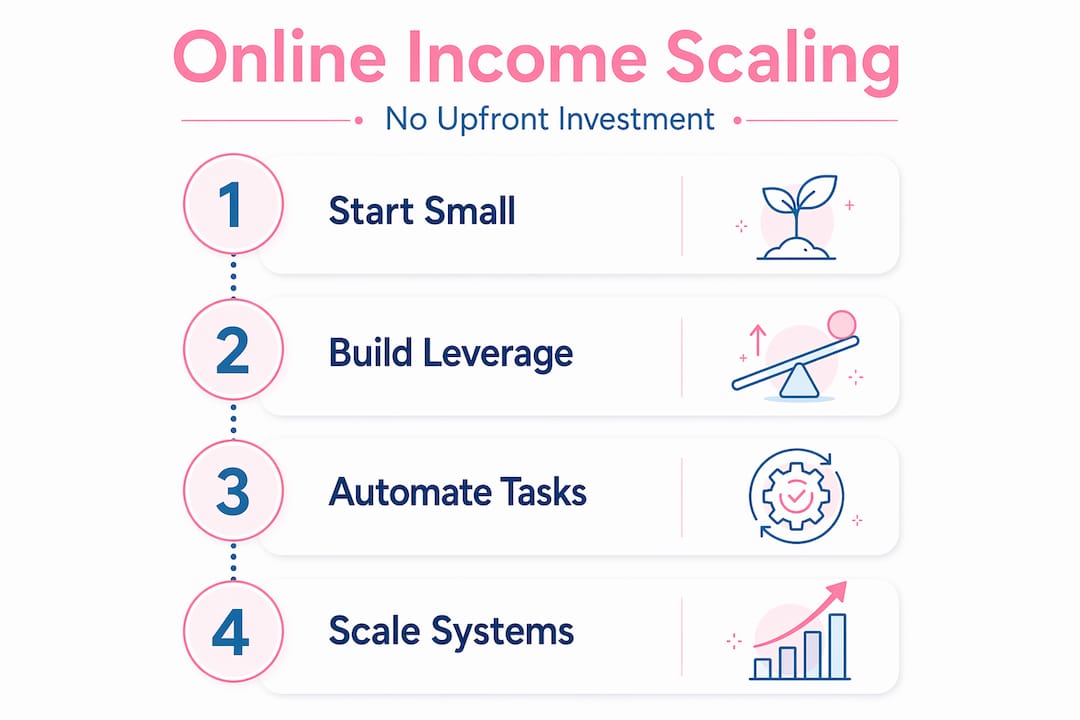
Combining a feeder income with an evergreen asset is the architecture that produces compound growth without adding work hours. A faceless YouTube channel, for example, generates ad revenue, affiliate commissions, and sponsorships from videos posted months or years ago. The compounding traffic from old videos means your income grows even when you are not creating new content.
Here is the order of operations that actually works:
- Pick one method and generate your first $100.
- Reinvest time (not money) into improving that one method.
- Build a complementary passive asset while your active income covers costs.
- Once the passive asset earns $200 to $300 per month consistently, add a second active income stream.
- Repeat the cycle with each new stream funding the next passive asset.
“Sustainable scaling requires moving from tactical hustle to intentional operational discipline, focusing on scalable systems rather than time-for-money exchanges.” — Luminate Bank
A beginner’s roadmap from first dollar to scaling
You do not need a plan with 47 steps. You need clarity on the next three moves. Here is what that looks like in practice for someone starting from zero.
- Choose your entry method. Pick from micro-freelancing, AI data labeling, or digital downloads based on your existing skills. If you write well, start on Fiverr. If you are detail-oriented, try AI labeling platforms. If you have design skills, create a template pack for Etsy.
- Set up your profile or listing today. Not this week. Today. A complete profile with a clear offer, a professional photo, and two to three portfolio samples dramatically increases your first conversion. Most zero-capital methods produce their first payout within 2 to 6 weeks of consistent platform engagement.
- Engage the platform actively. Leave thoughtful comments in relevant communities. Answer questions in forums. Apply to 10 gigs per day on freelancing platforms. The algorithm rewards activity, and early traction compounds.
- Track what converts. After your first three sales or gigs, look at what the buyer actually wanted versus what you offered. Adjust your listing or service description to match that language exactly.
- Raise your price by 20% after five positive reviews. This single move is how freelancers grow income without finding more clients. The same logic applies to digital products. Add a bonus, improve the design, and increase the price.
Pro Tip: Build an email list from day one, even if it is just a free Mailchimp account. Every buyer who joins your list is a future customer for your next product. That list is your most valuable zero-cost asset.
Common pitfalls that kill momentum
Scaling online income without investment is genuinely possible. But several predictable mistakes derail people who are otherwise doing everything right.
- Method overload: Trying three income streams at once means none of them get enough attention to gain traction. Scattered effort produces scattered results.
- Ignoring payout delays: Platforms like Fiverr and Upwork hold payments for 7 to 14 days, and minimum withdrawal thresholds add another layer of delay. Plan for 2 to 4 weeks before real cash hits your account.
- Scaling before the model works: Prioritizing profitability before scaling traffic is not optional. If your offer converts at 1% and you double your traffic, you double your costs without doubling your income.
- Skipping the email list: Relying entirely on platform traffic is fragile. One algorithm change can erase months of progress. An email list is yours regardless of what any platform does.
- Quitting too early: Most zero-investment methods feel slow for the first 30 to 60 days. That is normal. The people who succeed are almost always the ones who stayed consistent through the quiet period.
My honest take on scaling without capital
I have watched a lot of people approach zero-capital online income with the wrong mental model. They treat it like a lottery, trying method after method, hoping one will suddenly click. That is not how it works.
What I have found is that the people who actually grow their income online share one trait: they treat their first $100 as proof of concept, not as a destination. They study why it worked, then they do more of that specific thing. No pivoting, no chasing the next shiny method.
The hardest part is not the technical setup. It is resisting the urge to diversify too early. I have seen people walk away from a freelancing profile that was genuinely gaining traction because they got distracted by a new platform. They reset their momentum entirely and had to start over.
My honest advice is this: leveraged relationships and existing audiences reduce the cold traffic problem dramatically. Before you spend months building an audience from scratch, ask yourself who already trusts you. A small group of people who know your work is worth more than 10,000 strangers who stumbled across your listing.
Start small. Stay focused. Build one asset that earns while you sleep before you build the second one. That patience is not a weakness. It is the actual strategy.
— Michelle
Start scaling with a proven two-hour system
If you have read this far, you already understand the principles behind growing income online without upfront investment. The next step is having a structured system that puts those principles into a daily practice you can actually follow.

Earningdaily’s 2-Hour Workflow is built exactly for this. It gives you a step-by-step blueprint to generate $100 to $1,400 per day in profit by working just two hours daily. No existing following required. No product to create from scratch. No ad spend. Thousands of families have already used this system to move from financial stress to consistent daily income. If you are ready to stop researching and start earning, this is the place to begin.
FAQ
How fast can you earn online with no investment?
Most zero-capital methods produce a first payout within 2 to 6 weeks with consistent daily effort, depending on the platform and method you choose.
What is the best way to scale online income without spending money?
The most effective approach pairs an active income source like freelancing with a passive digital product, allowing one to fund your time while the other builds compounding income over months.
Do you need a social media following to earn online?
No. Platforms like Fiverr, Upwork, Gumroad, and Etsy have built-in traffic, so you can generate sales and clients without any existing audience or following.
Why does scaling fail for most beginners?
Scaling fails most often because people try to grow before their offer is profitable. Scaling an inefficient system increases losses rather than income, so unit economics must come first.
How many income streams should a beginner manage at once?
Start with one stream until it earns $200 to $300 per month consistently, then add a second. Combining multiple income streams offsets individual income ceilings, but only after the first stream is stable.