

How Online Income Replaces Your Exhausting Second Job
Online income replaces exhausting second jobs by combining active freelance work with scalable digital products that earn money even when you are not working. The technical term for this approach is the “active-to-asset income model,” and it is the most sustainable path away from the physical and mental toll of a traditional second job. Platforms like Upwork, Etsy, and Teachable make it possible to start earning within days using skills you already have. Freedom After 45 has built its entire framework around this model, helping thousands of families move from financial overwhelm to a balanced life without quitting their primary job first.
How online income replaces exhausting second jobs: the core methods
Not all online income is created equal. Some methods pay immediately, others build over time, and the smartest approach layers both. Understanding the difference is what separates people who replace their second job within six months from those who spin their wheels for years.
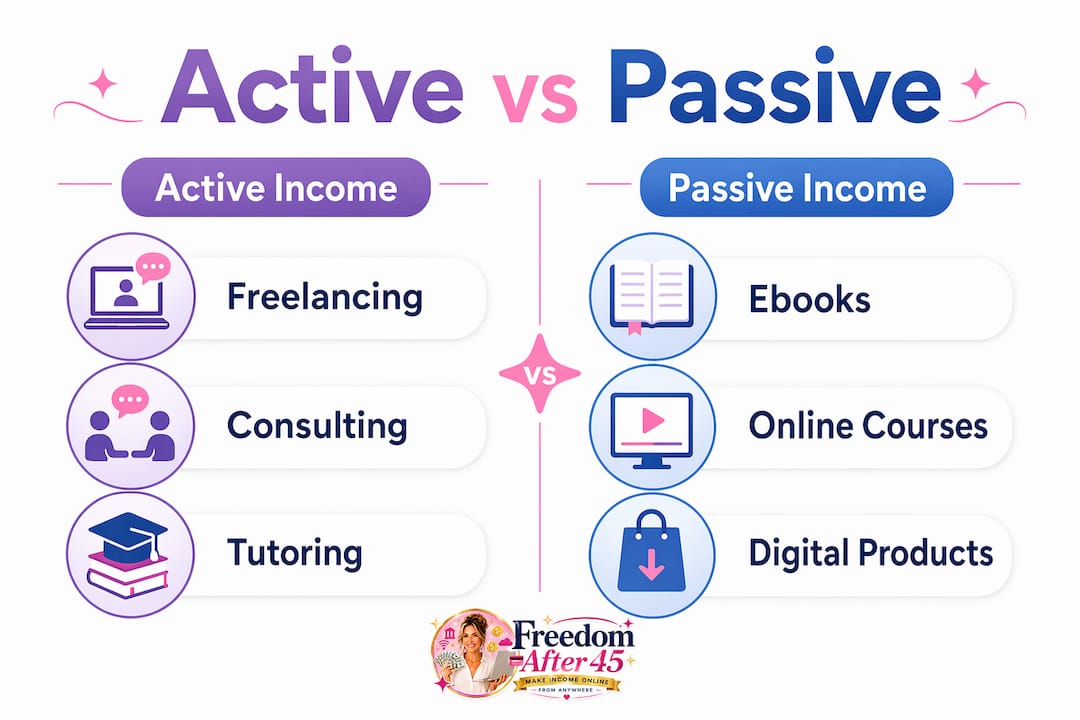
Active income methods pay you for time and output. Freelancing on Upwork, consulting via LinkedIn, tutoring on Wyzant, and driving for DoorDash all fall here. These generate cash fast, which matters when you need to cover a car payment next month. Online side jobs on Indeed frequently pay above $15 per hour, which is the practical benchmark for meaningful income replacement. That rate means 15 hours of focused online work per week can match a part-time retail or food service job without the commute, the uniform, or the manager breathing down your neck.

Passive income methods take longer to build but pay without your direct involvement. Ebooks sold on Gumroad, courses hosted on Teachable, Notion templates on Etsy, and membership communities on Patreon all generate recurring revenue. The active-to-asset income model works precisely because you use active freelancing to fund your life while you build these digital assets on the side.
| Method | Time to first dollar | Earning potential | Upfront cost |
|---|---|---|---|
| Freelancing (Upwork, Fiverr) | 1 to 7 days | $15 to $150/hr | None |
| Gig apps (DoorDash, Instacart) | 1 to 3 days | $12 to $25/hr | None |
| Digital products (Etsy, Gumroad) | 2 to 8 weeks | Unlimited, recurring | Low |
| Online courses (Teachable, Udemy) | 4 to 12 weeks | Unlimited, recurring | Low |
The gig economy apps offer the fastest on-ramp, but they cap your earnings at your available hours. Digital products do not. Diversifying across multiple platforms reduces risk and prevents full income loss if one channel dries up. Think of it as an income stack, not a single replacement job.
Pro Tip: Pick one active method and one passive method to pursue simultaneously. The active work pays your bills now; the passive work buys your freedom later.
How to start earning online without experience or upfront investment
The biggest lie in the “make money online” space is that you need a large following, a polished website, or startup capital. You need none of those things. You need a marketable skill and a credible profile.
Here is the practical starting sequence:
- Audit your existing skills. Write down everything you do competently at your current job or in daily life. Writing, spreadsheet work, customer service, graphic design, data entry, social media management, and bookkeeping are all in demand on Upwork and Fiverr right now. You are not starting from zero.
- Build a profile that proves your ability. Portfolios with mock projects and testimonials significantly increase hiring chances even without paid client history. Create two or three spec projects that follow the problem, action, result format. A mock logo redesign, a sample blog post, or a cleaned-up spreadsheet all count as proof of work.
- Apply to five jobs per day for two weeks. Volume matters early on. Write personalized proposals that address the client’s specific problem, not a generic pitch about your skills. Upwork’s algorithm rewards activity, and your first three reviews unlock dramatically better visibility.
- Set a fixed time block for online work. Two hours per day is enough to build meaningful momentum. Trying to squeeze in work at random times leads to the same burnout you were trying to escape. Treat your online income hours like a standing appointment.
- Master one stream before adding another. The income stack approach works best when each layer is stable before you add the next. Chasing five income streams at once produces mediocre results in all of them.
Pro Tip: Use mini case studies structured as problem, action, result to replace client testimonials when you are just starting out. Clients care about outcomes, not credentials.
What tax obligations come with online income?
This is the section most “make money online” articles skip, and it is the one that causes the most financial pain. Online income is real income, and the IRS treats it accordingly.
Freelancers and independent contractors must file Schedule SE once net earnings exceed $400 in a calendar year. Self-employment tax is calculated on 92.35% of your net income at a rate of approximately 15.3%. That covers Social Security and Medicare contributions that an employer would normally split with you. When you work for yourself, you pay both halves.
The practical implication is significant. If you earn $2,000 in a month from freelancing, your self-employment tax alone could be around $280 before federal income tax is added. Many first-time online earners are blindsided by this at tax time because they spent every dollar they made.
Here is how to avoid that trap:
- Set aside 25 to 30 percent of every payment into a separate savings account the day it arrives.
- Track every business expense weekly. Software subscriptions, home office costs, and equipment purchases reduce your net income and therefore your tax bill.
- Pay estimated quarterly taxes using IRS Form 1040-ES to avoid underpayment penalties.
- Open a separate checking account for your online income from day one. Mixing personal and business finances makes bookkeeping painful and deductions easy to miss.
Treating online income as a real business from the start, including proper bookkeeping and tax planning, prevents the surprise liabilities that cause people to abandon otherwise profitable income streams. Tools like QuickBooks Self-Employed or Wave can automate most of this tracking for under $20 per month.
How to shift from active work to passive income over time
The goal is not to trade one exhausting job for another exhausting side hustle. The goal is to build income that does not require your constant presence. That transition follows a predictable path.
- Stabilize your active income first. Reach a consistent $500 to $1,000 per month from freelancing or gig work before investing time in digital products. This removes financial pressure and gives you the mental space to create.
- Identify your most repeatable knowledge. What do clients ask you the same questions about? What problems do you solve on every project? That repeated knowledge is the foundation of a digital product. A freelance social media manager might package their onboarding process into a $47 template bundle on Etsy.
- Create a minimum viable product. A 20-page ebook, a one-hour video course, or a set of five templates is enough to test demand. Use Gumroad or Teachable to host it with zero upfront cost. Price it between $19 and $97 to attract buyers without undervaluing your work.
- Automate your marketing. An email list of 500 engaged subscribers outperforms a social media following of 10,000 passive scrollers. Use ConvertKit or MailerLite to set up a simple welcome sequence that sells your product on autopilot. SEO-optimized blog posts and Pinterest pins can drive traffic to your product page for years without ongoing effort.
- Add recurring revenue. A monthly membership at $19 per month with 50 members generates $950 per month in predictable income. That stability is what makes quitting a second job feel safe rather than reckless.
The gradual transition from hourly work to evergreen digital products and automated systems is the proven path to reducing burnout while increasing financial flexibility. The key word is gradual. Rushing this transition is how people end up with half-finished courses and no income from either source.
Pro Tip: Before building any digital product, sell it first. Offer it as a “founding member” deal to your first 10 clients or email subscribers. Real sales validate demand before you invest 40 hours in creation.
Key takeaways
Replacing a second job with online income works when you combine active freelancing for immediate cash flow with digital products that earn passively over time.
| Point | Details |
|---|---|
| Start with active income | Freelancing on Upwork or gig apps generates cash within days using skills you already have. |
| Build a proof-based profile | Mock projects and mini case studies replace testimonials and increase hiring rates for beginners. |
| Plan for self-employment tax | Set aside 25 to 30 percent of every payment and file Schedule SE once net earnings exceed $400. |
| Transition to passive income gradually | Stabilize active income first, then create digital products like ebooks, templates, or memberships. |
| Diversify your income stack | Running two or three income channels reduces platform risk and accelerates income replacement. |
Why most people stay stuck in second jobs longer than they need to
The honest reason most people do not replace their second job with online income is not a lack of opportunity. It is a lack of patience with the early, unglamorous phase. I have watched people abandon Upwork after three rejections, give up on an ebook after two weeks of zero sales, and conclude that “online income doesn’t work for people like me.” That conclusion is almost always premature.
The quiet side hustle that builds on existing knowledge and gains momentum through early sales is sustainable precisely because it does not demand a dramatic life overhaul. What it does demand is consistency over a 90-day window that most people never complete. The hustle culture version of this story promises $10,000 in 30 days. The real version looks like $200 in month one, $600 in month two, and $1,400 in month three. That trajectory is not exciting on day one. It is life-changing by month six.
The other misconception worth naming is that passive income is effortless. It is not. It is front-loaded effort that pays dividends later. The ebook you write in January can earn money in December without you touching it again, but you still have to write it in January. Reframing the work as investment rather than labor changes how you sustain it.
Freedom After 45 was built on the belief that financial freedom does not require a dramatic leap. It requires a repeatable system applied consistently by someone who is done being exhausted.
— Freedom After 45
A two-hour daily system for replacing your second job
If you are ready to stop trading sleep for a second paycheck, the 2-Hour Workflow at Freedom After 45 is the most direct path forward. The system is designed specifically for people who have limited time, no existing audience, and no product to sell yet.

Freedom After 45 teaches you how to generate $100 to $1,400 per day by investing just two focused hours. The workflow requires no social media following and no upfront product inventory. Thousands of families have already used it to transition from financial overwhelm to a life that runs on their terms. If the idea of replacing your second job with something that actually fits your life sounds worth two hours of your day, this is where to start.
FAQ
What is the fastest way to replace a second job with online income?
Freelancing on platforms like Upwork or Fiverr is the fastest path, with first earnings possible within one to seven days. Focus on skills you already have and apply to multiple jobs daily to build momentum quickly.
How much can you realistically earn from online side work?
Online side jobs frequently pay above $15 per hour, and digital products can generate recurring income with no ceiling. Consistent freelancers working 10 to 15 hours per week often match or exceed part-time job income within 60 to 90 days.
Do you have to pay taxes on online income?
Yes. Self-employment tax applies once net earnings exceed $400, calculated at approximately 15.3% on 92.35% of your net income. Setting aside 25 to 30 percent of every payment and filing Schedule SE with Form 1040 keeps you compliant.
Is online work worth it compared to a traditional second job?
Online work offers flexibility, no commute, and the ability to scale into passive income, which a traditional second job cannot provide. The trade-off is that it requires more self-discipline and a longer ramp-up period before income stabilizes.
How do you avoid burnout when building online income?
Set fixed two-hour work blocks, master one income stream before adding another, and treat the work as a long-term investment rather than a sprint. The gradual shift from active to passive income is the most effective burnout prevention strategy available.