

How Online Income Bypasses Startup Barriers in 2026
Online income bypasses startup barriers by replacing capital requirements with skill investment, letting you launch a real business for as little as $0 to $500 upfront. Traditional entrepreneurship demanded office leases, inventory, payroll, and investor approval before you earned your first dollar. Digital platforms like Coursera, Etsy, and freelancing marketplaces have rewritten those rules entirely. The shift is not just about cost. It is about who gets permission to start. Today, that permission is yours by default.
How online income bypasses startup barriers directly
Traditional startup barriers fall into three categories: capital, infrastructure, and operational complexity. A brick-and-mortar business needs a location, equipment, staff, and months of runway before revenue appears. Online income models strip most of that away from day one.
Capital requirements drop to near zero. Many online income paths carry startup costs of $0–$500 and can reach $100,000 per year within 6–18 months for someone with marketable skills. That timeline would be unthinkable for a traditional retail or service business, where break-even often takes two to three years.

Physical infrastructure becomes optional. You do not need a storefront, warehouse, or dedicated office. A laptop and a reliable internet connection replace what used to cost tens of thousands of dollars in setup fees. Platforms like Etsy, Gumroad, and Teachable handle storefronts, checkout, and delivery for you.
Payment infrastructure is no longer a gatekeeping problem. Cross-border payment delays once locked out freelancers in developing markets entirely. Hurupay now processes $50 million for freelancers across Africa by providing virtual multi-currency accounts and solving the account-flag problem that geography used to create. That kind of payment access was simply unavailable five years ago.
Here is where the real trade-off lives:
- Money vs. time. Low capital entry means you invest effort and skill instead of cash.
- Inventory risk disappears. Digital products have near-zero marginal reproduction cost, so every additional sale costs you nothing to fulfill.
- Operational complexity shrinks. No supply chain, no shipping logistics, no vendor contracts.
- Cash flow starts faster. A freelancer can invoice and collect within days. A product seller on Etsy can make a first sale within a week of listing.
Pro Tip: Start with a service before you build a product. Services generate cash immediately and teach you exactly what your market will pay for before you invest weeks creating something.
What new challenges replace the old barriers?
Bypassing traditional startup barriers does not mean bypassing all barriers. The obstacles simply change shape. Understanding this shift is what separates people who build sustainable online income from those who stall after the first few weeks.
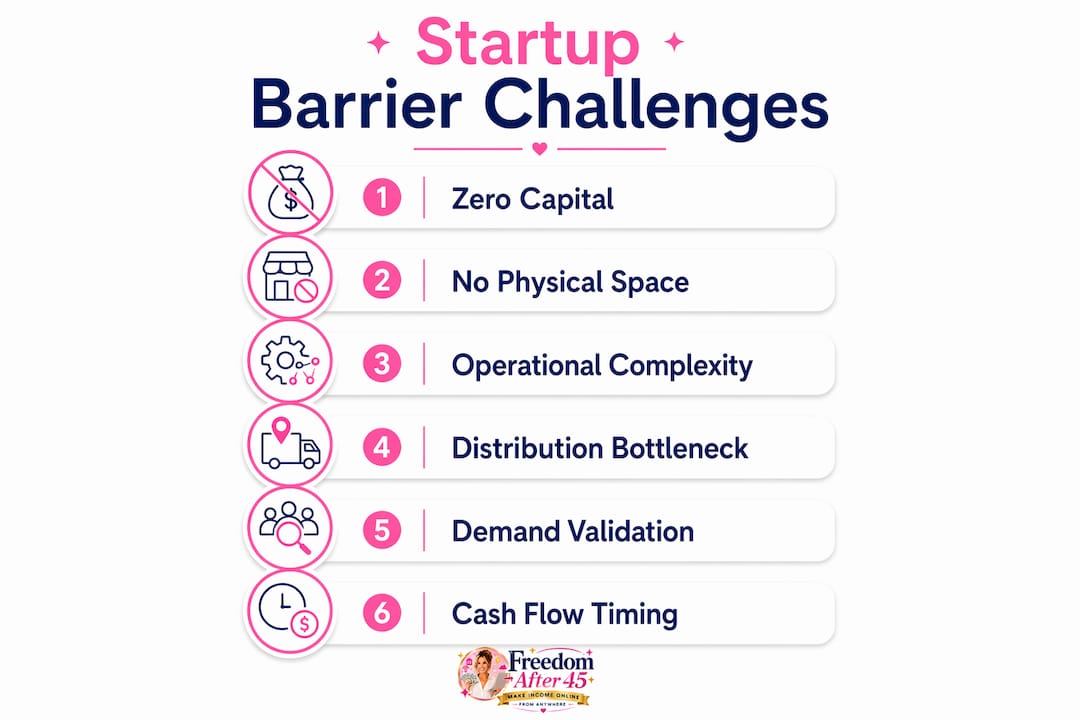
Distribution is now the primary bottleneck. Permissionless creation is only the first step; the real challenge is engineered distribution through funnels and retention systems that convert traffic into paying customers. You can publish a course on Teachable in a day. Getting 1,000 people to see it is the actual work.
Demand validation is non-negotiable. Many first-time online entrepreneurs build before they sell. That is backwards. The correct sequence is to validate demand with real buyers before investing significant time in creation.
Cash flow timing creates pressure. Even when sales happen, payment timing and settlement gaps create cash flow stress. Platforms hold funds for 7–14 days. Freelance invoices can sit unpaid for 30 days. You need a financial buffer even when revenue is technically flowing.
Platform dependency adds compliance complexity. Selling through Amazon, Etsy, or app stores means accepting their rules, fees, and the risk of account suspension. Transaction-layer compliance involving tax, payment responsibility, and payout reconciliation creates hidden startup barriers that catch small operators off guard.
Here is a practical sequence for tackling these new challenges:
- Identify one specific problem your target buyer has and confirm they are actively searching for a solution.
- Validate with a minimum offer before building the full product or service. A simple landing page or a direct message to five potential clients works.
- Build one traffic channel before diversifying. SEO, YouTube, or a single social platform each take 3–6 months to compound. Pick one and stay consistent.
- Set up payment infrastructure early. Tools like Hurupay, Stripe, or PayPal each have different geographic coverage and fee structures. Choose based on where your buyers are.
- Track cash flow weekly. Know exactly when money arrives and when your next expense hits.
Pro Tip: Treat your first 90 days as a validation sprint, not a launch. Your goal is one paying customer, not a perfect product.
How do online business models compare on startup barriers?
Not all online income models remove the same barriers. The table below compares the most common models on four dimensions: startup cost, time to first revenue, difficulty level, and the primary barrier that remains.
| Business Model | Startup Cost | Time to Revenue | Difficulty | Primary Remaining Barrier |
|---|---|---|---|---|
| Freelancing / Services | $0–$100 | Days to weeks | Low | Client acquisition |
| Digital products (Etsy, Gumroad) | $0–$200 | Weeks to months | Medium | First sale and discoverability |
| Coaching / Consulting | $0–$300 | Weeks | Low to Medium | Credibility and positioning |
| Content creation (YouTube, blog) | $0–$500 | 6–18 months | Medium to High | Audience growth and monetization |
| SaaS / Subscription software | $500–$5,000+ | 6–36 months | High | Technical build and churn management |
Online income startup costs vary widely by model, from freelancing at near-zero cost with fast revenue to SaaS requiring higher investment but offering recurring income. That range matters because it means you can match a model to your current resources, not just your ambitions.
A few patterns stand out from this comparison:
- Freelancing and consulting generate cash the fastest but require active time for every dollar earned.
- Digital products and content creation offer the most scalable income but demand patience. Passive income requires significant upfront work before it becomes genuinely hands-off.
- SaaS is the highest-ceiling model but also the most capital and skill-intensive. It is rarely the right starting point for someone new to online income.
The smartest entry point for most people is a service or consulting model that funds the creation of a digital product over time. You earn while you build.
Practical steps to start earning online despite startup challenges
Starting an online income stream is less about having the right idea and more about executing the right sequence. These steps apply whether you are starting from scratch or pivoting from a traditional job.
- Identify one marketable skill you already have. Writing, design, bookkeeping, video editing, and tutoring all have active buyer markets on platforms like Upwork, Fiverr, and Toptal. If you do not have a skill yet, platforms like Coursera offer certificates in high-demand areas within weeks.
- Use free tools to start. Canva handles design. Google Docs handles writing. Zoom handles coaching calls. You do not need paid software until revenue justifies it.
- Validate before you build. Offer your service or product idea to five real people before investing more than 10 hours in creation. A single paid client confirms your direction faster than any market research.
- Leverage your network to cut costs. Entrepreneurs who stretch scarce resources by leveraging networks early reduce costs and turn capital barriers into relationship advantages. Ask a contact to review your offer, share your listing, or refer you to their first client.
- Start as a side project. Keep your current income source while you build. This removes financial pressure and gives you room to iterate without desperation.
- Solve your payment problem early. If you serve international clients, tools like Hurupay or Stripe handle multi-currency payouts and reduce the friction that kills early momentum.
Selling digital products on platforms like Etsy or Gumroad eliminates inventory risk but shifts the challenge to platform dependency and making that critical first sale. Plan for that shift. Build a small email list or social following in parallel so you are never entirely dependent on one platform’s algorithm.
Pro Tip: Your first $1,000 online is the hardest. Once you have earned it, you have proof of concept. Every dollar after that is iteration, not invention.
Key takeaways
Online income bypasses startup barriers by replacing capital and infrastructure requirements with skill, effort, and digital platforms, but distribution and demand validation remain the real work.
| Point | Details |
|---|---|
| Capital barriers are largely removed | Most online income models start for $0–$500, compared to thousands for traditional businesses. |
| Distribution is the new bottleneck | Getting traffic and converting buyers is harder than creating a product or service. |
| Model choice determines timeline | Freelancing generates revenue in days; content creation and SaaS take 6–36 months. |
| Passive income requires upfront effort | Expect significant time and skill investment before income becomes hands-off. |
| Networks and free tools cut costs further | Leveraging relationships and platforms like Canva or Coursera reduces startup friction to near zero. |
The uncomfortable truth about “low barrier” online income
Freedom After 45 has watched thousands of people start online income streams, and the pattern is consistent. The capital barrier is gone. That part is real. But the people who stall are not the ones who ran out of money. They are the ones who underestimated distribution.
Building a digital product takes a weekend. Building an audience that buys it takes months. Most people spend 80% of their energy on creation and 20% on distribution. The ratio should be reversed, especially in the first year. The market does not reward the best product. It rewards the product that reaches the most buyers.
The other thing worth saying plainly: passive income is not immediate. The phrase gets used as a selling point, but the reality is that every passive income stream has an active phase first. A course, a template pack, an affiliate site. Each one requires real work before it earns while you sleep. That is not a reason to avoid it. It is a reason to start now rather than waiting for the perfect moment.
The good news is that the tools available in 2026 compress that active phase significantly. Payment infrastructure like Hurupay removes geographic friction. AI tools accelerate content creation. Platforms like Etsy and Gumroad provide built-in audiences. The barriers are lower than they have ever been. The work is still real, but the ceiling is higher than any traditional business model ever offered someone starting with limited capital.
Start small. Validate fast. Iterate without ego.
— Freedom After 45
Start earning daily with a proven 2-hour workflow
If you are ready to move from reading about online income to actually generating it, Freedom After 45 built the exact system for where you are right now.

The 2-Hour Workflow at earningdaily.net is a step-by-step blueprint designed for people who want to earn $100 to $1,400 per day without a social media following, an existing product, or prior experience. It removes the guesswork from distribution, validation, and cash flow timing. Thousands of families have already used it to move from financial overwhelm to a structured, repeatable income. You do not need to figure this out alone. The path is already mapped.
FAQ
What is the cheapest way to start an online income stream?
Freelancing and service-based models are the lowest-cost entry points, often starting for $0 to $100. Platforms like Upwork and Fiverr provide built-in buyer traffic so you do not need a marketing budget to land your first client.
How long does it take to earn real money online?
Freelancing and consulting can generate income within days to weeks. Digital products and content creation typically take 6–18 months to produce consistent revenue, depending on your niche and distribution strategy.
Does online income really bypass traditional startup barriers?
Yes, but it replaces capital barriers with skill and distribution challenges. You trade the need for funding and infrastructure for the need to build an audience and convert traffic into paying customers.
What is the biggest mistake new online entrepreneurs make?
Building before validating. Most people invest weeks creating a product before confirming that real buyers exist. The correct sequence is to validate demand first, then build, which saves time and prevents wasted effort.
Do i need technical skills to start earning online?
No technical skills are required for most entry-level models like freelancing, coaching, or selling digital templates. Tools like Canva, Gumroad, and Zoom handle the technical side so you can focus on delivering value to clients.