

How New Entrepreneurs Earn Their First $100 Online
Earning your first $100 online is defined by one principle: deliver real value before you build anything complex. How new entrepreneurs earn first $100 online comes down to choosing one accessible method, executing it consistently, and collecting payment. Platforms like Upwork, Fiverr, Gumroad, and Canva remove nearly every traditional barrier. You do not need a product, a following, or startup capital. The methods that work fastest include freelancing transferable skills, selling unused personal items, and creating small digital products. Timelines range from one day to four weeks depending on your approach. Consistency and focus beat perfection every time.
What are the fastest proven ways to earn your first $100 online?
The fastest path to $100 depends on what you already have: skills, stuff, or time. Each method below has a realistic timeline and a clear effort level.
| Method | Timeline | Startup Cost | Effort Level |
|---|---|---|---|
| Selling unused items | 1 to 5 days | $0 | Low |
| Freelancing on Upwork or Fiverr | 1 to 2 weeks | $0 | Medium |
| Small digital products on Gumroad or Etsy | 2 to 4 weeks | $0 to $15 | Medium |
| Dropshipping | 4 to 8 weeks | $50+ | High |
Selling unused personal items is the single fastest option for most beginners. You already own the inventory, and platforms like eBay and Facebook Marketplace handle the audience. Freelancing comes second because platforms like Upwork and Fiverr connect you to buyers actively searching for help right now. Digital products take slightly longer to set up but carry the advantage of earning while you sleep once the listing is live.

Dropshipping is slower and more capital-intensive. It is worth understanding as a future path, but it is not the right first move when your goal is reaching $100 quickly.
Pro Tip: Pick one method and commit to it for two full weeks before switching. Jumping between strategies is the number one reason new entrepreneurs stall before their first sale.
How to get started with freelancing and win your first clients quickly
Freelancing is the most direct way to convert existing knowledge into cash. Writing, graphic design, data entry, video editing, social media scheduling, and basic web research all qualify. You do not need a degree or a portfolio of paid work to start.
Follow these steps to land your first freelancing client fast:
- Create a niche-specific profile. Write a headline that names exactly who you help and what you do. “I help small e-commerce brands write product descriptions that convert” beats “Freelance writer available.”
- Build two or three portfolio samples. Create them yourself if you have no paid work yet. A mock product description, a sample graphic, or a short research report proves your capability.
- Send 8 to 10 targeted proposals every day. Focus on entry-level jobs priced under $100. Competition is lower and clients are more willing to take a chance on a new profile.
- Use AI tools like Claude to draft your proposals. Write the core pitch yourself, then use Claude to tighten the language and check clarity. This saves time without sacrificing authenticity.
- Deliver excellent work and ask for a review. A five-star review on your first job compounds. It makes every future proposal significantly more credible.
Consistent daily proposals outperform occasional bursts of effort. One hour of focused outreach every day beats four hours once a week. Speed in outreach matters more than a perfect profile. Get the profile to “good enough,” then spend your energy on proposals.
Pro Tip: Target clients who have hired before and left reviews. They understand the platform, they pay on time, and they know how to give useful feedback. New clients with zero hire history are riskier for your first job.
What are the essentials of selling unused personal items to reach $100 fast?
Selling unused items online is the fastest proof of concept for anyone new to online income. It requires zero investment and teaches you the core mechanics of ecommerce: pricing, photography, listing copy, and buyer communication.
Here is the process that works:
- Walk through your home and collect items unused for six months or more. Electronics, clothing, books, kitchen gadgets, sporting equipment, and collectibles all sell well.
- Research comparable sold prices. On eBay, filter by “Sold Listings” to see what buyers actually paid, not just what sellers are asking.
- Take photos in natural light. Set items near a window on a plain background. Clear photos increase buyer confidence and reduce questions.
- Write honest, detailed descriptions. Include dimensions, condition, brand, and any flaws. Buyers who feel informed buy faster and leave better feedback.
- Price to sell, not to maximize. Set your price 10 to 15 percent below comparable sold listings. A quick sale beats waiting three weeks for an extra $8.
- Respond to buyer messages within one hour. Fast communication closes sales. Slow responses lose them to competing listings.
This method builds something more valuable than $100. It builds sales confidence. You learn how buyers think, how to write copy that converts, and how to handle transactions professionally. That foundation transfers directly to every other online income method you pursue next.
How to create and sell small digital products as a beginner entrepreneur
Digital products are the closest thing to passive income for new entrepreneurs. You create the product once and sell it repeatedly with no shipping, no inventory, and no per-unit cost.
The key is to start small and focused. Beginners who try to build full online courses or 200-page ebooks spend weeks creating something nobody has confirmed they want. Instead, build products that solve one specific problem in under 30 minutes of the buyer’s time.
Strong beginner digital product ideas include:
- Canva template packs for small business owners, content creators, or job seekers (resume templates, Instagram post templates, pitch deck slides)
- AI prompt packs for specific use cases like writing product descriptions, drafting client emails, or generating social media captions
- Focused checklists or guides such as a “New Etsy Seller Launch Checklist” or a “30-Day Freelance Pitch Tracker”
Canva handles design at no cost. Claude handles writing and editing. Gumroad and Etsy both allow free accounts and take a small percentage only when you make a sale. There is no upfront cost to list.
A 30-day content and product approach shows that selling a small bundle to roughly ten customers at $10 each reaches the $100 mark without a large audience. The math is simple: one focused product, one clear niche, ten buyers. Targeting a small, specific audience with a clear problem solved beats targeting everyone with a generic product every time.
The passive income potential is real but modest at first. A Canva template pack priced at $7 that sells three times a week generates $84 per month with zero additional work after the initial listing. That compounds as you add more products.
What new entrepreneurs need to know about taxes on their first $100 online
Online income is taxable from the first dollar earned, regardless of whether you receive a tax form. Many beginners assume that if a platform does not send a 1099, they owe nothing. That assumption is wrong and can lead to IRS penalties.
Here is what you need to understand before your first payment arrives:
- W-9 and W-8BEN forms: US-based earners submit a W-9 to platforms like Upwork or Gumroad. Non-US earners submit a W-8BEN. These forms establish your tax identity with the platform.
- Self-employment tax: Freelance and affiliate income carries a self-employment tax rate of approximately 15.3%, covering Social Security and Medicare. This is in addition to your regular income tax rate.
- Quarterly estimated taxes: If you expect to owe more than $1,000 in taxes for the year, the IRS requires quarterly estimated payments. Missing these triggers penalties.
- Business deductions: Internet service, software subscriptions, home office space, and equipment used for your online business are all deductible. Track every expense from day one.
- No 1099 does not mean no tax owed. IRS third-party reporting means platforms report your earnings regardless of whether they send you a form. Report all income on Schedule C.
Start a simple spreadsheet on day one. Log every dollar earned and every business expense. This takes five minutes per week and saves hours of stress at tax time.
Key takeaways
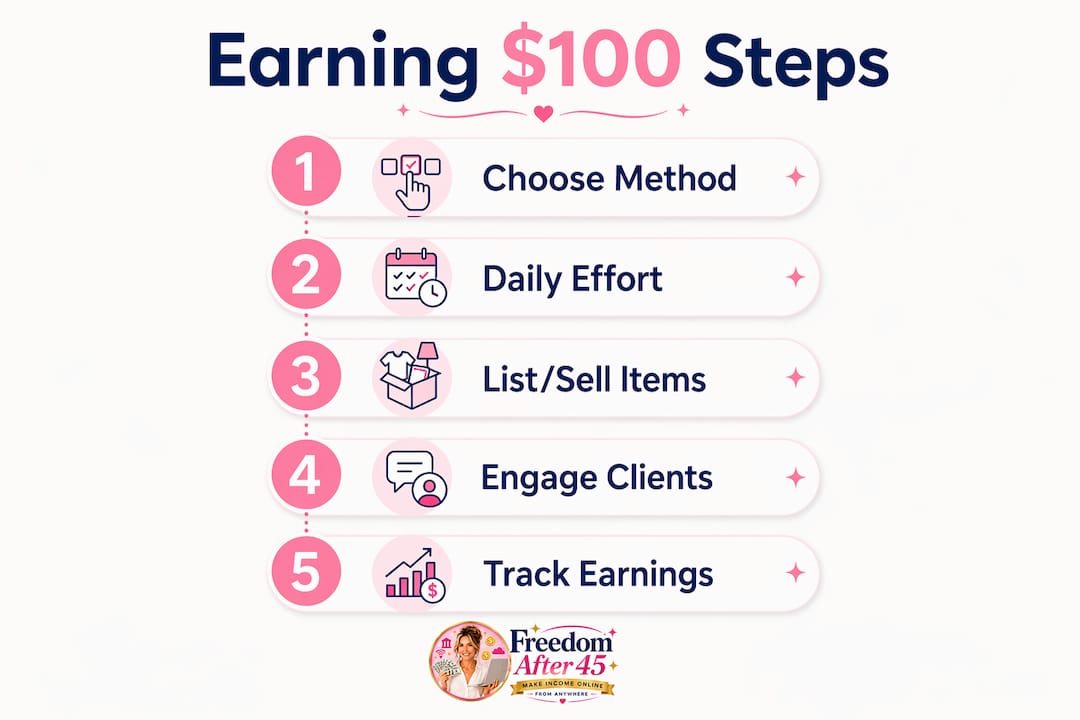
Earning your first $100 online requires choosing one method, executing it daily, and treating every transaction as a learning opportunity that compounds into larger income.
| Point | Details |
|---|---|
| Fastest method is selling items | Unused personal items on eBay or Facebook Marketplace can generate $100 within one to five days. |
| Freelancing beats waiting | Sending 8 to 10 daily proposals on Upwork or Fiverr produces results within one to two weeks. |
| Digital products scale passively | A focused Canva template or checklist on Gumroad earns repeatedly with no extra work per sale. |
| Tax compliance starts at dollar one | Self-employment tax runs approximately 15.3%; track income and expenses from your very first payment. |
| Consistency outperforms perfection | One hour of daily effort beats sporadic longer sessions every time. |
What I’ve learned watching beginners chase their first $100 online
At Freedom After 45, we have seen hundreds of new entrepreneurs make the same mistake: they spend three weeks building a “perfect” funnel before talking to a single potential customer. The first $100 rarely comes from a polished system. It comes from a direct offer, a clear price, and a fast response to someone who needs help right now.
The entrepreneurs who reach $100 fastest share one habit. They validate demand early through simple conversations, not complex surveys. A five-minute chat with a potential buyer reveals whether your offer solves a real problem or just sounds good in your head. That feedback is worth more than any course or tool.
The second pattern I see is the trap of spreading effort across too many channels at once. Someone tries freelancing on Monday, lists items on Tuesday, starts a blog on Wednesday, and signs up for affiliate marketing on Thursday. By Friday, nothing has traction and they conclude “online income doesn’t work.” It works. Scattered effort does not.
One clear offer with a single next step closes sales faster than a complicated multi-step funnel. A $15 Canva template pack with a “Buy Now” button on Gumroad outperforms a five-email sequence leading to a $97 course for a beginner. Start simple. Add complexity only after you have proven the offer converts.
The first $100 is not about the money. It is proof that a stranger valued what you created enough to pay for it. That proof changes how you think about your own potential.
— Freedom After 45
Ready to build a system that earns daily, not occasionally?
The methods in this article work. They also require you to figure out the details yourself, test what resonates, and iterate through trial and error. That process takes time most people do not have.

Freedom After 45 built the 2-Hour Workflow specifically for people who want a structured, proven path instead of scattered experiments. The system requires no existing audience, no product of your own, and no prior online business experience. Thousands of families have used it to move from financial overwhelm to consistent daily income by investing just two focused hours a day. If you are ready to stop experimenting and start earning, this is the next step.
FAQ
How fast can a beginner realistically earn their first $100 online?
Selling unused personal items on eBay or Facebook Marketplace is the fastest route, with most people reaching $100 within one to five days. Freelancing on Upwork or Fiverr typically takes one to two weeks with consistent daily proposals.
Do I need money to start earning online as a new entrepreneur?
Most of the fastest methods cost nothing to start. Upwork, Fiverr, Facebook Marketplace, and Gumroad all offer free accounts. Canva’s free tier is sufficient to create and sell digital templates without any upfront investment.
Is online income taxable if I only earn $100?
Yes. Online income is taxable from the first dollar, regardless of whether you receive a 1099 form. Freelance and self-employment income carries a self-employment tax rate of approximately 15.3% in addition to regular income tax.
What is the biggest mistake new entrepreneurs make when trying to earn online?
Trying multiple methods simultaneously is the most common mistake. Picking one method and committing to it for at least two weeks produces far better results than splitting attention across freelancing, digital products, and affiliate marketing at the same time.
Can I earn $100 online without any special skills?
Yes. Selling unused personal items requires no skills at all, only items you already own and a free marketplace account. Basic tasks like data entry, research, and social media scheduling on Fiverr also require minimal specialized knowledge to start.