

How Entrepreneurs Earn Recurring Online Income
Most people assume recurring online income requires a massive audience, a tech background, or serious startup capital. None of that is true. Understanding how entrepreneurs earn recurring online income comes down to two things: choosing the right business model and managing what happens after the first sale. The industry term for this is recurring revenue, and it is built on subscriptions, memberships, digital products, and services that pay on a predictable schedule. Get the model right and the lifecycle management right, and you have something far more powerful than a one-time payday.
Table of Contents
- Key Takeaways
- How entrepreneurs earn recurring online income
- Lifecycle drivers that make income predictable
- Practical steps to build your first recurring stream
- Common pitfalls that stall recurring income
- My honest take on building recurring income
- Start building your recurring income today
- FAQ
Key Takeaways
| Point | Details |
|---|---|
| Model selection matters | Subscriptions, memberships, and digital products are the most accessible recurring revenue strategies for new entrepreneurs. |
| Post-sale work drives income | Lifecycle management after the first sale determines whether recurring income grows or quietly collapses. |
| Churn is the silent killer | Moving churn from 2% to 7% monthly cuts average customer lifespan from 50 months to just 14 months. |
| Payment recovery is underrated | Recovering failed payments alone can recoup up to 38% of lost revenue, making it one of the highest-ROI activities. |
| Start small, then scale | A minimum viable subscription offering built around one clear problem is the fastest path to your first recurring dollar. |
How entrepreneurs earn recurring online income
Recurring revenue is not a single business model. It is a category of entrepreneur income streams that share one defining trait: customers pay on a repeating schedule rather than once. The most accessible online business models for income fall into a few clear categories.
Subscriptions and memberships are the most direct path. You charge a monthly or annual fee for access to a course library, a private community, software, or exclusive content. Sites monetize through subscriptions and paid membership tiers, which give members exclusive access in exchange for a recurring fee. Think of a fitness coach who moves from one-off training sessions to a $49/month online program. Same expertise, completely different income structure.
Digital products with recurring licensing work similarly. A Notion template pack, a stock photo subscription, or a software plugin with an annual license all generate income without requiring you to show up every day.
Productized recurring services are one of the most underused models. Instead of billing hourly, you bundle a defined set of tasks into a monthly retainer. A freelance social media manager, for example, bundles micro-tasks into monthly retainers, creating predictable cash flow for both sides.
Freemium-to-paid funnels use free access as the entry point. Spotify’s model is the clearest example: free drives engagement then conversion to premium, with paid tiers deepening average revenue per user over time. You do not need Spotify’s scale to use this logic. A free email course that converts to a paid membership works on the same principle.
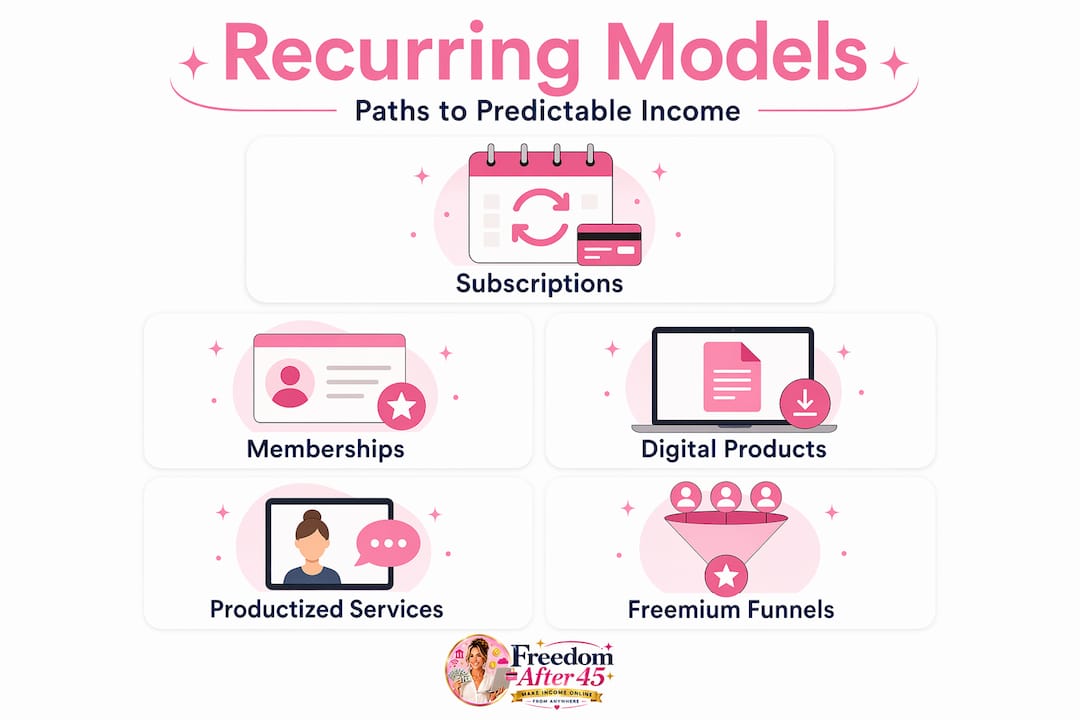
Here is a quick comparison of the most common models:
| Model | Startup cost | Complexity | Scalability |
|---|---|---|---|
| Online membership/course | Low | Medium | High |
| Productized service retainer | Very low | Low | Medium |
| SaaS product | High | High | Very high |
| Digital product subscription | Low | Low | High |
| Affiliate/ad revenue | Very low | Low | Medium |
Affiliate and advertising revenue deserve mention as supplemental streams. They are not the foundation of a recurring income business, but they compound well once you have an audience or content library generating consistent traffic.
Lifecycle drivers that make income predictable
Here is what most guides skip entirely. You can have the perfect subscription model and still watch your income shrink month after month. That happens when entrepreneurs treat recurring revenue as a billing problem instead of a lifecycle commitment.
Recurring revenue grows through lifecycle execution, not just billing. The lifecycle has four stages that every recurring income business must manage:
- Onboarding: Getting new subscribers to their first win quickly. A member who sees results in week one stays far longer than one who feels lost.
- Adoption: Helping members use what they are paying for. Underused subscriptions get canceled. Regular check-ins, tutorials, and usage nudges keep engagement high.
- Relationship management: Staying visible and relevant between billing cycles. This is where email sequences, community engagement, and content updates do their work.
- Renewal readiness: Proactively addressing hesitation before the renewal date arrives. A well-timed win summary or a loyalty offer can save a cancellation that was already decided.
The numbers make this concrete. Changing churn from 2% to 7% monthly reduces customer lifetime value from roughly 50 months to just 14 months. That is not a small difference. It means a business with identical acquisition numbers can generate three times more revenue simply by retaining customers longer.
Pricing and operational recovery often drive recurring revenue growth more than marketing alone. Tactics like dunning management (automated follow-ups on failed payments), upsell offers at renewal, and catalog refreshes all move monthly recurring revenue without adding a single new customer.

Pro Tip: Track involuntary churn separately from voluntary churn. Involuntary churn happens when a payment fails, not when a customer decides to leave. Smart retry logic and email recovery sequences can recoup a significant portion of that revenue before the subscription ever lapses.
Practical steps to build your first recurring stream
You do not need a finished product or a large audience to start. You need a clear problem, a defined audience, and a repeatable way to deliver value. Here is how to move from zero to your first recurring revenue without significant upfront cost.
- Identify one specific problem you can solve on a recurring basis. Not “I help people with marketing.” More like “I write two SEO blog posts per month for local service businesses.” Specificity is what makes a retainer or subscription feel worth paying for every month.
- Build a minimum viable subscription offering. Start with one tier, one price, and one clear deliverable. Complexity kills momentum. A $97/month membership with weekly video lessons and a private Q&A thread is something you can launch in a week.
- Use a freemium or free trial entry point. Offer a free resource, a trial period, or a low-cost introductory offer. This lowers the barrier to entry and lets your value speak before someone commits to a recurring charge.
- Set up proper billing infrastructure from day one. Bank transfers lack native recurring billing capabilities, so use card billing or direct debit through a platform like Stripe or a dedicated membership tool. Automation here is not optional. Manual billing does not scale and creates gaps that cost you revenue.
- Build your upgrade path before you need it. Even if you launch with one tier, know what the next tier looks like. A clear upgrade path means your existing subscribers become your best source of revenue growth through upsells rather than constant new acquisition.
Pro Tip: Once your first tier is stable, add an annual billing option at a 15-20% discount. Annual subscribers churn at dramatically lower rates than monthly subscribers, and the upfront cash flow gives you room to invest in content and community.
The tools available today make this more accessible than ever. Platforms like Kajabi, Memberful, and Patreon handle billing, content delivery, and community in one place. You can have a functioning subscription business running before you spend a dollar on advertising.
Common pitfalls that stall recurring income
Even well-designed recurring income models fail when entrepreneurs make predictable mistakes. Knowing them in advance saves you months of frustration.
- Ignoring churn signals. Most cancellations are predictable. Low login frequency, skipped renewals, and unanswered emails are all warning signs. If you are not tracking engagement metrics, you are flying blind until the cancellation email arrives.
- Underestimating the operational workload. “Passive income” is a real concept, but it describes the income, not the work. Recurring revenue is a lifecycle commitment, not a set-it-and-forget-it system. Plan for ongoing content creation, community management, and customer support from the start.
- Relying on a single revenue stream or channel. One membership plus one traffic source is fragile. Diversifying your ways to earn online revenue, whether through multiple tiers, affiliate income, or a secondary digital product, protects you when one stream dips.
- Poor billing infrastructure. Failed payments are silent revenue leaks. Without retry logic and recovery emails, a payment failure becomes a cancellation by default. Recovery workflows can recoup meaningful revenue that would otherwise disappear without any customer ever intending to leave.
- Confusing voluntary and involuntary churn. Voluntary churn means a customer chose to leave. Involuntary churn means a payment failed. They require completely different responses. Treating all churn as a product problem when half of it is a billing problem means you are solving the wrong thing.
My honest take on building recurring income
I have seen a lot of people approach recurring revenue the wrong way. They obsess over conversion rates and acquisition funnels, then wonder why their monthly revenue stays flat despite signing up new members every week. The problem is almost always what happens after the sale.
Subscription revenue is earned twice: once at conversion and again at renewal. Most entrepreneurs only work on the first half. The renewal is where the real money compounds, and it requires a completely different skill set. It requires empathy, consistency, and operational discipline.
What I have learned is that the entrepreneurs who build genuinely sustainable recurring income are not necessarily the best marketers. They are the ones who treat every subscriber like someone worth keeping. They send the onboarding email. They notice when engagement drops. They fix the billing retry before it becomes a churn statistic.
If you are just starting out, do not wait until you have a large audience or a polished product. Start with one problem, one offer, and one commitment to show up for your subscribers every month. The income compounds when the retention compounds. That is the part most people skip, and it is the part that makes all the difference.
— Freedom After 45
Start building your recurring income today
If this article clarified the models and mechanics, the next step is putting a real workflow behind them. Freedom After 45 offers a proven system designed specifically for people who want to generate daily recurring income without a product, a following, or a complicated setup.

The 2-Hour Workflow at Freedom After 45 walks you through a step-by-step process to earn 100% profit online daily, with reported results ranging from $100 to $1,400 per day. Thousands of families have already used it to move from financial stress to genuine freedom. It requires just two hours a day and no prior experience. If you are ready to stop reading about recurring income and start building it, this is the place to start.
FAQ
What is recurring online income?
Recurring online income is revenue earned on a predictable, repeating schedule through subscriptions, memberships, digital products, or retainer services. Unlike one-time sales, it compounds over time as you retain customers.
How much does it cost to start a recurring income business?
Many recurring revenue strategies require very little upfront investment. A productized service retainer or a basic membership site can be launched with minimal cost using existing platforms for billing and content delivery.
Why does churn matter so much for recurring income?
Churn directly reduces customer lifetime value. Moving churn from 2% to 7% monthly cuts the average customer lifespan from 50 months to 14 months, meaning you need far more new customers just to stay flat.
What is the fastest way to create passive income online?
The fastest path is converting an existing skill into a productized monthly retainer or launching a simple membership with a defined deliverable. Both can generate recurring revenue within weeks without requiring a large audience.
How do I recover lost revenue from failed payments?
Use a billing platform with automated retry logic and email recovery sequences. Smart retry workflows can recover up to 38% of revenue lost to failed payments before a subscription ever formally lapses.