

How Earning $100 Daily Changes Your Mindset
Most people believe only life-changing sums of money shift how they think about finances. That assumption is wrong, and understanding how earning $100 daily changes mindset is where real financial transformation begins. The psychological shift does not come from a windfall. It comes from proof, repeated daily, that you can generate income on your own terms. This article covers the behavioral science behind daily income mindset, practical experiments you can run this week, and the specific mental rewiring that happens when small consistent wins stack up over time.
Table of Contents
- Key Takeaways
- How earning $100 daily changes mindset through psychological capital
- From scarcity thinking to abundance: what $100 daily actually signals
- The science of micro-celebrations and why they rewire your brain
- Your 30-day $100 daily income experiment
- Common pitfalls when building a daily income mindset
- My honest take on why $100 daily matters more than you think
- Start building your daily income system today
- FAQ
Key Takeaways
| Point | Details |
|---|---|
| Daily proof beats big wins | Earning $100 consistently builds self-efficacy faster than occasional large income events. |
| Scarcity thinking fades with structure | Repeated daily wins create abundance signals that reduce panic-driven financial decisions. |
| Celebrate wins immediately | Micro-celebrations after each $100 day encode the habit neurologically and sustain motivation. |
| A 30-day experiment is enough | A focused 30-day income challenge produces concrete evidence that rewires financial confidence. |
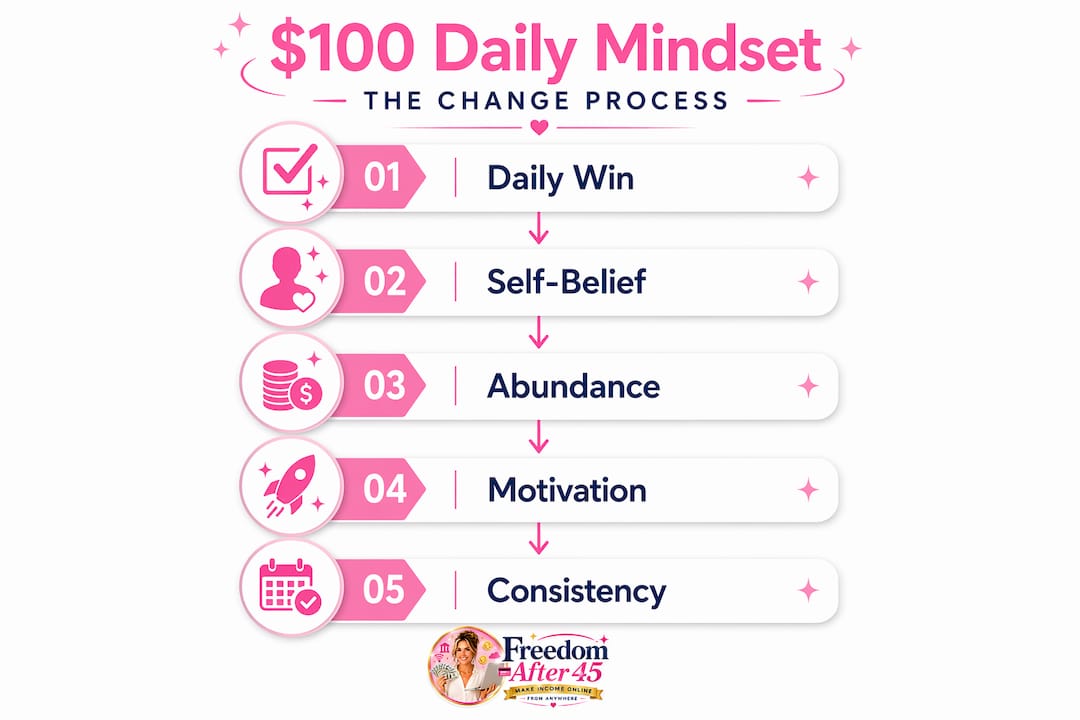
| Mindset shift is a process | Changing mindset by earning daily requires consistent repetition, not a single breakthrough moment. |
How earning $100 daily changes mindset through psychological capital
Behavioral scientists use the term psychological capital (PsyCap) to describe a cluster of mental resources: hope, self-efficacy, resilience, and optimism. These are not personality traits you are born with. They are skills you build through repeated experience. And consistent daily income is one of the most direct ways to build all four at once.
Research published in Frontiers in Psychology found that psychological capital significantly improves financial wellbeing both directly (β = 0.563, p < 0.001) and through improved financial behavior (β = 0.081, p < 0.004). That means the mindset shift is not just emotional. It changes how you actually handle money.
Here is what each component looks like in practice when you earn $100 daily:
- Hope grows because you have a working method, not just a wish. You know the path to income exists because you walked it yesterday.
- Self-efficacy builds because mastery experiences build belief faster than affirmations. Earning $100 is a mastery experience. Repeating it daily compounds that belief.
- Resilience strengthens because a bad day does not feel catastrophic when you know you have earned before and can earn again.
- Optimism shifts from wishful thinking to evidence-based expectation. You expect income because you have earned it repeatedly.
A separate study on financial self-efficacy and wellbeing confirmed that goal setting partially mediates this effect. When daily earnings give you confidence, you set clearer financial goals, which further improves your financial outcomes. The cycle feeds itself.
Pro Tip: Write down your income source and the amount every day you hit $100. This physical record becomes tangible evidence your brain uses to strengthen self-efficacy faster than memory alone.
From scarcity thinking to abundance: what $100 daily actually signals
Scarcity mindset is not just about having less money. It is a cognitive state where your brain is preoccupied with what you lack, which narrows thinking and drives impulsive decisions. People operating from scarcity tend to avoid financial planning, make short-term choices that cost more long-term, and feel chronic low-level stress around money.

Abundance mindset is the opposite. Research shows that abundance thinking focuses on value creation rather than hoarding, reduces panic decisions, and stabilizes financial behavior over time. The key insight is that abundance thinking is not about having a lot of money. It is about believing that value can be generated.
Earning $100 daily sends that signal repeatedly. Each day you earn, your brain receives a small but clear message: you are capable of creating value. Over time, those signals accumulate into a new default setting.
| Scarcity mindset | Abundance mindset |
|---|---|
| Focuses on what is missing | Focuses on what can be created |
| Avoids financial planning | Actively sets and tracks goals |
| Makes impulsive, fear-driven decisions | Makes strategic, value-driven decisions |
| Sees income as fixed and scarce | Sees income as expandable through effort |
| High financial stress, low control | Lower stress, higher perceived control |
The transition is not always smooth. Research on scarcity-to-abundance transitions found that the order of the shift matters, and that people with childhood scarcity experiences face a more complex path. If you grew up with financial stress, the daily $100 income signal needs more repetition before it overrides old patterns. That is not a flaw. It is just biology. Knowing this helps you stay patient.
“Mindset change from scarcity to abundance is not linear and benefits from repeated, structured returns to a sense of control.” The daily income routine is exactly that structure.
The science of micro-celebrations and why they rewire your brain
Here is something most financial advice completely ignores. When you acknowledge a win matters as much as the win itself. The brain encodes experiences based on peak moments and end moments. If you earn $100 and immediately move on without any recognition, your brain files it as neutral. If you pause and celebrate, even briefly, it gets filed as a reward.
This is the psychology of daily income working in your favor. Immediate celebration enhances habit formation by tagging the behavior with a dopamine response. Your brain then seeks to repeat the behavior to get that response again. Over time, the habit of earning becomes self-reinforcing.
Micro-celebrations do not have to be elaborate. The point is immediacy and intentionality. Here are four practical ways to apply this principle starting today:
- The 10-second pause. The moment you confirm a $100 day, stop. Take a breath. Say out loud or in writing: “I did that.” This is not affirmation. It is acknowledgment of a real event.
- The progress log. Keep a simple notebook or phone note where you record each $100 day with a single sentence about how you earned it. Reading back through this log after two weeks is genuinely motivating.
- The small reward ritual. Pair your $100 day with a specific small pleasure: a good cup of coffee, a walk, a favorite playlist. The pairing trains your brain to associate earning with positive feeling.
- The weekly review. Every seven days, count your $100 days and note the trend. Progress is motivating on its own, but seeing it clearly amplifies the effect.
Pro Tip: Do not wait until you feel motivated to celebrate. The celebration creates the motivation. Reverse the sequence and the habit builds much faster.
Your 30-day $100 daily income experiment
The most direct way to experience the impact of $100 daily is to run a structured 30-day experiment. This is not about getting rich in a month. It is about generating repeated proof that you can earn outside of a paycheck. That proof is what actually changes how you think about money.
A documented 30-day $100 experiment produced consistent side income equal to 15 to 25 percent of salary within about six months. The income mattered. But the confidence shift happened in the first 30 days.
Here is how to run your own version:
- Inventory your skills honestly. Write down five things you can do that someone else would pay for. These do not have to be glamorous. Writing, editing, tutoring, organizing, designing, advising, cooking, building. Start with what you already know.
- Package a micro offer. Take one skill and create a simple offer around it. “I will write three social media captions for $30.” “I will organize your digital files for $50.” Small, specific, and deliverable in under two hours.
- Set a daily action target, not just an income target. Decide that every day you will take one concrete step: send two outreach messages, post one offer, follow up with one lead. Daily action is what creates daily income.
- Track every dollar. Record what you earned, how you earned it, and how long it took. This data becomes your personal proof of concept.
- Refine after week one. Look at what worked and double down. Drop what did not produce results. The experiment teaches you what your market actually wants.
Note that 40% of Americans with side income cite inconsistency as their biggest challenge. The daily structure of this experiment directly addresses that. You are not trying to earn $3,000 this month. You are trying to earn $100 today. That narrow focus is what makes the mindset shift possible.
Common pitfalls when building a daily income mindset
Even with the right framework, most people hit predictable obstacles. Knowing them in advance makes them easier to navigate.
- Impatience in week two. The first week feels exciting. The second week often feels flat. This is normal. The mindset shift is still building even when results feel slow. Keep the daily action target regardless of income results.
- Scarcity relapse after a bad day. One zero-income day can trigger old scarcity patterns hard. The antidote is your progress log. Look at the evidence you have already built before reacting emotionally.
- Identity jumping without a system. Some people declare themselves entrepreneurs before they have a working income system. The identity shift should follow the evidence, not precede it. Let the daily $100 build the identity rather than forcing the identity to build the income.
- Skipping the celebration. When life gets busy, the micro-celebration is the first thing people drop. This is a mistake. The emotional tagging of wins is what makes the habit stick. Protect it.
- Treating every setback as a signal to quit. Financial growth and mindset development both involve plateaus. A plateau is not failure. It is the phase where the new behavior is consolidating before the next leap.
My honest take on why $100 daily matters more than you think
I have watched hundreds of people try to change their financial lives, and the pattern is consistent. The ones who wait for a big opportunity stay stuck. The ones who start generating small, repeatable income today are the ones who look back in six months completely transformed.
What I have learned is that the dollar amount is almost secondary. What $100 daily actually does is give you evidence. And evidence beats motivation every single time. You cannot talk yourself into confidence. You earn your way into it.
The autonomy piece is what surprises people most. When you know you can generate $100 today if you need to, your relationship with your job, your bills, and your stress changes. Not because $100 solves everything, but because you are no longer completely dependent on one source. That psychological shift, the feeling of having options, is worth more than the money itself.
The mindset shift is a process, not an event. I have seen people make real progress in 30 days and then stall because they expected a permanent transformation after one good month. The daily income routine needs to become a permanent structure, not a temporary experiment. That is when the real financial growth and mindset change become self-sustaining.
— Freedom After 45
Start building your daily income system today
If this article resonated with you, the next step is not more reading. It is a working system.

At Freedom After 45, the 2-Hour Workflow is built specifically for people who want to generate $100 to $1,400 daily without needing a social media following, an existing audience, or a product of their own. It is a step-by-step blueprint that thousands of families have already used to move from financial overwhelm to real daily income. You invest two hours a day. The system handles the rest. If you are ready to stop waiting for the right moment and start building daily proof of your own earning ability, this is where to begin.
FAQ
How does earning $100 daily actually change your mindset?
Earning $100 daily builds psychological capital, specifically self-efficacy and optimism, by providing repeated mastery experiences. Over time, this consistent proof of earning ability replaces scarcity-driven thinking with an evidence-based belief that income is within your control.
How long does it take to notice a mindset shift from daily income?
Most people notice a meaningful shift within 30 days of consistent daily earning. Research on the 30-day $100 experiment shows that confidence and financial behavior begin changing well before income reaches significant levels.
What is the difference between a scarcity and abundance mindset in finance?
A scarcity mindset focuses on what is lacking and drives fear-based financial decisions, while an abundance mindset focuses on value creation and strategic action. Daily income routines help shift this by sending repeated signals that earning is possible and repeatable.
Why do micro-celebrations matter when building a daily income habit?
Celebrating a $100 win immediately after it happens triggers a dopamine response that tags the behavior as rewarding. This neurological tagging is what transforms a one-time action into a reliable habit over time.
Can a $100 daily income goal work for someone with no business experience?
Yes. The most effective approach is to start with existing skills packaged as simple micro offers. The goal is not expertise in business but repeated proof of earning, which builds the confidence and systems needed to grow from there.