

Earn Money Online as a Student: 2026 Guide
Tuition, rent, groceries, textbooks. The costs of being a student keep climbing, and a part-time campus job rarely covers the gap. If you want to earn money online as a student without sacrificing your GPA or your sanity, you need a plan built around your actual schedule, not someone else’s. This guide cuts through the noise and gives you realistic, beginner-friendly methods that fit between classes, work on a laptop or phone, and pay out in real money. No pyramid schemes. No “unlimited earning potential” nonsense. Just what actually works.
Table of Contents
- Key takeaways
- How to earn money online as a student: what to prepare first
- Best online money-making methods for students, step by step
- Common challenges when earning online as a student
- How to track your progress and optimize your earnings
- My honest take on student side hustles
- Start earning smarter with Earningdaily
- FAQ
Key takeaways
| Point | Details |
|---|---|
| Start with your skills | Identify what you already know before choosing a side hustle to speed up your first paycheck. |
| Stack low-effort with focused work | Combine passive tasks like surveys with active freelance work to maximize income without burning out. |
| Verify every platform | Check reviews, payout proofs, and terms before signing up to avoid scams targeting students. |
| Set income goals, not just time | Measure progress by dollars earned per hour, not hours spent, to find what’s worth your time. |
| Scale what works | Once one income stream pays consistently, reinvest time into growing it before adding another. |
How to earn money online as a student: what to prepare first
Before you open a new browser tab and sign up for the first survey site you find, spend thirty minutes on setup. Students who skip this step waste weeks on platforms that don’t pay well or, worse, hand their personal data to sketchy operators.
Get your tools in order
You need a reliable internet connection, a device that can run a browser and basic apps, and a dedicated email address for your online income accounts. That last point matters more than people realize. Keeping your side hustle email separate from your academic email protects you from phishing attempts and keeps your inbox manageable.
Here are the core tools worth having from day one:
- A PayPal or Venmo account for receiving payments. Most survey and task apps pay out through these, often with a $10 payout threshold processed within one to three business days.
- A Google Drive or Notion workspace to track your hours, earnings, and platform logins.
- A time-blocking calendar (Google Calendar works fine) to protect study time from creeping hustle hours.
- A VPN if you use public campus Wi-Fi for anything involving financial accounts.
Know your skills and your schedule honestly
The biggest mistake students make is chasing the highest-paying method instead of the fastest-starting one. If you have zero freelance experience, jumping straight into high-ticket copywriting projects will frustrate you. Start where your skills already are. Strong writer? Content mills and blog clients pay faster than you think. Good at explaining concepts? Online tutoring has almost no barrier to entry.

Pro Tip: Write down three things people ask you for help with regularly. Those are your marketable skills, and they are the fastest path to your first online paycheck.
Students should also be aware that identity-targeting scams are real and growing. Never pay to join a platform, never share your Social Security number with an unverified site, and always Google a platform’s name plus “scam” or “reviews” before creating an account.
Best online money-making methods for students, step by step
Here is where most articles give you a vague list. Instead, here are specific starting steps for each method so you can take action today.
- Paid survey and mobile task apps. Download apps like KashKick, Swagbucks, or Surveoo. Complete your profile fully since that determines which surveys you qualify for. Dedicate fifteen to twenty minutes between classes. Dedicated users report earning up to $600 per month from task-based platforms, though $50 to $150 is more typical for casual use. Cashback apps like Rakuten add another layer: frequent users average roughly $290 per year just from shopping they were already doing.
- Freelancing with no experience. Create a free profile on Fiverr or Upwork. Pick one service: proofreading, data entry, social media scheduling, or basic graphic design. Write a clear, specific description of what you offer and set a price slightly below market rate to land your first two or three reviews. After five positive reviews, raise your rate. The key is specializing immediately rather than offering everything.
- Online tutoring. Platforms like Tutor.com, Wyzant, and Chegg Tutors let you apply with your student ID and transcript. If you scored well in a subject, you can teach it. Set your availability around your class schedule and charge by the hour. Many student tutors earn $15 to $30 per hour with no formal teaching credential.
- Selling digital products. Your class notes, study guides, Canva templates, and Notion dashboards have real market value. Upload them to Etsy, Gumroad, or Payhip. A well-formatted set of nursing school notes or a LSAT study template can sell dozens of times with zero additional work after the initial upload.
- Brand ambassador and referral programs. Many apps pay you cash or credits for referring friends. This works especially well on campus. Sign up for the referral programs of apps you already use, share your link in relevant group chats, and collect passive income from signups.
Pro Tip: Do not spread yourself across five methods at once. Pick two from this list, run them for thirty days, and compare your hourly earnings before adding anything new.
Here is a quick comparison to help you choose:
| Method | Startup effort | Monthly income range | Schedule flexibility |
|---|---|---|---|
| Survey and task apps | Very low | $50 to $600 | Very high |
| Freelancing | Medium | $100 to $1,500+ | High |
| Online tutoring | Low to medium | $150 to $800 | High |
| Digital product sales | Medium upfront | $20 to $500+ passive | Very high |
| Referral programs | Very low | $10 to $150 | Very high |
Common challenges when earning online as a student
Side hustles for students have shifted from optional to necessary for many, driven by rising costs rather than entrepreneurial ambition. That economic pressure makes it tempting to overcommit, and overcommitment is where burnout starts.
Protecting your time and your mental health
The students who burn out fastest are the ones who treat every free hour as earning potential. Your academic performance is your primary asset. A dropped GPA costs far more in long-term earning potential than an extra $200 from survey apps.
“The goal is not to maximize hours worked. The goal is to maximize dollars earned per hour while keeping your grades intact.”
Use time-stacking strategies to protect yourself: run low-effort tasks like surveys or cashback shopping during commutes, meal breaks, or TV time. Reserve focused work blocks of sixty to ninety minutes for freelancing or tutoring. Never let side hustle work bleed into study time you had already scheduled.
Here are the most common mistakes and how to sidestep them:
- Chasing too many platforms at once. You end up with $8 on five different apps and no momentum anywhere. Consolidate.
- Ignoring red flags on new platforms. If a site promises $500 per day for basic tasks, it is a scam. Legitimate platforms are transparent about typical earnings.
- Skipping tax tracking. In the U.S., self-employment income above $400 per year is taxable. Keep a simple spreadsheet from day one.
- Sharing sensitive data carelessly. Legitimate platforms never need your bank login, full Social Security number, or student financial aid details. Scams targeting students online are sophisticated and growing.
Pro Tip: Set a firm rule: no side hustle work after 10 p.m. on weeknights. Sleep and recovery protect your ability to study and earn consistently.
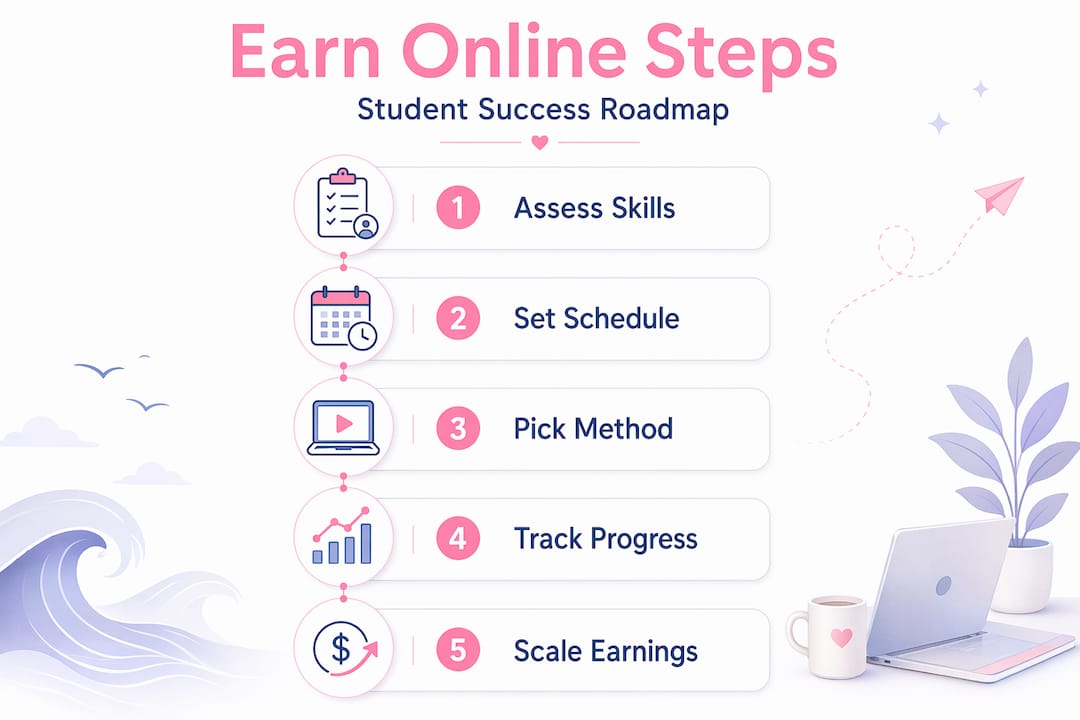
How to track your progress and optimize your earnings
Motivation fades when you cannot see progress. Tracking your income turns an abstract effort into a measurable result, and that visibility is what keeps you consistent.
Setting goals that actually mean something
Vague goals like “make more money” do not work. Specific goals do. Try: “Earn $200 this month from tutoring” or “Complete 50 surveys this week.” Once you hit a target, you know the method works. Once you miss it consistently, you know to pivot.
Use this verification checklist to assess your side hustles monthly:
| Check | What to look for |
|---|---|
| Hourly rate | Are you earning at least $10 per hour of active time? |
| Payout reliability | Has the platform paid on time every time? |
| Growth trend | Are earnings increasing, flat, or declining month over month? |
| Time cost | Is this hustle cutting into study time or sleep? |
| Scalability | Can you earn more without proportionally more time? |
When a method scores well on all five, double down. When it scores poorly on three or more, drop it. Students who raised over $75,000 through collegiate pitch competitions started with a single focused idea, not ten scattered ones. The same principle applies to online income: depth beats breadth in the early stages.
Scaling looks different at different stages. At $0 to $100 per month, your job is to find what works. At $100 to $500 per month, your job is to do more of that one thing. At $500 and above, you can start diversifying or reinvesting in tools that save you time.
My honest take on student side hustles
I have watched a lot of students approach online income the wrong way, and the pattern is almost always the same. They start with too much enthusiasm, sign up for everything, earn $23 in the first month, and quit.
What I have learned is that the students who succeed treat their first online income like a skill, not a lottery ticket. They pick one method, get genuinely good at it, and build from there. The student who spends two months becoming a reliable Fiverr proofreader with fifteen reviews will out-earn the student who tried six platforms in the same period.
I also think the conversation around student side hustles undervalues the career upside. Freelancing builds a portfolio. Tutoring sharpens your own understanding of the subject. Selling digital products teaches you basic marketing. These are not just income streams. They are resume lines and real skills that compound over time.
My honest advice: start smaller than you think you need to. Earn your first $50 before you worry about earning $500. Protect your GPA above everything else. And never, ever pay to access a platform that promises to teach you how to earn money online. Legitimate opportunities do not charge you to participate.
— Michelle
Start earning smarter with Earningdaily
You now have a clear map of where to start. But knowing the methods and knowing how to execute them efficiently are two different things.

Earningdaily’s 2-Hour Workflow is built specifically for people who want real online income without quitting their current life. The program shows you step by step how to generate $100 to $1,400 daily using just two hours, with no existing audience, no product, and no prior experience required. Thousands of people have already used it to move from financial stress to consistent daily income. If you are a student who wants a proven system rather than a patchwork of side hustles, this is worth your next two hours.
FAQ
What is the easiest way to earn money online as a student?
Survey and task apps are the lowest-barrier entry point. Platforms with a $10 payout minimum let you cash out quickly via PayPal, making them ideal for students who want fast, low-effort income between classes.
How much can a student realistically earn online per month?
It depends on the method and time invested. Survey apps typically yield $50 to $150 per month for casual users, while freelancing or tutoring can reach $500 to $1,500 with consistent effort. Some students report up to $600 monthly from dedicated task platform use alone.
How do I avoid scams when looking for online jobs for students?
Never pay to join a platform, never share your financial aid details or full Social Security number, and always search a platform’s name plus “reviews” or “scam” before signing up. Identity-targeting scams specifically targeting students are increasing, so caution is non-negotiable.
Can freelancing work for students with no experience?
Yes. Start with simple, verifiable services like proofreading, data entry, or social media scheduling. Set a competitive rate, collect your first five reviews, and raise your price from there. Most successful student freelancers specialize in one service rather than offering everything.
When should a student scale up their online income?
Scale when one income stream pays consistently for at least sixty days and does not interfere with your academic performance. Students who focused on a single venture generated $10,000 in thirty days. Depth and consistency beat volume every time.