

Earn $100 Daily While Studying: A Student's Guide
Earning $100 daily while studying is achievable through a combination of online tutoring, freelance writing, and user testing that fit around your class schedule. Students who combine multiple income streams can realistically hit $50–$100 per day without sacrificing grades. Platforms like Upwork, Fiverr, UserTesting, Wyzant, and Vedantu make it possible to start earning within days of signing up. The key is income stacking: running two or three low-effort, flexible gigs simultaneously rather than relying on a single source. This guide walks you through the best options, a practical time management system, and a step-by-step plan to get started.
What are the best online jobs for students to earn $100 daily?
The fastest path to $100 per day as a student is combining three income types: skill-based freelancing, knowledge-based tutoring, and passive microtask work. Each fills a different slot in your schedule and pays at a different rate.
Freelance writing
Freelance writing on platforms like Upwork and Fiverr pays $10–$50 per article for beginners. That means writing two to five short pieces per day can cover your daily target on its own. The learning curve is short. If you can write a clear college essay, you can write a blog post for a client.
Online tutoring
Tutoring in subjects you currently study is the fastest route to meaningful income because your prep time is nearly zero. Platforms like Wyzant, Vedantu, and Unacademy pay $15–$100+ per hour depending on subject and level. A single two-hour tutoring session in calculus or chemistry can cover half your daily goal.

User testing and microtasks
UserTesting and similar platforms pay $10–$30 per test. These sessions typically run 15–20 minutes, making them ideal for short breaks between study blocks. Asynchronous tasks like user testing require no fixed schedule and no client approval, which makes them the most student-friendly income type available.
Social media management
Managing social accounts for small businesses pays $200–$500 per month per client. Two clients puts you well above $100 per day on a monthly average. You can handle scheduling and basic content creation in under an hour daily using tools like Buffer or Later.
Here is a quick comparison of the most practical options:
| Income Stream | Pay Rate | Time Per Day | Skill Required |
|---|---|---|---|
| Freelance Writing | $10–$50/article | 1–3 hours | Moderate |
| Online Tutoring | $15–$100+/hour | 1–2 hours | High (subject-specific) |
| User Testing | $10–$30/test | 30–60 minutes | Low |
| Social Media Mgmt | $200–$500/client/mo | 30–60 minutes | Moderate |
| Surveys (Swagbucks, Qmee) | $20–$50/month | 15–30 minutes | None |
Pro Tip: Start with user testing on UserTesting or Respondent while you build your freelance writing or tutoring profile. It requires zero setup and pays immediately.
Low-barrier platforms like Swagbucks and Qmee yield $20–$50 monthly from surveys and search rewards. That is not enough on its own, but it adds a reliable baseline to your income stack with almost no effort.
How do you balance studying and side hustles without burning out?
The biggest mistake students make is treating a side hustle like a part-time job. That approach kills grades and motivation within weeks. The solution is treating income work as scheduled breaks, not as additional obligations stacked on top of studying.
Here is a system that works:
- Identify your low-energy windows. Most students have 30–60 minute gaps between classes or after dinner when they cannot focus on complex material. These are your income windows.
- Set a hard weekly time cap. Limiting income work to 1–3 hours per day prevents academic interference and keeps the work sustainable long-term.
- Use time-blocking. Assign specific gig types to specific time slots. Reserve mornings for deep study, afternoons for tutoring sessions, and evenings for asynchronous tasks like user testing or writing.
- Work in 30–90 minute focused sessions. Research supports 30–90 minute work sessions as the sweet spot for balancing academic load with income-producing activity. Anything longer starts cutting into recovery time.
- Batch asynchronous tasks. Complete user tests, surveys, and content drafts in batches during your lowest-energy periods. These tasks do not require deep focus and fit naturally into study breaks.
Pro Tip: Stack asynchronous gigs like UserTesting and Swagbucks during TV time or commutes. You are not replacing study time. You are monetizing time that was already unproductive.
The goal is not to maximize income every single day. The goal is to build a consistent routine that generates $100 daily on average without creating stress. Consistency beats intensity every time when you are also carrying a full course load.
Step-by-step plan to start making $100 daily as a student
Beginners who start freelancing early in their academic career see their earning potential multiply 3–5x by senior year compared to students who wait. That compounding effect is the strongest argument for starting now, even if your first week earns almost nothing.
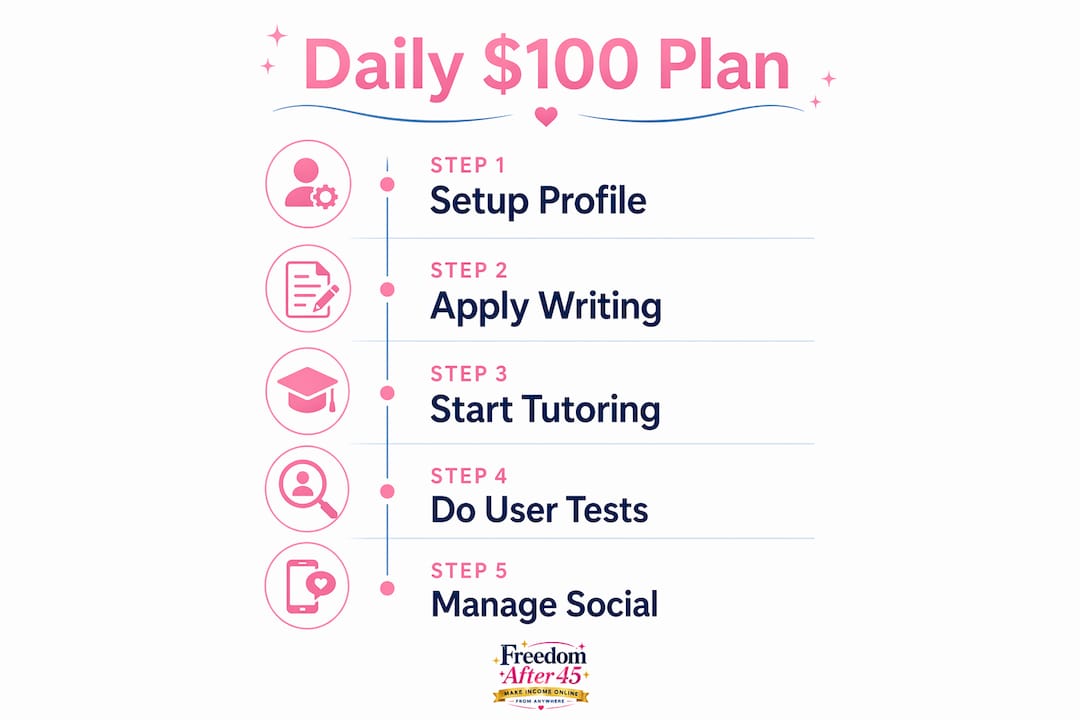
Follow this four-week launch plan:
- Week 1: Pick one income stream and set up your profile. Choose tutoring if you excel in a specific subject, or freelance writing if you prefer flexible hours. Create a complete Upwork or Wyzant profile with a clear bio, a sample piece or lesson plan, and a competitive beginner rate.
- Week 2: Apply daily and collect your first reviews. Send five to ten proposals or accept five tutoring requests. Your only goal this week is getting paid once and earning your first review. Pricing does not matter yet.
- Week 3: Add a second income stream. Once your first stream is generating $20–$40 per day, add user testing through UserTesting or Respondent. Stacking 2–3 income streams from low-effort asynchronous gigs is the proven method for reaching consistent $50–$100 daily goals.
- Week 4: Raise your rates and optimize your schedule. Increase your freelance or tutoring rate by 20–30%. Most clients will stay. Use the extra margin to work fewer hours for the same income.
| Week | Focus | Expected Daily Income |
|---|---|---|
| Week 1 | Profile setup and first application | $0–$10 |
| Week 2 | First paid gigs and reviews | $10–$30 |
| Week 3 | Add second income stream | $30–$70 |
| Week 4 | Rate increase and routine lock-in | $70–$100+ |
Beginners typically earn $20–$50 per month from simple tasks in the first few weeks. Skilled students with a clear niche can reach $100–$500 monthly within the first month. The gap between those two outcomes comes down to how quickly you specialize and how consistently you show up.
What mistakes kill student earnings before they start?
Most students who fail to reach consistent daily income make the same five mistakes. Recognizing them early saves weeks of wasted effort.
- Chasing scams. If a platform promises $500 per day for clicking links or watching videos, it is a scam. Legitimate platforms like Upwork, UserTesting, and Wyzant have verifiable payment histories and public reviews.
- Overcommitting time. Treating side hustles like full-time jobs is the most common reason students quit or see their grades drop. Set a firm daily hour limit and protect it.
- Waiting to start. Students who delay building a freelance profile until their final year miss the compounding benefit of early reputation building. Starting early multiplies earning potential significantly by the time graduation arrives.
- Underpricing and never raising rates. Many beginners set low rates to win clients and never adjust them. Raise your rate after every five positive reviews.
- Relying on a single income source. One client, one platform, or one gig type creates fragile income. A canceled contract or a slow week on one platform can wipe out your daily earnings entirely.
Employers value the soft skills students build by managing freelancing deadlines alongside academic work. Consistency matters more than experience for beginners, according to Internshala’s research on student online jobs.
Pro Tip: Prioritize recurring gigs over one-off projects. A tutoring student who books weekly sessions or a social media client on a monthly retainer gives you predictable income you can plan around.
Key takeaways
Students who combine tutoring, freelance writing, and user testing on platforms like Upwork, Wyzant, and UserTesting can reach $100 daily within four weeks by stacking income streams and capping work at 1–3 hours per day.
| Point | Details |
|---|---|
| Income stacking works | Combining tutoring, writing, and user testing reaches $100 daily faster than any single gig. |
| Start in week one | Building a profile early compounds your reputation and multiplies earnings 3–5x by senior year. |
| Cap your hours | Limiting income work to 1–3 hours daily protects your grades and prevents burnout. |
| Raise rates consistently | Increase your freelance or tutoring rate after every five positive reviews to grow income without more hours. |
| Avoid single-source reliance | One income stream creates fragile daily earnings. Two to three streams create stability. |
What i have learned about earning while studying
At Freedom After 45, we have worked with thousands of students and early-career earners who tried to build income alongside demanding schedules. The pattern we see most often is this: the students who succeed do not work harder. They work in smaller, smarter windows.
The conventional advice tells you to hustle every spare minute. That advice burns people out within a month. What actually works is treating your income sessions the way you treat a gym workout. You schedule it, you show up, you do the work, and then you stop. You do not try to squeeze in extra sets at midnight.
The other thing most guides miss is the emotional side of starting. Your first week on Upwork or Wyzant will feel slow and discouraging. You will send proposals that get no response. You will complete a user test for $10 and wonder if it is worth it. That phase lasts about two weeks for most people. The students who push through it are the ones who end up earning $100 daily by month two.
One more thing worth saying directly: your degree is still your primary asset. Side income is a supplement, not a replacement. The students who treat it that way protect both their GPA and their earning potential. The ones who let a side hustle consume their schedule often end up with neither.
— Freedom After 45
A two-hour system designed for students like you
If you want a structured path rather than piecing together gigs on your own, Freedom After 45 built exactly that. The 2-Hour Workflow is a step-by-step blueprint that teaches you how to generate daily online income in two focused hours, with no existing audience, no product, and no prior experience required.

Thousands of families have already used this system to move from financial stress to consistent daily earnings. For students, the flexibility is the point. You work two hours, you earn, and you get back to your studies. The workflow is designed to fit around your life, not replace it. If you are ready to stop guessing and start earning with a proven system, the daily income blueprint at Freedom After 45 is the clearest next step available.
FAQ
Can students realistically earn $100 daily online?
Yes. Students who combine freelance writing, online tutoring, and user testing can reach $50–$100 daily within four weeks. The key is stacking two to three income streams rather than relying on one.
How many hours per day does earning $100 require?
Most students reach $100 daily in 1–3 focused hours by combining tutoring at $15–$100 per hour with asynchronous tasks like user testing. Keeping work sessions to 30–90 minutes prevents academic interference.
What is the fastest online job for students to start?
User testing on platforms like UserTesting or Respondent requires no setup and pays $10–$30 per test. Tutoring in your current academic subjects is the fastest route to higher hourly rates.
Do i need experience to start freelancing as a student?
No prior client experience is required to start on Upwork or Fiverr. Employers value consistency and deadline management, which students already demonstrate through academic work, according to Internshala.
What is the biggest mistake students make with side hustles?
The most common mistake is treating a side hustle like a full-time job, which leads to academic decline and burnout. Setting a firm daily hour cap and prioritizing recurring gigs over one-off projects solves both problems.