

Consistency and Student Online Income: A 2026 Guide
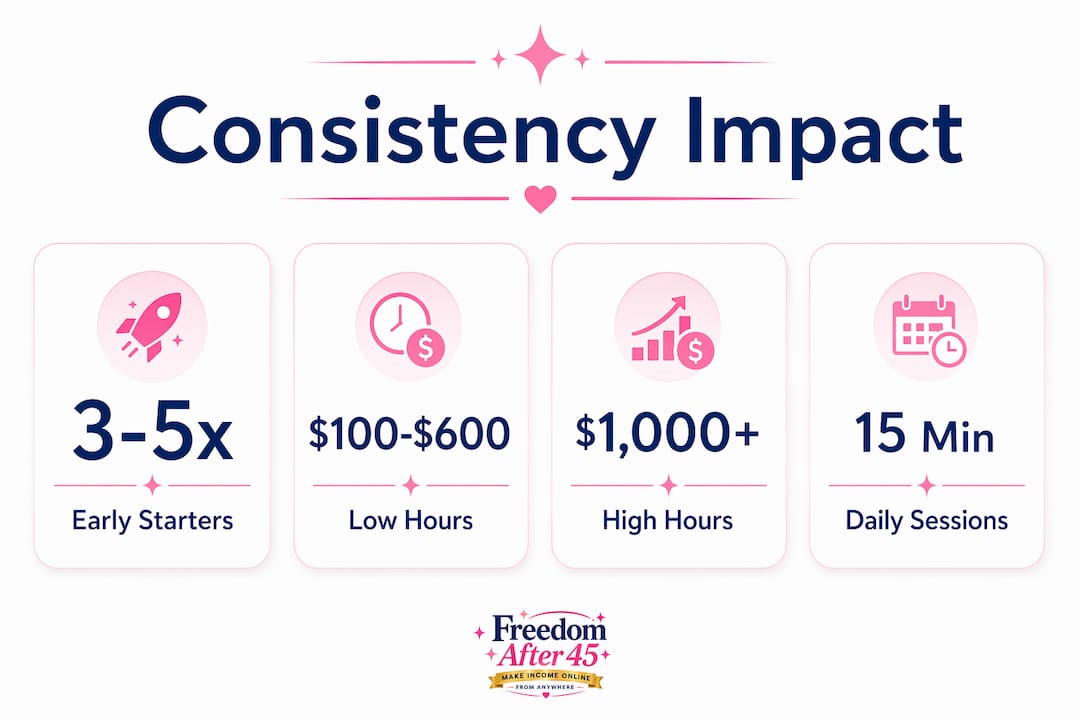
Consistency is the single most reliable predictor of whether a student’s online income grows or stalls. The role of consistency in student online income is not about working harder every day. It is about building repeatable systems that generate earnings even when effort fluctuates. Students who start early earn 3–5 times more by their senior year than those who wait. That gap is not talent. It is compounded effort. Freedom After 45 has seen this pattern repeat across thousands of earners: the ones who show up regularly, even imperfectly, are the ones who reach financial stability first.
What does consistency mean for student online income?
Consistency is not perfection. It is regular, reliable engagement with your income activities, regardless of how much time you have on any given day. A student who publishes one piece of content per week for six months outperforms one who publishes ten pieces in a single month and then disappears.

The biggest misconception students carry is that consistency requires large, unbroken blocks of time. It does not. The most durable earning systems are built from small, repeatable actions stacked over weeks and months. Think of it as a savings account. Each deposit is small, but the balance grows steadily.
Three principles define practical consistency for students:
- Show up in any capacity. A 20-minute session counts. Skipping entirely does not.
- Use modular tasks. Break income work into sub-30-minute segments so you can fit them between classes, meals, or study blocks.
- Protect the system, not the output. During exam week, reduce what you produce. Never stop the habit entirely.
Chasing viral projects and intermittent intense bursts cause burnout and irregular cash flow. Predictable, repeatable actions outperform them every time.
Pro Tip: Set a minimum viable session of 15 minutes. On your busiest days, do only that. The habit stays alive, and the income system keeps moving.
How early consistency compounds student earnings over time
Starting in year one of college or your online income effort is not just advisable. It is financially significant. Students who begin early build client trust, portfolio depth, and platform authority that late starters cannot replicate quickly. These assets compound the same way interest does.
The earnings difference between early and late starters is substantial. A Q2 2026 study found that students investing 5–10 weekly hours typically earn $100–$600 per month. Those who commit 15–20 weekly hours reach $1,000–$2,500 per month. The hours matter, but the timing matters more. An early starter at 5 hours per week builds more by year three than a late starter at 15 hours per week, because reputation and skill accumulation take time to pay off.
| Engagement Level | Weekly Hours | Typical Monthly Earnings |
|---|---|---|
| Early starter, low hours | 5–10 | $100–$600 |
| Early starter, high hours | 15–20 | $1,000–$2,500 |
| Late starter, low hours | 5–10 | $50–$200 |
| Late starter, high hours | 15–20 | $400–$900 |
Reputational capital is the hidden asset in this equation. Clients return to earners they trust. Platforms reward accounts with consistent posting histories. Search engines rank content from sites with regular publishing cadences. None of these advantages appear overnight. They accumulate through steady effort over months and years.
The risk of sporadic effort is not just lower income. It is lost compounding. Every month a student delays or goes dark, they reset part of the trust and visibility they built. That is the real cost of inconsistency.
How to balance academics and income consistency
Balancing study and online earning is not about splitting time equally. It is about adapting your workload to match your academic cycle without abandoning your income system entirely.
The students who sustain both academics and earnings over four years use one core strategy: they scale down during high-pressure periods rather than stopping. During finals, they might publish half as much content, respond to fewer client messages, or pause new projects. The system stays alive. The momentum does not reset.
Here is a practical framework for maintaining income consistency through an academic year:
- Map your academic calendar at the start of each semester. Identify exam weeks, project deadlines, and lighter periods. Plan your income output around them, not against them.
- Build a content or task buffer during slow weeks. Write three blog posts when you have time. Schedule them to publish during your busiest weeks. The output continues even when your effort pauses.
- Use sub-30-minute modular tasks as your baseline. Modular workflows let you maintain income activity in short windows without needing a full work session.
- Set a weekly minimum, not a daily one. Weekly targets are more forgiving and easier to hit around unpredictable class schedules.
- Review your system monthly, not daily. Daily reviews create anxiety. Monthly reviews show real progress and reveal what to adjust.
Pro Tip: Treat your income system like a class you cannot drop. You would not skip it for weeks without consequence. Apply the same standard to your earning habits.
The goal is not to earn the same amount every week. The goal is to keep the system running so that your reputation, skills, and client relationships keep growing even during your hardest academic stretches.
What are the most effective consistent income streams for students?
Not all online income opportunities for students suit consistent, low-intensity engagement. The best ones reward regular effort with compounding returns and do not require large upfront investments of time or money.
Freelance writing and content creation are the most accessible entry points. A student who writes two articles per week for six months builds a portfolio that attracts higher-paying clients. The barrier to entry is low, and the skill compounds directly into earnings.
Online tutoring rewards consistency through repeat clients and referrals. A student who tutors reliably builds a roster of returning students. That roster generates predictable weekly income without constant marketing.
Digital product sales (templates, study guides, printables) require upfront effort but generate passive income once listed. Consistency here means adding new products regularly and updating existing ones. Platforms like Etsy and Gumroad reward active sellers with better visibility.
Content creation on video or audio platforms compounds through subscriber growth. A student who posts one video per week for a year builds an audience that generates ad revenue, sponsorships, or affiliate income. The compounding effect is real, but it requires patience measured in months, not weeks.
Key considerations for choosing the right stream:
- Time commitment: Tutoring and freelance writing pay faster but require active hours. Digital products and content creation take longer to pay off but scale without proportional time increases.
- Skill match: Choose a stream that uses skills you already have or are building through your studies. A finance student tutoring accounting earns more per hour than a generalist tutor.
- Schedule fit: Tutoring requires fixed appointment times. Writing and digital products do not. Match the structure of the income stream to the structure of your academic schedule.
The intensity trap is most dangerous here. Students often pick the income stream that sounds most exciting, go all-in for three weeks, burn out, and quit. The better approach is to pick one stream, commit to a minimum weekly output, and stay with it for at least 90 days before evaluating results.
Key Takeaways
Consistency in student online income is the compounding force that separates earners who reach financial stability from those who stay stuck in sporadic, unpredictable cash flow.
| Point | Details |
|---|---|
| Start early for maximum compounding | Students who begin in year one earn 3–5 times more by senior year than late starters. |
| Consistency beats intensity | Steady, low-intensity effort outperforms sporadic bursts and prevents burnout. |
| Modular workflows protect the system | Sub-30-minute tasks keep income activity alive during busy academic periods. |
| Match income streams to your schedule | Choose streams that fit your existing skills and academic calendar for sustainable output. |
| Reputational capital compounds over time | Client trust and platform authority grow with consistent engagement and cannot be rushed. |
What I have learned about consistency that most advice skips
The most common mistake I see is students treating consistency as a performance metric rather than a system design problem. They ask, “How do I stay motivated?” when the real question is, “How do I build a system that runs even when I am not motivated?”
Motivation is unreliable. Academic stress, personal setbacks, and schedule disruptions are guaranteed. The students who build durable income streams are the ones who design their systems to survive those disruptions, not the ones who rely on willpower to push through them.
The second mistake is chasing visible progress too early. A student who posts content for eight weeks and sees minimal results often quits. But those eight weeks built search indexing, platform trust, and skill that would have paid off in weeks nine through twenty. Quitting at week eight is the most expensive decision in online income building.
Patience is not passive. It is the active choice to keep showing up while the compounding works in the background. The students I have seen reach $1,000 per month consistently are not the ones who worked the hardest in any single week. They are the ones who never fully stopped, even during their worst semesters.
Start smaller than you think you need to. Protect the habit above the output. And measure your progress in quarters, not weeks.
— Freedom After 45
A proven workflow for consistent student earnings
Building consistent online income is easier when you have a system designed for it from the start. Freedom After 45 built the 2-Hour Workflow specifically for people who need real, daily income without sacrificing everything else in their lives.

The workflow is built on the same principles this article covers: repeatable actions, low time investment per session, and compounding results over time. Students balancing coursework and earning goals have used it to generate meaningful daily income without burning out or falling behind academically. The system requires no existing audience, no product inventory, and no prior experience. It is a step-by-step structure that keeps you consistent even when life gets complicated.
FAQ
What is the role of consistency in student online income?
Consistency transforms sporadic online efforts into stable, compounding income streams. Students who engage regularly build client trust, platform authority, and skills that generate significantly higher earnings over time.
How many hours per week do students need to earn consistently online?
Students investing 5–10 weekly hours typically earn $100–$600 per month. Those who commit 15–20 weekly hours reach $1,000–$2,500 per month, according to Q2 2026 data.
How can students maintain income consistency during exams?
Students should scale down output during exam periods rather than stopping entirely. Using pre-built content buffers and modular sub-30-minute tasks keeps the income system active without competing with academic priorities.
Why do most students fail to build consistent online income?
Most students fall into the intensity trap: they work in short, intense bursts, burn out, and quit. Steady, low-intensity, high-frequency effort produces more durable results than any single high-output sprint.
Which online income streams reward consistency the most?
Freelance writing, online tutoring, digital product sales, and content creation all reward consistent engagement. Each builds reputational capital and compounding returns that grow substantially over months and years of regular effort.