

A Women Entrepreneur Community That Runs on Two Hours a Day
A women entrepreneur community, in the sense that matters to you right now, isn’t a networking group or a masterclass series. It’s a paid, structured cohort. Freedom After 45 runs one built specifically for women 45 to 65: the 2-Hour Workflow, a step-by-step system for building recurring daily passive income with roughly two hours of focused work.
You’re not building a following first. You’re not launching a product line. You’re learning a repeatable daily routine, backed by a community that keeps you accountable and unstuck.
This membership fits women who want steady income without a second full-time job, and who’d rather follow a proven sequence than reinvent one.
- Step-by-step modules with templates, not theory
- Weekly cohort calls and peer accountability
- Tech support so a stalled setup doesn’t stall your income
- A workflow designed to become recurring, not a one-time push
Ready to see it? Check the program details and what week one looks like.
Key Takeaways
The 2-Hour Workflow works because it pairs a simple daily routine with structured community support, which research consistently links to better follow-through than solo effort.
| Point | Details |
|---|---|
| Time commitment | Roughly two hours a day, heavier learning load in the first three months, lighter maintenance after. |
| Core tools | Learn three to five tools deeply (email, landing page, payment, course host, automation) rather than juggling many. |
| Income range | Typical members report daily income in the $100 to $1,400 range once methods are running on autopilot. |
| Support structure | Weekly cohort calls, a private forum, and peer accountability partners handle tech and motivation gaps. |
| Best next step | Freedom After 45’s 2-Hour Workflow gives women 45 to 65 a step-by-step, community-backed path into recurring income. |
Table of Contents
- What Do You Actually Get Inside the Community?
- Who Gets the Best Results, and How Long Does It Take?
- How Does the 2-Hour Workflow Actually Work Day to Day?
- What Kind of Results Are Realistic?
- How Do You Join and What Happens First?
- Do You Need Experience to Enroll?
- What Are the Refund and Cancellation Terms?
- What Do the Payment Options Look Like?
- What the Research Actually Supports, and What Doesn’t
- Why Freedom After 45 Fits This Exact Need
- Frequently Asked Questions
- Sources
What Do You Actually Get Inside the Community?
Members don’t get a stack of PDFs and a “good luck.” The 2-Hour Workflow is built as a sequence of modules, each one ending in something you actually produce, not just something you understand.
- Foundation module — you pick one income method and set up the three accounts you’ll use for the next 90 days (no more, no fewer).
- Asset-building module — you create your first digital product, template pack, or automated newsletter using done-for-you swipe files.
- Automation module — you connect your email tool and landing page so leads and sales happen without you sitting at the computer.
- Maintenance module — you learn the weekly checklist that keeps income flowing on autopilot.
Beyond the modules, the support structure is where most members say the real value sits. Weekly cohort calls let you troubleshoot in real time instead of guessing alone. A private forum handles the “why won’t this button work” questions within hours, not days. Peer accountability partners, matched inside your cohort, check in on your progress the way a workout buddy would.
The automation layer is what turns this from a job into something closer to passive income: evergreen funnels, pre-built email sequences, and template packs that keep working after you’ve built them once.

Pro Tip: Resist the urge to explore every tool available. Members who commit to 3 to 5 core tools for their first 90 days move faster than those who shop around for the “perfect” platform.
Who Gets the Best Results, and How Long Does It Take?
The strongest results come from a specific kind of member: someone 45 to 65, financially motivated but not desperate, with an hour or two of daily availability and a willingness to follow a sequence instead of freelancing her own path. You don’t need a following. You don’t need a product idea walking in the door.
The first three months tend to be learning-heavy. You’re setting up accounts, building your first assets, and getting comfortable with a small toolkit. After that, most members shift into a maintenance rhythm: less building, more checking, tweaking, and scaling what already works.
A typical two-hour weekday might break down like this:
- Months 1 to 3: 45 minutes learning, 60 minutes building, 15 minutes community check-in
- Months 4 and beyond: 30 minutes maintenance, 45 minutes outreach or content refresh, 45 minutes flexible growth work
How Does the 2-Hour Workflow Actually Work Day to Day?
Picture your two hours split roughly in half. The first hour is creation time: you’re writing, recording, or repurposing something, a template, a short digital guide, a newsletter issue. The second hour is automation and maintenance: scheduling that content, checking your funnel’s performance, or answering the handful of messages your audience sent overnight.
The income methods taught inside the community fall into a few clear categories:
- Digital products you build once and sell repeatedly
- Evergreen micro-courses that run on autopilot after setup
- Automated newsletters monetized through sponsorships or affiliate links
- Affiliate funnels that route traffic toward vetted offers
- Workflow licensing, where you package your own system for other members to use
None of this requires mastering ten platforms. The community’s guiding principle is to learn three to five tools deeply, usually one for email, one for landing pages, one for payments, one for hosting a course, and one simple automation connector, and map a single workflow that uses all of them together. That composition is what actually reduces the tech overwhelm women describe when starting later in life.
The research backs the community model itself. A longitudinal case study on women returning to IT found that structured intervention programs support participant learning regardless of how deeply someone engages, meaning even members who move slower still benefit from the structure. Separately, industry case summaries on late starters recommend consistency and daily community support as the two biggest predictors of sustained online income, more than raw hustle or hours logged.
What Kind of Results Are Realistic?
Results vary by effort, niche, and how quickly you move through the maintenance phase, so treat these as illustrative bands rather than guarantees:
- Conservative: a member who’s still in her first 60 days, building her first asset and testing her workflow, sees early, modest daily income while she works out the kinks
- Typical: a member 6 to 12 months in, with two or three income methods running on autopilot, sees steadier daily income within the $100 to $1,400 range the program’s own materials describe
- Aspirational: a member who’s layered multiple automated assets and refined her funnel sees the top end of that range consistently
Research on women’s transitions into sustainable work backs up why the community piece matters as much as the tactics. A Wiley study on social networks and learning programs found that social support structures are central to helping women move into lasting employment and income streams, not incidental to it. Forbes has also noted that women over 50 are increasingly building owned assets rather than chasing platform-dependent gigs, which lines up with what this community teaches.
“Community and a confident guide reduce the dropout driven by tech frustration, and mentorship helps translate life experience into an actual online product.” That’s the pattern experienced practitioners point to again and again when women over 50 succeed at building something online.
Full case studies, with specifics on what each member built and how long it took, are available on the program page.
How Do You Join and What Happens First?
Signing up is straightforward, but a little prep beforehand makes week one smoother.
- Create your account on the program page and pick your starting cohort date.
- Complete the foundation module, which walks you through your first account setups.
- Schedule your onboarding call or your first cohort session, whichever fits your calendar.
Before you start, prepare two things: a basic tech checklist (a working email address, a laptop or tablet, and about two free hours a day) and a short worksheet on the niche or idea you’re leaning toward, even a rough one.
The first 30 to 90 days follow a set cadence: onboarding, then structured training through the modules, then gradual integration into your cohort’s calls and forum threads. Early wins are built into the first month on purpose, because momentum in week two matters more than perfection in week ten.
Pro Tip: Don’t wait for the “perfect” niche idea before signing up. Members who start with a rough direction and refine it during the foundation module tend to launch faster than those who stall out pre-planning.
Start here: see the current cohort schedule and what’s included at sign-up.
Do You Need Experience to Enroll?
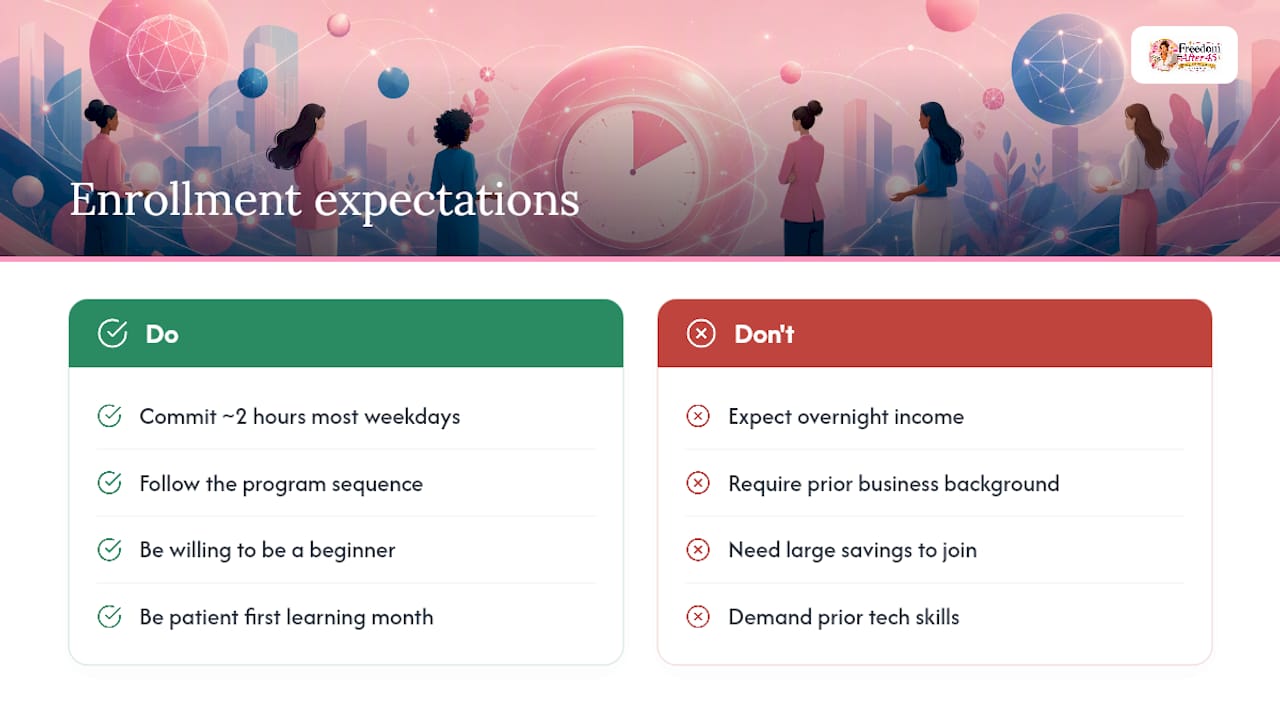
You don’t need a business background, a following, or existing tech skills to enroll. What matters more is mindset and consistency. Members who succeed tend to share three traits: they’re willing to follow a sequence rather than freelance their own process, they can commit to two hours most weekdays, and they’re comfortable being a beginner again for a few months.
Basic computer literacy helps, being able to send an email, follow a video tutorial, or copy and paste, but the modules assume no prior tech knowledge. There’s no requirement around age beyond the community’s practical focus on women 45 to 65, no requirement for existing savings to invest heavily, and no requirement for a college background or formal marketing training.
What the program does ask for upfront is patience during the first learning-heavy month. If you’re expecting overnight income with zero setup time, this isn’t that. If you’re willing to spend 90 days building before you expect steady returns, the structure is designed around exactly that timeline. A rough idea of what you’d want to sell or teach helps, but it’s not mandatory before day one. The foundation module is built to help you land on that decision if you walk in without one.
What Are the Refund and Cancellation Terms?
Specific refund windows, contract lengths, and cancellation procedures are detailed on the program’s enrollment page rather than in general terms here, since these details can be updated and are best confirmed at the point of sign-up.
What’s worth knowing before you enroll: read the refund policy on the checkout page in full before you pay, note any deadline for requesting a refund, and understand whether membership renews automatically or runs as a one-time purchase. If you’re unsure about a specific clause, the tech support and community forum can typically point you to the right contact for a direct answer before your first payment or before any renewal date.
What Do the Payment Options Look Like?
Pricing structure and available tiers are listed on the program’s official pricing page, where you’ll find the most current numbers rather than figures that could go stale here. Programs like this one commonly offer a few paths in: a one-time payment for full access, or a split-payment option for members who’d rather spread the cost across a few months.
Some tiers may include add-ons like extended coaching access or expanded template libraries, depending on what’s currently offered. Before you commit, compare what’s included at each tier against your own timeline. If you’re planning to move through the modules at a steady weekday pace, a standard tier is usually sufficient. If you know you’ll want extra one-on-one troubleshooting early on, checking whether a higher tier includes that is worth the five minutes it takes.
What the Research Actually Supports, and What Doesn’t
The conventional advice for women starting an online business after 50 leans hard on hustle: post more, network harder, learn every tool available. The research doesn’t back that up. What actually predicts follow-through is structure and social support, not sheer effort. A woman working through a defined sequence with a cohort behind her tends to outlast one improvising alone with unlimited tools and no schedule.
Where most advice falls short is the tech piece. Telling a 52-year-old to “just learn marketing” without narrowing the toolkit is how overwhelm kills momentum in week two. The fix isn’t more resources. It’s fewer tools, used well, inside a workflow that doesn’t require relearning something new every week.
If you’re deciding where to put your first two hours, prioritize the community and the sequence over any single tactic. The tactic changes. The structure is what carries you through the slow first month into the steadier ones that follow.
Why Freedom After 45 Fits This Exact Need
You’ve read what a real 2-Hour Workflow looks like: a defined sequence, a small toolkit, and a cohort that keeps you from quitting in week three. Freedom After 45 built the program around exactly that structure, specifically for women 45 to 65 who want recurring income without a marketing degree or an existing audience.

What sets it apart from piecing together free tutorials on your own is the sequencing: you’re not guessing which of ten income methods to try first, you’re following a tested order with templates already built. The cohort calls and forum mean tech questions get answered same day, not after a week of frustrated searching. If what you’ve read here matches what you’re looking for, visit the program page to see the current cohort dates and enrollment details.
Frequently Asked Questions
Is this a women entrepreneur community or a course? It’s both. The 2-Hour Workflow is a step-by-step course, but the cohort calls, private forum, and peer accountability make the community structure central to how members actually finish the program and keep their income recurring.
Do I need a social media following to start? No. The program is specifically built for women without an existing audience, product, or following. The modules focus on building your first asset from scratch.
How much can I realistically earn? Outcomes vary, but typical members report daily income in the $100 to $1,400 range once their methods are set up and running on autopilot, usually after the first few months.
What if I’m not tech savvy? The modules assume no prior tech background. The community’s core principle is learning three to five simple tools deeply instead of many tools shallowly, which is what most members over 50 find manageable.
How long until I see income? Most members treat the first three months as setup and learning, with income becoming steadier as the workflow shifts into maintenance mode afterward.
Sources
- Intervention programme for women returning to IT (community of practice perspective)
- Over 50 and Starting Online 2026: Real Success Stories | EarnifyHub
- Women over 50 are redefining work (Forbes)