

Why Professionals Need Income Outside Their Salary
Your salary is a single point of failure. One layoff, one company restructuring, one health event, and your entire financial life is at risk. That’s the core reason why professionals need income outside salary, and the data backs it up hard: 53% of Americans with side income say they would struggle to cover essential expenses without it.
For women over 45, this isn’t abstract. It’s the difference between negotiating your next career move from a position of strength versus desperation.
Why income beyond your salary matters:
- A single salary creates income concentration risk, limiting your options when employers make decisions you can’t control
- 34% of U.S. workers live paycheck to paycheck, with little buffer against disruption
- Side income acts as career insurance, giving you the freedom to pivot or push back
- Additional income streams support retirement planning and reduce tax exposure
- Building income now, while employed, is far easier than starting from zero after a job loss
1. The real financial risks of relying on a single salary
A salary feels secure because it’s predictable. But predictability and security are not the same thing.
“A second income stream does not need to be big to matter. It just needs to exist before you need it.” — Benzinga
When income concentration risk is your reality, you lose negotiating power. You can’t walk away from a bad situation if walking away means your household income drops to zero. You can’t take a career risk if there’s nothing to fall back on.
Specific financial vulnerabilities of single-salary dependence:
- No emergency cushion: only 37% of working Americans keep a dedicated emergency fund
- Forced reliance on credit cards when cash flow tightens between paychecks
- Zero runway if laid off, forcing acceptance of the first job offer regardless of fit
- No leverage in salary negotiations when you can’t afford to walk
- Retirement savings stall when every dollar is spoken for
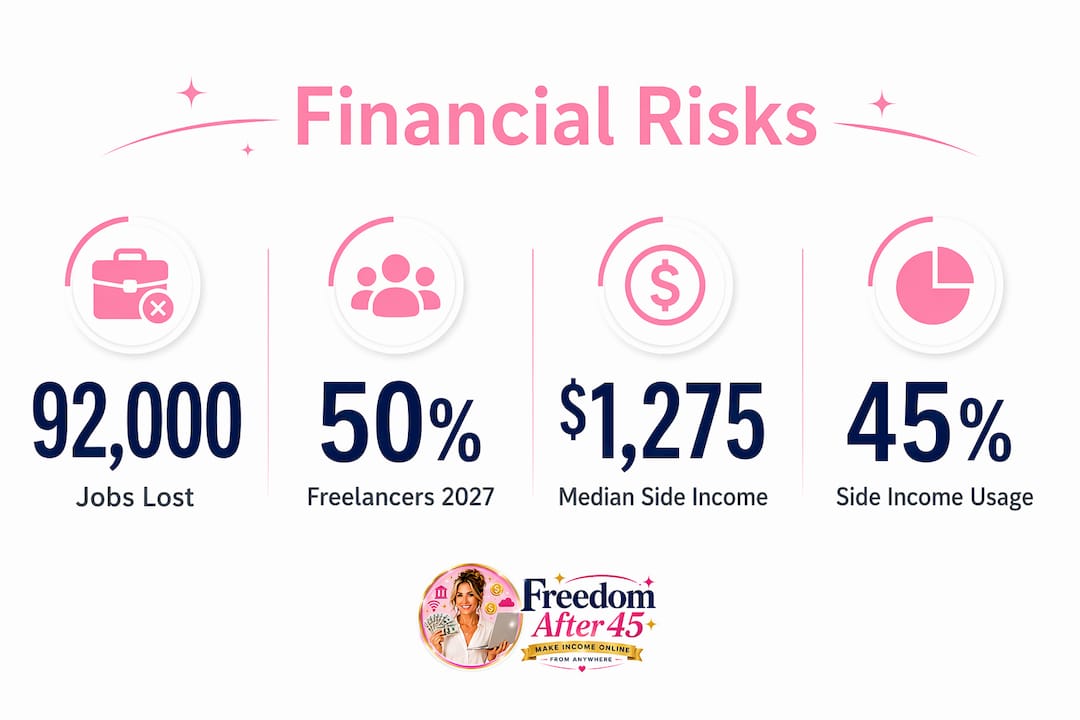
The U.S. economy shed 92,000 jobs in February 2026, per Bureau of Labor Statistics data. That’s not a warning sign on the horizon. It’s already happening.
2. Key benefits of income diversification for professionals
Income diversification does more than pad your bank account. It restructures your entire relationship with work.

Career optionality means you negotiate from strength, not fear. When a second income stream covers even a portion of your expenses, you can afford to say no to a bad offer, take time to find the right next role, or pivot entirely. That psychological shift is real and immediate.
For women over 45, income diversification also addresses longevity risk directly. Tax diversification across income types — earned income, portfolio income, and passive income — can meaningfully reduce your tax burden in retirement, when most people are drawing from multiple sources anyway.
Tangible benefits worth naming:
- Financial resilience: a second stream absorbs the shock of job loss
- Career flexibility: the freedom to pivot without financial panic
- Retirement readiness: multiple income types optimize tax efficiency
- Psychological confidence: you stop tolerating situations you’d otherwise leave
- Skill validation: earning outside your employer proves your expertise has market value
More than 50% of U.S. workers are projected to have some form of freelance or independent income by 2027. The professionals building that now aren’t chasing hustle culture. They’re managing risk the same way investors do.
3. How women over 45 can build daily passive income efficiently
The most time-efficient starting point is always your existing expertise. You don’t need a new skill set. You need a new application for the one you already have.
Building income streams while still employed is dramatically easier than starting after a layoff. You have runway, you have time to test without pressure, and you have the credibility of a current professional role behind you.
Practical starting points for women over 45:
- One paid consultation with someone in your network who needs your specific expertise
- A digital product (template, guide, or toolkit) built from knowledge you use daily
- A small freelance project in your professional area, scoped to fit around your schedule
- An advisory engagement with a small business that can’t afford a full-time hire
Pro Tip: Start with one income stream, validate that people will pay you for it, and stabilize it before adding a second. Three well-managed streams beat seven neglected ones every time.
The Freedom After 45 “2-Hour Workflow” is built around exactly this principle. Two focused hours a day, applied to a method that doesn’t require a social media following, a product, or prior online experience. The goal is daily income that fits your life, not a second full-time job.
4. Specific passive income ideas for women over 45 with minimal time
Not all passive income requires capital or technical skills. The best options for women over 45 draw on what you already know.
Low-effort, high-relevance options:
- Digital templates and toolkits: Package your professional process into a downloadable product. A budgeting spreadsheet, a project planning template, or an onboarding guide can sell repeatedly with zero ongoing time.
- Micro-consulting: Five to ten hours per month at a professional rate. Your employer pays you to solve specific problems. Other companies have the same problems and can’t afford a full-time hire.
- Online courses or workshops: A focused, practical course on one skill you’ve spent years developing. Platforms handle delivery; you build it once.
- Advisory roles: Small businesses and startups regularly pay for part-time expertise in finance, HR, marketing, and operations.
- Content that compounds: A newsletter or LinkedIn presence builds slowly but creates a professional asset that no employer can take from you.
The median monthly side income is $1,275, roughly adding 25% to the median household income. That’s not a rounding error. That’s a retirement contribution, an emergency fund, or the financial cushion that lets you leave a job that isn’t working.
5. Steps to start building additional income with limited time and money
The sequence matters more than the speed.
Starting while you’re employed gives you the luxury of experimentation. Starting after a layoff gives you only pressure.
- Audit your expertise. Write down three problems you solve at work that other people or businesses also face. That list is your starting inventory.
- Test one paid interaction. Offer one consultation, one small project, or one digital product. Charge for it. The amount matters less than the validation.
- Stabilize before scaling. Repeat what worked two or three more times before adding anything new.
- Protect your primary job. Your salary is the foundation. Nothing you build on the side should compromise it.
- Reinvest early income. Put the first earnings back into tools, education, or time-saving resources that make the stream more efficient.
The professionals with the most career resilience in 2026 earn income independently of any single employer. They didn’t get there by moving fast. They got there by starting early.
6. Real examples of successful income diversification by professionals
The pattern repeats across industries and age groups. A finance professional packages her budgeting process into a downloadable spreadsheet pack. It earns $200–$400 per month with no ongoing hours once built. An HR director offers fractional advisory services to two small businesses, five hours per month each, at a professional rate. A marketing manager turns her campaign planning process into a workshop she runs quarterly.
None of these required quitting a job. None required a large upfront investment. All of them started with one paid interaction that validated demand before anything was built.
45% of Americans with side income use it to pay off debt and cover regular living expenses. That’s not discretionary spending. That’s financial stability built one stream at a time.
Freedom After 45 gives you a clear path to daily income
Most income-building advice assumes you have time, tech skills, or an existing audience. Freedom After 45 was built for women who have none of those things and still want real results.

The 2-Hour Workflow is a step-by-step blueprint that generates daily passive income, using just two focused hours a day. No social media following required. No product to create from scratch. No prior online experience needed. Thousands of women over 45 have used it to build income streams that run alongside their existing jobs, not instead of them. If you’re ready to stop depending on a single paycheck, this is where to start.
Key Takeaways
Income outside your salary isn’t a luxury for professionals over 45; it’s the most practical form of financial security available when a single salary can disappear overnight.
| Point | Details |
|---|---|
| Single salary = single risk | 34% of U.S. workers live paycheck to paycheck, with no buffer against job loss. |
| Side income is often essential | 53% of Americans with side income say they’d struggle to cover basic expenses without it. |
| Start while employed | Building income streams before disruption gives you runway, leverage, and time to test. |
| Use existing expertise first | Consulting, advisory work, and digital products draw on skills you already have daily. |
| Freedom After 45 | The 2-Hour Workflow helps women over 45 build daily passive income without prior experience or a following. |