

Why Passive Income Protects Against Job Loss
Passive income is money that keeps arriving after your paycheck stops. Think dividends, rental cash flow, digital product sales, royalties. It functions as career insurance by covering real expenses and buying you time to recover on your own terms rather than your employer’s. The short answer: yes, passive income meaningfully protects against job loss, and even modest coverage changes everything about how you respond to it.
The protection works in three ways:
- Covers expenses so you can pay rent, groceries, and utilities without immediately draining savings
- Buys time for a deliberate job search or career pivot instead of a panicked one
- Preserves choice so you can decline a bad offer and wait for a better one
How much protection you get depends on your Passive Coverage Ratio (PCR), which is simply your monthly passive income divided by your monthly essential expenses. Research shows that achieving a moderate Passive Coverage Ratio (PCR) produces a measurable shift from survival behavior to strategic thinking after a layoff. Increasing your PCR further improves negotiation freedom and can eventually make work optional.
Pro Tip: Build a liquid emergency fund of 3–6 months of essential expenses before you optimize for passive income yield. Without that cash buffer, a medical bill or car repair can force you to sell income-producing assets at the worst possible time.
Table of Contents
- Why passive income protects against job loss — the mechanisms that matter
- What types of passive income actually protect you after a layoff?
- How much passive income do you actually need?
- Does passive income affect unemployment benefits, and how is it taxed?
- Why passive income is not a guaranteed safety net
- A 6-step action plan to start building income that actually protects you
- How Freedom After 45’s 2-Hour Workflow fits this protection framework
- Key Takeaways
- Passive income as career insurance: a perspective worth taking seriously
- The 2-Hour Workflow: a guided path to daily passive income
- Useful U.S.-focused sources and further reading
Why passive income protects against job loss — the mechanisms that matter
Passive income does not just soften the financial blow of losing a job. It changes the decisions you make in the weeks and months after. Here is how each mechanism works.
- Expense replacement. Even $600 a month from dividend ETFs or a digital product covers groceries and a phone bill. That is not retirement money; it is breathing room. When a layoff hits, you are not immediately choosing between eating and paying rent.
- Time buffer for a real job search. The average U.S. job search takes weeks to months. Without any income, most people accept the first offer they get. With even partial passive coverage, you can afford to wait for the right role.
- Retirement savings stay intact. Tapping a 401(k) early costs you a 10% penalty plus income taxes. Passive income means you never have to make that trade.
- Negotiation leverage. When you do not desperately need the next paycheck, you negotiate differently. You can push back on salary, title, or remote-work terms without flinching.
- Psychological resilience. Passive income yields measurable psychological benefits: it increases perceived control and reduces anxiety during career disruption. That is not a soft benefit. Anxiety impairs decision-making, and the decisions you make in the first 30 days after a layoff tend to shape the next two years.
The PCR concept matters here because it turns an abstract goal (“build passive income”) into a measurable target. A reader with $4,000 in monthly expenses who generates $1,600 passively sits at 40% PCR. That is enough to reduce panic and extend a job search by several months without touching savings.
Pro Tip: Calculate your PCR right now. Divide your current monthly passive income by your essential monthly expenses. If the number is below 20%, that is your baseline and your first target to move.
What types of passive income actually protect you after a layoff?
Not all passive income is equally useful when a job disappears. Liquidity and reliability matter far more than raw yield in a job-loss scenario. A rental property generating $1,200 a month sounds great until you need to sell it quickly and the market is soft.

| Stream | Startup Effort | Typical Monthly Yield | Liquidity | Key Risk | U.S. Tax Notes |
|---|---|---|---|---|---|
| Dividend index funds | Low | Varies with portfolio size | High | Market volatility | Qualified dividends taxed at 0–20% |
| High-dividend ETFs | Low | Varies with portfolio size | High | Concentration risk | Same as above |
| REITs | Low–Medium | Varies with portfolio size | Medium–High | Interest rate sensitivity | Dividends taxed as ordinary income |
| Rental property | High | Varies by market | Low | Vacancy, repairs, management | Depreciation deductions available |
| Digital products (courses, eBooks) | Medium | Varies widely | High | Requires initial creation effort | Self-employment or ordinary income |
| Royalties/licensing | Medium | Varies widely | High | Dependent on platform or licensee | Ordinary income |
| Peer lending/notes | Medium | Varies by platform | Low–Medium | Default risk, platform risk | Interest taxed as ordinary income |
| Automated affiliate sites | Medium–High | Varies widely | Medium | Algorithm changes, platform shifts | Ordinary income |
A few things stand out from this comparison. Dividend index funds and REITs are the fastest to start and the easiest to exit if you need cash. Rental income is often the highest in raw dollars but the hardest to access quickly. Digital products sit in an interesting middle ground: they take real effort upfront, but once built, they generate income with minimal ongoing work and zero capital at risk beyond your time.
- Prioritize high-liquidity streams first if you are within five years of a potential career disruption.
- Rental income works best as a secondary layer, not your primary protection, unless you have a property manager and reserves.
- Digital products and royalties are the most accessible for people without significant investment capital.
Pro Tip: REITs held in a brokerage account give you real-estate income exposure with stock-market liquidity. For job-loss protection, that combination is hard to beat at the early stages of building.
The seven streams of income framework used by financial educators (earned, profit, interest, dividends, rental, capital gains, royalties) is a useful mental map here. The goal is not to own all seven. It is to own at least two or three that are liquid and reliable enough to cover essential expenses when earned income stops.
How much passive income do you actually need?
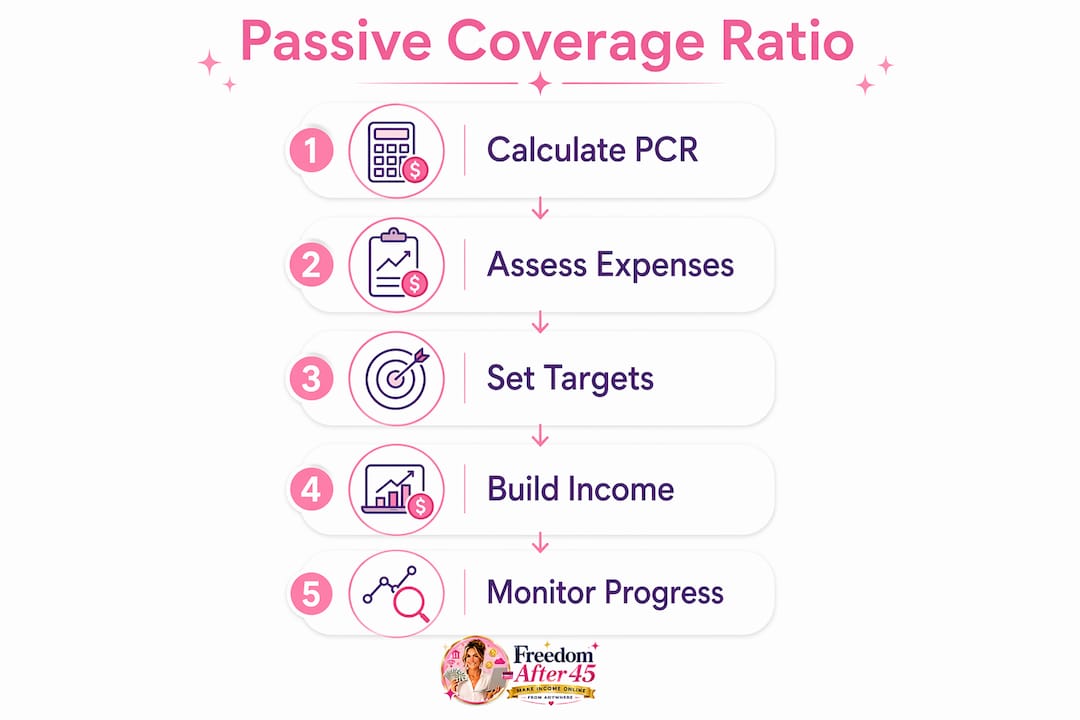
The math is simpler than most people expect. Start with your essential monthly expenses, then set a PCR target based on the level of protection you want.
Three sample profiles:
- Single renter, $3,200/month in expenses. A 40% PCR means $1,280/month in passive income. That covers groceries, utilities, and phone. A 100% PCR means $3,200/month, which makes work genuinely optional.
- Dual-income family, $6,500/month in expenses. One partner losing their job drops household income by roughly half. A 25% PCR ($1,625/month) keeps the household from immediately cutting into savings. A 50% PCR ($3,250/month) replaces the lost income almost entirely.
- High earner with mortgage, $9,000/month in expenses. Even a 20% PCR ($1,800/month) buys 60–90 days of extended runway without touching retirement accounts.
| PCR Target | What It Buys You | Realistic Starting Point |
|---|---|---|
| 20% | Reduced panic; 1–2 extra months of runway | $500 invested in dividend ETFs + one digital product |
| 40% | Strategic job search; avoid bad offers | Diversified portfolio + one reliable digital income stream |
| 50% | Genuine negotiation freedom; can decline roles | Multiple streams, some automation in place |
| 100% | Work optional | Full portfolio + scaled digital or rental income |
Practitioners recommend aiming for 20–40% PCR first rather than chasing 100% immediately. The psychological and practical benefits at that range are outsized compared to the effort required to get there.
Timeline reality check:
- Low capital: Dividend ETFs at typical yields take years to reach a modest monthly income. A digital product can reach that range faster, depending on effort and distribution.
- Mid capital: A diversified mix of dividend funds and REITs can build a moderate PCR over a few years of consistent contributions.
- Higher capital allows building a substantial PCR more quickly, especially with diversified and multiple income streams.
One critical distinction: an emergency fund and passive income are not the same thing and do not replace each other. A cash buffer protects passive assets from forced liquidation. Passive income replaces earned income. You need both.
Pro Tip: Run the math on your own PCR before you invest a dollar. Knowing your target number turns “build passive income” from a vague aspiration into a specific financial goal with a timeline.
Does passive income affect unemployment benefits, and how is it taxed?
The direct answer: passive income generally does not cancel standard unemployment benefits in the United States because those benefits are calculated from wages earned through active employment, not from investment or passive income streams. But the rules are not uniform across all 50 states, and some edge cases exist.
State unemployment rules vary, and some programs require disclosure of certain unearned income or will review material participation in a business activity. If you run an automated affiliate site that you actively manage, for example, a state agency might classify that as active income, which could affect your claim.
Practical steps after a job loss:
- File your unemployment claim promptly and answer all income questions accurately.
- Report any income streams the state form asks about, including rental income or business distributions.
- Keep records showing non-material participation in passive activities if you need to demonstrate they are genuinely passive.
- Consult your state’s unemployment office directly if you have multiple income streams.
The IRS draws a clear line between passive and active income under material participation rules. If you participate in an activity for more than 500 hours per year, the IRS generally treats it as active. That classification affects how losses and income are reported and whether passive activity loss rules apply. Publication 925 from the IRS covers this in detail and is worth reading if you have rental income or a business interest.
Pro Tip: Keep a simple log of hours spent managing each income stream. If a state agency or the IRS ever questions whether an activity is passive, that log is your first line of defense.
Why passive income is not a guaranteed safety net
Passive income reduces risk. It also introduces new vulnerabilities if you are not careful about how you build it.
- Illiquidity trap. Rental property and some private lending platforms cannot be converted to cash quickly. If a large unexpected expense hits, you may be stuck.
- Concentration risk. Putting all passive income into one stream (say, a single rental property or one affiliate site) means one bad event wipes out the protection entirely.
- Sequence-of-returns risk. If a market downturn hits the same month you lose your job, the value of your dividend portfolio drops just when you need it most.
- Tax surprises. REIT dividends are taxed as ordinary income, not at the lower qualified dividend rate. Rental income has depreciation recapture rules on sale. These can create unexpected tax bills.
- Forced liquidation. Without a cash emergency fund, a medical bill or home repair can force you to sell income-producing assets at a loss to cover the shortfall.
- Underestimating management time. Rental properties, affiliate sites, and some digital products require ongoing attention. That time cost is real, especially when you are also job searching.
- Overconfidence in projected yields. A dividend ETF’s historical yield is not a guarantee. Rental vacancy rates fluctuate. Digital product sales can plateau.
The psychological risk is worth naming separately. When passive income is working well, it is easy to assume it will keep working. Ignoring downside scenarios, skipping insurance on a rental property, or failing to diversify across streams are all ways that overconfidence turns a safety net into a liability.
Pro Tip: Treat your emergency fund and your passive income portfolio as two separate systems with two separate jobs. The emergency fund absorbs shocks. The passive income replaces earnings. Neither does the other’s job well.
A 6-step action plan to start building income that actually protects you
A focused plan compresses the most effective early moves into a 30–90 day sprint that produces real results without requiring you to quit your job or risk your savings.
- Stabilize your emergency fund first. Before you invest a dollar in passive income, build 3–6 months of essential expenses in a high-yield savings account. This is non-negotiable.
- Calculate your PCR and set a target. Divide current monthly passive income by monthly essential expenses. Set a 90-day target to reach 10–20% PCR as a first milestone.
- Start with high-liquidity, low-cost options. Open a brokerage account and begin contributing to a dividend-focused index fund or a REIT ETF. These require no special knowledge, start at any dollar amount, and are liquid.
- Create one digital product or service MVP. A short eBook, a template pack, a mini-course, or a licensing agreement for a skill you already have. This does not require a social media following or a product idea from scratch.
- Automate and scale. Set up automatic contributions to your investment accounts. Use a platform that handles digital product delivery automatically. Remove yourself from the daily operations as much as possible.
- Review your allocation and tax structure quarterly. Check your PCR, rebalance if one stream has grown disproportionately, and confirm you are taking available deductions (depreciation, home office, business expenses).
30-day milestones: Emergency fund assessment complete. Brokerage account open. First contribution made. One digital product idea validated.
60-day milestones: First passive income received (even $10 matters as proof of concept). Digital product MVP created or outlined.
90-day milestones: PCR calculated and tracked. Two streams active. Tax structure reviewed.
What to avoid in the first 90 days:
- High-leverage real estate flips that require significant capital and carry substantial downside risk
- Unvetted peer-to-peer lending platforms without adequate reserves
- Any strategy that requires you to leave your current job before passive income is proven
Pro Tip: If you have 2–4 hours per week, split your effort: one hour on investment contributions and tracking, one hour on building or marketing a digital product. Small consistent effort compounds faster than occasional large pushes.
How Freedom After 45’s 2-Hour Workflow fits this protection framework
The 2-Hour Workflow from Freedom After 45 is designed specifically for women aged 45–65 who want to build daily passive income without needing an existing audience, a product, or significant startup capital. It maps directly onto the 6-step plan above, with the key difference being that it compresses the learning curve significantly.
Here is how the workflow aligns with the protective framework:
- Step 1 (stabilize and assess): The program begins with a financial baseline assessment so you know exactly what PCR target you are working toward.
- Step 2 (product creation): Video lessons and downloadable templates walk you through creating a digital product from scratch, even with no prior experience.
- Step 3 (distribution without an audience): The system teaches specific distribution methods that do not require a social media following, which removes the biggest barrier most people face.
- Step 4 (automation): The workflow is designed to run in two hours per day, with automation handling delivery, payment processing, and follow-up.
- Step 5 (scaling): Case studies within the program show reported daily income ranges of $100–$1,400, with outcomes depending on effort, consistency, and the specific product built.
- Step 6 (community and support): A community component keeps participants accountable and provides real-time answers to implementation questions.
The program fits best for women who want a guided, step-by-step path rather than piecing together a strategy from scattered sources. It does not require investment capital, which makes it a practical first move for anyone whose primary barrier is time and knowledge rather than money.
Pro Tip: If you are currently employed, start the 2-Hour Workflow now, while you still have a paycheck. Building passive income before a job loss is infinitely easier than building it after one.
Key Takeaways
Passive income is the most reliable financial protection against job loss because it replaces earned income, buys decision-making time, and preserves long-term assets when a paycheck stops.
| Point | Details |
|---|---|
| PCR is your protection metric | Divide monthly passive income by monthly expenses; aim for 20–40% as your first target. |
| Liquidity matters most after a layoff | Dividend ETFs and REITs offer income plus the ability to access capital quickly if needed. |
| Emergency fund and passive income are separate | Keep 3–6 months of cash reserves; passive income replaces earnings, not emergency cash. |
| Start before you need it | Building passive income while employed is faster, lower-risk, and more effective than starting after a layoff. |
| Freedom After 45 offers a guided path | The 2-Hour Workflow gives women 45–65 a step-by-step system to build daily passive income with two hours per day and no prior audience or product required. |
Passive income as career insurance: a perspective worth taking seriously
The conventional framing of passive income as a retirement strategy misses the point entirely for most working adults. Retirement is decades away. A layoff can happen next quarter. The more useful frame is career insurance: a set of income streams that run alongside your job and activate automatically when your job disappears.
What most articles get wrong is the sequencing. They tell you to build passive income as if it is a separate life project that competes with your career for time and attention. The better approach is to treat it as a risk-management layer that runs in the background, the same way you maintain health insurance while you are healthy. You are not building passive income instead of working. You are building it because you work, and because any job can end without warning.
The psychological shift that comes with even modest passive coverage is real and documented. When you know that $800 a month will keep arriving regardless of what your employer decides, you negotiate differently, you tolerate less, and you make better long-term career decisions. That is not a soft benefit. That is a structural advantage.
The readers who benefit most from this framing are not people who hate their jobs. They are people who like their jobs but understand that industries shift, companies restructure, and no employment contract is permanent. Building income optionality is not pessimism. It is the clearest-eyed thing a working adult can do in 2026.
The 2-Hour Workflow: a guided path to daily passive income
Most passive income advice tells you what to do without showing you how. Freedom After 45 takes a different approach: a step-by-step blueprint that walks you through building a digital income stream from scratch, designed specifically for women over 45 who want real results without a social media following, a tech background, or a large startup budget.

The program delivers video lessons, downloadable workflow templates, case studies, and a support community, all structured around a two-hour daily commitment. Participants report varying daily income depending on effort, consistency, and the specific product or system they build. The system handles the parts most people get stuck on: what to create, how to distribute it without an audience, and how to automate delivery so income continues without daily intervention.
If the 6-step action plan in this article resonates with you and you want a guided, proven system rather than a DIY approach, the 2-Hour Workflow is built for exactly that situation. Start the 2-Hour Workflow and build the passive income layer your career needs before you ever need it.
Useful U.S.-focused sources and further reading
- IRS Publication 925 — Passive Activity and At-Risk Rules: The primary IRS reference for passive vs. active income classification, material participation tests, and loss rules. Read this before filing taxes on rental income or business interests.
- IRS Topic 409 — Capital Gains and Losses: Covers how capital gains from selling income-producing assets are taxed, including the distinction between short- and long-term rates.
- SEC — REITs Overview: The SEC’s plain-language explainer on how REITs work, how they are regulated, and what investors should know before buying.
- FINRA: The Financial Industry Regulatory Authority’s investor education resources cover dividend investing, brokerage account basics, and how to verify a broker’s credentials.
- Ramsey Solutions — What Is Passive Income?: A practical overview of passive income types, the role of emergency funds, and how passive income interacts with unemployment benefits.
- Katharine Gallagher — Income Optionality as Career Insurance: The clearest articulation of the career-insurance framing, with practical guidance on building income optionality alongside employment.
- Bricksfolios — Passive Income Is Mental Health Insurance: Research-backed analysis of the psychological benefits of passive income and the PCR thresholds that produce measurable behavioral shifts.
- Financial Samurai — Passive Income and Unemployment Insurance: Covers the nuances of how passive income interacts with state unemployment benefit rules and what to disclose.
- DebtFreeDr — 7 Streams of Income: A practical taxonomy of income types used by financial educators to explain diversification and why multiple streams matter.
- Freedom After 45 — 2-Hour Workflow: The client’s guided program for building daily passive income with two hours per day, designed for women 45–65 without prior experience or an existing audience.
This article is general financial information, not professional financial or tax advice. Consult a qualified financial advisor or tax professional for guidance specific to your situation, and verify current rules with the IRS or your state’s unemployment office.