

Why Gen X Women Face Unique Financial Pressures
Gen X women face a convergence of financial pressures that no other generation has encountered in quite the same combination: caregiving obligations that eat into both time and savings, a retirement system that shifted the rules mid-career, persistent wage gaps, and debt loads that grew across multiple economic downturns. The result is a cohort caught between what they were promised and what the numbers actually show.
- Caregiving pulls Gen X women out of the workforce or into part-time roles, directly reducing wages, employer retirement matches, and Social Security credits.
- Retirement-system shifts from pensions to 401(k)s happened before Gen X could benefit from auto-enrollment, leaving a compressed catch-up window.
- Debt (student loans, mortgages, consumer credit) accumulated across multiple recessions and remains elevated at midlife.
- Wage gaps and career interruptions reduce lifetime earnings and shrink the Social Security benefit that is supposed to anchor retirement income.
- Perimenopause and caregiving stress create a health feedback loop that compounds every financial pressure above.
According to CNBC’s reporting on retirement research, Gen X is the least financially prepared generation for retirement by many measures, and family responsibilities are a primary reason women in this cohort have reduced or stopped saving altogether.
Key Takeaways
Gen X women face a retirement and financial crisis driven by structural forces, not personal failure, and the most effective response combines urgent catch-up actions with a clear-eyed view of the systemic causes.
| Point | Details |
|---|---|
| Structural retirement gap | Gen X missed auto-enrollment and pension coverage, leaving most with a compressed catch-up window of roughly 10–15 years, though some have more or less time depending on age and circumstances. |
| Caregiving’s hidden cost | Reduced employer matches, lost Social Security credits, and eldercare expenses collectively cost caregivers hundreds of thousands of dollars over a lifetime, with actual gaps varying widely according to caregiving duration, employment status, and family structure. |
| Debt compounds the risk | High student-loan balances and rising delinquency among borrowers over 40 reduce the cash flow available for retirement saving. |
| Health amplifies every pressure | Perimenopause-related sleep loss and caregiving stress impair financial decision-making and raise out-of-pocket medical costs. |
| Freedom After 45 | The 2-Hour Workflow offers a practical income option for Gen X women who need additional cash flow to fund catch-up contributions or reduce debt. |
Table of Contents
- What do the numbers actually show about Gen X women’s financial risk?
- How caregiving creates a persistent financial drag for Gen X women
- Why the pension-to-401(k) shift left Gen X women with a shorter catch-up window
- How Gen X women’s debt profile raises risk at midlife
- How wage gaps, career breaks, and gray divorce shrink lifetime earnings
- Why menopause and caregiving stress amplify every financial risk
- What Gen X women can do right now: a prioritized checklist
- Why these pressures are structural, not personal failures
- What this looks like from the inside
- A different way to build income around your real schedule
- Sources
What do the numbers actually show about Gen X women’s financial risk?
The data paints a stark picture. USA Today’s reporting on Gen X retirement finds that many Gen X households expect a retirement shortfall measured in hundreds of thousands of dollars versus their savings targets. SSGA’s industry analysis confirms that Gen X women enter retirement with materially less wealth than men in the same cohort and are less likely to have a comprehensive financial plan in place.
| Metric | What the data shows |
|---|---|
| Retirement preparedness | Gen X ranks last among living generations on most retirement-readiness measures |
| Sandwich-generation caregiving | Gen X is the generation most likely to be supporting both children and aging parents simultaneously |
| Student loan debt | Gen X carries higher average student-loan balances than younger cohorts, with rising delinquency among borrowers over 40 |
| Retirement savings confidence | Gen X women report lower confidence in meeting long-term retirement goals than Gen X men or older women |
Consider a 52-year-old woman with $95,000 in a 401(k), $28,000 in student loan debt, and a parent moving into assisted living. With roughly 13 years until a standard retirement age, she has limited time to close a gap that, according to industry and journalistic reports, could easily reach hundreds of thousands of dollars or more when healthcare costs are factored in. A dual-earner household fares better on paper, but if one partner reduces hours to manage caregiving, the employer match loss alone can cost tens of thousands over a decade.
- Gen X women have roughly 10–15 years to close a retirement gap that took decades to open. For some, the catch-up window may be shorter or longer depending on age, caregiving status, and current savings.
- Every year of delayed catch-up contributions costs compounding growth that cannot be recovered.
How caregiving creates a persistent financial drag for Gen X women
The sandwich generation label gets used loosely, but for Gen X women the timing is genuinely punishing. Many are in their late 40s and early 50s, still carrying college-age children or paying for younger kids’ activities, while simultaneously managing a parent’s declining health. These two caregiving windows overlap precisely during the years when earnings typically peak and retirement contributions should be at their highest.
The Atlantic’s reporting on Gen X caregiving documents how specialized care needs, particularly for parents with dementia or complex medical conditions, frequently exceed standard assisted-living cost estimates. When personal savings must bridge those gaps, retirement reserves deplete faster than any calculator projects.
The financial erosion goes beyond the obvious. SSGA’s analysis identifies caregiving’s “hidden tax”: reduced employer matching, fewer years of contributions, and lower Social Security credits that collectively cost a caregiver hundreds of thousands over a lifetime. Most retirement planning tools do not model this compounding loss.
Two quick scenarios:
A single-earner household where the woman steps back to part-time at 48 to manage eldercare loses not just half her salary but her full employer 401(k) match, her health insurance (forcing marketplace coverage), and potentially years of Social Security earnings history. A dual-earner household where both partners stay employed but one absorbs all caregiving coordination loses fewer dollars directly but pays in chronic stress, reduced sleep, and the cognitive load that affects every financial decision.
Pro Tip: Request a Social Security earnings statement at ssa.gov every year while caregiving. Gaps in your earnings record are visible and quantifiable, which makes it easier to model the long-term cost and decide whether a spousal benefit strategy or delayed claiming makes sense for your situation.
Why the pension-to-401(k) shift left Gen X women with a shorter catch-up window
Gen X entered the workforce during a structural transition that most people only understood in hindsight. Defined-benefit pensions, which guaranteed a monthly income regardless of market performance or contribution discipline, were being phased out across corporate America through the 1980s and 1990s. What replaced them, the 401(k), required workers to opt in, choose their own investments, and contribute consistently. Investopedia’s analysis of Gen X retirement challenges explains that auto-enrollment and auto-escalation features, which nudge workers to save without requiring active decisions, were not widely adopted until after many Gen X workers had already missed their early-career compounding years.
The retirement shortfall is real and measurable. Multiple retirement reports from 2024–2025 show Gen X ranking lowest on retirement preparedness, with many households expecting to fall hundreds of thousands of dollars short of their savings targets.
| Feature | Pension era | 401(k) era |
|---|---|---|
| Enrollment | Automatic | Opt-in (auto-enroll came later) |
| Investment risk | Employer bears it | Employee bears it |
| Benefit guarantee | Fixed monthly income | Market-dependent balance |
| Portability | Limited | Portable across jobs |
| Contribution discipline required | None | High |
The LIMRA/Institute retirement challenges paper identifies repeated economic shocks (the dot-com crash, the 2008 financial crisis, COVID-19) as compounding the structural problem. Each downturn either wiped out early savings or forced Gen X workers to pause contributions at exactly the wrong time.
Catch-up actions worth taking now:
- Workers aged 50 and older can contribute an additional $7,500 to a 401(k) above the standard limit in 2026, according to current IRS rules. Max this before any other investment.
- Traditional and Roth IRA catch-up contributions (an extra $1,000 above the standard limit for those 50+) are available even if you have a workplace plan.
- If your employer offers a Health Savings Account (HSA), treat it as a secondary retirement vehicle: contributions are pre-tax, growth is tax-free, and withdrawals for medical expenses are tax-free.
How Gen X women’s debt profile raises risk at midlife
Debt is not inherently a crisis, but the combination Gen X women carry at midlife is particularly difficult to manage. Investopedia’s reporting on Gen X financial struggles highlights that Gen X holds higher average student-loan balances than younger cohorts and that borrowers over 40 are showing rising serious-delinquency rates, a trend that accelerated through 2024–2025.
- Student loans: Many Gen X women are known to have borrowed for undergraduate and graduate degrees in the 1980s and 1990s, then took on additional debt to fund children’s education. Balances that should have been paid off are still active at 50.
- Mortgages: Gen X bought homes during two of the most volatile housing markets in modern history (the late 1990s boom and the post-2008 recovery). Many carry mortgages that extend into their late 60s.
- Consumer credit: Credit card balances tend to rise during caregiving periods when income drops and expenses spike. High-rate revolving debt is the fastest way to erode any financial cushion.
Delinquency among older borrowers is a specific warning sign. When a 50-year-old misses loan payments, the credit damage affects mortgage refinancing options, insurance rates, and even employment background checks, creating a cascade that is harder to reverse than it would be at 30.
Pro Tip: Prioritize debt payoff in this order: high-interest revolving credit first (anything above 18% APR), then private student loans with no income-based repayment options, then federal student loans (which have income-driven repayment and forgiveness pathways). Never deprioritize retirement contributions entirely to pay debt, but match the math: paying 22% APR credit card debt is a guaranteed 22% return.
How wage gaps, career breaks, and gray divorce shrink lifetime earnings
The financial consequences of earning less, working less, and divorcing later in life stack in ways that are hard to recover from.
- Wage gap: Women in the Gen X cohort have earned less than male peers across their careers. Lower base salaries mean smaller raises, smaller employer matches, and smaller Social Security benefits, since the benefit formula is based on lifetime earnings.
- Caregiving career breaks: A two-year career pause at 47 does not just cost two years of salary. It costs two years of employer match, two years of Social Security earnings credits, and often a step back in seniority or title that takes years to recover.
- Gray divorce: Divorce after 50 splits assets that were built for one household’s retirement into two. Women typically emerge with less liquid wealth, lower earning capacity, and a shorter runway to rebuild.
SSGA’s analysis finds that Gen X women enter retirement with materially less wealth than men and report lower confidence in meeting long-term goals. The wage gap is a structural driver, not a personal failure.
Racial and ethnic disparities sharpen every one of these effects. Black and Latina Gen X women face larger wage gaps relative to white male peers, are more likely to be primary caregivers without paid support, and have lower median household wealth, which means less cushion when any one of these pressures intensifies. Forbes’ reporting on Gen X women’s financial futures documents how structural inequities compound across a career, leaving women of color with the narrowest margin for error at midlife.
Why menopause and caregiving stress amplify every financial risk
The physical and cognitive effects of perimenopause are not separate from financial outcomes. They are directly connected.
Time’s reporting on Gen X women and sleep finds that Gen X women get less sleep than any other generation, with perimenopause-related insomnia a primary driver. Sleep deprivation impairs the prefrontal cortex functions responsible for financial decision-making: risk assessment, impulse control, and long-term planning. A woman managing a parent’s care on four hours of sleep is not making the same financial decisions she would make rested.
Chronic stress from caregiving also raises cortisol levels, which research links to increased risk of cardiovascular disease, depression, and immune dysfunction. Each of these conditions carries direct financial costs: higher insurance premiums, more out-of-pocket medical spending, and potential reductions in work capacity. The SSGA “coordination decade” framework captures this precisely: retirement, caregiving, healthcare, and career complexity all collide in the same 10-year window.
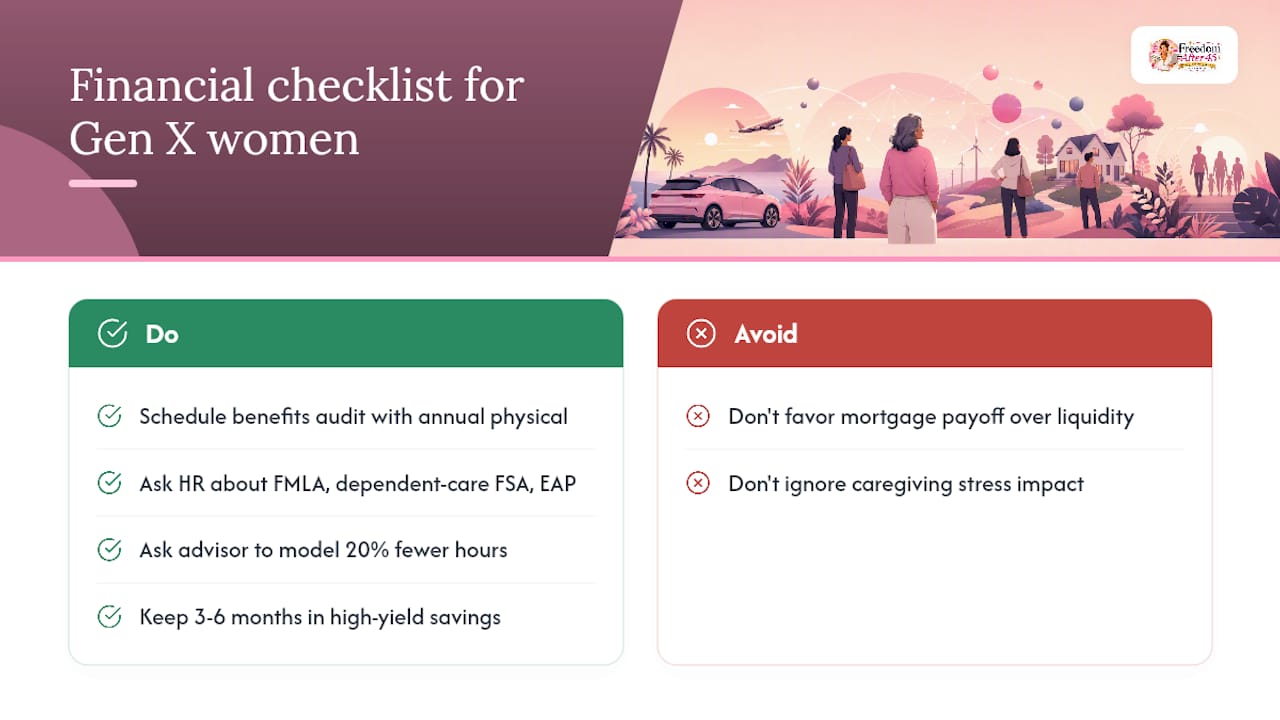
Pro Tip: Schedule a benefits audit alongside your next annual physical. Ask your HR department specifically about FMLA protections, dependent care FSA limits, and any Employee Assistance Program (EAP) mental health benefits. Then ask your financial advisor to model a scenario where you reduce hours by 20% for two years. Seeing the number makes the tradeoff concrete and often reveals that a small liquidity buffer (three to six months of expenses in a high-yield savings account) is more protective than accelerating mortgage payoff.
What Gen X women can do right now: a prioritized checklist
The window is compressed, but it is not closed. The actions below are ordered by urgency and impact.
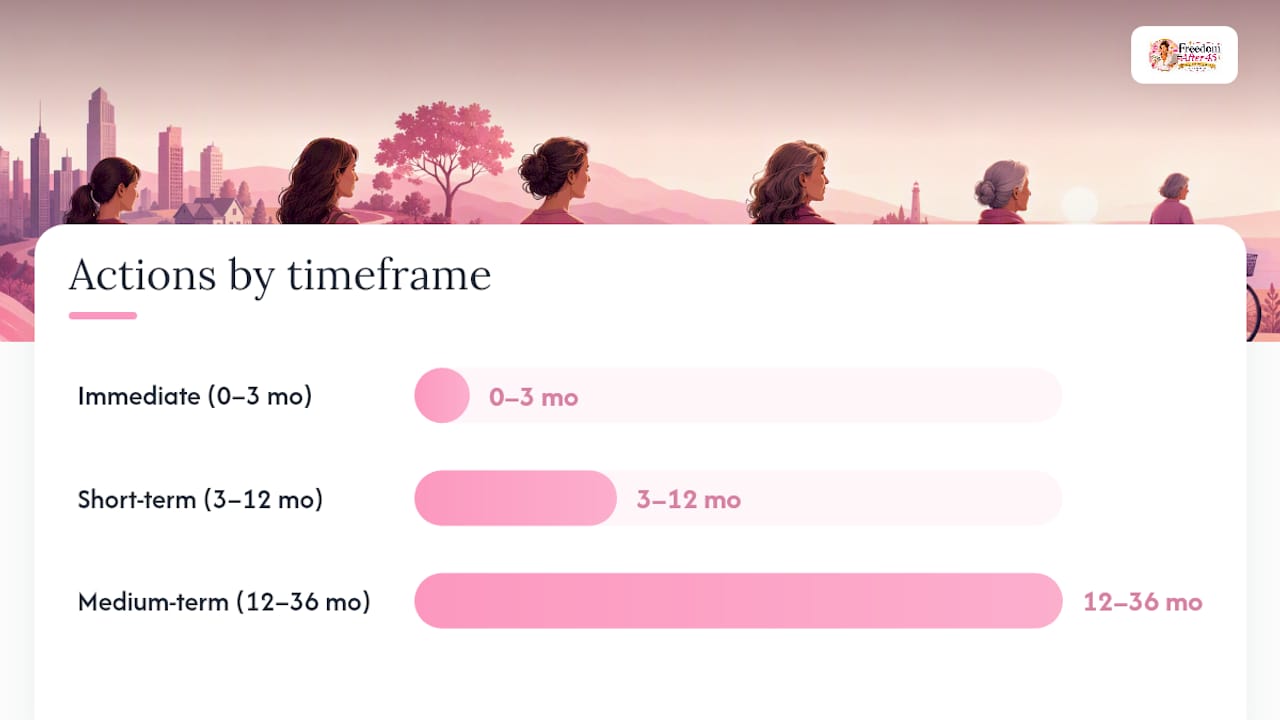
Immediate (0–3 months):
- Pull your Social Security earnings statement at ssa.gov and identify any gaps from caregiving years.
- Open or fund a high-yield savings account with a target of three months of essential expenses. This is your decision buffer, not an investment.
- Log into your 401(k) and confirm you are contributing at least enough to capture the full employer match. If you are not, increase by 1% this month.
- Request a benefits audit from HR: FMLA eligibility, dependent care FSA, HSA availability, and any caregiver support programs.
Short-term (3–12 months):
- Maximize catch-up contributions: $7,500 extra to your 401(k) and $1,000 extra to your IRA if you are 50 or older.
- List every debt with its interest rate. Pay minimums on everything below 10% APR and direct extra cash to the highest-rate balance first.
- Review your beneficiary designations on every account, especially after any divorce or family change.
- If you have federal student loans, log into studentaid.gov and confirm your repayment plan. Income-driven repayment options may free up cash for retirement contributions.
Medium-term (12–36 months):
- Model two Social Security claiming scenarios with a fee-only financial planner: your own benefit versus a spousal or survivor benefit if applicable.
- Research your state’s caregiver support programs and any available tax credits for dependent care.
- If divorce is a factor, consult a Certified Divorce Financial Analyst (CDFA) before finalizing any asset split. Retirement accounts divided incorrectly lose significant value to taxes and penalties.
Pro Tip: When talking to HR about part-time protections, say specifically: “I need to understand how a reduction to 32 hours per week would affect my benefits eligibility, 401(k) match, and FMLA status.” That framing gets a concrete answer faster than a general question about flexibility.
Why these pressures are structural, not personal failures
The financial strain Gen X women carry is not the result of poor decisions. It is the predictable outcome of policy and market changes that converged on this cohort at the worst possible time.
Pension coverage in the private sector fell from roughly 38% of workers in 1979 to under 15% by the early 2000s, according to LIMRA’s retirement challenges research. Healthcare costs have grown faster than wages for three consecutive decades. Housing prices in most major metros have outpaced income growth since the mid-1990s. Social Security faces projected funding pressure that could reduce benefits for future retirees if no legislative fix is enacted.
Gen X women hit each of these structural shifts at the exact life stage where the impact was greatest: entering the workforce as pensions disappeared, buying homes at peak prices, and reaching peak caregiving years as healthcare costs surged.
Individual planning matters and the checklist above is real. But the scale of the problem also calls for policy attention including expanded caregiver credits in Social Security, stronger auto-enrollment mandates for 401(k) plans, and affordable long-term care options to better support families. Understanding the structural dimension is not defeatist. It is accurate, and it points toward the right mix of personal action and collective advocacy.
What this looks like from the inside
Picture a 49-year-old woman who did everything she was supposed to do: finished her degree, built a career, contributed to her 401(k) when she could. Then her mother’s health declined, her teenager needed more support, and her employer restructured. She is not behind because she was careless. She is behind because the system she was handed was designed for a different life than the one she is actually living. Ada Calhoun’s research, documented in NPR’s coverage of Why We Can’t Sleep, captures exactly this: the exhaustion Gen X women feel is not weakness. It is the rational response to being asked to carry more than the infrastructure was built to support. The numbers in this article are not abstract. They map directly onto the decisions she makes every week about where the money goes and what gets deferred again.
A different way to build income around your real schedule
The financial pressures Gen X women face are real, and the checklist above addresses the structural pieces. But catch-up contributions and debt payoff both require one thing most caregivers are short on: cash flow. That is where Freedom After 45 offers something different.

The Freedom After 45 2-Hour Workflow is a step-by-step online course and blueprint built specifically for women over 45 who need to generate daily income without an existing social media following, a product to sell, or a 40-hour week to spare. The system is designed around a two-hour daily commitment, which fits inside the caregiving and employment schedule most Gen X women are already managing. Thousands of women have used it to create consistent daily income that supplements retirement contributions, pays down high-rate debt, or simply rebuilds the liquidity buffer that caregiving eroded. If your 6–24 month plan includes finding an income source that works around your obligations rather than against them, this is worth a look.
Disclosure: Freedom After 45 is a paid program. Results vary based on individual effort and circumstances.
Sources
- Raising the wealth management bar for Gen X women - SSGA
- Why Gen X Faces Retirement Savings Challenges and What It Means for You - Investopedia
- Retirement Challenges Facing Gen X - LIMRA/Institute
- For Gen X, retirement bites - USA Today
- Gen X is facing a retirement crisis - CNBC
- Why We Can’t Sleep documents the unique pressures on Gen X women - NPR
- Gen X Women Get Less Sleep Than Any Other Generation. Why? - Time
This article is general information, not a substitute for advice from a qualified financial advisor. Consult a qualified financial professional about your own circumstances before acting on anything here.