

Why Financial Stress Hijacks Your Daily Decisions
Financial stress doesn’t just make you feel bad. It literally reduces your ability to think clearly, and that’s why it affects daily decisions in ways that feel almost impossible to control. Research co-authored by Chicago Booth’s Sendhil Mullainathan and Princeton’s Eldar Shafir found that working through a difficult financial problem creates cognitive strain comparable to losing a full night’s sleep, roughly equivalent to a 13-IQ-point drop. That’s not a character flaw. That’s biology. The single most useful thing you can do right now: apply a brief pause before any non-urgent financial decision. That one habit alone can prevent the worst stress-driven choices.
Freedom After 45 was built around this reality. When your mental bandwidth is taxed, you need a system that does the thinking for you, not more willpower.
Table of Contents
- Why does financial stress affect daily decisions so deeply?
- What experiments reveal about risk-taking under money stress
- How financial stress distorts the decisions you make every day
- Evidence-based steps to protect your decisions from financial stress
- How a 2-hour daily workflow protects your decision quality
- Key Takeaways
- Why simple and time-boxed is the right answer here
- Sources and further reading
Why does financial stress affect daily decisions so deeply?
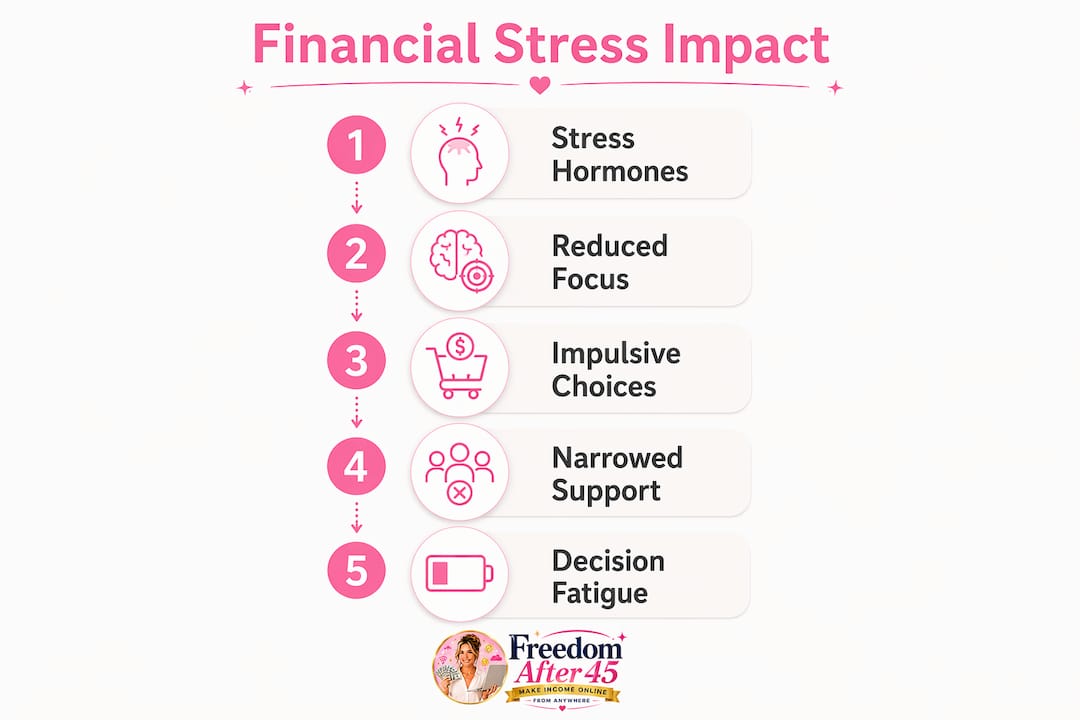
Stress doesn’t just make you anxious. It physically reassigns your brain’s resources. When cortisol and adrenaline spike, the prefrontal cortex, the part responsible for planning, impulse control, and weighing consequences, gets sidelined. Your brain shifts into survival mode, prioritizing fast, reactive responses over careful deliberation.

The result is what researchers call “tunneling.” Scarcity narrows attention so tightly onto the immediate problem that long-term consequences become nearly invisible. You’re not ignoring the future because you don’t care. You literally can’t see it clearly right now.
Acute vs. chronic stress work differently:
- Acute stress (a sudden bill, an unexpected expense) hits fast and fades. It can sharpen focus briefly but impairs complex reasoning in the moment.
- Chronic stress (ongoing debt, income uncertainty, caregiving costs) creates a persistent bandwidth tax. Decision quality degrades across the board, not just during a crisis.
For women over 45 managing household finances, caregiving responsibilities, and retirement planning simultaneously, chronic stress is the more common pattern. And chronic load doesn’t reset overnight. It compounds.
Here’s what that looks like in practice: you sit down to review your budget, feel the familiar tightening in your chest, and suddenly you’re clicking “buy now” on something you didn’t plan to purchase. That’s not weakness. That’s prefrontal impairment flipping a planned choice into an automatic one.
What experiments reveal about risk-taking under money stress
The brain under financial stress doesn’t just make worse decisions. It makes predictably different ones depending on how a choice is framed. A controlled experiment found a statistically significant interaction (F(1, 26) = 6.40, p < .05): participants under stress became more conservative when choices were framed as potential gains, but shifted toward higher-risk options when the same choice was framed as avoiding a loss.
That asymmetry matters enormously for everyday money decisions:
- Investment timing: Stressed investors tend to hold back when markets rise (gain frame) but panic-sell or double down when facing losses.
- Emergency borrowing: A high-APR loan feels acceptable when framed as “avoiding late fees” rather than “taking on debt.”
- Purchase decisions: A discount framed as “save $40” feels less urgent than “don’t pay $40 more.”
- Negotiation: Under stress, people accept worse terms to end the discomfort of uncertainty faster.
Pro Tip: Before any financial decision, ask yourself: “Am I being shown what I gain or what I avoid losing?” Loss framing creates urgency that isn’t real. Naming it breaks its grip.
Reframing a choice, or simply delaying it by 24 hours, is often enough to restore more balanced thinking.
How financial stress distorts the decisions you make every day
The effects show up in specific, recognizable patterns. Women over 45 navigating income gaps, caregiving costs, or retirement uncertainty tend to encounter these most often:
- Ignoring bills: Not from laziness, but because active financial worry dips cognitive performance enough that avoidance feels like relief.
- Impulse purchases: Small, immediate rewards feel disproportionately satisfying when the future feels threatening.
- Payday borrowing: High-cost short-term loans get accepted because the immediate problem (rent, utilities) crowds out the long-term cost (APR, debt spiral).
- Selling assets prematurely: Stocks, savings bonds, or retirement funds get liquidated at the worst moments, driven by loss-frame urgency.
- Skipping long-term planning: Insurance reviews, retirement contributions, and income-building steps get postponed indefinitely.
The social dimension is real too. Financial stress tends to shrink the support network people actually use. Asking for help feels like admitting failure, so stressed individuals often make worse decisions alone rather than reaching out. For women in this age group who are also primary caregivers, income volatility and emotional load compound each other, making the tunneling effect even more pronounced.
Evidence-based steps to protect your decisions from financial stress
The goal isn’t to eliminate stress before acting. It’s to build systems that work despite stress.
Core strategies, with time costs:
- Automate recurring decisions (bill pay, savings transfers, course promotions): removes micro-decisions entirely. Setup takes 1–2 hours; ongoing cost is near zero.
- Apply the 24–48 hour pause rule for any non-routine financial choice: costs nothing, prevents the most impulsive errors.
- Use a written decision checklist for high-stakes choices (loans, investments, pricing): 10 minutes to create, reusable indefinitely.
- Build a small emergency buffer (even $500–$1,000): reducing scarcity itself measurably improves cognitive function and decision quality.
- Delegate complexity (tax prep, bookkeeping): automation and pre-commitment preserve bandwidth for the decisions that actually matter.
Pro Tip: During high-stress periods, cut the number of active financial decisions in half. Fewer choices mean less bandwidth drain. Decide what you’ll automate this week and stop re-deciding it.
10-minute decision audit: Write down three financial decisions you’ve been avoiding or making impulsively. For each one, note: Is this urgent or just uncomfortable? Can it be automated or delegated? What’s the 48-hour cost of waiting? That audit alone surfaces the highest-risk choices.
| Strategy | What it does | Weekly time cost |
|---|---|---|
| Automatic bill pay | Eliminates missed payments and late-fee stress | 1–2 hours setup, near zero ongoing |
| 24–48 hour pause rule | Blocks impulsive high-stakes choices | — |
| Written decision checklist | Externalizes judgment during low-bandwidth moments | 10 min to build |
| Emergency buffer ($500–$1,000) | Reduces scarcity pressure on daily decisions | Ongoing savings habit |
| Delegate tax/bookkeeping | Frees cognitive load for income-building tasks | 1–2 hrs/year to arrange |
How a 2-hour daily workflow protects your decision quality
A regular, time-boxed routine does something willpower alone can’t: it externalizes your decision rules. When the workflow is written down and scheduled, you don’t have to decide whether to do it. That’s the bandwidth savings.
Here’s a simple structure that works:
| Block | Duration | What it accomplishes |
|---|---|---|
| Morning review | 10 min | Check one financial metric, confirm the day’s income task, apply the pause rule to any new decisions |
| Core income work | — | Execute the day’s primary passive income activity (course promotion, content, outreach) |
| Close and automate | 10 min | Log results, queue tomorrow’s task, confirm any automated transfers or scheduled actions |
The 2-Hour Workflow at Freedom After 45 is built on exactly this principle. Women following the system report daily earnings in the $100–$1,400 range, but the deeper benefit is reduced decision fatigue. When the system handles the what and when, your brain handles the how, and that’s where real progress happens.
This is a behavioral guardrail, not a magic fix. Stress will still show up. The workflow means it shows up to a structure that holds, not an open field of unprotected choices.
Key Takeaways
Financial stress reduces cognitive bandwidth by the equivalent of 13 IQ points, making short-term survival feel more urgent than long-term goals, and a structured daily workflow is the most reliable protection against stress-driven decision errors.
| Point | Details |
|---|---|
| The 13-IQ-point cost | Financial worry impairs thinking as much as losing a full night’s sleep — this is biology, not weakness. |
| Tunneling blocks long-term thinking | Stress narrows focus to immediate problems, hiding the long-term cost of short-sighted choices. |
| Framing changes risk behavior | Stress makes you conservative on gains but risk-seeking on losses — name the frame before deciding. |
| Automation beats willpower | Pre-committed rules and automated systems protect decisions when bandwidth is lowest. |
| The 2-hour structure works | A time-boxed daily workflow externalizes decisions and reduces the cognitive tax of financial stress. |
Your one-week challenge: Today, set up one automatic payment. Tomorrow, write your 10-minute decision audit. By day seven, try the 2-hour workflow once. Poor choices under stress are a biological response, not a moral failure. The right structure makes better decisions the default.
Why simple and time-boxed is the right answer here
The research is clear on one thing most financial advice ignores: complexity is the enemy when bandwidth is already taxed. Elaborate budgeting systems, multi-step investment strategies, and high-effort income plans all demand the cognitive resources that financial stress has already depleted. That’s why they fail for the people who need them most.
A time-boxed, low-complexity approach isn’t a compromise. It’s the scientifically correct response to how stress actually works. The IZA working paper on financial stress makes this explicit: people who recognize that stress impairs their judgment are far more likely to adopt external rules and avoid the poverty traps that stress-plus-naivete creates. Awareness is the first move. Structure is the second.
Freedom After 45 exists because that structure shouldn’t require a financial advisor, a large starting budget, or an existing audience. The 2-Hour Workflow was designed for women over 45 who are already stretched, already stressed, and still ready to build something real. Start with the one-week challenge above. The system does the rest.
Sources and further reading
The claims in this article draw on peer-reviewed research, practitioner guidance, and program evidence. Key sources:
- Chicago Booth — How Financial Stress Can Impact Your Thinking — Peer-reviewed research base. The primary source for the 13-IQ-point cognitive cost finding, co-authored by Sendhil Mullainathan (Chicago Booth) and Eldar Shafir (Princeton).
- PMC — Experimental results on stress and risk-taking — Peer-reviewed. Controlled experiment documenting gain/loss framing effects on risk behavior under acute stress.
- PMC — Financial Worries and Psychological Distress Among U.S. Adults — Peer-reviewed. National data on the prevalence and mental health consequences of financial stress in the U.S.
- IZA Discussion Paper — The Economics of Financial Stress — Working paper. Models how stress plus naivete about stress leads to worse saving behavior and welfare losses.
- Simply Psychology — The Psychology of Scarcity — Practitioner explainer. Accessible summary of tunneling, trade-off blindness, and scarcity research.
- Relearning Money — Don’t Make Big Money Decisions When You’re This Stressed — Practitioner guide. Covers the Stress Thermometer tool, pause protocols, and written planning frameworks.
- Citizens Private Wealth — How Stress and Anxiety Influence Financial Decision-Making — Practitioner/advisor piece. Automation, liquidity buffers, and delegation recommendations from financial advisors.
- Psychology Today — How Financial Anxiety Clouds Your Brain — Popular explainer. Timing effects and cognitive performance dips during active financial worry.
- Freedom After 45 — 2-Hour Workflow — Program landing page. Describes the workflow structure, outcomes, and access details.