

Financial Overwhelm Is Not Permanent: Your 2-Hour Reset
Financial overwhelm is rarely permanent. You can reduce its grip right now with three immediate steps, and most people who follow a structured approach see measurable change within about a week. The Anxiety & Depression Association of America (ADAA) makes a critical distinction: financial worry is usually situational, meaning it is tied to specific circumstances that can change, not a fixed feature of your psychology. The FDIC also provides reassurance that your bank deposits are federally insured, so even in a financial crisis, your basic account protections remain intact.
Three things to do in the next 60 minutes:
- Pause and breathe (5 minutes). Sit somewhere quiet, breathe in for four counts, hold for four, exhale for four. Do this four times. Your nervous system needs a reset before your finances do.
- Run a 20–30 minute financial inventory. Open every account, write down your current balances, minimum payments, income, and the next three due dates. Clarity is the fastest anxiety reducer there is.
- Set one automatic transfer or schedule one bill. Even $10 moved to savings or one bill scheduled for autopay creates a sense of forward motion that breaks the paralysis loop.
What to expect after seven days:
- You know your real balances (not the foggy, feared version)
- At least one bill is negotiated, scheduled, or deferred
- You have slept better on some nights compared to the week before
- You have a written list of what is owed and when, which you can actually look at without panic
Key Takeaways
Financial overwhelm is situational, not permanent, and the fastest way out is a structured inventory followed by one creditor call and one automated financial action.
| Point | Details |
|---|---|
| Overwhelm is situational | The ADAA confirms financial worry is usually tied to specific circumstances, not a fixed disorder, and responds to concrete action. |
| Clarity beats motivation | A 20–30 minute written inventory of balances, payments, and due dates reduces anxiety faster than any mindset exercise alone. |
| Free help exists | The NFCC, HUD, FTC, and USA.gov offer free counseling, housing assistance, debt guidance, and benefits access at no cost. |
| Progress follows a timeline | Most people see measurable change in 7 days; a 30/60/90-day plan with specific milestones makes recovery trackable and real. |
| Freedom After 45 | Women 45–65 ready to build income alongside recovery can access the 2-hour workflow program at earningdaily.net. |
Table of Contents
- Why financial overwhelm feels permanent when it usually isn’t
- How financial stress affects your health and when to get urgent help
- Practical first steps you can take this week to stop the spiral
- How to build a realistic plan from triage to stability
- A focused 2-hour session to break paralysis
- How to keep progress going and avoid sliding back
- Real examples of recovery from financial overwhelm
- Common misconceptions that make financial overwhelm feel permanent
- What we know about financial overwhelm after working with thousands of families
- A structured program for women who want guided support
- Authoritative U.S. resources and where to go next
- Sources
Why financial overwhelm feels permanent when it usually isn’t
The feeling of permanence is the cruelest part. When you are in the middle of it, the stress feels like a character trait rather than a response to a situation. Understanding why that happens is the first step toward overcoming financial stress for good.
Financial overwhelm sits at the intersection of real situational stressors (job loss, medical bills, a sudden rent increase, a broken car) and cognitive patterns that amplify them. The three most common patterns are:
- Scarcity mindset: When money is tight, the brain narrows its focus almost entirely onto the shortage. Research by behavioral economists Sendhil Mullainathan and Eldar Shafir showed that scarcity literally consumes cognitive bandwidth, making it harder to plan, prioritize, or think long-term.
- Catastrophizing: The mind jumps from “I missed a payment” to “I will lose everything.” That leap feels logical in the moment but almost never reflects the actual trajectory.
- Financial bypassing: Described by financial therapist Bari Tessler and explored in Psychology Today, this is the pattern of obsessively checking balances or avoiding them entirely as a way to manage anxiety rather than the underlying financial problem. It keeps you busy without moving you forward.
Here is what the loop looks like in practice: you open a bill that is higher than expected, your stomach drops, you spend two hours mentally calculating worst-case scenarios, and then you close the laptop without doing anything. The next day, the bill is still there, the anxiety is higher, and the avoidance feels even more justified. That loop is not a personality flaw. It is a predictable stress response, and it breaks when you change the inputs.
The ADAA draws a clear line between situational financial anxiety and Generalized Anxiety Disorder (GAD). GAD involves persistent, excessive worry that interferes with daily life across multiple domains and does not resolve when circumstances improve. Situational financial worry, by contrast, is tied to specific events and typically responds to concrete action. Most people reading this are dealing with the situational kind.
Pro Tip: The feeling of permanence is an interface problem, not a reality problem. You are experiencing the emotional output of a stress system responding to incomplete information. Give it real numbers and a real plan, and the signal changes.
How financial stress affects your health and when to get urgent help
Persistent financial stress does not stay in your wallet. It moves into your body. Sleep disruption is usually the first sign: the mind replays numbers and scenarios at 2 AM when there is nothing else competing for attention. Concentration drops, appetite shifts (either disappears or spikes), and the immune system takes a measurable hit over time. HelpGuide’s guidance on coping with financial stress confirms that these physical effects are well-documented and that stepwise practical approaches genuinely reduce them.
Watch for these signs that stress has crossed into crisis:
- Sleeping very little most nights for an extended period
- Significant appetite loss or stress eating that is affecting your weight or energy
- Panic attacks: racing heart, shortness of breath, a sense of dread that arrives without warning
- Withdrawing from friends, family, or activities you normally enjoy
- Increased alcohol or substance use to manage the anxiety
- Thoughts of self-harm or feeling that others would be better off without you
That last item is not a rhetorical addition. Financial stress is one of the documented triggers for suicidal ideation, and it is more common than most people admit. If you are having those thoughts, stop here and call or text 988.
The 988 Suicide & Crisis Lifeline is free, confidential, and available 24 hours a day, 7 days a week. Call or text 988 from anywhere in the United States. You do not need to be in immediate danger to call. If money stress has you feeling hopeless or trapped, that is exactly the kind of call 988 is designed to receive. You can also chat at 988lifeline.org.
The ADAA and the American Psychological Association both normalize seeking professional support for financial anxiety. Talking to a therapist or counselor is not a sign that the problem is too big to solve. It is a sign that you are taking the problem seriously enough to use every available tool.
Practical first steps you can take this week to stop the spiral
The fastest way to reduce financial anxiety is to replace vague dread with specific numbers. Practical guides consistently show that clarity, not motivation, is what breaks the paralysis. Here is a structured first week.
Your 20–30 minute financial inventory checklist:
- Current balance in every checking and savings account
- Total amount owed on each credit card, loan, or line of credit
- Minimum payment and due date for each debt
- Monthly take-home income (after taxes)
- All automatic debits scheduled in the next 30 days
- Three upcoming bills and their amounts
Once you have those numbers on paper or in a spreadsheet, the fog lifts. You are no longer fighting a monster in the dark.
Triage: essentials vs. negotiables

| Category | Examples | Action |
|---|---|---|
| Non-negotiable essentials | Rent/mortgage, utilities, groceries, medications | Pay first; call provider if you cannot |
| Negotiable essentials | Car payment, insurance, phone | Call to defer, reduce, or restructure |
| Discretionary | Subscriptions, dining out, memberships | Pause or cancel immediately |
Calling a creditor: what to say
Most people avoid this call because they expect hostility. Creditors generally prefer a partial payment or a modified plan over a default. Here is a simple script:
“Hi, I’m calling about my account. I’m going through a temporary financial hardship and I want to stay current. Can you tell me what hardship options or payment deferral programs are available?”
Ask specifically about: interest rate reduction, a temporary payment pause, a modified payment plan, or waiving a late fee. The FTC’s debt guidance recommends getting any agreement in writing before you make a payment under a new arrangement.
Where to go for immediate help:
- National Foundation for Credit Counseling (NFCC): Free or low-cost nonprofit credit counseling, debt management plans, and budget help.
- HUD housing assistance: If rent or mortgage is the primary stressor, HUD connects you to approved housing counselors and emergency rental assistance programs.
- FTC debt guidance: Consumer-protection advice on dealing with collectors and evaluating debt-relief options.
- USA.gov benefits finder: Identifies federal and state assistance programs you may qualify for, including food, healthcare, and utility help.
Pro Tip: Do not cancel automatic payments blindly. Some autopay arrangements include rate discounts or protect your credit score. Check each one before pausing it, and only pause when you have confirmed there is no penalty.
How to build a realistic plan from triage to stability
Triage buys you breathing room. A plan is what gets you out. The AARP’s step-by-step guide to conquering financial fears recommends a budget reality check as the foundation, followed by creditor negotiation and nonprofit counseling when needed.
One-page budget in five steps:
- Write your monthly take-home income at the top.
- Subtract fixed essentials: rent/mortgage, utilities, insurance, minimum debt payments.
- Subtract variable essentials: groceries, transportation, medications.
- Whatever remains is your discretionary pool. Allocate a portion to debt payoff and a small amount to savings before spending the rest.
- Set a weekly review date (Sunday evening works for most people) to check actual vs. planned spending.
Debt options: what fits your situation
- Debt snowball: Pay minimums on everything, throw extra money at the smallest balance first. Fast psychological wins, slightly more interest paid overall.
- Debt avalanche: Pay minimums on everything, attack the highest-interest debt first. Mathematically optimal, slower to feel progress.
- Debt consolidation: Combine multiple debts into one loan, ideally at a lower interest rate. Works best with good enough credit to qualify for a lower rate.
- Nonprofit credit counseling (NFCC): A certified counselor reviews your full picture and may negotiate a Debt Management Plan (DMP) with creditors, often reducing interest rates significantly. No credit score requirement to get counseling.
When to consider each: snowball if you need early motivation; avalanche if you are disciplined and carrying high-rate balances; consolidation if you qualify and the math works; NFCC counseling if you feel too overwhelmed to manage it alone or if creditors are not responding to your calls.
Your 30/60/90-day milestone roadmap:
| Milestone | Target | Measurable sign of progress |
|---|---|---|
| Month 1 | Clarity and one negotiated payment | Written inventory complete; at least one creditor contacted; budget drafted |
| Month 2 | Emergency buffer started | $10 set aside in a separate account; one subscription canceled |
| Month 3 | Reduced balances or restored sleep | At least one minimum balance reduced; sleeping 6+ hours most nights |
The FDIC notes that understanding your bank account protections can itself reduce anxiety: deposits at FDIC-insured banks are protected up to $250,000 per depositor, per institution, per ownership category. Knowing your money is not at risk of simply disappearing removes one layer of fear.
A focused 2-hour session to break paralysis
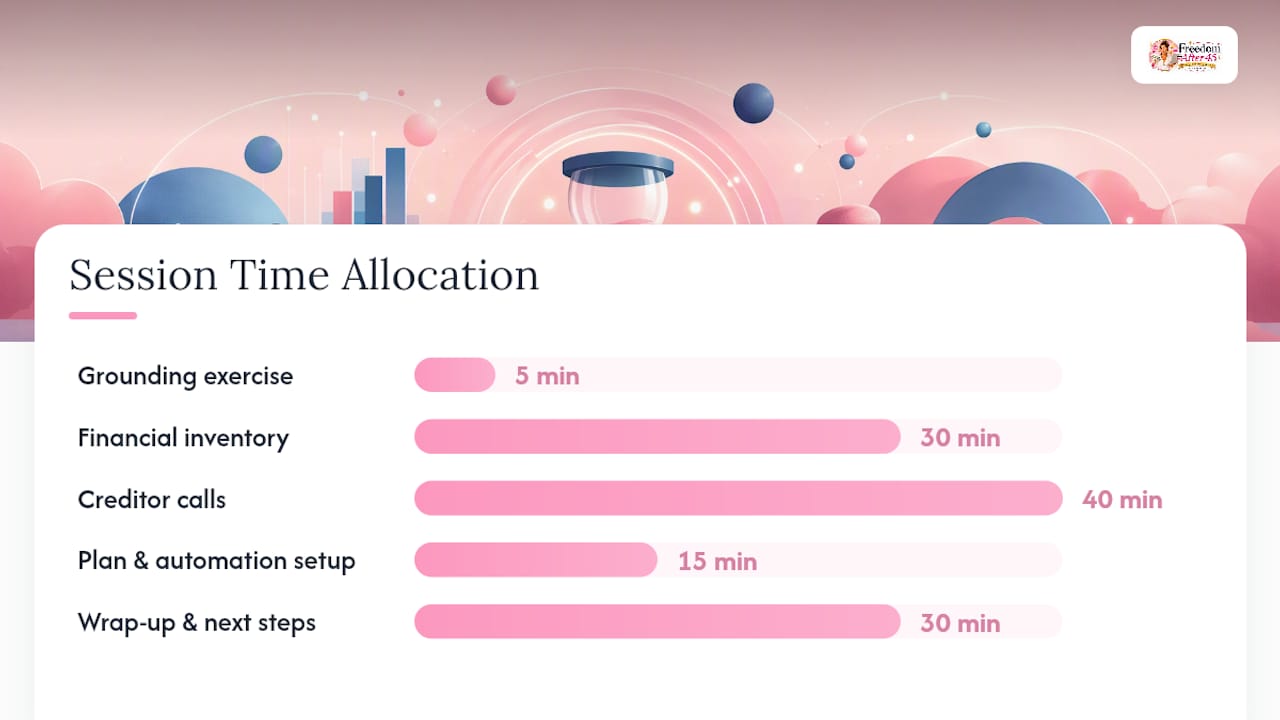
This is the session that moves you from panic to concrete progress. Block two hours, silence your phone, and work through these timed steps.
- Minutes 0–5: Grounding exercise. Sit comfortably. Name five things you can see, four you can touch, three you can hear, two you can smell, one you can taste. This is a standard sensory grounding technique that lowers physiological arousal and improves decision-making. You are not wasting time here; you are improving the quality of every decision you make in the next two hours.
- Minutes 5–35: Financial inventory. Use the checklist from Section 4. Write every number down. Do not judge, do not calculate worst cases. Just list.
- Minutes 35–75: Creditor calls and negotiations. Pick the two or three most urgent accounts. Use the script above. If you reach voicemail, leave a message with your name, account number, and a callback number, and note that you are calling about a hardship arrangement. Follow up with an email if you have a contact address.
- Minutes 75–90: Short plan and automation setup. Draft your one-page budget. Set one automatic transfer, even $10 to savings. Schedule your next bill payment. Put a calendar reminder for your weekly review.
- Minutes 90–120: Wrap-up and next steps. Write down the three most important things you did not finish and schedule them for tomorrow. Close the session with a five-minute walk or stretch.
Short email template for landlords or utility providers:
Subject: Request for Payment Arrangement — [Your Name / Account Number]
I am writing to request a temporary payment arrangement due to a financial hardship. I am committed to resolving my balance and would like to discuss a deferred payment plan or reduced installment option. Please let me know the best way to proceed. Thank you.
Pro Tip: Repeat this 2-hour session once a week until your situation stabilizes. After three sessions, most people report that the panic has dropped significantly, even if the numbers have not changed dramatically yet. When the anxiety is severe enough to interfere with the session itself, that is the signal to bring in a certified NFCC counselor or a licensed therapist.
How to keep progress going and avoid sliding back
The hardest part of coping with financial challenges is not the first week. It is week four, when the urgency fades but the work is not finished. Here is a maintenance framework that keeps momentum without burning you out.
Weekly habits:
- Review your account balances every Sunday (set a 15-minute calendar block)
- Check that all scheduled payments went through
- Log any unplanned spending and adjust next week’s discretionary budget
- Note one small win, no matter how minor: a fee waived, a balance that dropped by $50, a night of better sleep
Monthly habits:
- Update your full budget with actual numbers vs. planned
- Check your credit report for errors (free at AnnualCreditReport.com)
- Reassess your debt payoff order if balances or interest rates have changed
- Celebrate a milestone, even a small one, before moving to the next goal
Mindset shifts that actually hold:
Debt is not a moral failing. It is a math problem with a solution that takes time. Replacing shame with what psychologists call “actionable guilt” (the kind that motivates a specific next step rather than general self-criticism) is one of the most practical mindset shifts available. When the thought “I am terrible with money” appears, replace it with “I made a specific decision that I am now correcting.”
When to bring in professional help:
- Your anxiety is severe enough to affect work, relationships, or physical health for more than two weeks
- You are receiving collection calls and do not know your rights
- Your debt-to-income ratio makes a DIY plan unrealistic
- You want an NFCC-certified counselor to negotiate on your behalf
An NFCC-certified counselor, a financial therapist, or a licensed mental-health therapist for severe anxiety are all legitimate next steps, not last resorts.
Real examples of recovery from financial overwhelm
Recovery from financial overwhelm follows recognizable patterns, and seeing those patterns makes the path feel less abstract.
The sudden job loss scenario. A woman in her early 50s loses her job and faces three months of mortgage payments she cannot cover. She calls her mortgage servicer using a hardship script similar to the one above, requests a forbearance, and is granted a 90-day pause. She contacts the NFCC, which helps her restructure two credit card balances into a Debt Management Plan at a reduced interest rate. By month three, she has a part-time income stream and a written budget. The mortgage is current. The credit cards are on a fixed monthly payment. The crisis did not disappear overnight, but it became manageable within 90 days.
The medical bill spiral. A couple in their late 40s receives a $14,000 hospital bill after an unexpected surgery. They assume it is non-negotiable. It is not. Hospital billing departments routinely offer financial assistance programs, income-based discounts, and extended payment plans. After one phone call and a financial hardship application, their balance is reduced and spread over 24 months at zero interest. The lesson: the number on the bill is rarely the final number.
The debt-shame loop. A woman avoids opening her mail for four months because the anxiety of seeing the numbers is too high. When she finally sits down with a counselor, the total debt is significant but not catastrophic. The avoidance had cost her in late fees and a lower credit score, but the underlying debt was manageable with a plan. The counselor helped her set up autopay, dispute two errors on her credit report, and build a 6-month payoff timeline. The shame had made the problem feel much larger than it was.
These are not outliers. They are the standard arc of financial recovery: a crisis, a moment of clarity, a structured response, and a measurable improvement over 30–90 days.
Common misconceptions that make financial overwhelm feel permanent
Several beliefs keep people stuck longer than the financial situation itself requires.
“Missing a payment ruins my credit forever.” A single missed payment stays on a credit report for seven years, but its impact on your score diminishes significantly after the first 12–18 months, especially if you establish a consistent on-time payment pattern afterward. Credit scores are dynamic, not fixed.
“Debt collectors can take everything I own.” Federal law under the Fair Debt Collection Practices Act (FDCPA) limits what collectors can do. They cannot garnish wages without a court judgment, and many assets (including retirement accounts in most states) are protected. The FTC’s debt guidance outlines your rights clearly.
“I make too little to save anything.” Saving $10 a week is $520 a year. The psychological effect of having any buffer, even a small one, is disproportionate to the dollar amount. The goal in the early stages is not the size of the savings; it is the habit and the sense of agency it creates.
“Asking for help means I failed.” The NFCC exists specifically because financial hardship is common and the system is complex. Using a free nonprofit counseling service is not a sign of failure. It is the same logic as seeing a doctor when you are sick.
“My situation is too far gone to fix.” This one is almost never true. Bankruptcy, which most people view as the worst outcome, is itself a legal tool designed to give people a fresh start. Short of that, debt settlement, consolidation, income-based repayment plans, and assistance programs cover an enormous range of situations. The steps to financial recovery exist precisely because recovery is the expected outcome, not the exception.
What we know about financial overwhelm after working with thousands of families
The most underestimated truth about financial overwhelm is this: the feeling of being trapped is almost always more severe than the actual financial situation. That gap between perceived and actual severity is where most people stay stuck the longest.
What we have seen, working with women over 45 who came to Freedom After 45 in financial distress, is that the turning point rarely comes from a windfall or a dramatic change in income. It comes from a single session of honest accounting, one creditor call that goes better than expected, or one small income stream that proves the situation is not fixed. The evidence shifts the belief, and the belief shifts the behavior.
The 2-hour workflow is not magic. It is a structure that forces the kind of focused, specific action that anxiety makes nearly impossible to do spontaneously. Pair that structure with the resources in this article, and the path from overwhelm to stability becomes a series of manageable steps rather than an impossible wall.
A structured program for women who want guided support
Freedom After 45 offers a paid, step-by-step online course and downloadable workflow blueprint built specifically for women aged 45–65 who want a structured, repeatable system for generating daily income online, without needing an existing social media following, a product, or prior experience.

The program is designed for women who have done the triage work described in this article and are ready to build a new income stream alongside their recovery plan. It runs on a 2-hour-a-day commitment and includes video instructions, real case studies, and a community for ongoing support. If you want a guided path rather than a solo one, the 2-hour workflow is available here. Clicking through takes you to the program overview, where you can see exactly what is included before making any decision.
Authoritative U.S. resources and where to go next
Every resource below is free to access and covers a specific part of the financial recovery process.
- National Foundation for Credit Counseling (NFCC): Nonprofit credit counseling, Debt Management Plans, and budget coaching. Use this first if debt is the primary stressor.
- FTC debt guidance: Your rights with debt collectors, how to evaluate debt-relief companies, and negotiation scripts. Use this before talking to any for-profit debt-relief service.
- HUD housing assistance: Approved housing counselors, emergency rental assistance, and mortgage relief programs. Use this if rent or mortgage is the primary driver of overwhelm.
- FDIC: Information on deposit insurance and bank account protections. Use this to confirm your deposits are protected and to understand your banking rights.
- ADAA financial anxiety guidance: Helps you distinguish situational financial stress from clinical anxiety and find mental-health support. Use this if the emotional symptoms are as heavy as the financial ones.
- USA.gov benefits finder: Identifies federal and state programs for food, healthcare, utilities, and unemployment. Use this to find assistance you may not know you qualify for.
- 988 Suicide & Crisis Lifeline: Call or text 988, available 24/7, free and confidential. Use this immediately if financial stress has led to thoughts of self-harm or hopelessness.
This article provides general information for educational purposes and is not a substitute for professional financial, legal, or mental-health advice. Confirm current program details and eligibility with the relevant agency or a qualified professional.
Sources
- Financial anxiety vs. GAD: When money worry becomes an anxiety disorder
- Coping with Financial Stress
- Step-By-Step Guide to Solving Financial Messes
- Federal Deposit Insurance Corporation (FDIC)
- U.S. Department of Housing and Urban Development (HUD)
- How to get out of debt