

Financial Breathing Room Explained for Women Over 45
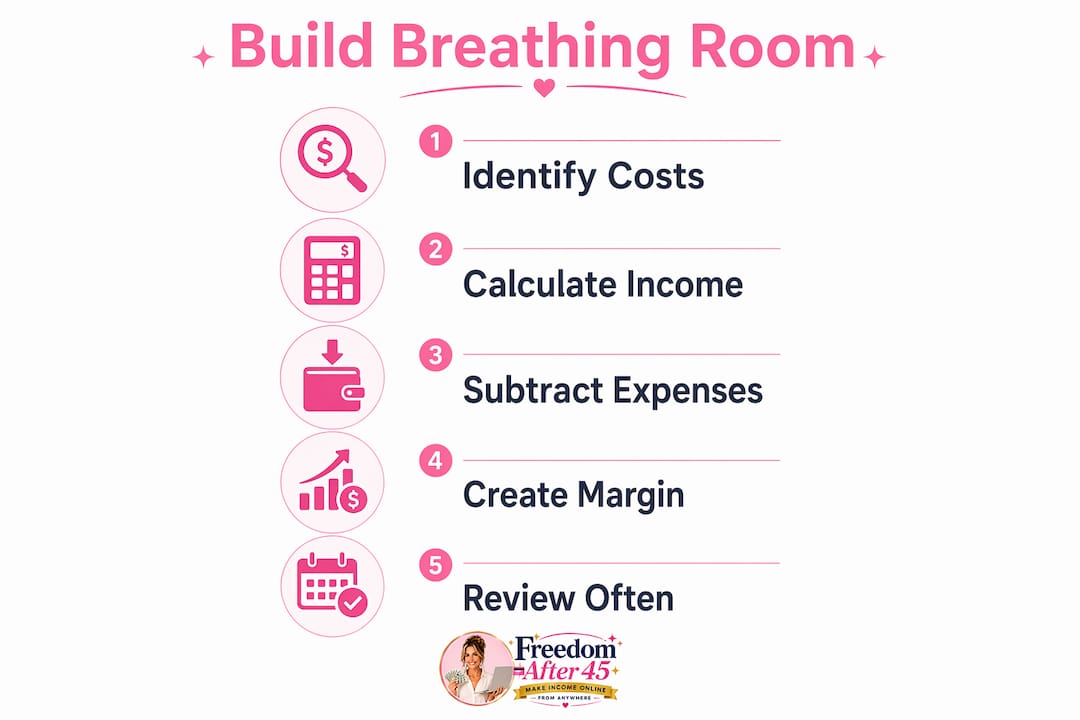
Financial breathing room is the intentional gap between your regular take-home income and your committed monthly costs — the margin that lets you absorb a surprise expense, skip a panic-driven decision, and still show up for your two-hour income routine the next morning. It has three core components: your monthly cash-flow margin (what’s left after every bill is paid), an accessible short-term cushion (cash you can reach in 24 hours), and a low fixed-cost base (the smaller your locked-in obligations, the wider your margin automatically becomes).
According to UCC Mortgage Co., breathing room is about margin, not extreme efficiency. You’re not trying to squeeze every dollar — you’re building structural flexibility. The fastest way to check whether you have it: subtract your total fixed monthly bills from your net monthly income. If the number is under 10% of your income, you’re operating without a cushion.

Pro Tip: Open your last bank statement right now and circle every recurring charge. Add them up. Subtract from your net income. That single number tells you more about your financial health than your savings balance does.
Table of Contents
- Why financial breathing room matters more than you think
- How does breathing room differ from savings, emergency funds, and budgeting?
- How to measure your breathing room right now
- A compact 90-day plan to build breathing room in two hours a day
- How breathing room makes the 2-Hour Workflow actually work
- Your 30-day action checklist for immediate breathing room
- Key Takeaways
- The thing most financial advice gets wrong
- The 2-Hour Workflow that builds breathing room from day one
Why financial breathing room matters more than you think
The protection is obvious: a $400 car repair doesn’t become a $400 credit card balance with 22% interest. But the less-discussed benefit is cognitive. Research from MoneyGatha shows that margin changes how people make decisions under pressure — those with breathing room can pause, evaluate, and negotiate instead of reacting. That’s not a soft benefit. It’s the difference between accepting the first offer and waiting for a better one.
78% of Americans live paycheck to paycheck — which means most households are one unexpected bill away from debt, not one good decision away from wealth.
For a two-hour daily passive-income workflow, this matters operationally. When cash is tight, you skip the $30 ad test because you’re afraid of losing it. You rush content because you need income this week, not next month. Breathing room removes that scramble. You post consistently, test small, and let results compound — which is exactly how a course-based income system builds momentum.
- Financial margin prevents small shocks from escalating into debt spirals
- Cognitive margin reduces reactive, fear-based financial decisions
- Operational margin lets you run paid ad tests and wait for optimization
- Emotional margin keeps your two-hour routine consistent, even in hard weeks
How does breathing room differ from savings, emergency funds, and budgeting?
These four concepts overlap, but they solve different problems. Confusing them is why people with $20,000 in savings still feel financially trapped.
| Concept | What it is | Where it helps | Where it falls short |
|---|---|---|---|
| Emergency fund | 3–6 months of fixed expenses in cash | Major disruptions: job loss, medical crisis | Doesn’t help with monthly cash-flow tightness |
| Financial breathing room | Monthly margin between income and committed costs | Day-to-day flexibility, opportunity timing | Not a substitute for a true emergency reserve |
| General savings | Accumulated wealth (retirement, investments) | Long-term goals, wealth building | Large balance ≠ monthly margin |
| Tight budgeting | Tracking and cutting spending | Reducing waste | Creates burnout without a parallel income strategy |
UCC Mortgage Co. frames it precisely: you can have significant savings and zero breathing room if your fixed costs consume every paycheck. A $50,000 retirement account doesn’t help you when your car insurance, mortgage, and subscriptions eat 95% of your monthly income before groceries.
Quick rule of thumb: If your fixed costs consume a large portion of net income, prioritize reducing them before adding to savings. If you have no short-term cushion at all, build an accessible reserve before anything else.
How to measure your breathing room right now
Three metrics give you a complete picture. Run these numbers in under 20 minutes.
The three metrics
- Cash-flow margin: (Net monthly income − total monthly committed costs) ÷ net monthly income × 100. Target: 10–20%.
- Immediate-access cushion: Cash in a checking or savings account you can reach today. Starter target: a few hundred dollars, scaling to several months of variable expenses as income grows.
- Fixed-cost ratio: Total fixed monthly costs ÷ net monthly income. Target: under 70%.
Worked example
| Scenario | Net income | Fixed costs | Variable costs | Cash-flow margin | Margin % |
|---|---|---|---|---|---|
| Before side income | — | — | — | $300 | — |
That $300 monthly side income nearly doubles the margin percentage. It doesn’t just add $300 — it moves you from a danger zone into a functional buffer. That’s the leverage point a two-hour daily workflow targets.
Pro Tip: Bill clustering kills breathing room even when your math looks fine. If five bills hit in the same week, you’ll feel broke even with a 15% margin. Set bill due dates to spread across the month — most providers will adjust with one phone call.
A compact 90-day plan to build breathing room in two hours a day
Tracking every dollar for even two weeks reveals spending leaks most people never notice. That’s where the 90-day plan starts.
Weeks 1–4: Track, trim, and automate
- Spend 30 minutes auditing all subscriptions and recurring charges. Cancel or pause anything unused.
- Call one provider per week (insurance, internet, phone) and ask for a loyalty discount or hardship rate. Negotiating bills is one of the highest-impact, lowest-effort moves available.
- Set up an automatic transfer of $25–$50 per paycheck to a dedicated cushion account. Small automated transfers convert intention into results without relying on willpower.
- Use 60 minutes daily on income creation (course outline, content drafts, landing page copy) and 30 minutes on outreach or marketing.
Weeks 5–8: Add income and reduce fixed costs
- Launch or refine one micro-course module. Set a price. Publish.
- Run a small paid ad test ($5–$10/day) and track results for two weeks before scaling.
- Renegotiate one fixed cost (gym membership, streaming bundle, car insurance).
- Review the cushion account balance. If it’s at $500, redirect $25/week toward a 3-month buffer goal.
Weeks 9–12: Consolidate and scale
- Measure your three metrics again. Compare to Week 1 numbers.
- Scale the income activity that showed the best return per hour.
- Automate one more financial task (bill pay, savings transfer, expense categorization).
- Set a 90-day income target for the next cycle.
The two-lever model works fastest when you pull both at once. Combining small income boosts with deliberate spending cuts accelerates breathing-room gains faster than either move alone. A woman who adds $200/month in course income while cutting $150 in unused subscriptions gains $350 in monthly margin — enough to fund ad tests, build a cushion, and still feel the difference.
How breathing room makes the 2-Hour Workflow actually work
Without margin, a passive-income routine becomes a pressure cooker. With it, the same two hours feel completely different.
- You can run a paid ad for two weeks without pulling it early out of fear
- You can invest in a $97 course tool or template without guilt-spiraling
- You can take a week off for caregiving without the whole system collapsing
- You can wait for an email sequence to warm up instead of pitching cold every day
Financial margin is what turns a side hustle into a system. When you’re not reacting to this week’s shortfall, you can think about next month’s growth. That shift in time horizon is where passive income actually becomes passive.
Caregiving responsibilities create recurring out-of-pocket costs that quietly erode margin over time. Planning for those costs explicitly — not treating them as surprises — is part of what makes a breathing-room strategy work for women in this season of life.
Your 30-day action checklist for immediate breathing room
Week-by-week targets
- Week 1 — Audit and automate: List every subscription, cancel two, set up a $25 auto-transfer to a cushion account, and spend 60 minutes drafting your first income asset.
- Week 2 — Quick wins and income setup: Call one bill provider for a discount, publish one piece of content, and set up a simple landing page or offer.
- Week 3 — Scale tests: Run a small ad test or outreach push, track results daily in 15 minutes, and redirect any savings from Week 2 negotiations into the cushion.
- Week 4 — Consolidate and measure: Recalculate your cash-flow margin, review cushion balance, and set your Month 2 income target.
Non-negotiable finance moves
- Pause at least two subscriptions you haven’t used in 30 days
- Negotiate one recurring bill (even a $10 reduction compounds)
- Set up an automatic transfer, even $25, to a separate account labeled “cushion”
- Track every dollar spent for 14 consecutive days
Common obstacles and how to handle them
- Emotional friction: Seeing your numbers clearly feels scary. Do it anyway — clarity is less stressful than avoidance.
- Caregiving interruptions: Build your two-hour routine around your caregiving schedule, not against it. Early morning or late evening blocks work for many women in this situation.
- Debt traps: If minimum payments are consuming margin, prioritize the highest-interest debt first. Even $50 extra per month toward principal changes the math within 90 days.
Key Takeaways
Financial breathing room is a structural choice available at any income level — and a $300/month side income can nearly double your monthly margin percentage.
| Point | Details |
|---|---|
| Core definition | Breathing room is the monthly gap between income and committed costs, not your savings balance. |
| — | 78% of Americans live paycheck to paycheck, making margin-building a priority, not a luxury. |
| Starter cushion target | Build $500 in accessible cash first, then scale toward 3 months of variable expenses. |
| Two-lever rule | Combining small income gains with spending cuts creates margin faster than either move alone. |
| Freedom After 45 fit | The 2-Hour Workflow is designed to add the income lever while the 90-day plan handles the cost side. |
The thing most financial advice gets wrong
Breathing room gets framed as a reward for discipline — something you earn after years of sacrifice. That framing keeps people stuck. The truth, based on everything the research shows, is that breathing room is a design choice. You engineer it by lowering your fixed-cost base and adding a small, consistent income stream. Neither requires a high salary. Neither requires perfection.
What it does require is a willingness to stop optimizing and start creating margin. Those are different projects. Optimization asks: “How can I squeeze more from what I have?” Margin asks: “How can I need less from each paycheck while earning slightly more?” The second question has a much better answer for women over 45 who are building something new.
The cognitive shift that comes with even $300 in monthly margin is disproportionate to the dollar amount. You stop making decisions from scarcity. You start thinking in weeks instead of days. That’s not a small thing — it’s the foundation every sustainable income system is built on.
The 2-Hour Workflow that builds breathing room from day one
Most courses teach you what to do. The Freedom After 45 2-Hour Workflow shows you exactly when and how to do it — in two focused hours a day, with no existing audience, no product, and no prior experience required.

The program maps directly to the 90-day plan above: income creation in the first hour, finance and marketing tasks in the second. Thousands of women have used it to generate daily passive income ranging from $100 to $1,400, with step-by-step video instructions, real case studies, and a community that keeps you accountable when caregiving or life interrupts your routine.
The breathing room you build through the workflow isn’t a side effect — it’s the point. Wider margin means you can test, wait, and scale without panic. That’s what turns two hours a day into a real income system.
Ready to start? Visit earningdaily.net and get the blueprint that makes it concrete.