

Midlife Financial Security for Women: Build Options and Income
Midlife financial security for women means having enough flexibility to handle what life actually throws at you, not hitting a specific net worth number. It’s the cushion, the income options, and the legal basics that keep a health scare, a caregiving stretch, or a job loss from forcing a decision you’ll regret. Financial planners increasingly frame it as option-creation rather than accumulation: can you absorb a disruption without raiding your retirement account?
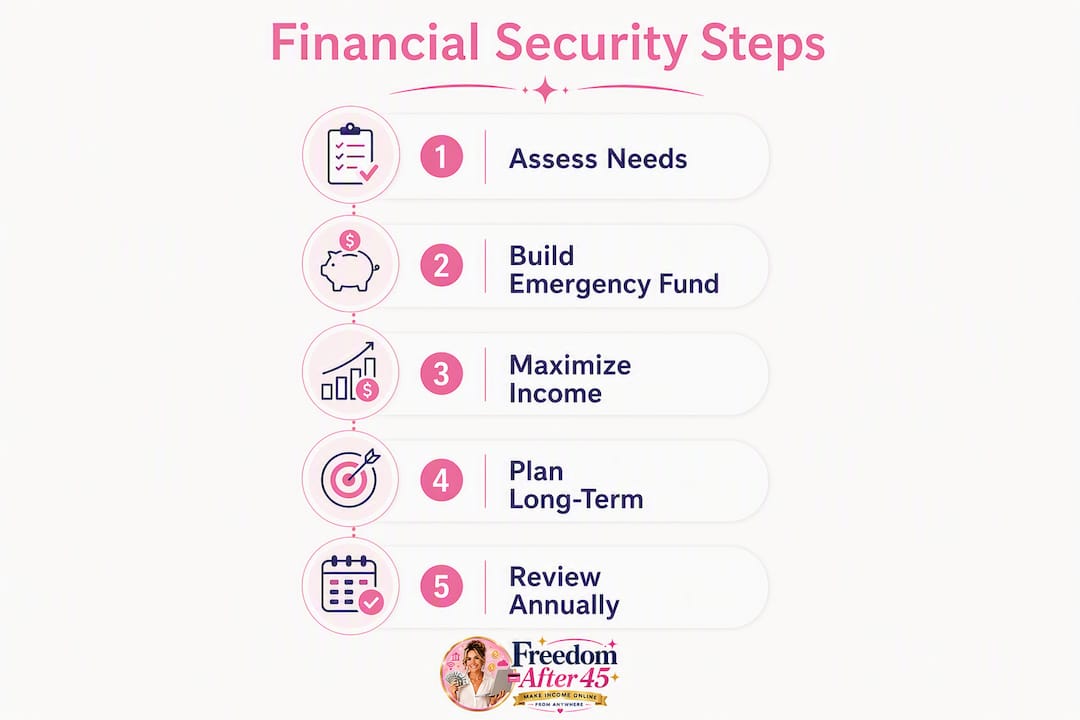
The core pillars to check right now:
- Emergency fund: 6–12 months of living expenses in cash (more on why women need the higher end below)
- Predictable income: at least one income stream that doesn’t depend entirely on your employer
- Protected retirement savings: a 401(k), IRA, or HSA with consistent contributions
- Insurance: health, disability, and at minimum a plan for long-term care costs
- Legal and estate basics: updated will, beneficiary designations, and a healthcare proxy
The CFP Board recommends reviewing all five areas at least once a year during midlife. The Social Security Administration’s my Social Security portal lets you check your projected benefit in under ten minutes. Start there.
Table of Contents
- What does financial security actually look like day to day?
- Why midlife hits women differently than men
- How to measure your current financial security in 30–60 minutes
- Prioritized strategies to build security now
- What realistic progress looks like in 6–24 months
- Why confidence matters as much as knowledge
- When should you hire a financial advisor?
- A practical 2-hour daily workflow to build income and security
- Key Takeaways
- The confidence gap is the real obstacle
- A structured next step for women who want a guided system
- Useful sources for further reading
What does financial security actually look like day to day?
Concrete markers matter more than abstract targets. Here’s what security looks like in practice for women at midlife:
- A 6–12 month cash cushion in a high-yield savings account, separate from checking
- At least one income source that could partially replace wages if your job disappeared tomorrow
- A documented Social Security claiming plan, even a rough one
- One tax-advantaged account (401(k), Roth IRA, or HSA) receiving regular contributions
The picture shifts by household type. A single woman needs to plan for the full cost of long-term care herself, with no in-home partner as a fallback. Single women face lower average Social Security benefits and higher long-term care exposure than partnered women, which means insurance and income diversification carry more weight in their plans. A partnered woman may have two Social Security streams to coordinate, which creates sequencing opportunities. A caregiver may have gaps in her work history that reduce both her benefit and her 401(k) balance.
For self-employed and entrepreneur women, the markers look slightly different: a solo 401(k) or SEP-IRA replacing the employer plan, a larger cash buffer to absorb irregular income, and business income that doesn’t collapse if one client leaves.
Pro Tip: If retirement is fewer than ten years away, prioritize liquidity over long-term tax-advantaged savings until you have at least six months of expenses in cash. A forced early withdrawal from a 401(k) costs you the 10% penalty plus income taxes, which wipes out months of contributions.
Why midlife hits women differently than men
The financial risks women face in midlife aren’t primarily about the stock market. They’re about life volatility: the caregiving years, the career pivots, the health costs that cluster between 45 and 65.
“The greatest risk to midlife women isn’t market volatility. It’s life volatility: caregiving, career pivots, and health changes that force financial decisions before they’re ready.” — The C.O.R.E. Group, midlife planning research
The structural drivers of midlife financial disruption for women:
- Caregiving penalty: Women spend more time out of the workforce for caregiving, producing compounding shortfalls in retirement savings and Social Security credits
- Pay gap carryover: Lower lifetime earnings mean smaller 401(k) balances and lower Social Security benefits at claiming age
- Longevity: Women statistically outlive men, meaning retirement savings must stretch further
- Menopause costs: Increased doctor visits, prescriptions, and interventions can run thousands of dollars per year and strain cash flow if unbudgeted
- Career interruptions: Re-entering the workforce at reduced seniority or shifting to self-employment mid-career resets income trajectories
Plans built for a linear career and a partnered household often fail women in midlife. The fix is building in flexibility from the start.

How to measure your current financial security in 30–60 minutes
Run this self-audit before you change anything. You need four numbers and one online lookup.
Step-by-step audit:
- Emergency coverage: Divide your liquid savings by your monthly expenses. Target: 6–12 months; women facing caregiving responsibilities or with variable income should aim for the upper end of this range.
- Income replacement ratio: Add up all income you could access if your primary job ended (side income, rental, benefits). Divide by your current net monthly income. Target: 50% or higher.
- Retirement savings multiple: Divide your total retirement account balance by your annual spending. A common benchmark at age 50 is 3–4x; at 60, 6–8x.
- Debt-to-income: Divide total monthly debt payments by gross monthly income. Target: below 36%, with mortgage below 28%.
- Social Security projection: Log into SSA.gov/myaccount and check your estimated benefit at 62, full retirement age, and 70.
| Metric | Entry target | Stretch target |
|---|---|---|
| Emergency fund | 6 months of expenses | 6–12 months |
| Income replacement ratio | 30% | 50%+ |
| Retirement savings multiple | 3x annual spending | 5x annual spending |
| Debt-to-income ratio | Below 36% | Below 36% |
| Social Security projection reviewed | Once | Annually, with claiming plan |
If two or more metrics fall in the entry column, that’s where to focus first.
Prioritized strategies to build security now
Rank your moves by impact, not by what feels easiest. Here’s the sequence that most financial planners recommend for women in midlife:
- Build the cash buffer first. Advisors recommend 6–12 months of expenses for midlife women specifically, because job loss or caregiving can force investment withdrawals during market downturns. Open a high-yield savings account and automate a fixed transfer the day after payday.
- Diversify income. A second income stream, whether freelance, part-time, or an online system like the Freedom After 45 2-Hour Workflow, reduces the damage any single income disruption can cause.
- Maximize catch-up retirement contributions. Women 50 and older can contribute an extra $1,000 to a traditional or Roth IRA and an extra $7,500 to a 401(k) annually (2024 IRS limits). Self-employed women should open a solo 401(k) or SEP-IRA.
- Reduce high-cost debt. Credit card debt above 18% APR costs more than most investments return. Pay it down before increasing retirement contributions beyond the employer match.
- Optimize insurance. Disability insurance is the most underused protection in midlife. An HSA paired with a high-deductible health plan builds tax-free healthcare savings. Start researching hybrid long-term care policies before age 60, when premiums are lower.
- Plan Social Security claiming. Delaying benefits past full retirement age increases your monthly payout by a significant percentage per year up to a later age. For women with longer life expectancies, that math often favors waiting.
- Update legal and estate basics. A will, durable power of attorney, and updated beneficiary designations take one afternoon and protect everything else on this list.
Pro Tip: When money is tight, follow this order: employer 401(k) match first (free money), then emergency fund to six months, then high-cost debt, then IRA contributions. Don’t skip the match.
What realistic progress looks like in 6–24 months
Three scenarios, with rough math you can adapt:
- Conservative path (saving $300/month): Reaches three months of expenses in roughly 12–18 months for a household spending $2,000/month. Adds $3,600/year to retirement savings.
- Moderate path (saving $600/month): Reaches six months of expenses in 12–18 months for the same household. Adds $7,200/year to retirement savings, which at 50+ includes catch-up room.
- Accelerated path (saving $1,000+/month, often via added income): Reaches a 12-month cushion in 18–24 months and maxes out IRA contributions. Requires a second income source for most midlife women.
Budget explicitly for two cost categories most plans miss. Menopause-related healthcare costs can run thousands of dollars per year in prescriptions and specialist visits. Caregiving costs, whether for a child or an aging parent, can add hundreds to thousands per month in direct expenses or lost income. Line-item both in your budget before setting savings targets.
Inflation note: A dollar saved today buys less in ten years. Keeping cash in a high-yield savings account (currently 4–5% APY at many online banks) partially offsets inflation while preserving liquidity.
Why confidence matters as much as knowledge
Research consistently shows that women report lower financial confidence than men even when their knowledge levels are similar. That gap, not ignorance, is what causes paralysis. The antidote is structured, small action.
A weekly habit checklist that actually works:
- Monday (30 minutes): Review last week’s spending against your budget; flag any surprises
- Wednesday (15 minutes): Check that automatic transfers to savings and retirement ran correctly
- Friday (15 minutes): One income diversification action: apply for a freelance project, research a new skill, or log one hour on your income-building system
Monthly: review your emergency fund balance against your target and adjust the automatic transfer if income changed.
Pro Tip: Accountability cuts paralysis faster than motivation does. A peer group, a financial coach, or a structured daily workflow like Freedom After 45’s 2-Hour Workflow gives you a system to follow on the days when confidence is low.
When should you hire a financial advisor?
Some situations genuinely require professional help. Seek a CFP-credentialed advisor when:
- You’re navigating a divorce, widowhood, or a large inheritance
- You have complex caregiving decisions that affect your income and benefits
- You’re within five years of retirement and haven’t modeled Social Security claiming
- You’re starting a business and need to set up a solo 401(k) or SEP-IRA correctly
Questions worth asking any advisor before you hire them:
- Are you a fiduciary at all times, not just sometimes?
- How do you model caregiving interruptions in a retirement projection?
- Do you plan for longevity differently for women clients?
- How do you coordinate Social Security claiming with portfolio withdrawals?
- What are your fees, and how are you compensated?
Prioritize CFP credentials for comprehensive planning and a CPA for tax-heavy situations. The CFP Board’s advisor search tool lets you filter by specialty and fee structure.
A practical 2-hour daily workflow to build income and security
This template works whether you’re employed, self-employed, or somewhere in between. The goal for the first 90 days is to test one income idea and build the habit.
Daily 2-hour block (sample):
- 0:00–0:30 — Research and learning: One focused task: a new skill, a market opportunity, or a platform walkthrough
- 0:30–1:00 — Content creation or service delivery: Write one piece of content, complete one client deliverable, or set up one product listing
- 1:00–1:30 — Outreach or sales: Send three emails, respond to inquiries, or post one offer
- 1:30–2:00 — Financial review: Update your income tracker, check your savings balance, and log one financial action completed
30/60/90-day milestones:
- Day 30: Complete your first income test. Did anything earn even $1? That’s proof of concept.
- Day 60: Scale what worked. Repeat the action that generated income; cut what didn’t.
- Day 90: Assess whether the income stream is worth expanding or replacing with a better option.
For employed women, run this block in the morning before work or during lunch. For self-employed women, treat it as a protected client slot. The structure matters more than the specific hours.
Pro Tip: Track income attempts in a simple spreadsheet: date, action, result. After 30 days, patterns become obvious. Most women find one or two actions that generate results and several that don’t. Double down on the ones that work.
Key Takeaways
Midlife financial security for women requires building flexibility and income options, not chasing a single net-worth target, because life volatility is the real risk.
| Point | Details |
|---|---|
| Define security as options | Security means absorbing disruptions without raiding retirement savings, not hitting a number. |
| Cash buffer is the foundation | Advisors recommend 6–12 months of expenses for midlife women facing caregiving or career risk. |
| Catch-up contributions matter | Women 50+ can contribute an extra $7,500 to a 401(k) and $1,000 to an IRA annually. |
| Social Security timing is consequential | Delaying benefits past full retirement age increases monthly payouts by roughly 8% per year up to age 70. |
| Freedom After 45 | The 2-Hour Workflow offers a structured daily system for building a second income stream without prior resources. |
The confidence gap is the real obstacle
Most women who feel financially behind aren’t behind because they made bad decisions. They’re behind because the system wasn’t designed for their lives: the caregiving years, the pay gaps, the career pivots that looked like setbacks but were actually choices made for people they love.
What actually moves the needle isn’t a perfect plan. It’s a repeatable system you can follow on a Tuesday morning when you’re tired and stressed. The Freedom After 45 2-Hour Workflow was built specifically for that reality: a structured, daily process that doesn’t require a social media following, a product, or a large upfront investment. Small, consistent action compounds. That’s not a motivational line; it’s what the behavioral research on financial confidence actually shows.
A structured next step for women who want a guided system
Most financial advice tells you what to do and leaves you to figure out how. Freedom After 45 closes that gap with a step-by-step online course and downloadable workflow blueprint built for women 45–65 who want to generate daily income without starting from scratch.

The program suits you if you have two hours a day, want a second income stream, and don’t have an existing audience or product. It includes video instructions, case studies from women in similar situations, and a community for ongoing support. Early participants typically complete their first income test within 30–90 days.
Read the program terms before purchasing, and start with the smallest commitment available to test the system before scaling. Visit earningdaily.net to see the current program details and get started.
Useful sources for further reading
- Social Security Administration — my Social Security portal: Check your projected benefit at multiple claiming ages and review your earnings record for gaps.
- IRS retirement plan contribution limits: Official catch-up contribution limits for IRAs and 401(k)s for women 50 and older.
- CFP Board — Find a CFP Professional: Search for fee-only, fiduciary advisors by specialty and location.
- Rethinking65 — How to Build Real Financial Security for Women: Practitioner-focused overview of the caregiving penalty and wealth gap.
- Mercer Advisors — Financial Planning for Single Women Over 50: Covers Social Security sequencing, long-term care exposure, and income planning for single households.
- Guardian Life — Thriving Through Menopause and Midlife: Explains menopause-related healthcare costs and how to budget for them.
- Voya — 5 Things You Should Know About Financial Well-Being at Midlife: Research on the confidence gap and longevity income options including annuities.