

What Does Income Freedom Feel Like Daily in 2026?
What income freedom actually feels like day to day
Most people expect income freedom to arrive with fireworks. The reality, as anyone who has crossed that line will tell you, is far quieter. Financial freedom is not a number on a screen or a dramatic moment. It is a gradual shift in how daily life feels, defined more by what disappears than what appears.
What disappears first is the alarm clock. Not just the 5:00 AM wake-up, but the low-grade dread that used to ride alongside it. The morning no longer belongs to a commute or a calendar full of meetings. It belongs to you. That shift alone changes the texture of an ordinary Tuesday in ways that are hard to describe until you have lived both sides of it.
Here is what experiencing income freedom looks like in practice:
- No financial coercion. Decisions about work, time, and relationships get made based on what you actually want, not what your bank balance demands.
- Self-directed mornings. You wake up without an alarm, spend the first hour on health or something creative, and move through the day at your own pace.
- Calm as the default. The background hum of financial anxiety that most people carry for years simply goes quiet.
- Purpose over survival. Instead of grinding through tasks to keep the lights on, you choose work or projects that genuinely matter to you.
- Health and relationships move to the front. Exercise, real meals, and unhurried time with people you love stop being weekend luxuries.
One person who left a 13-year career at Apple described his new daily routine this way: no alarm, 90 minutes of walking in nature, a sauna, a cold plunge, then a few hours of creative work, a gym session, and an afternoon on the porch with a book. His screen time dropped by more than 50%. His stress levels fell dramatically. His relationships improved because he finally had the time and space to show up fully.
That is what income freedom feels like daily. Not flashy. Quiet, intentional, and entirely yours.

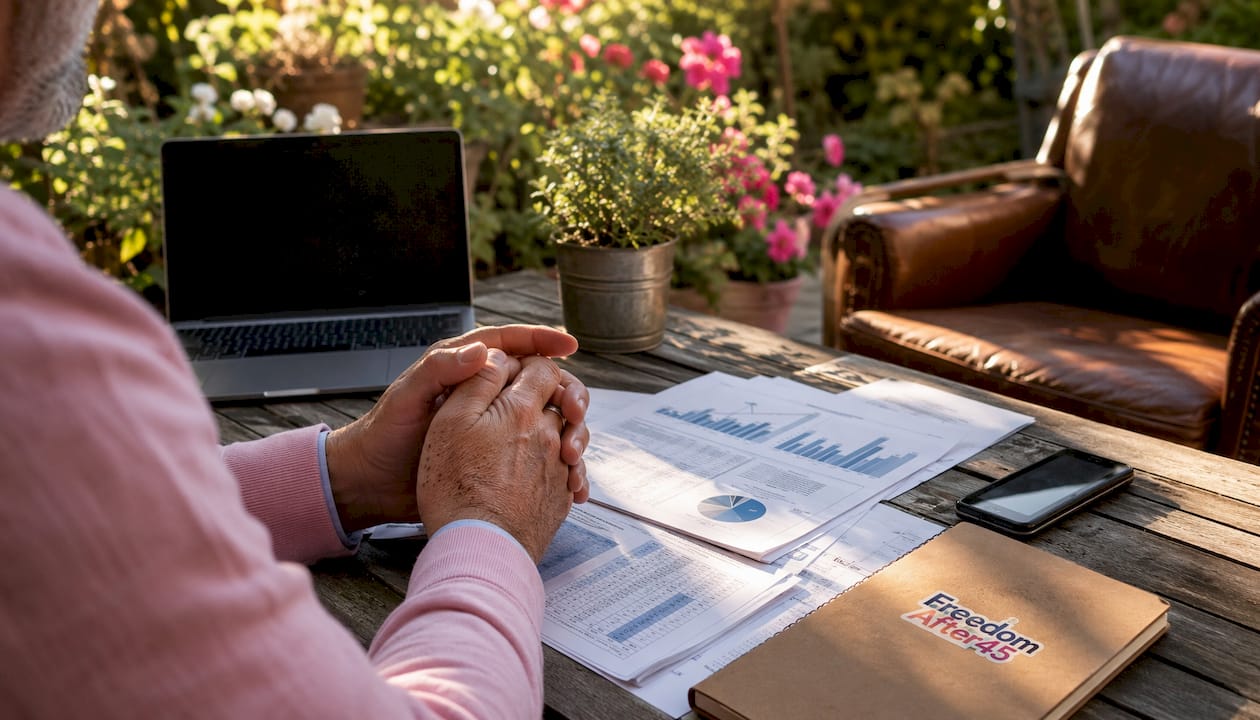
How financial independence shifts your emotional and psychological world
The most underrated benefit of financial freedom is not the time. It is the mental space. When money stops being a source of daily fear, your mind opens up to things it had been too exhausted to reach for.
True financial freedom means making life choices based on purpose and values rather than financial necessity. That sounds abstract until you experience what it means to say no to a bad opportunity, a draining relationship, or a project that conflicts with your values, without the sick feeling that you cannot afford to. The ability to say no is one of the most concrete emotional benefits of income freedom.
Here is what changes psychologically once financial pressure lifts:
- Financial anxiety drops. The constant mental calculation of “can I afford this?” fades. Unexpected expenses become manageable rather than catastrophic.
- Autonomy increases. You stop asking for permission, from employers, from circumstances, from your bank account.
- Creativity returns. Mental bandwidth that was consumed by financial stress gets redirected toward ideas, projects, and connection.
- Confidence builds quietly. Not the loud kind, but the steady kind that comes from knowing your bills are covered no matter what.
- Peace replaces urgency. The relentless pressure to perform, produce, and prove yourself softens into something that actually feels like living.
Financial freedom offers the opportunity to choose meaningful work or pursuits, not just freedom from work. That distinction matters more than most people realize when they are still in the grind. Freedom from something is relief. Freedom for something is fulfillment. The emotional payoff of income freedom lives in that second category.
Practical lifestyle changes you notice after achieving income freedom
The lifestyle shifts that follow income freedom are not always the ones people expect. Yes, there is more travel and more time for hobbies. But the changes that actually improve daily quality of life tend to be smaller and more personal.
People with income freedom consistently report prioritizing health, movement, and intentional living in ways that contrast sharply with their previous survival-mode routines. The difference is not that they suddenly have money for a gym membership. It is that they have time to actually use it, and no longer feel guilty for doing so.
Practical changes that show up in daily life with financial freedom:
- Health becomes woven into the day, not squeezed around it. Morning walks, midday workouts, real meals cooked at home. Movement stops being a 45-minute block you fight to protect.
- Commutes disappear. Hours that used to vanish in traffic or on trains come back. That alone can return two or more hours to every weekday.
- Screen time drops. Without constant work notifications, phone use falls naturally. One person who left corporate life reported his screen time fell by more than 50%, landing under 2.5 hours per day.
- Relationships deepen. You have the time and emotional bandwidth to actually show up for the people who matter. Conversations do not get cut short by a work call.
- Hobbies become serious pursuits. Things that used to live on a “someday” list, writing, music, travel, learning a language, get real time and real attention.
- Travel expands. Without the two-week vacation constraint, travel becomes slower and richer. A month in a different city, a season on the road, a backcountry trip that lasts more than a weekend.
Pro Tip: Before you leave your career, map out what your ideal day looks like from the moment you wake up until you go to bed. People who do this planning well in advance transition far more smoothly than those who figure it out after the fact.
Why striving for financial independence is worth it
The case for pursuing financial independence is not just about retirement or passive income. It is about reclaiming the one resource that never comes back: your time, and the quality of the life you spend it on.
- Freedom from constant financial worry. The quiet version of financial freedom starts with something as simple as three to six months of expenses saved. That single change shifts the entire risk profile of your life. A job loss becomes a disruption, not a catastrophe.
- The ability to pursue meaningful work. When income covers your expenses, you stop choosing work based on what pays and start choosing it based on what matters. That shift changes not just your career but your sense of self.
- Improved quality of life and relationships. Time and emotional bandwidth are finite. When financial pressure stops consuming both, the people and experiences that actually enrich your life get more of each.
- Flexibility to respond to life’s changes. Health crises, family needs, unexpected opportunities. Financial independence means you can respond to life as it actually unfolds rather than being locked into a path because you cannot afford to leave it.
- Long-term security and peace of mind. Knowing that your financial foundation is solid changes how you carry yourself every day. It is not arrogance. It is the quiet confidence that comes from having built something real.
The goal, as one investor and author put it, is not just to earn $100,000 a year in passive income. The goal is to become the person who is free to live life on purpose. That reframe changes everything about how you approach the work of building income freedom.
Challenges and psychological transitions you should expect
Reaching financial independence does not automatically feel like freedom. For many people, the first weeks or months after leaving a career feel disorienting in ways they did not anticipate. Understanding why this happens is the first step to navigating it well.
The phenomenon has a name: the Freedom Gap. It is the distance between reaching financial independence and actually feeling free. Work provides more than income. It provides structure, identity, social connection, and a ready answer to “what do you do?” When that scaffolding disappears, the absence can feel uncomfortably close to anxiety, even when the bank account says everything is fine.
Here is what the psychological transition typically involves:
- Identity disorientation. If your sense of self was tied to your career, removing the career can feel like losing yourself. This is not a sign that something went wrong. It is a predictable phase of transition.
- Restlessness and guilt. Many people feel unproductive despite having complete freedom, or guilty for resting when they are “supposed to” be enjoying themselves.
- Directionlessness. Total autonomy without a clear purpose can feel paralyzing rather than liberating. Freedom without structure tends toward entropy.
- Social friction. Some relationships were built more on shared professional context than genuine connection. Those tend to drift. Building new ones takes time and effort.
- Financial anxiety that lingers. Even with enough money, the habit of financial worry does not vanish overnight. Rules and systems help.
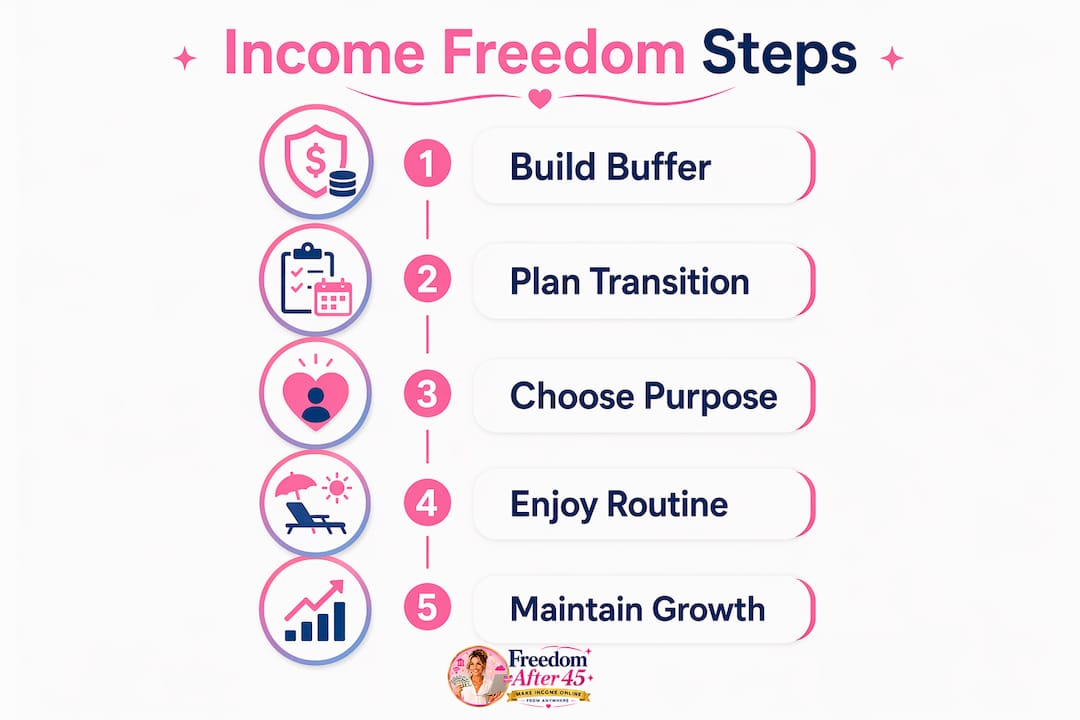
A well-planned cash buffer of 6 months to 2 years of living expenses is one of the most effective tools for reducing this lingering anxiety. When you are not pulling from volatile investments to pay rent, the daily psychological pressure drops significantly.
Pro Tip: Plan your transition toward something, not away from something. Set a meaningful goal or mission before you leave your career. People who retire “to” a purpose, whether that is a creative project, a community role, or a physical challenge, adapt far more quickly than those who retire “from” a job with no clear direction waiting on the other side.
How Freedom After 45 helps you build daily passive income
The emotional and practical benefits of income freedom are real. The harder question is how to get there, especially if you are starting without a large portfolio, a social media following, or an existing product to sell.
Freedom After 45 was built specifically to answer that question for women over 45. The program centers on a 2-Hour Workflow that teaches a step-by-step method for generating $100 to $1,400 in daily passive income, with no social media presence required and no product creation needed.
What the program delivers in practice:
- A clear, repeatable daily workflow that fits into roughly two hours.
- A step-by-step structure that removes the overwhelm most people feel when approaching online income for the first time.
- Accessibility for anyone starting from scratch, no existing audience, no technical background required.
- A focus on building meaningful, recurring income rather than one-time wins.
- A community of women who have already made the transition, with real outcomes backing the method.
The thousands of families who have worked through the Freedom After 45 program did not start with exceptional resources. They started with two hours a day and a clear system. The daily routine that income freedom eventually produces, the unhurried mornings, the purposeful work, the time for health and relationships, begins with exactly that kind of small, consistent action.

If you are ready to start building that daily routine for yourself, the 2-Hour Workflow is the place to begin.
What a real day looks like for someone with income freedom
Abstract descriptions of financial freedom are easy to find. What is harder to find is a concrete picture of what an actual day looks like once you get there.
One person who left a 13-year corporate career in 2026 described his daily routine in detail. He wakes without an alarm. The first 90 minutes of his day are devoted entirely to health: a walk in nature with his girlfriend and dog, a sauna session, a cold plunge. After that, he works on something creative for a few hours, not because he has to, but because he wants to. A gym session or an afternoon run follows. The evening might be a book on the porch or music. His phone, which used to light up constantly with work notifications, barely leaves his pocket. He makes a handful of calls per week.
Six months into this life, he had spent 76 nights either traveling or camping in the backcountry. His stress levels had dropped dramatically. His relationships had improved. His net worth, despite not obsessing over it daily, had reached an all-time high.
That is not a fantasy. It is a documented outcome from someone who planned the transition carefully, built a cash buffer, defined his dream day well in advance, and set a meaningful mission to anchor his new life. The daily routine of income freedom looks different for everyone, but the common thread is the same: every day is a choice rather than an obligation.
For women building toward this kind of life through the Freedom After 45 program, the daily routine often starts much smaller. Two hours of focused work in the morning, a growing income stream that requires less attention over time, and gradually more space for the things that matter. The destination is the same. The path is just sized for where you are right now.
Common misconceptions about what income freedom actually feels like
The version of financial freedom that gets the most attention online, the beach laptop, the instant happiness, the permanent vacation, sets up expectations that the real experience rarely matches. Getting clear on what income freedom is not makes it easier to build toward what it actually is.
Misconception 1: It feels like permanent vacation. The first few days might. After that, most people discover that unstructured time without purpose feels hollow rather than liberating. The happiest people with income freedom are not doing nothing. They are doing exactly what they want, which usually involves some form of challenge, contribution, or creative work.
Misconception 2: Financial anxiety disappears automatically. The habit of financial worry is deeply ingrained. Even people with more than enough money often find the anxiety persists until they build deliberate systems around it: a cash buffer, scheduled financial reviews, rules about checking markets. The money solves the financial problem. The psychology requires its own work.
Misconception 3: Relationships improve immediately. Time helps, but the transition period can actually strain relationships. Partners suddenly navigate dramatically increased time together. Some friendships, built more on shared professional context than genuine connection, fade. New relationships take time to build. The improvement in relationships that most people report comes after the transition settles, not during it.
Misconception 4: You need extreme wealth to experience it. The quiet version of financial freedom is available to most people well before full retirement. Three to six months of expenses saved, no high-interest debt, and enough runway to leave a bad situation without immediate collapse. That level of financial margin changes the texture of daily life in ways that are genuinely meaningful, even if the beach laptop version is still years away.
Misconception 5: Income freedom means never working again. Most people with genuine income freedom continue to work. They just work on their own terms, at their own pace, on projects they find meaningful. The difference is not the absence of work. It is the absence of financial coercion driving every decision about it.
Key Takeaways
Daily income freedom is defined by the absence of financial coercion and the presence of purposeful, self-directed routines built around health, relationships, and meaningful work.
| Point | Details |
|---|---|
| Freedom feels quiet, not flashy | The daily experience is calm and intentional, not dramatic; anxiety fades and mornings become yours. |
| Psychological transitions are real | The Freedom Gap is a predictable phase; planning your purpose before leaving a career shortens it significantly. |
| A cash buffer reduces daily stress | Six months to 2 years of living expenses set aside lets you avoid pulling from volatile investments and lowers financial anxiety. |
| Purpose matters as much as money | Income freedom without a clear direction can feel like restlessness; retiring to something produces far better outcomes than retiring from something. |
| The quiet version is reachable sooner | Three to six months of expenses saved and no high-interest debt already changes the quality of daily financial life in meaningful ways. |