
3–5 Email Welcome Sequence for Creators with Ready to Send Templates
A welcome email sequence is an automated series of emails triggered the moment someone joins your list, built to deliver what you promised, set expectations, and start earning trust. The single most important move: send email one immediately and hand over the lead magnet or content within minutes of signup. Start small, with 3 to 5 emails, then expand once you see how subscribers respond.
TL;DR:Sending the first welcome email immediately after signup is crucial because it captures attention during the highest engagement window.The sequence should typically include 3 to 5 emails spaced 1 to 3 days apart, focusing on delivering promised content and building trust.Successful sequences use clear, benefit-driven subject lines and a single, action-focused CTA in each email to maximize engagement.Incorporating a low-friction reply prompt early in the sequence improves deliverability and helps train inbox providers to recognize your emails as wanted.Regularly testing and analyzing open, click, reply, and conversion rates against a control group ensure continuous improvements in sequence performance.
Freedom After 45Build Income Around Your ScheduleFreedom After 45 offers a step-by-step 2-Hour Workflow blueprint for women over 45 seeking recurring income without traditional barriers.Explore the 2-Hour Workflow
Table of Contents
- What Is a Welcome Email Sequence (And What It Isn’t)?
- Why a Welcome Sequence Matters: The Numbers Behind It
- Core Components and Best Practices for a Welcome Sequence
- Ready-to-Copy Welcome Sequence Templates You Can Adapt Today
- How Many Emails Should Be in Your Sequence?
- How to Set Up Your Welcome Email Automation
- Subject Lines, Preheaders, and CTAs That Actually Work
- Deliverability Tactics That Protect Your Welcome Sequence
- Measuring and Improving Your Sequence Over Time
- Why This Matters for Freedom After 45 Readers
- A Short Note on Starting Small
- Sources
- FAQ
What Is a Welcome Email Sequence (And What It Isn’t)?
A welcome email sequence is a set of automated emails triggered by a specific event: someone signs up for your list, confirms a double opt-in, or makes a first purchase. Each email fires on a schedule, not on demand, and each one has a job to do before the next one arrives.
It’s easy to confuse this with other types of automated flows, so here’s the distinction. A single welcome email is just that: one message, often automatic, that says “thanks for joining.” A welcome sequence is a short series, usually three to seven emails, that carries a new contact through their first days on your list. Onboarding flows are a different animal entirely. They’re typically tied to product setup (think software walkthroughs or account configuration) and can run for weeks. Long-term nurture campaigns are broader still, mixing content, promotions, and re-engagement over months.
The welcome sequence has four narrow goals: deliver the thing you promised, tell subscribers what to expect next (frequency, topics, tone), collect a bit of first-party data (a reply, a click, a survey answer), and point people toward one clear first action, whether that’s reading a guide, watching a video, or checking out an offer. Everything outside those four goals belongs in a different type of campaign.
Why a Welcome Sequence Matters: The Numbers Behind It
Welcome emails average a high open rate, according to Omnisend’s ecommerce marketing data. This rate is roughly three to four times higher than a typical newsletter send, and it happens because timing and intent are on your side. Someone who just handed you their email address is paying attention in a way they won’t be again for weeks.
By the Numbers: Welcome emails average a 68.6% open rate, making the first few days after signup the highest-attention window you’ll ever get with a new subscriber.
That window matters because it’s the closest thing email marketing has to a captive audience. Subscribers who just opted in are curious, not yet fatigued by your sending cadence, and mentally primed to evaluate whether you’re worth their inbox space. The sequence you send in those first days shapes whether they open your next fifty emails or quietly stop.
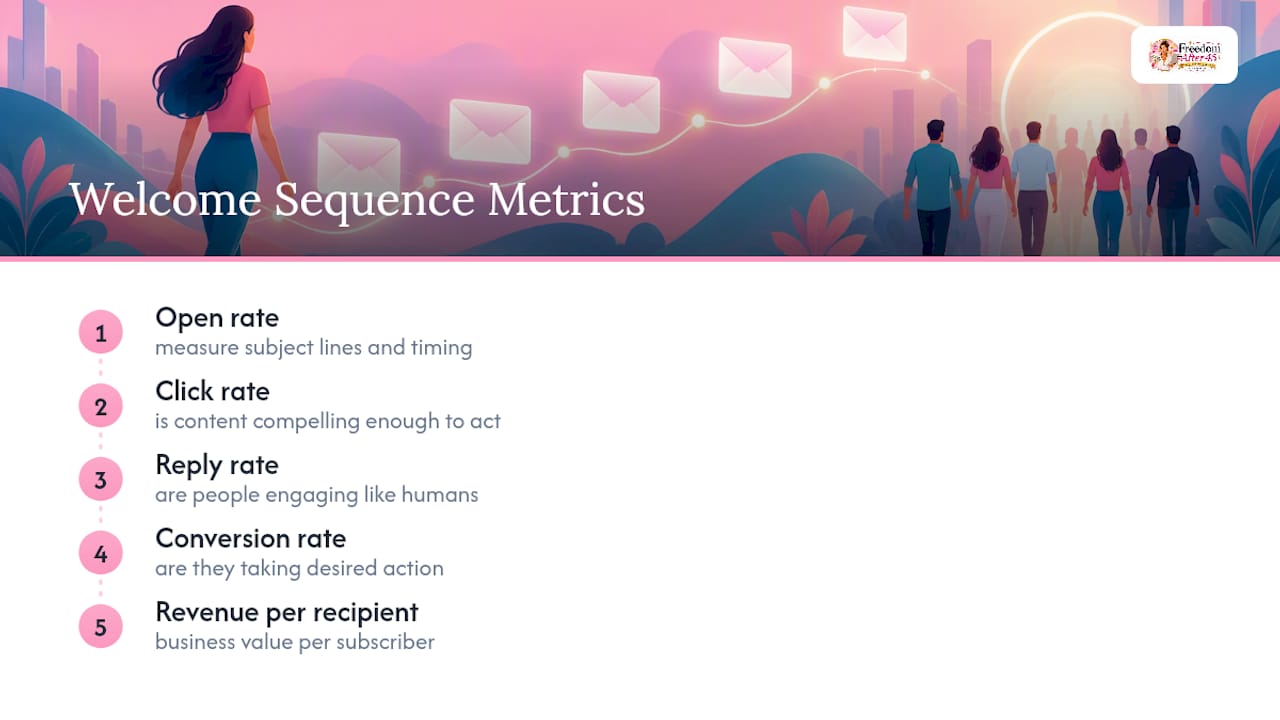
Track five numbers as you build and refine the sequence: open rate (are subject lines and timing working), click rate (is the content compelling enough to act on), reply rate (are people engaging like humans, not just skimming), conversion rate (are they taking the action you want), and revenue per recipient (if you’re selling anything). A regular newsletter competes with dozens of other emails for attention. A welcome sequence competes with almost nothing, because it lands when the reader is still deciding if you matter.
Core Components and Best Practices for a Welcome Sequence
Every email in the sequence should do exactly one job and ask for exactly one action. Trying to deliver a lead magnet, pitch a discount, and ask for a reply in the same email splits attention three ways, and split attention usually means no action at all.
Email one carries the heaviest weight. It’s often responsible for the majority of the sequence’s total engagement, according to Bloomreach’s research on automated welcome series, so this is the email worth drafting three times over. Deliver exactly what you promised (the guide, the discount code, the checklist) and state, in plain language, what subscribers can expect next: how often you’ll email, what kind of content, and roughly how long the sequence runs.
Beyond email one, a handful of practices separate sequences that convert from ones that get ignored:
- Subject lines should promise something specific. “Here’s your guide” beats “Welcome!” every time.
- Keep copy on-brand and conversational. Match the tone people expect from the rest of your content, not a generic corporate voice.
- Add light social proof where it’s earned. A subscriber count, a testimonial line, or a specific result builds credibility without needing a hard sell.
- Include an unsubscribe link in every email. This isn’t optional, and it keeps your sender reputation healthy.
- Write for accessibility. Use clear contrast, descriptive link text, and short paragraphs that work on mobile screens.
- Build in exit conditions. If someone buys, replies, or clicks a specific link, they should exit the sequence or branch to a different path rather than get the generic follow-up.
Klaviyo’s guidance on welcome email best practices points to a consistent pattern: successful sequences use welcome emails to collect first-party data, whether that’s a reply, a preference click, or a short survey answer, while still moving the reader toward one primary action.
Pro Tip: Before you launch, read the entire sequence back to back as if you’re a brand-new subscriber. If any two emails feel like they’re saying the same thing, cut one. Redundancy is the fastest way to earn an unsubscribe.
Before you turn the sequence on, run through a short launch checklist: confirm the trigger fires correctly on a test signup, check that links work on mobile, verify the unsubscribe link is visible, and read every subject line out loud to catch anything that sounds like spam.
Ready-to-Copy Welcome Sequence Templates You Can Adapt Today
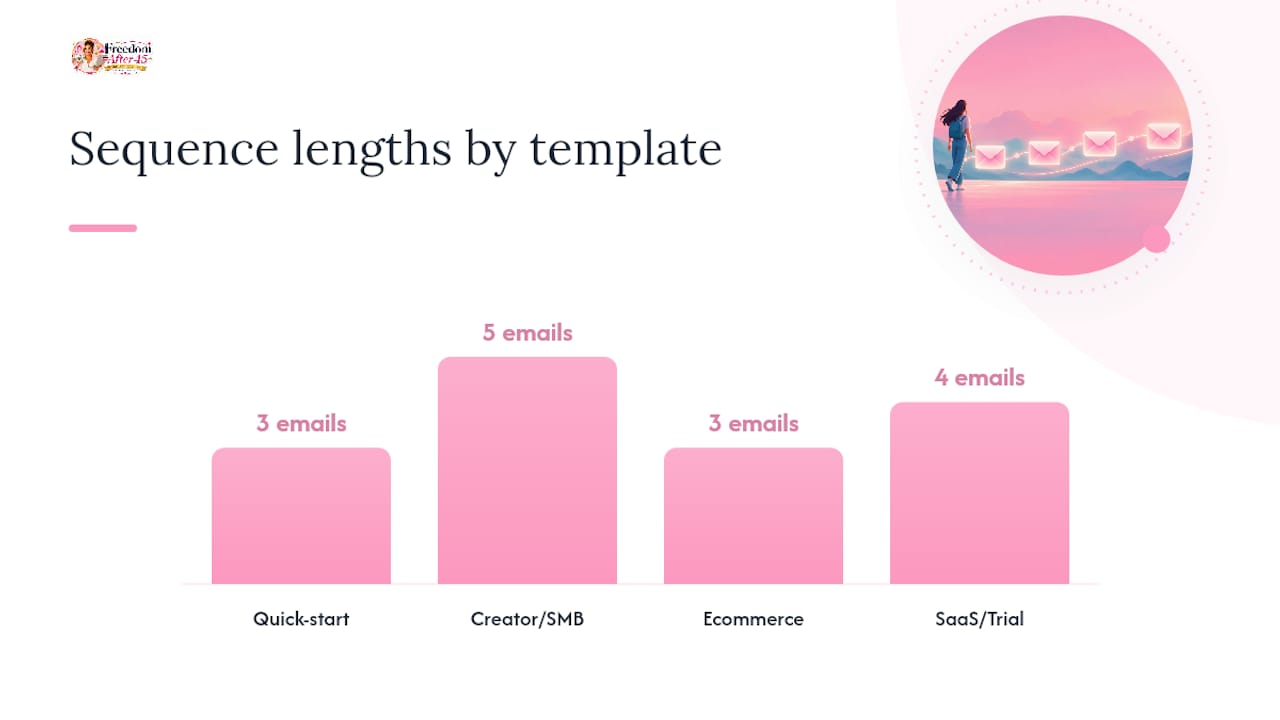
Different goals call for different sequence lengths. Here are four templates built around common situations, each following the job-per-email framework recommended by Mailneo’s setup guide.
1. The 3-email quick-start sequence (best for simple lead magnets)
- Day 0: Deliver the promised content. Subject line: “Here’s your [guide/checklist] — plus what’s next”
- Day 2: Add one piece of bonus value related to the lead magnet. Subject line: “The part most people miss about [topic]”
- Day 5: Make a soft, low-pressure offer. Subject line: “A quick option if you want to go further”
2. The 5-email creator or small-business sequence (best for personal brands and info products)
- Day 0: Welcome and deliver the lead magnet.
- Day 1: Tell your story, briefly and specifically, so subscribers know who’s writing to them.
- Day 3: Share your single best piece of free value, no strings attached.
- Day 5: Show proof: a result, a specific example, a short case story.
- Day 7: Make the offer, tied directly to the problem you’ve been solving in the previous four emails.
3. The ecommerce coupon sequence (best for online stores)
- Day 0: Welcome plus discount code delivery.
- Day 2: Highlight best sellers or a curated starting point, sent only to non-purchasers.
- Day 6: Reminder that the coupon expires soon, sent only if no purchase has occurred; anyone who already bought exits the sequence automatically.
4. The SaaS or trial sequence (best for software with a free trial)
- Day 0: Welcome and point to the single most important first setup step.
- Day 1: Highlight one feature tied to the user’s stated goal, with a direct support link.
- Day 3: Check in on activation progress; branch based on whether the key action was completed.
- Day 6: Offer help or a proof point if the trial user still hasn’t activated.
Pick the shortest template that still lets every email carry real value. A 3-email sequence beats a padded 7-email one if you don’t have five distinct things worth saying yet.
How Many Emails Should Be in Your Sequence?
Most guidance settles on 3 to 7 emails, with 4 to 5 emails hitting the practical sweet spot for creators and small businesses, according to Campaigner’s research on welcome sequence length. That range isn’t arbitrary. Fewer than three emails rarely gives you enough room to deliver, build trust, and make an offer. More than seven starts testing a new subscriber’s patience before they’ve even decided if they like you.
Timing matters as much as count. The reliable pattern:
- Send email one immediately, within minutes of signup, not hours.
- Space follow-up emails 1 to 3 days apart.
- Keep the entire sequence inside a 7 to 14 day window.
Let the value of each email decide the length, not a target number. A sequence with four genuinely useful emails outperforms one with seven that includes padding just to hit a round number. If you find yourself writing an email with nothing new to say, that’s a sign to cut it, not stretch it.
B2B sequences can usually run a bit longer and slower, since buying decisions take more time and involve more research. Ecommerce sequences tend to run tighter and faster, especially when a coupon code has an expiration date attached, because urgency does more work there than patience does.
How to Set Up Your Welcome Email Automation
Setting up the automation itself is mechanical work once you know the order of operations. Here’s the sequence, tool-agnostic, that works in any email platform:
- Choose your trigger. Decide whether the sequence starts on raw signup, confirmed double opt-in, or first purchase. Confirmed opt-in tends to produce a cleaner, more engaged list.
- Set email one to send immediately. No delay on the first message. Delivery speed is part of the promise you made when someone signed up.
- Build the workflow with timed delays. Space subsequent emails 1 to 3 days apart, matching the cadence you outlined in email one.
- Draft each email as its own campaign inside the workflow, keeping one job and one CTA per message.
- Add conditional splits. Route purchasers, repliers, or highly engaged clickers onto a different path so they stop getting generic follow-ups.
- Account for time zones. Where your platform allows it, send based on the recipient’s local time rather than a single fixed hour.
- Fork email one by source, if you collect people from multiple lead magnets or signup forms, so the delivered content always matches what was promised.
Pro Tip: Before launching to your full list, run a 10% holdout group that gets no sequence at all. Compare their behavior against the group that does receive it, as Mailneo’s testing framework recommends, and you’ll have real evidence the sequence is doing something rather than just assuming it is.
Test every send path with a dummy signup before going live: confirm the trigger fires, links resolve, and the conditional splits route correctly. A broken automation is invisible until a real subscriber hits it.
Subject Lines, Preheaders, and CTAs That Actually Work
Three subject-line formulas cover most welcome sequence needs. The delivery-promise formula states exactly what’s inside (“Your free guide is here”). The benefit-focused formula leads with the outcome (“Cut your setup time in half”). The low-friction-action formula makes responding feel easy (“Quick question: what’s your biggest challenge with X?”).
Preheader text is the sentence readers see next to the subject line in their inbox, and it’s wasted real estate if it just repeats the subject. Use it to add a second reason to open, not a restatement of the first.
- Pair a curiosity-driven subject with a concrete preheader detail, and vice versa.
- Keep every email to one primary CTA, even if a secondary link exists somewhere in the footer.
- Write CTA button text as an action, not a label: “Get my guide” beats “Click here” or “Learn more.”
- Test one variable per email cycle: subject line this round, CTA wording next round, never both at once.
Small, sequential experiments like this tell you which lever actually moves opens or clicks, instead of leaving you guessing which change caused what.
Deliverability Tactics That Protect Your Welcome Sequence
Getting into the inbox matters more than any subject-line trick, because a brilliant email in the spam folder helps nobody. One underused tactic: include a genuinely low-friction reply prompt in an early email, something as simple as “reply with your biggest question.” According to EmailOctopus’s research on deliverability, that small action helps train inbox providers to recognize your messages as wanted, which improves placement for everything you send afterward.
Avoid patterns that read as spam-like to filters: excessive links, all-caps subject lines, and image-only emails with little text. Keep your sending domain healthy by monitoring bounce rates and always including a visible unsubscribe link, both because it’s required and because it keeps your list clean of people who’ll never engage anyway.
Once the sequence is live, prioritize these tests: subject line variations, send-time windows, single-link versus multi-link layouts, and conditional sends that skip promotional content for anyone who’s already purchased. If a subscriber goes quiet after the sequence ends, that’s the moment to shift them into a re-engagement flow or, eventually, suppress them from regular sends rather than let a dead contact drag down your metrics.
Measuring and Improving Your Sequence Over Time
Five KPIs tell you almost everything you need to know: open rate (subject line and timing), click rate (content relevance), reply rate (engagement depth), conversion rate (did the CTA work), and revenue per recipient (if a purchase is the end goal). Read them per email, not just as a sequence average, because a strong email one can mask a weak email three.
| Metric | What it tells you | Where to look first if it’s weak |
|---|---|---|
| Open rate | Subject line and send timing | Rewrite subject, test send delay |
| Click rate | Content relevance and CTA clarity | Simplify CTA, cut competing links |
| Reply rate | Depth of engagement | Add a direct, low-friction question |
| Conversion rate | Whether the offer lands | Revisit offer timing or framing |
| Revenue per recipient | Overall sequence ROI | Compare against holdout group |
A 10% holdout control, a group that receives no welcome sequence at all, gives you a clean baseline. Compare their conversion and revenue numbers against the group that did get the sequence after 30 days, and you’ll have real evidence of incremental lift rather than a guess.
Run one variable per testing cycle: change a subject line, wait 30 days, measure the cohort, then move to the next variable. Any email that consistently underperforms across two or three cycles should get rewritten from scratch or cut. If a step in the sequence never earns its keep, retiring it is a better use of subscriber attention than leaving it in out of habit.
Why This Matters for Freedom After 45 Readers
Freedom After 45 built the 2-Hour Workflow around one idea: you shouldn’t need an existing following or a finished product to start building income streams online. That same principle applies directly to welcome sequences. You don’t need a huge list or a polished funnel to run one. You need one lead magnet, three to five honest emails, and the discipline to send them on schedule.
For course creators, info-product sellers, and anyone building a service-based offering, the templates above map directly onto what you’re already doing. The 5-email creator sequence works whether you’re delivering a free workbook or a mini-course preview. The soft-offer email at the end is where your actual product, whatever shape it takes, gets its first real introduction to a warm audience.
The step-by-step format used throughout the 2-Hour Workflow reflects the same logic behind a good welcome sequence: one clear job per step, delivered in an order that builds confidence instead of overwhelm. If you’re building your first offer and want the fuller system behind it, including the case studies and community support that go with it, the 2-Hour Workflow blueprint walks through the setup in the same plain, sequential way this article just did.
A Short Note on Starting Small
Start with three emails, not seven. It’s tempting to build the elaborate version first, but a short sequence you actually finish and send beats an ambitious one that sits half-drafted for a month.
Respect the trust a new subscriber just gave you. They handed over their inbox, one of the few genuinely scarce things they own, and that deserves a sequence that delivers before it asks for anything. Test one change at a time. Watch what happens. Adjust.
If you try one of the templates above and something surprising happens, good or bad, that’s worth paying attention to. The patterns that work for your specific audience rarely match the patterns that worked for someone else’s.
— Freedom After 45
Sources
- Omnisend — Email, SMS & push marketing ecommerce 2024
- Campaigner — How many emails should be in a welcome email sequence?
- Klaviyo — Welcome email examples & best practices to boost sales
- Bloomreach — Start the customer journey right with an automated welcome email series
- Mailneo — How to set up an email welcome sequence (with examples)
FAQ
What Are Some Good Examples of Welcome Emails?
Strong examples deliver the promised content immediately, state a clear cadence expectation (“expect one email every few days for the next two weeks”), and end with one specific CTA. A short brand-story email and a social-proof email are two of the most reliable formats used across Klaviyo’s welcome email examples.
How Do You Write a Welcoming Email?
Open by delivering exactly what you promised at signup, before anything else. Keep the tone conversational, use one clear CTA, and tell the reader what to expect next so the relationship starts on a transparent note.
What Is an Email Sequence?
An email sequence is a series of automated emails triggered by a specific event, like a signup or purchase, that sends on a set schedule rather than all at once. A welcome sequence is the most common type, typically running 3 to 7 emails over 7 to 14 days.
What Is a Good Subject Line for a Welcome Email?
The strongest subject lines state a specific delivery or benefit, such as “Your free guide is here” or “Here’s how to get started in 5 minutes.” Vague lines like “Welcome!” tend to underperform because they promise nothing concrete for the reader to open for.
How Many Emails Should a Welcome Sequence Have?
Most guidance recommends 3 to 7 emails, with 4 to 5 emails often the practical sweet spot for creators and small businesses. The right number depends on how much genuine value you have to deliver, not a fixed target.