

Transition Your Family to Passive Earnings: 2-Hour Workflow
You can start transitioning your family to passive earnings today, in two hours, without a social media following or an existing product. The single next step: pick one digital micro-product idea, validate demand before you build it, and write down your household’s monthly income target.
First-day checklist (complete in two hours):
- Calculate your family’s monthly income floor — add living costs plus all ongoing family obligations.
- Write down one skill, knowledge area, or life experience you could package into a simple PDF or template.
- Search for that topic on Etsy or Google to confirm people are already buying similar products.
- Open a free account on a delivery platform (Payhip or Gumroad work well for beginners).
- Draft a one-paragraph description of your product and set a price.
Pro Tip: Validate demand before you spend a single hour building. Pre-sell a simple PDF or offer a free preview to confirm real interest — this one step prevents months of wasted effort.
Table of Contents
- How do you transition your family to passive earnings step by step?
- Which passive-income models work without a social following?
- How does the 2-Hour Workflow fit your daily schedule?
- What U.S. tax and legal basics do families need to know?
- How do you involve your family and set household income targets?
- Key Takeaways
- What women 45+ often get wrong about passive income
- The 2-Hour Workflow: your recommended next step
- Useful U.S. resources for passive income and tax guidance
How do you transition your family to passive earnings step by step?
The honest answer: it takes multiple months to a few years to build income that meaningfully covers family expenses. That timeline is manageable when you break it into milestones.
| Phase | Timeline | Primary Goal | What Success Looks Like |
|---|---|---|---|
| Foundation | Initial months | Validate and launch first product | First sale; email list started |
| Growth | Next several months | Add a second stream; automate delivery | Modest passive income generated |
| Scale | Following months to years | Diversify; reinvest earnings | Increasing passive income; active income increasingly optional |
First-week action plan (fits a 2-hour daily window):
- Day 1–2: Complete the first-day checklist above; set your income target.
- Day 3–4: Outline your MVP (minimum viable product) — a one-page template or short guide.
- Day 5–6: Set up your delivery platform and upload a draft version.
- Day 7: Share with three people in your network and ask for honest feedback.
Passive income rarely starts immediately — it requires heavy upfront setup followed by lower ongoing effort. Plan for that reality from day one. Once a stream is live, check it quarterly rather than daily; allowing several months for product funnels to show real traction prevents premature abandonment.
Which passive-income models work without a social following?
Not every model fits a busy woman over 45 with limited capital and real family obligations. These four are some of the more accessible starting points, varying in upfront time, minimal capital, and time to revenue.
Digital micro-products and templates offer a low-cost startup path and can reach buyers without a large following when paired with SEO or small email lists. Dividend investing and index funds are reliable but slow — they often require thousands in capital to generate meaningful monthly cash flow, so they work best as a parallel stream, not a starting point.
Mixing streams reduces risk. Start with one digital product for fast feedback, then layer in a REIT position once you have spare cash to invest. Avoid starting three streams simultaneously — depth beats breadth in the first six months.
How does the 2-Hour Workflow fit your daily schedule?
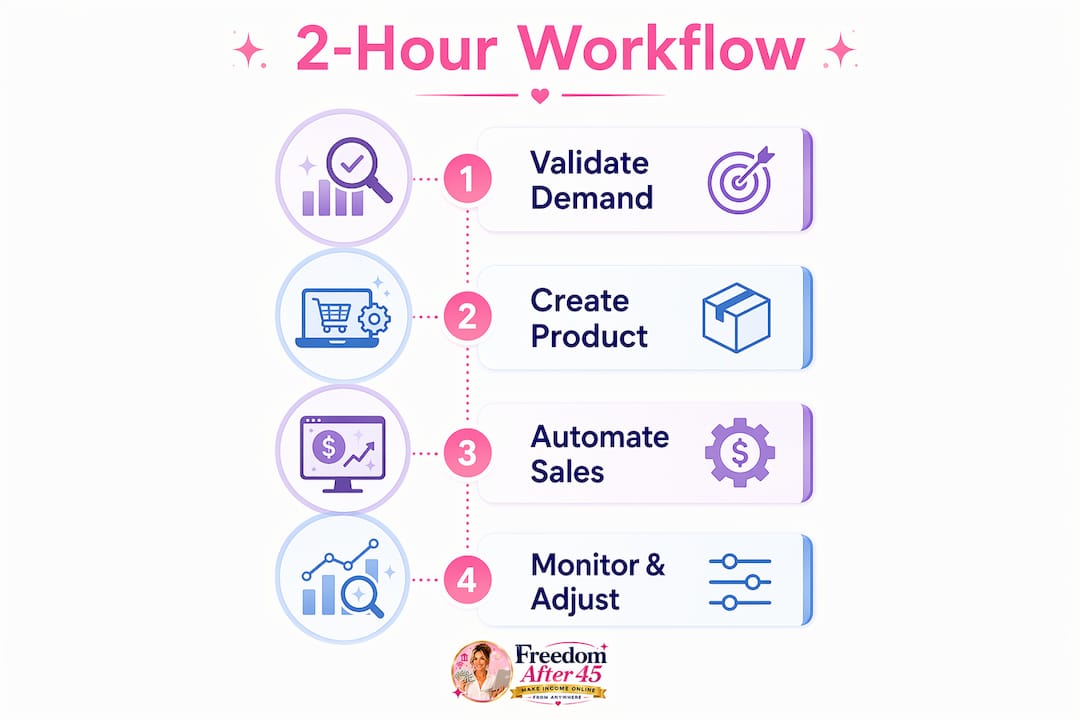
The 2-Hour Workflow is a repeatable daily routine broken into four concrete tasks:
- Validate (Week 1–2): Spend 30 minutes researching demand for your chosen topic using free search tools.
- Build MVP (Week 2–4): Use 60 minutes daily to create a simple deliverable — a template, checklist, or short guide.
- Automate delivery (Week 4–6): Set up automated email delivery and payment processing so the product sells while you sleep.
- Set up one traffic source (Week 6–12): Choose Pinterest (a search engine, not social media) or a basic SEO blog post — no follower count required.
Weeks 1–12 milestones: first product live by week 4; first automated sale by week 6; second product drafted by week 10; first quarterly review at week 12.
Packaging existing expertise into downloadable products requires low capital and can be automated completely. Non-technical users follow the workflow without writing code or managing a social profile.

What U.S. tax and legal basics do families need to know?
Passive income has specific IRS treatment. The IRS defines passive activities as trade or business activities without material participation, and rental activities. Digital product income, however, is typically treated as self-employment income — not passive under the IRS definition — so it is subject to self-employment tax. Consult a CPA to confirm how your specific streams are classified.
Key compliance points:
- Digital product sales generate 1099-K forms once you exceed platform thresholds; keep records from day one.
- Investment income (dividends, REIT distributions) is reported on 1099-DIV; qualified dividends are taxed at 0%, 15%, or 20% depending on your income bracket.
- Max out tax-advantaged accounts (IRA, Roth IRA) before investing in taxable brokerage accounts to reduce your annual tax bill.
- Treat passive income as structural family protection, not optional income — your target must cover family obligations, not just personal costs.
Risk management:
- Keep a 3–6 month emergency fund before reducing active income.
- Run a six-month dry run: live only on passive receipts while directing your paycheck to savings to expose hidden costs before you commit fully.
- For digital products, register a simple LLC to separate personal and business liability.
Pro Tip: Use a dedicated folder in Google Drive or a free tool like Wave to log every income source, platform fee, and expense monthly. Clean records cut your tax prep time in half and protect you if the IRS asks questions.
This article is general information, not professional tax or legal advice. Confirm your specific situation with a qualified CPA or attorney.
How do you involve your family and set household income targets?
When you are the household safety net, your passive income target must include all ongoing family commitments, not just your personal living costs. Build that number first, then work backward to the streams needed to hit it.
Sample earnings allocation table:
| Bucket | Suggested Allocation | Purpose |
|---|---|---|
| Household needs | — | Rent, utilities, groceries, insurance |
| Family obligations | 20% | Childcare, eldercare, education costs |
| Emergency savings | 15% | Build to 3–6 months of expenses |
| Reinvestment | 15% | Fund next income stream or pay down debt |
Household roles checklist:
- You: product creation, quarterly income review, platform management.
- Partner or trusted family member: customer message triage (30 min/week), bookkeeping check-in.
- Everyone: agree on the “no lifestyle inflation” rule — funnel early earnings into savings or reinvestment, not discretionary spending.
For the dry run lasting several months, redirect your paycheck into a separate savings account and pay all household expenses from passive income only. Track every gap. That gap is your real income target.
Key Takeaways
Building a family’s passive income takes consistent daily effort over 12–36 months, starting with one validated digital product and a clear household income target.
| Point | Details |
|---|---|
| Start with demand validation | Pre-sell or test an MVP before building to avoid wasted effort. |
| Use a milestone timeline | It is common to see modest income in the first year, with growth accelerating over two to three years as you layer streams and reinvest. |
| Mix 2–3 income streams | Combine a digital product with index funds or REITs to reduce single-stream risk. |
| Run a six-month dry run | Live on passive income only while saving your paycheck to expose real gaps before committing. |
| Freedom After 45 | The 2-Hour Workflow gives women 45+ a step-by-step system to reach these milestones without a social following. |
What women 45+ often get wrong about passive income
Most women who come to Freedom After 45 have tried something before and stopped. Not because the idea was wrong, but because nobody told them the beginning looks unimpressive on purpose. The first product earns $5. Then $20. Then $90 in a month. That is not failure — that is a system proving it works before it scales.
The part that surprises people most: you do not need an audience. You need one well-described product in a place where people are already searching. Pinterest, Etsy, and a simple SEO-optimized product page do that work. No follower count required.
The 2-Hour Workflow: your recommended next step
Women over 45 who want a structured path to daily passive earnings without building a social media presence have one clear option: the Freedom After 45 2-Hour Workflow.

The program delivers video lessons, a downloadable blueprint, real participant case studies, and a community of women at the same stage. You follow a scaffolded sequence: validate, build, automate, and set up one traffic source. No coding. No existing audience. No product required on day one. Thousands of families have used this system, with participants reporting daily earnings ranging from $100 to $1,400 depending on the streams they build and the time they invest. Results vary, and income grows with consistency.
Visit earningdaily.net to see the full program details and start your first two-hour session today.
Useful U.S. resources for passive income and tax guidance
- IRS Passive Activity Rules (Coursera overview): Clear explanation of how the IRS classifies passive vs. active income — read this before filing.
- IRS.gov — Self-Employment Tax: Official source for self-employment tax rates and quarterly estimated payment schedules.
- Investor.gov (SEC): Free, unbiased guidance on dividend investing, index funds, and REITs from the U.S. Securities and Exchange Commission.
- BiggerPockets dry-run case study: A real family’s six-month transition from earned to passive income — useful for setting realistic expectations.
- Earned to Owned — passive income guide: Practical framework for first-generation wealth builders managing family obligations alongside income building.