

Caregivers: 5 Step Flexible Time Management You Can Set Up in a Week
Start with a short time audit, lock in your anchor points (meds, meals, appointments), then protect some daily breaks for yourself. Small changes compound fast: a simple delegation script and a one-page care sheet can shave real crisis time off your week. None of this requires a rigid schedule, just a flexible framework you adjust weekly.
TL;DR:Conduct a 3 to 7-day time audit to identify hidden administrative tasks and real-time patterns affecting scheduling flexibility.Lock in fixed anchor points like medications, meals, and appointments to create a stable framework around which flexible blocks are built.Build caregiving schedules with 60 to 90-minute task blocks and 15 to 30-minute buffers to absorb unavoidable delays and disruptions.Delegate specific tasks using bundled requests and maintain a one-page emergency care sheet to ensure consistent care without overwhelming helpers.Schedule two daily 15-minute breaks and at least one respite session per month to prioritize self-care and prevent caregiver burnout.
Freedom After 45Make Room for Income GoalsFreedom After 45 shares a step-by-step 2-Hour Workflow for women over 45 seeking recurring income alongside busy responsibilities.Explore the 2-Hour Workflow
Table of Contents
- Quick-Win Strategies for Managing Caregiving Time
- How Do You Build a Caregiving Schedule That Survives Chaos?
- How Do You Delegate Care Tasks Without Guilt?
- Which Tools Actually Save Caregivers Time?
- Why Self-Care Belongs on Your Caregiving Schedule
- A 5-Step Workflow for Building Your Caregiving Schedule
- Schedules Change. That’s Not Failure, That’s the System Working
- Where to Find More Caregiving Time-Management Help
- Sources
- FAQ
Quick-Win Strategies for Managing Caregiving Time
You don’t need a perfect system on day one. You need a handful of moves that pay off within a week, then you build from there. Caregiver Action Network puts it plainly: managing caregiver time comes down to prioritizing tasks, delegating what you can, and defending time for yourself.
Here’s where to start, each one doable in 5 to 10 minutes:
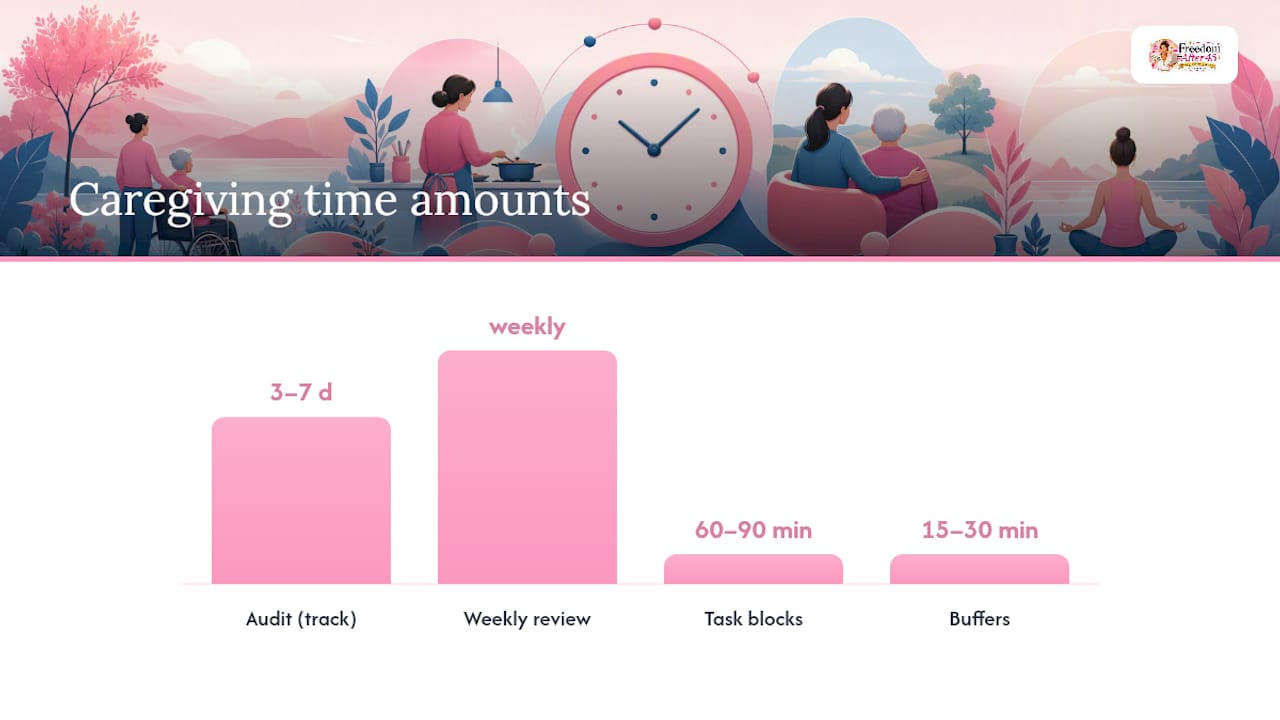
- Run a time audit. For 3 to 7 days, log what you do, when it starts and ends, and how long cleanup or prep takes. Include interruptions. You’ll spot patterns you didn’t know existed.
- Mark your anchor points. Medication times, meals, and appointments are fixed. Everything else flexes around them.
- Batch similar tasks. Group errands, phone calls to doctors, and meal prep into single blocks instead of scattering them through the day.
- Use a delegation script. Try: “Can you handle grocery pickup on Tuesdays? I’ll text you the list by Monday night.” Specific asks get answered; vague ones get ignored.
- Set up a shared calendar and medication reminders. One source of truth beats three sticky notes and a mental list.
- Block 15 minutes weekly for review. What worked? What blew up? Adjust before next week starts.
AgingCare recommends breaking big tasks into smaller pieces and building a weekly schedule around them rather than trying to plan every minute. That distinction, blocks instead of minutes, is what keeps a caregiving schedule from collapsing the first time something goes wrong.
How Do You Build a Caregiving Schedule That Survives Chaos?
A schedule that only works when nothing goes wrong isn’t a schedule. It’s a wish list. Building one that survives real days takes four steps, in this order.
- Audit first. Track everything for 3 to 7 days: start and end times, prep and cleanup, and every interruption. Graying With Grace found that a week-long audit followed by flexible time blocks produces schedules that actually hold up against real-world variability, unlike hour-by-hour plans that fall apart at the first delay.
- Identify your anchors. Medications, meals, and appointments don’t move. Write them down and treat them as fixed posts, not suggestions.
- Build blocks, not minutes. Group related tasks into 60 to 90 minute windows. Add 15 to 30 minute buffers around anything unpredictable, like doctor calls or transportation.
- Review weekly, adjust monthly. Every week, ask what slipped and why. Once a month, zoom out: is the caregiving load itself changing? New medication, new mobility issue, new diagnosis?
Pro Tip: Put your buffer time right after anything involving another person’s schedule, a pharmacy pickup, a ride, a phone call to insurance. That’s where delays actually happen.
The temptation is to plan every minute because it feels like control. It’s the opposite. A rigid plan breaks the moment reality doesn’t cooperate, and reality rarely cooperates. A block-based plan with buffers absorbs the mess.
How Do You Delegate Care Tasks Without Guilt?
Most caregivers try to do everything because asking feels like admitting they can’t handle it. That’s backwards. Delegating well is a time-management skill, not a failure.
Start by sorting tasks into three buckets: things only you can do (medical decisions, primary emotional support), things anyone reliable can do (grocery runs, laundry, transportation), and things a paid or trained helper should do (bathing assistance, wound care, overnight monitoring).
- For the “anyone can do it” bucket, hand out specific, bundled tasks: “Can you bring dinner Wednesdays and pick up the prescription refill while you’re out?” One ask, two tasks, clear timing.
- For respite or paid care, Community Care Corps connects families with volunteer and short-term support programs, and ARCH Respite runs a locator to find respite services by region.
- When someone new steps in, use a 15-minute overlap handoff. Walk them through the current status before you leave, not after.
- Keep a one-page emergency care sheet with medications, allergies, doctor contacts, and daily routine, so anyone can step in with minimal orientation.
Leukemia & Lymphoma Society lists accepting help as one of its core tips, alongside realistic goals and steady routines, because caregivers who refuse help burn out faster and end up needing more support later, not less.
Which Tools Actually Save Caregivers Time?
A tool that adds fifteen minutes of setup and confusion every day isn’t saving you anything. The goal is friction reduction, not more apps.
- Shared calendars. Set one rule: everyone with access gets notifications only for anchor events (appointments, medication changes), not every minor update. Otherwise the calendar becomes noise everyone ignores.
- Medication organizers with reminder systems. Pair a physical pill organizer with a phone reminder as backup. Redundancy here matters more than in almost any other part of the schedule.
- Communication platforms like CaringBridge let you post one update that reaches the whole family instead of repeating the same information in five separate texts.
- Lightweight task tracking. Record what needs doing and who’s doing it. Skip detailed logs of every minute spent; that’s audit-phase work, not daily maintenance.
- Low-tech backups. A wall chart with the week’s blocks, a printed one-page emergency plan taped inside a kitchen cabinet. Batteries die and apps crash; paper doesn’t.
AyiConnect points to task batching and shared communication tools as two of the most reliable time savers for caregivers juggling coordination across multiple people.
Why Self-Care Belongs on Your Caregiving Schedule
Skipping your own breaks doesn’t make you more available for caregiving. It makes you slower, more reactive, and more likely to make mistakes that cost time later. Treat self-care as maintenance, the same category as changing your car’s oil, not a reward you earn after everything else is done.
- Schedule two 15-minute breaks daily, same time each day if possible, so they become part of the anchor structure instead of something you negotiate for.
- Book at least one planned respite session per month, even a few hours, through a local respite locator or a family member who can cover a set block.
- Use a boundary script when someone asks for more than you can give: “I can’t take that on this week, but I can help you find someone who can.”
- If exhaustion or dread starts showing up daily, that’s a signal to reach out to a caregiver support group or a counselor, not something to push through alone.
Pro Tip: Put your break on the shared calendar like any other anchor point. Family members who see “unavailable, 2:00 to 2:15” respect it more than an unscheduled disappearance.
Protecting time for yourself isn’t separate from managing caregiving time well. It’s the same skill applied to a different task.
A 5-Step Workflow for Building Your Caregiving Schedule
Practitioner guidance across caregiving resources tends to converge on the same sequence, even when the wording differs. Here’s the compact version:
- Audit. Track 3 to 7 days of activity, including hidden administrative time, insurance calls, pharmacy runs, paperwork, that caregivers often forget to count.
- Anchor. Lock in medications, meals, and appointments as fixed points. Graying With Grace frames this step as the foundation that keeps the rest of the day from collapsing when one thing runs late.
- Block. Group flexible tasks into windows of 60 to 90 minutes, built around the anchors, with 15 to 30 minute buffers on anything involving other people or transit.
- Delegate. Assign the tasks that don’t require your specific presence, using bundled, specific requests rather than open-ended ones.
- Review. Spend 15 minutes each week checking what worked. Documenting where time actually went, especially hidden admin time, helps you negotiate more support from a medical team or make the case for paid help later.
A caregiver managing evenings and weekends only needs a lighter version: audit just the caregiving hours, skip the full-day block structure, and focus review time on whether anchors and buffers held up. A round-the-clock caregiver needs the full workflow, plus a rotation plan for respite and handoffs built into the block structure itself, not added as an afterthought.
The 15-minute handoff overlap matters most here. A new caregiver stepping in cold, without a quick walkthrough, spends the first hour re-learning what the outgoing caregiver already knew. That’s an hour lost every single handoff, week after week.
Schedules Change. That’s Not Failure, That’s the System Working
A caregiver I’ve heard about built a tight morning routine, then her mother’s new medication schedule blew it up in a week. She didn’t scrap the system. She just moved the anchor points and rebuilt the blocks around them. That’s the whole job: adjust weekly, notice what’s working, and count the small wins, because they add up faster than they feel like they do.
— Freedom After 45
Where to Find More Caregiving Time-Management Help
A few resources are worth bookmarking alongside your own schedule. Caregiver Action Network offers broader guidance on coping with the time demands of caregiving beyond scheduling alone. ARCH Respite runs a locator tool to find respite care options by region, useful when you’re ready to plan actual time off. Community Care Corps connects caregivers with volunteer support programs for short-term relief. Leukemia & Lymphoma Society’s twelve tips cover the basics of routines and realistic goal-setting in more depth than a single checklist can.
Use these as supplements, not replacements, for the audit-anchor-block-delegate-review workflow. They fill in gaps the framework doesn’t cover, like finding paid respite providers or joining a support community for caregivers managing similar situations.
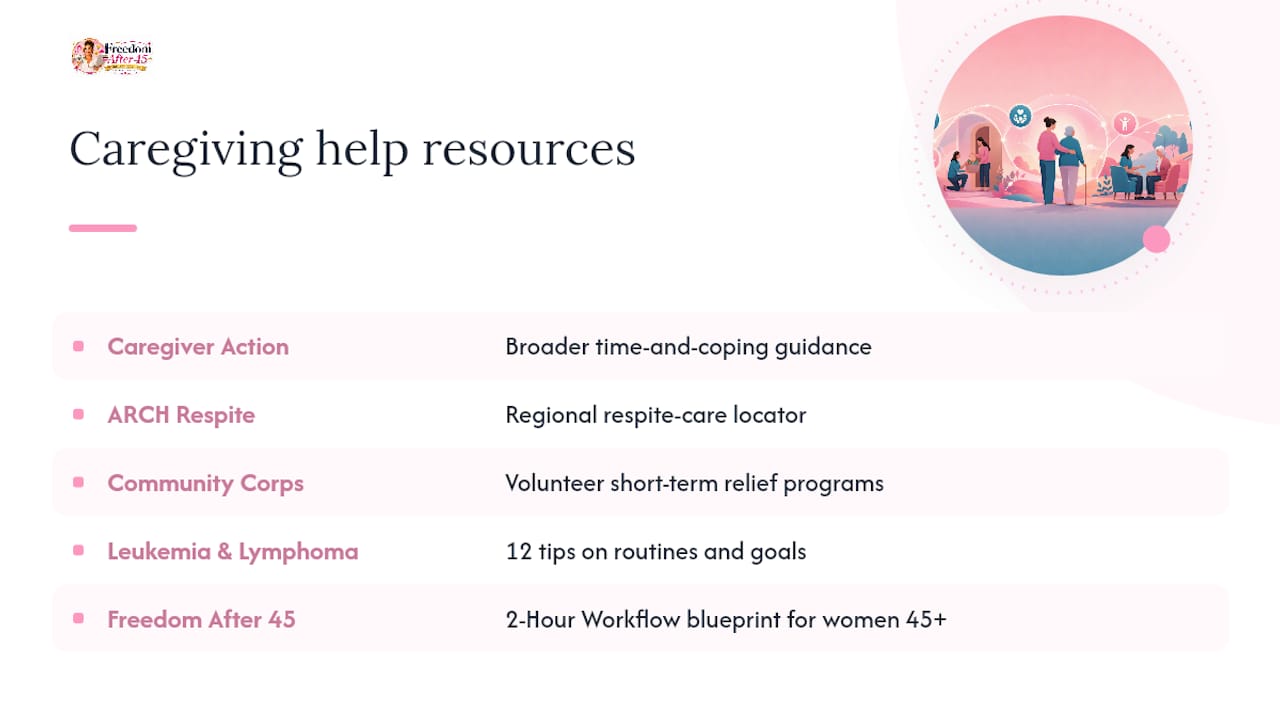
If your caregiving schedule has freed up even a small consistent block of time, and you’re looking for ways to put it toward something productive, Freedom After 45 built a 2-Hour Workflow blueprint designed for women over 45 juggling exactly this kind of stretched schedule. It’s a step-by-step system, no existing audience or product required, built for people who have a couple of hours and want to use them well.
Sources
- Coping with Time Demands — Caregiver Action Network
- Time Management Strategies for Caregivers — AgingCare
- Twelve tips for time management — Leukemia & Lymphoma Society
- 7 Steps to Create a Caregiving Schedule That Actually Works — Graying With Grace
FAQ
How Do You Manage Time as a Caregiver?
Run a short time audit to see where your hours actually go, lock in anchor points like medications and appointments, build flexible time blocks around them with buffers, delegate what you can, and review your schedule weekly to adjust for what changed.
What Are the 5 P’s of Time Management?
Definitions vary across sources, but a common version includes Prioritize, Plan, Prepare, Perform, and Perfect (through review). For caregivers specifically, the more reliable framework is audit, anchor, block, delegate, and review, since it accounts for the unpredictability caregiving adds to a daily schedule.
What Are the 4 P’s of Time Management?
Common versions cite Prioritize, Plan, Productivity, and Procrastination (avoiding it), though the exact list varies by source. Caregivers tend to get more mileage from concrete steps like time audits and anchor points than from general planning frameworks built for office work.
How Long Should a Caregiver Time Audit Last?
Several days is enough to reveal real patterns, including hidden administrative time like insurance calls and pharmacy runs that caregivers often forget to count.
What Should Go on a One-Page Emergency Care Sheet?
Include current medications and dosages, allergies, primary doctor contacts, daily routine basics, and emergency contacts, so anyone stepping in temporarily can act with minimal orientation.