

Student Passive Income: Two Hours Daily That Pay Off
Student passive income is recurring earnings built through upfront digital work, not hourly labor. The standard financial term is “residual income,” and it describes money that keeps flowing after the initial asset is created. For students, the two-hour daily window is the core constraint and the core opportunity. Platforms like YouTube, affiliate marketing networks, and digital product marketplaces let you build income-generating assets during study breaks, evenings, or early mornings. The IRS defines passive income as earnings from activities without material participation, which means your tax treatment depends on how much time you log, not just how little you work.
What do students need to start earning passive income in two hours daily?
The prerequisites are simpler than most students expect. You need a laptop, a reliable internet connection, and a handful of free or low-cost platforms. According to research on beginner setups, building a passive income stream under $25 per month is feasible using tools like Namecheap for domain registration, EasyWP for hosting, Canva for design, Claude AI for content drafting, and Beehiiv for email newsletters. That budget is lower than most students spend on textbooks in a week.
The skill set required is also accessible. Basic SEO, content creation, and digital marketing fundamentals are all learnable through free resources on YouTube and Google’s own training programs. You do not need a marketing degree. You need enough understanding to write a blog post that answers a specific search query, or to create a Canva template someone will pay $7 to download.

Time management is where most students stumble. The two-hour block works best when it is protected, not squeezed between classes. Treat it like a lab session: scheduled, focused, and non-negotiable. Morning blocks before 9 a.m. tend to produce more output than late-night sessions when mental energy is depleted from studying.
Pro Tip: Use a free tool like Google Calendar to block your two-hour income session the same way you block a class. Students who treat it as an appointment, not an option, are far more likely to stay consistent through the first 90 days.
Here is a quick comparison of the core platforms students use to get started:
| Platform | Monthly cost | Ease of use | Time to first income |
|---|---|---|---|
| Canva (digital products) | Free / $15 Pro | Very easy | 2 to 4 weeks |
| Beehiiv (email newsletter) | Free tier available | Easy | 4 to 8 weeks |
| WordPress + Namecheap | Under $10 | Moderate | 6 to 12 weeks |
| YouTube | Free | Moderate | 3 to 6 months |
| Amazon Associates | Free | Easy | 4 to 8 weeks |
Step-by-step roadmap for building passive income as a student
The roadmap below is built around a 90-day daily routine that mirrors what successful beginner digital earners actually follow. First revenue often appears within 30 to 60 days. Months three and four typically produce $300 to $500 per month. By months six through eight, consistent creators scale to $3,000 to $5,000 monthly. The $10,000 per month mark is realistic by months ten through twelve for those who stay the course.
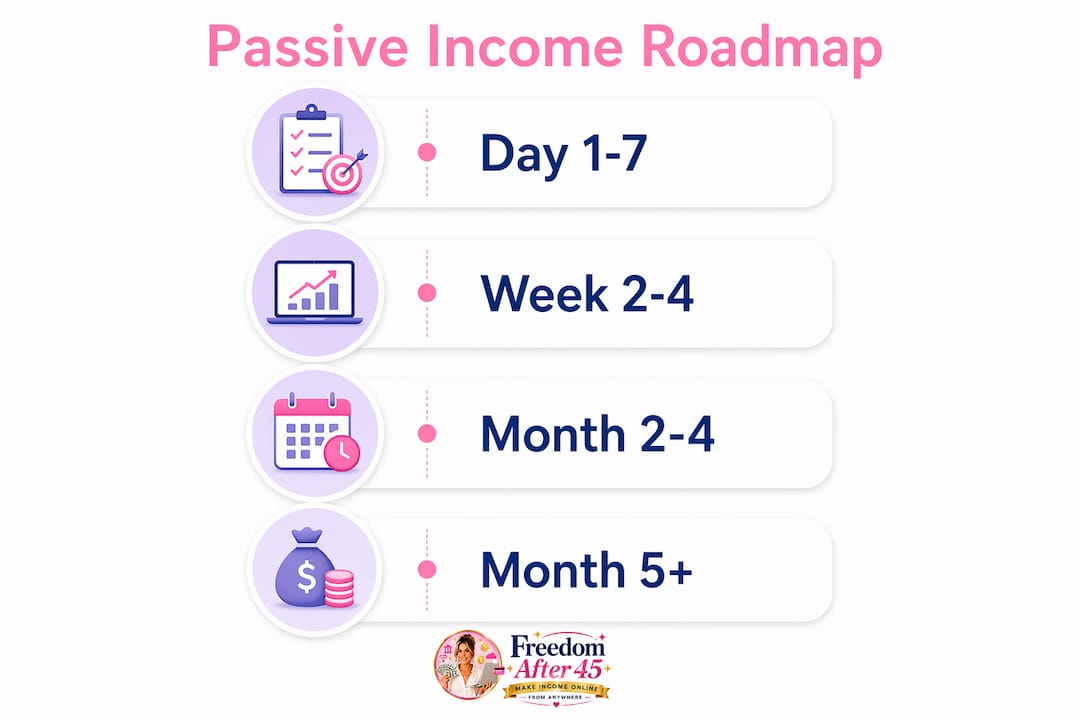
Here is how to structure your two hours each day across the first eight months:
- Days 1 to 7: Register a domain on Namecheap, set up WordPress or a Beehiiv newsletter, create social profiles on Pinterest or Instagram for content distribution, and write your first two pieces of content. Focus on one niche you already know from your studies or hobbies.
- Weeks 2 to 4: Publish three to four content pieces per week. Apply to affiliate programs like Amazon Associates, ShareASale, or Impact. Build your email list from day one, even if it starts with ten subscribers.
- Months 2 to 4: Optimize your top-performing content using Google Search Console data. Your first affiliate clicks and email engagement will appear here. Treat these as proof of concept, not paychecks yet.
- Months 5 to 8: Launch your first digital product. A Canva template pack, a study guide PDF, or a niche worksheet set can sell on Gumroad or Etsy with zero inventory cost. Add display ads through Mediavine or Ezoic once traffic qualifies.
- Months 9 to 12: Layer in a second income stream. If blogging is working, add a YouTube channel covering the same niche. If affiliate marketing is producing, create a product that solves the same problem your affiliate links address.
Pro Tip: Publishing consistent content and joining multiple affiliate programs in months two through four accelerates early monetization more than any single tactic. Diversify your affiliate partnerships early.
| Phase | Primary activity | Expected outcome |
|---|---|---|
| Days 1 to 7 | Setup and first content | Foundation built, no income yet |
| Weeks 2 to 4 | Content publishing, affiliate signup | First clicks, early list growth |
| Months 2 to 4 | Optimization, engagement | $50 to $300 per month |
| Months 5 to 8 | Digital products, ad revenue | $500 to $5,000 per month |
| Months 9 to 12 | Second income stream | $3,000 to $10,000 per month |
How to avoid the most common mistakes students make
The single biggest mistake is expecting income in week one. Affiliate marketing beginners typically reach their first $1,000 after 5.4 months of regular work. Only 4% of beginners using purely organic traffic hit that milestone in the first 30 days. That statistic reframes the entire project: you are building an asset, not earning a wage.
Here are the pitfalls that derail most student income builders:
- Burnout from overcommitting. Two hours is the ceiling, not the floor. Students who push to four or five hours during exam season crash and abandon their projects entirely.
- Chasing too many methods at once. Pick one primary method for the first 90 days. Blogging, affiliate marketing, or digital products each require focused attention before they compound.
- Ignoring quality in favor of volume. Ten well-researched blog posts outperform fifty thin articles every time in search rankings and affiliate conversion rates.
- Skipping tax records. The IRS uses material participation tests including a 500-hour annual rule to classify income. Students logging under two hours daily may face passive loss limitations. Keep a simple spreadsheet of your hours from day one.
“Even after earning $100k in digital products, significant ongoing active work remains involved. Passive income means recurring revenue post-launch, not effortless earnings from day one.”
Tracking progress matters as much as doing the work. Check Google Search Console weekly for ranking movement. Monitor affiliate dashboards for click-through rates. Review email open rates in Beehiiv monthly. These numbers tell you which content is working before income confirms it.
Which passive income methods work best for students with limited time?
Digital products, content platforms, and affiliate marketing are the three methods best suited to a two-hour daily schedule. Each has a different effort curve, income ceiling, and time-to-revenue window.
Passive income strategies require upfront investment of time or creativity before generating steady earnings. Students who accept this reality choose methods that match their existing skills rather than chasing the fastest payout.
Pro Tip: Match your method to your major. A finance student building a budgeting template on Gumroad has a credibility advantage over a generic creator. A nursing student writing study guides for NCLEX prep has a built-in audience of classmates and future cohorts.
Here is a direct comparison of the top methods for students:
| Method | Startup cost | Time to first income | Scalability | Best for |
|---|---|---|---|---|
| Digital products (Gumroad, Etsy) | Under $15 | 2 to 6 weeks | High | Creative, organized students |
| Affiliate marketing (blog or newsletter) | Under $25/month | 4 to 8 weeks | Very high | Writers, researchers |
| YouTube channel | Free | 3 to 6 months | Very high | Confident on camera |
| Blogging with SEO | Under $15/month | 6 to 12 weeks | High | Strong writers |
| Print-on-demand (Redbubble, Merch) | Free | 4 to 10 weeks | Moderate | Designers |
Digital products carry the highest margin because there is no inventory, no shipping, and no customer service beyond a simple FAQ page. A $15 study template sold 200 times generates $3,000 with zero additional work after the initial upload. Affiliate marketing scales further but requires an audience first. YouTube has the longest runway but the highest income ceiling once the algorithm picks up your content.
The methods to avoid in a two-hour window are those requiring real-time presence: tutoring, freelancing, and social media management all pay well but are not passive. They trade time for money, which defeats the purpose.
Key takeaways
Student passive income built on two hours daily is a long-term asset strategy, not a quick cash method, and the students who succeed treat it exactly that way.
| Point | Details |
|---|---|
| Realistic timeline | First meaningful income appears at 30 to 60 days; $1,000/month takes roughly five months of consistent work. |
| Low startup cost | A complete passive income setup costs under $25 per month using Canva, Namecheap, Beehiiv, and Claude AI. |
| Best methods for students | Digital products and affiliate marketing offer the highest return per hour for students with limited daily time. |
| Tax awareness | IRS material participation rules apply even to low-effort income; track your hours from day one to avoid surprises. |
| Consistency beats intensity | Two protected hours daily outperforms sporadic four-hour sessions every time over a 90-day horizon. |
Why the “passive” label is the most misleading part of this whole conversation
Here is what I have seen repeatedly working with students and beginners through Freedom After 45: the word “passive” sets people up for disappointment faster than any other single factor. Students come in expecting to set something up over a weekend and collect checks by Friday. That is not how any of this works, and pretending otherwise wastes everyone’s time.
The honest version is this: you are building a digital asset. An asset requires construction before it pays dividends. A blog post that ranks on Google and earns affiliate commissions for three years is genuinely passive after month six. But months one through five are active, focused, and sometimes frustrating. The students who make it through that window are not the most talented ones. They are the most consistent ones.
What I find most students get wrong is the comparison trap. They see a creator claiming $10,000 per month from a newsletter and assume that creator is working two hours a week. What they are not seeing is the 18 months of daily two-hour sessions that built the audience. The setup-to-optimization progression in digital passive income demands creating, launching, and iterating repeatedly before the compounding effect kicks in.
My advice: pick one method, give it 90 days of honest two-hour sessions, and measure traction rather than income in the first two months. First affiliate clicks, first email subscribers, first search rankings. These are the signals that tell you the asset is working before the money confirms it. Treat early results as learning milestones rather than immediate paychecks, and you will outlast 90% of the people who start alongside you.
— Freedom After 45
Start building your two-hour income workflow today
Freedom After 45 was built specifically for people who want real income from a structured two-hour daily commitment, without needing an existing audience, a product, or a social media following.

The 2-Hour Workflow blueprint at Freedom After 45 walks you through every phase covered in this article, from setup and content creation to affiliate monetization and digital product launches. It is designed for students and beginners who need a clear sequence, not a pile of disconnected tactics. Thousands of people have used this system to move from financial stress to consistent daily earnings. If you are ready to stop researching and start building, this is the structured next step.
FAQ
How long does it take to earn passive income as a student?
Most students see their first meaningful income within 30 to 60 days of consistent daily work. Reaching $1,000 per month typically takes around 5.4 months for affiliate marketing beginners working regularly.
What is the cheapest way to start passive income with two hours a day?
A complete starter setup using Namecheap, EasyWP, Canva, and Beehiiv costs under $25 per month. Digital products on Gumroad or Etsy can be launched for free with a Canva free account.
Does the IRS tax student passive income differently?
The IRS classifies income as passive based on material participation rules, not on how little effort you perceive yourself putting in. Students working under 500 hours annually on an income activity may face passive loss limitations, so tracking hours from the start matters.
Is affiliate marketing or digital products better for students?
Digital products generate higher margins per sale with no ongoing cost, while affiliate marketing scales further with audience growth. Students with strong writing skills and a clear niche often find affiliate marketing through a blog or newsletter produces more consistent income after month four.
Can you really earn passive income studying full time?
Yes, but the income is not immediate. Passive income setups require significant upfront effort before generating steady earnings. Students who protect a consistent two-hour daily block and focus on one method for 90 days build real income streams without sacrificing their academic performance.