

Avoid Penalties: U.S. Side Hustle Taxes and a Two Hour Weekly Routine
Yes, you owe taxes on your side hustle once net earnings hit $400, and the IRS wants you to report every dollar whether or not a form ever lands in your inbox. The single most important thing to do right now: open a separate account, start logging income weekly, and set aside a portion of what you earn for taxes, typically advised to cover both income and self-employment taxes. Everything else in this guide builds from that.
TL;DR:Side hustlers must report net earnings of $400 or more annually, regardless of whether payment forms are received, and should start tracking income immediately.Self-employment taxes are approximately 15.3%, with income deductions available for half, and proper recordkeeping reduces overall tax liability.Maintaining detailed, contemporaneous records of expenses and income, including receipts and mileage, safeguards against audits and simplifies tax filing.Quarterly estimated payments are required if expected tax owed exceeds $1,000, with safe harbor options protecting against penalties.Classify your activity as a business by keeping clear financial records, actively advertising, and treating profits and expenses professionally to avoid being categorized as a hobby.
Table of Contents
- When You Must File and Which IRS Forms to Use
- How Self-Employment Tax Works and How Much You’ll Owe
- Deductions and Recordkeeping: What You Can Write Off
- Estimated Quarterly Payments: Who Needs to Pay and How
- Hobby vs. Business: Why the IRS Test Actually Matters
- State and Multi-State Tax Basics for Side Hustlers
- A Simple Weekly Routine to Stay Organized
- Tax Implications of Hiring Contractors or Employees
- Impact of Retirement Contributions and Health Insurance Deductions
- Audit Triggers Specific to Side Hustles
- How to Calculate Net Income From Side Hustle Earnings
- Why Small Tax Habits Compound Into Business Freedom
- How the 2-Hour Workflow Complements These Tax Habits
- Official Forms and Primary IRS Pages to Bookmark
- Sources
When You Must File and Which IRS Forms to Use
The $400 threshold is the number that trips up more side hustlers than anything else. Once your net self-employment earnings reach $400 in a year, you’re required to file a return and pay self-employment tax, full stop. It doesn’t matter if you drove for a rideshare app three weekends a month or sold candles at a farmers market twice. Net earnings, not gross revenue, is the trigger, so a hustle that brought in $2,000 but cost you $1,700 in supplies and mileage sits just under the line.
Here’s the part that catches people off guard: the IRS expects you to report income even when no one sends you paperwork for it. Cash tips, Venmo payments from a private client, or a small side project that never generated a 1099. The reporting obligation doesn’t wait for a form to show up.
Three IRS documents do the heavy lifting for side hustle income:
- Schedule C reports your business income and expenses, feeding your net profit into Form 1040.
- Schedule SE calculates your self-employment tax based on that Schedule C profit.
- Form 1099-NEC or 1099-K may arrive from clients or payment platforms, but their absence doesn’t excuse you from reporting.
Start a folder, digital or physical, the day you make your first sale. Drop in every invoice, receipt, and payment confirmation as it happens rather than hunting for them in April.
How Self-Employment Tax Works and How Much You’ll Owe
Self-employment tax isn’t a penalty for having a side gig. It’s how you fund Social Security and Medicare when you don’t have an employer splitting the bill with you. A traditional job has your employer covering half of those payroll taxes automatically. Run your own show, and you’re on the hook for both halves.
The 15.3% breakdown: Self-employment tax generally runs about 15.3% of your net earnings, combining 12.4% for Social Security and 2.9% for Medicare. That’s the employer-plus-employee rate rolled into one bill you pay directly.
There’s real relief built into the math, though. You get to deduct half of your self-employment tax from your adjusted gross income, mirroring the deduction an employer would otherwise take on your behalf. It’s a below-the-line break that lowers your overall tax burden even though you never see the money.
A quick example: say your side hustle brings in $8,000 in gross receipts and you spend $2,000 on materials, software, and mileage. Net profit lands at $6,000. Schedule SE walks through the exact calculation, including the deduction you’ll claim on Form 1040.
Deductions and Recordkeeping: What You Can Write Off
Deductions are where side hustlers either save real money or leave it sitting on the table. Every dollar you deduct lowers both your income tax and your self-employment tax, since both are calculated on net profit, not gross revenue.
- Home office — Use the simplified method ($5 per square foot, up to 300 square feet) or the regular method based on actual expenses and the percentage of your home used exclusively for business.
- Mileage — Track every business mile driven; the IRS standard mileage rate changes annually, so check the current figure before filing.
- Supplies and software — Anything you buy specifically to run the hustle, from craft materials to a subscription tool.
- Phone and internet — Deduct the business-use percentage, not the whole bill, since most people use these for personal life too.
- Advertising and professional fees — Business cards, paid ads, and a bookkeeper or tax preparer’s fee all count.
- Startup costs — Up to $5,000 in costs incurred before you officially launched can be deducted in your first year.
Dual-use items need proration.
Pro Tip: Snap a photo of every receipt the day you get it and drop it into a dated folder. Waiting until tax season to reconstruct three months of purchases is where deductions quietly disappear.
A free spreadsheet or a basic budgeting app works fine for most side hustlers. Keep records for three to six years, and open a dedicated bank account before your first payment ever hits.
Estimated Quarterly Payments: Who Needs to Pay and How
If you expect to owe $1,000 or more in tax for the year, the IRS wants quarterly payments, not one lump sum in April. Skip them and you’ll likely face an underpayment penalty even if you pay everything owed by the filing deadline.
- Due dates fall roughly in mid-April, mid-June, mid-September, and mid-January of the following year.
- Safe harbor options protect you from penalties: pay 100% of last year’s tax liability (110% if your adjusted gross income topped $150,000), or 90% of this year’s actual liability.
- Form 1040-ES includes the worksheet for calculating your quarterly amount, or you can simplify by setting aside a flat percentage of each payment as it arrives.
Income that swings wildly month to month makes flat quarterly estimates painful. The annualized income installment method, built into the 1040-ES instructions, adjusts each payment based on what you actually earned in that period rather than forcing an even split.
Pay through IRS Direct Pay or EFTPS, both free and immediate. Underestimate a quarter? Adjust the next one upward rather than waiting until the following year to catch up.
Hobby vs. Business: Why the IRS Test Actually Matters
The IRS draws a hard line between a hobby and a business, and which side you land on changes what you’re allowed to deduct. Run a hobby, and you can’t deduct losses against other income at all. Run a business, and ordinary expenses come off the top even in a loss year.
The IRS looks at several factors to decide which one you’re operating: whether you run it in a businesslike way, how much time and effort you put in, whether you depend on the income, and whether you’ve shown a profit in at least some recent years.
A few habits push you firmly into business territory:
- Keep a dedicated bank account and clean financial records.
- Write a simple business plan, even one page, outlining your pricing and growth goals.
- Advertise actively rather than relying only on word of mouth.
- Make visible changes over time to improve profitability, like raising prices or cutting a losing product line.
Treat your side hustle like a business from day one, and the classification question mostly answers itself.
State and Multi-State Tax Basics for Side Hustlers
Federal rules are only half the picture. States vary enormously. Some, like Texas and Florida, charge no state income tax at all, while others tax side hustle income at rates comparable to a full-time salary.
Multi-state situations trip up more people than you’d expect:
- Providing remote services to clients based in another state can sometimes create a filing obligation there, depending on that state’s rules.
- Traveling to perform work in person, like a consulting gig or a craft fair in a neighboring state, may trigger nonresident filing requirements.
- Selling physical goods across state lines can create sales-tax registration obligations depending on volume and destination.
Track where your customers and clients are located as carefully as you track income. Check your own state revenue agency’s site for specifics, and loop in a tax professional the moment a nexus question feels murky. Nexus rules are notoriously inconsistent from state to state.
A Simple Weekly Routine to Stay Organized
Tax season stops being stressful the moment you build a repeatable weekly habit. A short, consistent routine beats a marathon scramble every April, and it’s the difference between confidently filing and panicking over missing receipts.
- Reconcile every deposit against your income log.
- Categorize the week’s expenses while they’re still fresh in memory.
- Scan and file any paper receipts before they end up crumpled in a bag.
- Log business mileage if you drove anywhere for the hustle.
- Move your tax-savings percentage into a separate account.
Consistency here does double duty: it shrinks what you’d otherwise pay a preparer to reconstruct at tax time, and clean, contemporaneous records are exactly what protects you if the IRS ever has questions.
Tax Implications of Hiring Contractors or Employees
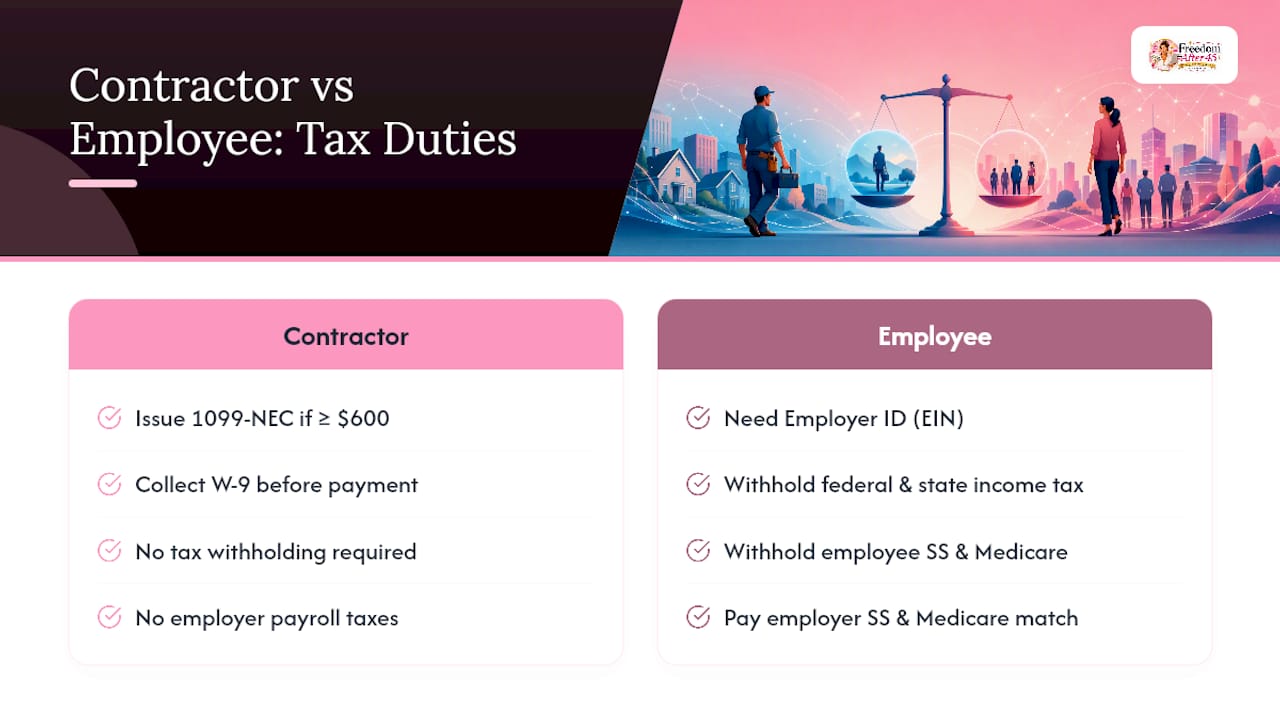
Growing your side hustle to the point where you need help changes your tax obligations substantially. Bring on an independent contractor and pay them $600 or more in a year, and you’re required to issue them a Form 1099-NEC by January 31 of the following year. You’ll also need their Form W-9 on file before you pay them anything, so you have the tax ID number needed to prepare that form correctly.
Hire an actual employee instead of a contractor, and the paperwork multiplies. You’ll need an Employer Identification Number, you’ll withhold federal and state income tax plus the employee’s share of Social Security and Medicare, and you’ll pay the employer’s matching share yourself. That’s on top of federal unemployment tax and, in most states, state unemployment insurance.
The contractor-versus-employee line isn’t yours to draw casually. The IRS looks at behavioral control, financial control, and the nature of the relationship, not what you decide to call the arrangement. Misclassifying an employee as a contractor to dodge payroll taxes is one of the more aggressively enforced areas of small business tax compliance, and the penalties for getting it wrong retroactively can be steep.
If you’re bringing in occasional freelance help, a graphic designer for a logo, a virtual assistant for a few hours a month, keeping that relationship clearly structured as project-based contractor work, with a written agreement and W-9 on file, keeps your obligations simple.
Impact of Retirement Contributions and Health Insurance Deductions
Two deductions consistently get overlooked by side hustlers, and both directly shrink your tax bill.
A SEP-IRA or Solo 401(k) lets you contribute a meaningful chunk of your net self-employment income toward retirement, and that contribution reduces your taxable income for the year. A Solo 401(k) in particular allows both an employee contribution and an employer profit-sharing contribution, which can add up fast even on modest side hustle profit. These accounts are worth opening well before December, since some structures need to exist before year-end even if you fund them later.
The self-employed health insurance deduction is the other one people miss entirely. This is an above-the-line deduction, meaning it reduces your adjusted gross income directly rather than requiring you to clear a deduction threshold.
Neither deduction reduces your self-employment tax itself. Both apply after the SE tax calculation, on the income tax side. But stacked together, a SEP-IRA contribution and health insurance premiums can meaningfully lower what you owe, particularly for someone whose side hustle has grown into a significant income source alongside a primary job.
Audit Triggers Specific to Side Hustles
Certain patterns catch the IRS’s attention more than others, and side hustlers hit several of them without realizing it.
Reporting a loss year after year is the biggest one. A side hustle that shows a loss for three or more consecutive years starts looking less like a business and more like a hobby being used to offset other income, exactly the distinction covered earlier. Claiming disproportionately large deductions relative to your income raises flags too, especially home office and vehicle deductions that seem inflated against modest gross receipts.
Mismatches between what payment platforms report on a 1099-K and what you report on Schedule C are increasingly common triggers, since the IRS cross-checks these forms against your return automatically. Rounding your numbers suspiciously, reporting suspiciously even figures instead of actual receipt totals, is a smaller but real signal.
The fix for nearly all of it is the same: keep contemporaneous, itemized records, report every dollar of income whether or not a form arrives, and only deduct expenses you can actually document if asked. An audit isn’t inherently catastrophic if your paperwork holds up. It’s a problem when the numbers were guessed rather than tracked.
How to Calculate Net Income From Side Hustle Earnings
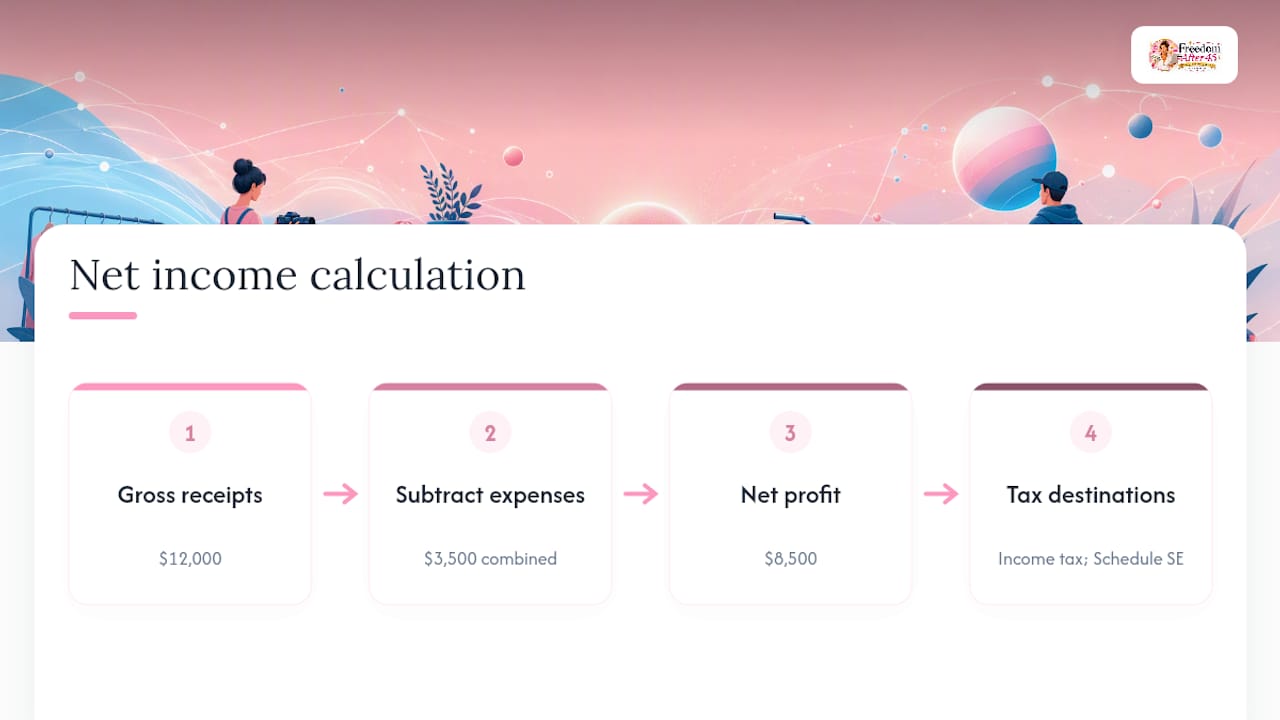
Net income is the number that actually matters for taxes, not the total you see hit your bank account. Start with gross receipts, every dollar of income from the hustle before anything is subtracted.
From there, subtract your ordinary and necessary business expenses: supplies, mileage, home office, software, advertising, professional fees, and anything else directly tied to running the hustle. What’s left is your net profit, the figure that flows onto Schedule C and then becomes the base for your Schedule SE calculation.
A concrete walk-through: gross receipts of $12,000, minus $3,500 in combined expenses (materials, mileage, a portion of your phone bill, a paid ad campaign), leaves $8,500 in net profit. That $8,500 is what gets taxed, both for income tax purposes and as the starting point for your self-employment tax calculation.
Getting this number right matters for more than just filing correctly. It’s also the figure lenders and even some assistance programs will ask for if you ever need to document self-employment income. Track it monthly rather than reconstructing it once a year, and you’ll always know where you stand instead of guessing until the numbers are due.
Why Small Tax Habits Compound Into Business Freedom
The side hustlers who panic every April are almost never the ones with complicated taxes. They’re the ones who never built a habit, so a whole year’s mess lands on them at once. Treating your bookkeeping as part of running the business, not a chore bolted onto it, changes how the whole thing feels.
A weekly ten-minute check-in does more for your bottom line than any last-minute scramble to justify deductions ever will. Build that habit now, and the tax side of your hustle stops being the thing you dread and starts being proof you’re running something real.
— Freedom After 45
How the 2-Hour Workflow Complements These Tax Habits
The 2-Hour Workflow blueprint addresses a common problem: side hustles often fail due to a lack of consistent organizational habits. The system provides step-by-step video instructions, templates, and community support to help build a routine that can be maintained in around two hours a day.

None of this replaces a tax professional or the IRS forms covered above. What it does is give you a repeatable weekly routine for tracking income, organizing receipts, and building the kind of consistent habit that makes tax season painless instead of dreaded, the same discipline this guide has been pushing from the start. If you want a ready-made system instead of building your tracking routine from scratch, check out the 2-Hour Workflow and see whether the structure fits how you already work.
Official Forms and Primary IRS Pages to Bookmark
Bookmark these before tax season sneaks up on you: the IRS gig work hub, Schedule SE guidance, Form 1040-ES for quarterly payments, and Publication 334 for a full small business tax overview. If you’d rather have a structured system guiding your routine, the 2-Hour Workflow is available as well.
This article is general information, not a substitute for advice from a qualified financial advisor. Consult a qualified financial professional about your own circumstances before acting on anything here.