

48 Hours to Stop Side Hustle Burnout and Keep Your Gig Small
Yes, you can keep a side hustle without burning out, but only if you protect your peak energy, set firm boundaries, and use a kill-switch the moment warning signs appear. About 67% of side hustlers report burnout from their extra work. In the next 48 hours: pause every new commitment, set one response window for clients, and reinstate a single recovery ritual you’ve dropped.
TL;DR:Burning out from a side hustle occurs faster due to lack of recovery time, no boundary infrastructure, and high emotional and mental load.Limiting new inquiries, setting a response window, and reinstating one recovery ritual can significantly reduce burnout within 48 hours.Tracking energy levels and building a weekly energy inventory helps prioritize peak hours, maintenance tasks, and scheduled recovery to prevent burnout.Unmanaged burnout can lead to cynicism, detachment from work, physical health issues, and long-term damage to personal identity and relationships.A structured, capped-time system like the 2-Hour Workflow supports steady income while minimizing burnout risks, especially for women over 45 balancing multiple responsibilities.
Table of Contents
- What to Do in the Next 48 Hours to Stop Side Hustle Burnout
- Why Do Side Hustles Cause Burnout So Fast?
- What Are the Warning Signs, and When Should You Pull the Kill-Switch?
- How Do You Prevent Burnout in a Side Job Long Term?
- How Do You Recover From Side Hustle Burnout?
- Does a Structured System Actually Reduce Burnout Risk?
- How Do You Balance a Side Hustle With a Full-Time Job and Personal Life?
- What Are the Mental Health Effects of Side Hustle Burnout?
- What Happens if Side Hustle Burnout Goes Unmanaged?
- When Should You Seek Professional Help for Burnout?
- How Does Side Hustle Burnout Actually Progress?
- You Have Permission to Keep Your Side Hustle Small
- Want a Guided System Instead of Building One From Scratch?
- Sources
What to Do in the Next 48 Hours to Stop Side Hustle Burnout
Panic mode makes everything worse. Before you touch your schedule, structure, or client list, work through this sequence in order.
- Freeze new intake. Turn off inquiries, pause marketing, decline new clients or gigs for two weeks. No exceptions.
- Set one response window. Pick a single 30 minute block per day for messages. Outside it, your phone stays face down.
- Cut peak hours by 25%. If you’re grinding four hours a night, drop to three. The math sounds small; the relief isn’t.
- Reinstate one recovery ritual. A walk, a full lunch break, eight hours of sleep once. Just one, done consistently, beats five good intentions.
- Automate or delegate one task. Invoicing software, a scheduling tool, a virtual assistant for an hour a week. Anything that removes a repeated decision.
Pro Tip: When a client pushes back on your new response window, say this: “I respond to all messages within 24 hours during business days, and that lets me give your project my full attention when I do.” That’s a boundary, not an apology.
Why Do Side Hustles Cause Burnout So Fast?
Burnout is a chronic stress response with three recognized dimensions: emotional exhaustion, depersonalization (a growing cynicism toward the work itself), and a shrinking sense of accomplishment, according to research on chronic workplace stress. A side hustle hits all three faster than a regular job because it has no built-in recovery period. Your primary job at least has weekends and sick days baked into its structure. A side hustle usually doesn’t, and that’s the design flaw, not a personal failure.
The real problem isn’t the hours. It’s what those hours cost in energy relative to what they pay, sometimes called your “shadow hourly rate,” a way of pricing in the fatigue, context switching, and mental load a gig actually demands, not just the invoice total. A $30 an hour freelance job that eats your only rest window most nights might have a shadow rate closer to $8.
Three forces make this worse:
- Survival pressure, not passion. Many people start a hustle because they need the income, not because they love the work, and that removes the intrinsic motivation that usually buffers stress.
- No boundary infrastructure. A side hustle has no HR department, no built-in vacation days, no coworker checking in on you.
- Constant-hustle marketing. Economic pressure and social media both normalize nonstop side work as a lifestyle rather than a temporary bridge.
Forbes’ reporting on this found nearly one in five side hustlers say their extra gig stresses them out more than their full-time job does. That’s not a minority problem. That’s most people running two jobs with only one recovery system, or none at all.
What Are the Warning Signs, and When Should You Pull the Kill-Switch?
Early signs are easy to dismiss because they feel like normal tiredness: irritability with clients, dreading tasks you used to enjoy, skipping meals to squeeze in an hour of work. Late signs are harder to ignore: sleep loss that carries into your primary job, forgetting deadlines at your day job, or feeling nothing when a client compliments your work. That numbness is the depersonalization dimension of burnout showing up in real time.
To self-triage quickly, ask three questions in order:
- Has this hustle cost me sleep in the last seven days?
- Has a coworker or manager noticed a drop in my day-job performance?
- Do I feel dread, not just tiredness, when I open my side hustle inbox?
Two “yes” answers means you pull the kill-switch today. Three means it’s worth talking to a therapist or your doctor, not just adjusting your calendar.
How Do You Prevent Burnout in a Side Job Long Term?
Treating symptoms after they show up is exhausting. The better approach is a system that keeps burnout from building in the first place, and it starts with rethinking what you’re actually managing. You’re not managing hours. You’re managing energy, and hours are just the container.
Build an energy inventory
Map your week into three tiers instead of one undifferentiated block of “work time”:
- Peak hours — your sharpest 2 to 4 hours, whenever they fall for your chronotype. This is where growth work, client calls, and creative tasks belong.
- Maintenance hours — lower-focus, repeatable tasks like invoicing, scheduling, or replying to routine emails. Batch these into short windows instead of scattering them all day.
- Recovery hours — non-negotiable, scheduled the same way you’d schedule a client call. If recovery isn’t on the calendar, it gets eaten first.
Most people build their week backward, filling every open hour with hustle work and hoping recovery happens in whatever’s left. It never is. Schedule the recovery block first, then the peak-hour growth work, then let maintenance fill the gaps.
Set scheduling and client rules
Protect your 2 to 4 peak hours like a locked appointment. Batch maintenance tasks into one or two windows a day instead of checking email every twenty minutes. And build these rules into how you work with clients from day one:
- Use asynchronous channels (email, project management tools) over real-time chat wherever possible.
- Publish a stated response window, and hold to it.
- Cap your active client or project count before you start feeling stretched, not after.
- Put scope in writing for every project, even small ones, so “quick favors” don’t quietly become unpaid scope creep.
Pro Tip: Write your capacity cap down as a number, not a feeling. “I take no more than three active clients” is enforceable. “I’ll take on more if I have time” never is.
Run a monthly audit
Once a month, calculate two numbers for each client or project. First, your shadow hourly rate: total pay divided by total hours including admin, emails, and revisions, not just billable time. Second, a rough yield-to-stress ratio, comparing how much a client pays against how much dread or friction they generate. A side hustle worth keeping usually scores well on both. One that scores badly on either is a candidate to drop or renegotiate, even if it’s your highest-paying client.
If you’re just starting out, keep the whole operation lean. Simple, low-overhead offers like templates or digital products create steady income without the client-management overhead that drives most burnout in the first place.
How Do You Recover From Side Hustle Burnout?
Recovery works best on a timeline, not a vague promise to “cut back eventually.” Vague plans dissolve the first time a client emails.
- First 48 to 72 hours: Stop all growth work immediately. Protect sleep like it’s a client deadline. Bring back one recovery ritual you’ve let slide, even a fifteen minute walk.
- Two-week stabilization: Accept zero new commitments. Track your sleep and recovery time daily, even loosely. Cut peak hours by 25% and hold that line for the full two weeks.
- Four to eight week phased return: Reintroduce growth work in small increments, monitoring how you feel each week. Keep a strict capacity cap, at least one client or project below what you were carrying before.
If you’re considering leaving your day job to scale the hustle instead of easing back, hold off. Financial reporting on this transition recommends securing months of consistent revenue and an emergency fund first, because quitting doesn’t fix burnout if the recovery windows disappear right along with the paycheck safety net.
Does a Structured System Actually Reduce Burnout Risk?
Freeform side hustles fail most often at the exact point this article keeps returning to: nobody built recovery into the plan. A structured routine removes that guesswork by design. Freedom After 45’s 2-Hour Workflow is built around the same energy inventory logic covered above: one focused block, a capped daily time commitment, and no requirement to build an audience or product from scratch first.
It’s aimed specifically at women 45 and older who are already balancing a full-time job, caregiving, or both, and simply don’t have bandwidth for a side hustle that demands unpredictable hours. The promise is a repeatable two-hour system, not another open-ended grind.
What it offers in practice:
- A fixed daily time box instead of an expanding one
- No existing following or product required to start
- Step-by-step video guidance built for people new to online income
- A support community for accountability and troubleshooting
How Do You Balance a Side Hustle With a Full-Time Job and Personal Life?
Balance isn’t a 50/50 split. It’s a hierarchy, and your full-time job and health belong above the hustle, not beside it. When people burn out, it’s usually because the side income quietly started outranking sleep, family time, or job performance without anyone deciding that on purpose.
Set the hierarchy explicitly: primary job and health first, relationships and rest second, side hustle third. Then let your calendar reflect that order instead of fitting the hustle in wherever a gap appears. If your side hustle regularly bumps something in tier one or two, that’s not a scheduling problem. That’s the kill-switch signal from earlier in this article showing up again.
Communicate the boundary out loud, too. Tell your household when your peak hours are so they’re not interrupted, and tell yourself the same thing about weekends. A side hustle that quietly consumes every “free” hour isn’t supplemental income anymore. It’s a second unpaid job with a paycheck attached, and the balance you’re managing is really about protecting the life the extra income was supposed to support.
What Are the Mental Health Effects of Side Hustle Burnout?
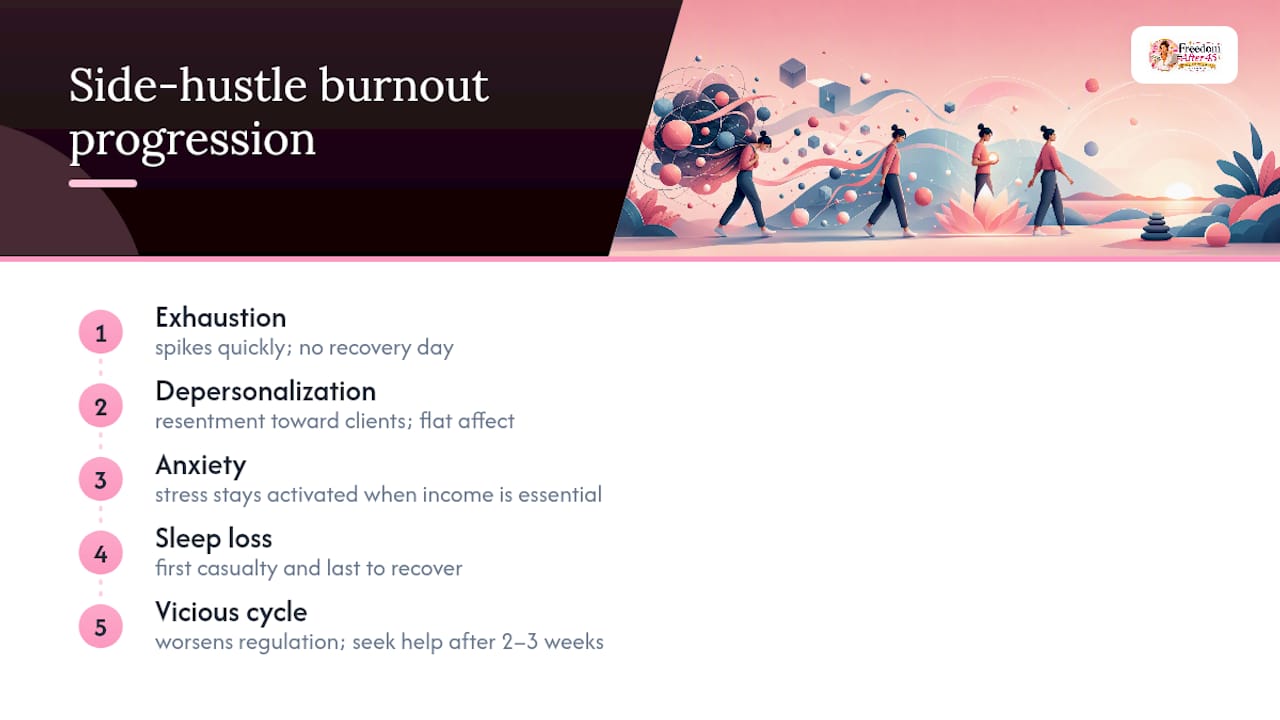
The three dimensions of burnout, emotional exhaustion, depersonalization, and reduced accomplishment, show up differently when the source is a side hustle rather than a primary career. Exhaustion tends to spike quickly because there’s no built-in recovery day. Depersonalization often looks like resentment toward clients or customers you used to enjoy working with, a flat, going-through-the-motions feeling that can bleed into your day job too.
Anxiety often compounds the exhaustion, especially for hustles tied to survival income rather than extra spending money. When rent or a car payment depends on gig income, the stress response stays activated even during “off” hours, because your nervous system doesn’t fully distinguish between “optional side project” and “essential income,” even when your conscious mind knows the difference.
Sleep is usually the first casualty and the last thing to recover, which matters because chronic stress and burnout feed each other in both directions: poor sleep worsens emotional regulation, and worse emotional regulation makes rest harder to protect. If irritability, dread, or a flat emotional response to your side hustle has lasted more than two or three weeks despite trying the two-week triage protocol, that’s worth raising with a doctor or therapist rather than pushing through alone.
What Happens if Side Hustle Burnout Goes Unmanaged?
Left unaddressed, side hustle burnout rarely stays contained to the side hustle. It spreads. Depersonalization that starts with gig clients tends to generalize, showing up as cynicism at your primary job, in relationships, or toward goals you used to care about.
The financial irony is sharp: people push through burnout to protect the income, and the burnout itself starts costing them income, through missed deadlines, lost clients, or a primary-job performance dip that risks the more stable paycheck. Long-term unmanaged burnout has also been linked to broader physical health consequences tied to chronic stress exposure, not just fatigue.
There’s also a quieter cost: identity erosion. When a side hustle that started as a source of pride or independence turns into a grind you resent, it can taint your relationship with work generally, making even your primary career feel heavier than it did before. That’s a much harder thing to recover from than a bad quarter of side income.
When Should You Seek Professional Help for Burnout?
Self-managed triage works for most non-clinical burnout episodes, but not all of them. If you’ve run the two-week stabilization plan and the exhaustion, cynicism, or dread hasn’t lifted, that’s a signal to bring in outside support rather than repeating the same protocol indefinitely.
A therapist familiar with occupational stress can help untangle whether what you’re experiencing is burnout, an underlying anxiety or mood disorder, or both feeding each other. That distinction matters for treatment. Burnout responds well to structural changes: fewer hours, better boundaries, real recovery time. Depression and anxiety often need additional support beyond a schedule adjustment.
Peer support groups, whether local small-business meetups or online communities built around gig work, offer something a solo grind can’t: other people who recognize the specific exhaustion of running two jobs at once. Isolation makes burnout worse, and side hustles are often solitary by nature, so deliberately building in a support network functions as its own kind of recovery infrastructure.
If your employer offers an employee assistance program, it typically covers confidential counseling sessions at no direct cost, and it’s worth using even if the stress originates outside your primary job.
How Does Side Hustle Burnout Actually Progress?
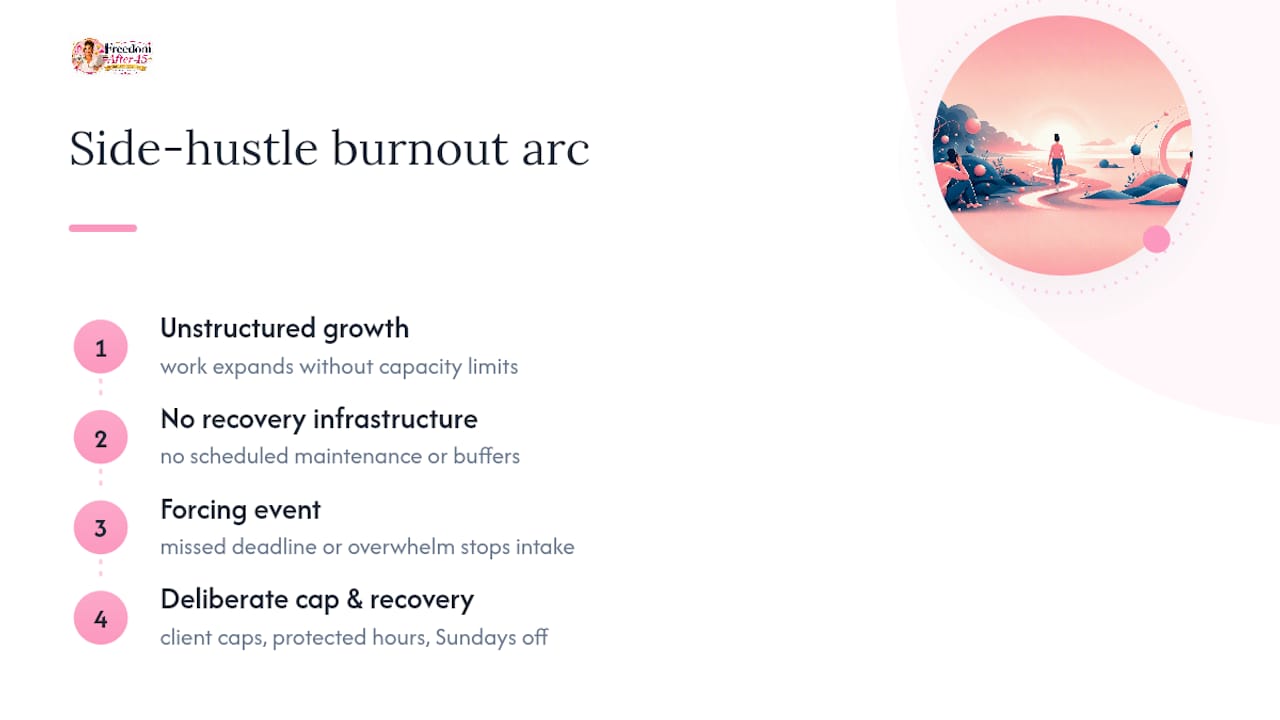
Consider two composite patterns that reflect how this typically unfolds. In the first, someone picks up freelance design work to cover a shortfall. Within three months, “just a few projects” becomes five active clients with no stated capacity cap. Sleep drops first, then patience with feedback, then enthusiasm for the work itself. The kill-switch moment arrives when a missed deadline at the primary job forces a hard stop, two weeks of zero new intake, and a permanent cap of three clients going forward.
In the second, someone starts a small online shop as a passion project. Growth work eats every evening because there’s no scheduled maintenance window, just constant reactive fulfillment and customer messages. The fix wasn’t quitting, it was building the energy inventory: two protected peak hours for product development, one batched hour for orders and messages, and Sundays fully off. Revenue didn’t drop. The dread did.
Both patterns share the same arc: unstructured growth, no recovery infrastructure, a forcing event, then a system built afterward that should have existed from day one. The lesson isn’t to avoid side hustles. It’s to build the structure before the forcing event happens, not after.
You Have Permission to Keep Your Side Hustle Small
Hustle culture sells the idea that bigger is always the goal, that if your side gig isn’t scaling, you’re doing it wrong. That framing is backwards for most people juggling a full-time job. A side hustle that stays small, stable, and boring can be the better outcome, not a consolation prize.
Success should be measured by fit with your actual life, not by growth curves that belong to someone with different constraints and different energy to spend. Rest and boundaries aren’t indulgences you earn after hitting a revenue number. They’re the infrastructure that lets the income keep existing at all.
— Freedom After 45
Want a Guided System Instead of Building One From Scratch?
Everything above works if you build and maintain it yourself: the energy inventory, the scheduling rules, the monthly audits. But building a system from zero is its own time cost, and that’s exactly where a lot of side hustlers lose momentum before they even start. Freedom After 45’s 2-Hour Workflow hands you that structure already built, with a fixed daily time commitment instead of an open-ended one that grows until it burns you out.

The program is a step-by-step course designed for women 45 and older who want daily income without needing an existing following, a product, or hours of spare time they don’t have. It includes video walkthroughs, real case studies, and access to a support community, the same peer infrastructure that helps buffer burnout on its own.
Here’s what to expect if you check it out:
- A structured two-hour daily workflow, not an expanding time commitment
- Step-by-step video instruction built for beginners
- Community support for accountability and troubleshooting
- No requirement for an existing audience or product to start
If a guided, capped-time system sounds like the missing piece, explore the 2-Hour Workflow and see whether the format fits your week before you commit to anything.