

Shiny Object Syndrome: A Science Backed 5 Step Plan to Finish Projects
Shiny object syndrome is the habit of abandoning a project you’re already working on because a newer, more exciting idea just showed up. It isn’t a clinical diagnosis, and it isn’t a character flaw either. It’s a learned behavior pattern that quietly drains your progress, and it usually gets worse until you build structure around it.
TL;DR:Limiting yourself to three active projects and reviewing new ideas weekly prevents impulsive switches driven by FOMO and novelty seeking.Using a decision checklist before starting new opportunities ensures they align with your goals and are worth the time investment.Turning off notifications and establishing deep work blocks reduces environmental distractions that hijack your focus repeatedly.Building a visible pause between impulse and action fosters deliberate choices, making switching less automatic and more strategic.Completing smaller projects consistently builds confidence and momentum, reducing exhaustion from perpetual starting without finishing.
Table of Contents
- What Does Shiny Object Syndrome Look Like?
- What Causes Shiny Object Syndrome, and How Is It Different From ADHD?
- What Does the Science Say About Why Shiny Ideas Grab Your Attention?
- A Practical Framework to Manage and Beat Shiny Object Syndrome
- How This Connects to Freedom After 45’s Approach
- What Changes When You Finally Stop Chasing Every New Idea
- Can Mindfulness and CBT Techniques Actually Help?
- What This Guide Gets Right That Most Advice Misses
- An Honest Alternative: A Guided 2-Hour-a-Day Workflow
- Sources
What Does Shiny Object Syndrome Look Like?
You don’t need a psychologist to spot shiny object syndrome in your own life. It shows up as a pattern, not a single event.
- You have five half-finished projects and a clear memory of how excited you were about each one.
- A new idea, tool, or trend makes your current work suddenly feel boring or “not worth it.”
- You research and plan constantly but rarely reach the middle of anything, let alone the end.
- Your progress on any one goal stalls for weeks while your list of “next big things” keeps growing.
Real-world versions look different depending on where you are. A crafter buys supplies for candle making, then switches to resin art before finishing a single batch. A small business owner redesigns the website for the third time this year instead of selling to the customers already on the list. A hobbyist runner signs up for a triathlon training plan two weeks into a running program. A person chasing a personal goal jumps from journaling to meditation apps to a new morning routine, never sticking with any one long enough to see results.
Run through this quick self-check: Do you have more unfinished projects than finished ones? Does a new opportunity excite you more than progress on your current one? Have you switched directions on the same goal more than twice this year? If two or more of those sound familiar, the pattern described by Dovetail’s breakdown of shiny object syndrome is likely already costing you time.
What Causes Shiny Object Syndrome, and How Is It Different From ADHD?
Shiny object syndrome usually traces back to a handful of overlapping drivers rather than one single cause.
- FOMO makes staying on your current path feel like missing out on something better.
- Novelty seeking rewards your brain for the idea of a project more than the grind of finishing one.
- Unrealistic expectations about how fast success should arrive make slow, steady progress feel like failure.
- Task-switching costs add up quietly. Every jump between projects costs you the mental warm-up time you’d already invested in the last one.
Constant notifications make this worse. Research on cell phone interruptions found that notifications cause measurable attention lapses even when you don’t touch the phone, because your brain still processes the alert. That’s a structural problem, not a willpower one.
Here’s where it gets important: shiny object syndrome is not the same as ADHD. Novelty seeking is a real, studied personality trait, but as one glossary explainer on novelty seeking and focus points out, shiny object syndrome itself isn’t a clinical diagnosis. ADHD involves a documented pattern of impulsivity and attention regulation that affects nearly every area of life, not just projects you’ve chosen. If your attention problems are sudden, severe, or interfering with basic daily functioning, that’s a signal to talk to a doctor rather than try another productivity hack. Harvard Health notes that sleep, stress, and even certain medications can affect concentration, so ruling those out matters before you assume it’s just a focus habit.
What Does the Science Say About Why Shiny Ideas Grab Your Attention?
Your brain is built to notice new things faster than familiar ones. That’s not a flaw. It’s a survival mechanism that misfires constantly in a world full of manufactured novelty.
Attention research on what scientists call attentional capture shows that novelty and salience, meaning how much something visually or emotionally stands out, pull your focus involuntarily. A review of attention and distraction in the predictive brain found that incentives can sharpen your focus on a target task, while prior distractions and unresolved mental clutter make you more vulnerable to the next shiny thing that crosses your path.
Novelty doesn’t just interest your brain. It hijacks the same attention systems that are supposed to be protecting your focus on the task in front of you.
That has a direct, practical payoff: if incentives strengthen focus and prior interference weakens it, then the fix is twofold. Build in real rewards for finishing what you started, and actively clear distractions before they build up. Journalistic coverage of attention research points to average on-screen focus dropping to roughly 47 seconds before switching in some studies, largely because devices are engineered to train frequent checking. That single number explains a lot about why finishing a two-hour task can feel harder now than it did a decade ago.
A Practical Framework to Manage and Beat Shiny Object Syndrome
You don’t fix shiny object syndrome by trying harder. You fix it by changing your environment and your decision rules so willpower isn’t doing all the work.
- Gatekeep new ideas with a parking lot. Keep a running list where every new idea gets written down instead of acted on. Review that list once a week, on a set day, and only “graduate” an idea if it survives the review.
- Cap your work in progress. Limit yourself to one to three active projects at a time, and set a “finish one before starting one” rule. A simple kanban board or one-page roadmap makes stalled progress impossible to ignore.
- Time-block your deep work. Protect specific hours for single-task focus, and use short sprints of 25 to 90 minutes rather than vague, open-ended “work on it sometime” blocks.
- Run every new opportunity through a decision checklist. Ask four questions: Does this align with my top three goals? How many hours will it take to see meaningful progress? What’s the actual evidence this is better than what I’m already doing? What am I giving up if I switch?
- Build environmental guardrails. Turn off nonessential notifications, keep your phone in another room during focus blocks, and if possible, tell a friend or accountability partner what you’re finishing this month.
Pro Tip: Before starting anything new, write down the actual hours you’ve already invested in your current project. Seeing that number in writing makes switching feel like the real loss it is, not just a lateral move.
This structure works because it makes switching a visible, deliberate choice instead of an impulsive one. Dovetail’s research on the topic notes that repeated switching often produces high effort with very little finished output, which is exactly the pattern a work-in-progress cap is designed to interrupt.
How This Connects to Freedom After 45’s Approach
Freedom After 45 built its ‘2-Hour Workflow’ blueprint around a version of the same principle: fewer moving parts, clear steps, and a defined daily time box instead of an open-ended list of “someday” projects. The program doesn’t require an existing following or product, which matters for readers whose shiny object syndrome shows up as chasing one online opportunity after another without ever building momentum on any of them… A structured workflow doesn’t replace the tactics above. It gives them a container to live in.
What Changes When You Finally Stop Chasing Every New Idea
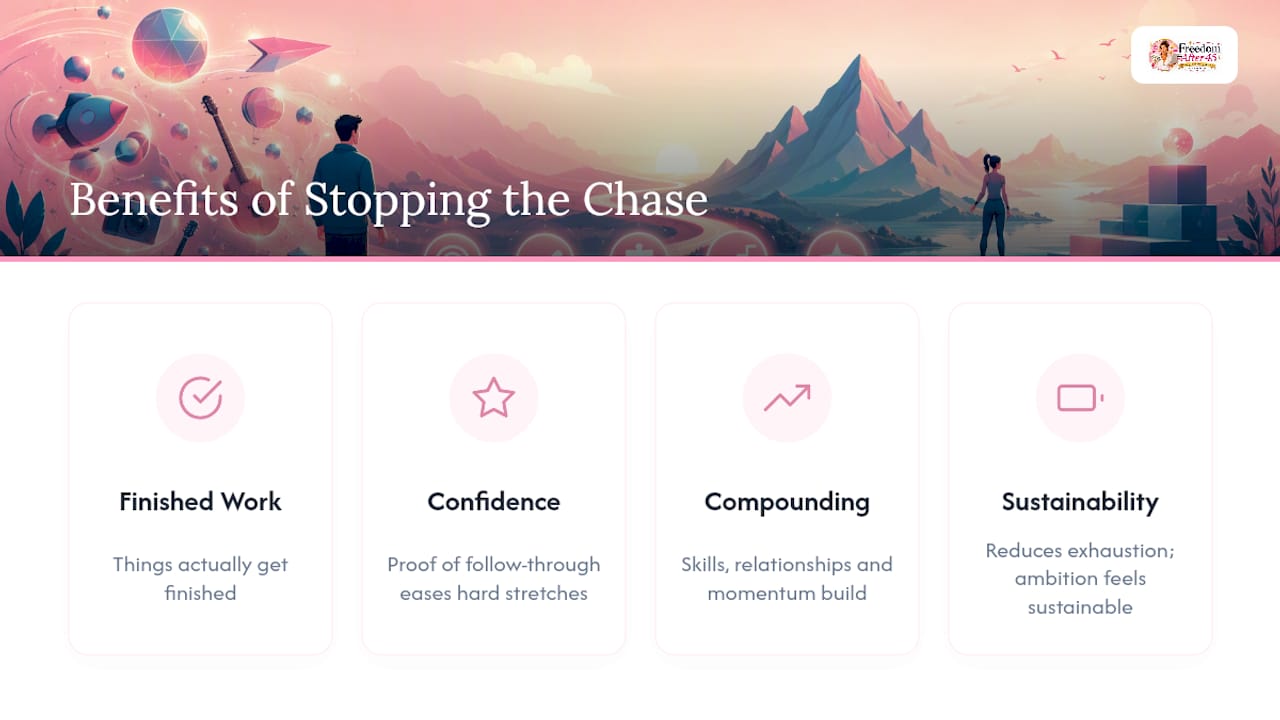
The most obvious payoff of beating shiny object syndrome is simple: things actually get finished. But the deeper benefit is what happens to your confidence once you have proof, not just intentions, that you can see something through.
Finishing builds a track record you can trust. Every completed project, even a small one, becomes evidence that you’re someone who follows through, which makes the next hard stretch of any goal easier to push through. That’s different from the confidence that comes from starting things, which feels good for a week and then evaporates the moment progress gets boring.
There’s also a compounding effect that switching never lets you access. Skills, relationships, and momentum all build on repetition in the same direction. A hobby you stick with for a year teaches you things month three never could. A small business you don’t abandon at the first plateau eventually breaks through it. Chasing new ideas resets that clock every time.
Finally, overcoming the pattern reduces the quiet exhaustion that comes from always starting and never arriving. That fatigue is real, even if it’s rarely named. Redirecting your energy toward fewer, better-chosen goals doesn’t just improve output. It changes how sustainable your ambition feels day to day.
Can Mindfulness and CBT Techniques Actually Help?
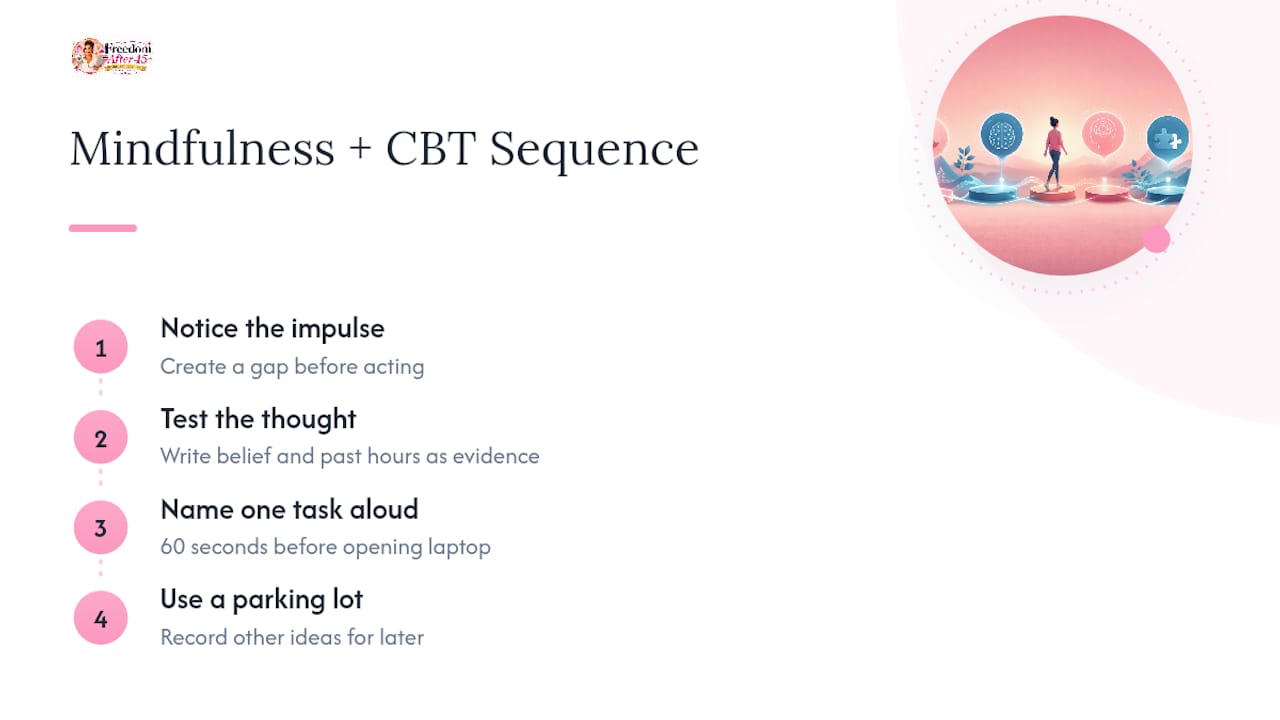
Mindfulness won’t stop new ideas from appearing, but it can change what you do in the moment one grabs your attention. The core skill is noticing the impulse to switch before you act on it, which creates a gap where a better decision can happen.
Cognitive behavioral techniques go a step further by targeting the thoughts that fuel the switch. A common one is catching the belief “this new idea will finally be the easy one” and testing it against evidence: was your last idea easy once you started it? Writing that thought down, next to the actual hours a project has taken so far, tends to deflate the urgency fast.
A simple daily practice works well here: before opening your laptop, spend sixty seconds naming your one task for that work session out loud. It sounds almost too small to matter, but it interrupts the autopilot switching that shiny object syndrome runs on. Pairing that with the parking-lot method from the framework above gives you both an emotional tool and a structural one, which is a stronger combination than either alone.
What This Guide Gets Right That Most Advice Misses
Most articles on shiny object syndrome treat it like a willpower failure, something you’re supposed to white-knuckle your way through with more discipline. That framing is backwards. The research on attentional capture makes clear that novelty pulls at your focus involuntarily. Fighting that with sheer effort is exhausting and rarely sustainable.
What actually works is removing the decision from the moment of temptation. A parking-lot list, a work-in-progress cap, a decision checklist. None of these rely on you feeling strong enough in the moment a shiny idea shows up. They rely on a rule you set earlier, when you were thinking clearly.
The other place conventional advice falls short is treating every pivot as a failure. Some idea-switching is healthy exploration, especially early in a project or a new skill. The difference is whether the switch happens after evidence and reflection, or purely because something newer felt more exciting for five minutes. If you take one thing from this guide, prioritize building the pause between impulse and action. Everything else in the framework exists to support that one habit.
— Freedom After 45
An Honest Alternative: A Guided 2-Hour-a-Day Workflow
If the framework above resonates but you’d rather follow a structured path than build every guardrail yourself, Freedom After 45 offers a step-by-step course and downloadable blueprint built specifically around a two-hour daily commitment.

The ‘2-Hour Workflow’ includes video instructions, case studies, and access to a community for support, which matters most for readers who do better with accountability than with a solo system of sticky notes and spreadsheets. It’s designed for people who don’t have an existing social media following or a product to sell, so it removes one of the most common excuses for chasing the next shiny opportunity instead of committing to one path. If you want to see the full breakdown of how the workflow is structured, check out the program details here and decide if a guided system fits better than building your own from scratch.