

45+ Women: Separate Business and Personal Finances in 30 Minutes
Start by opening a business checking account and a business credit card, then stop running a single dollar of business income or expense through your personal accounts. Formalize your structure, even as a sole proprietor, by documenting where business money starts and personal money begins, and get an EIN if you plan to hire, borrow, or open vendor accounts. Add a monthly reconciliation habit so cash flow is obvious at a glance.
TL;DR:Opening a dedicated business checking account and credit card, then ceasing personal transactions for business expenses, is crucial for clear financial separation.Maintaining monthly reconciliations, categorizing expenses, and documenting all transfers prevent patterns that could undermine liability protection and tax accuracy.Choosing the appropriate entity, obtaining an EIN, and establishing a consistent recordkeeping system support liability shielding and easier tax reporting.Using cloud bookkeeping tools, receipt scanners, and automated payment systems simplifies ongoing separation and audit readiness.Correcting past mixing involves reviewing a year’s statements, tagging transactions, recording owed funds, and immediately switching to a zero-tolerance policy on commingling.
Freedom After 45Build Income With Less OverwhelmFreedom After 45 offers a step-by-step 2-Hour Workflow blueprint for women over 45 seeking recurring income without traditional barriers.Explore Freedom After 45
Table of Contents
- Why Separating Business and Personal Finances Actually Matters
- Your Step-by-Step Checklist to Separate Accounts and Records
- Legal and Tax Essentials You Cannot Skip
- Choosing and Using Business Bank Accounts Correctly
- A Bookkeeping Routine That Actually Survives Real Life
- Protecting Your Assets and Staying Ready for Questions
- Setting Up a Budget and Expense Tracking System That Sticks
- Common Pitfalls That Undo Your Separation Efforts
- Handling Shared Expenses: Vehicles, Home Offices, and More
- Getting Family and Business Partners on the Same Page
- Fixing Past Commingling: A Retroactive Cleanup Plan
- Apps and Tools That Make Separation Easier to Maintain
- Freedom After 45’s Take: Why Financial Boundaries Free Up Your Time
- Want a Guided System Instead of Building One From Scratch?
- Sources
- FAQ
Why Separating Business and Personal Finances Actually Matters
Commingled funds are one of the most common contributors to early business failure, according to the Better Business Bureau, which points to confused cash flow and accounting errors as the mechanism. When your grocery run and your client invoice hit the same account, nobody, including you, can tell at a glance whether the business is profitable.
Separation solves three problems at once:
- Tax reporting gets simpler because deductible expenses are already isolated, not buried in a mixed statement.
- Liability protection for an LLC or corporation depends on keeping money separate; mixing accounts can undermine the legal wall you formed the entity to build.
- Vendors, lenders, and payment processors take a dedicated business account more seriously, which helps you establish a business credit profile instead of relying on your personal score forever.
Capital One frames it as “cash flow confusion,” a phrase that captures exactly what happens when a coffee run and a client payment sit in the same ledger line.
Your Step-by-Step Checklist to Separate Accounts and Records
Work through this in order. Each step makes the next one easier.
- Decide your structure. Stay a sole proprietor and document clear boundaries, or form an LLC or corporation. If you have employees or real liability exposure, talk to an advisor before you decide; the SBA treats entity formation as a first-line defense for personal assets.
- Get your EIN and open accounts. Apply for an Employer Identification Number, then open a business checking account and, if you’re holding a cash buffer, a separate savings account.
- Get a business credit card and retire the personal one. Route every business purchase through it starting today, no exceptions for “just this once.”
- Set a pay schedule. Decide whether you’re taking an owner’s draw or a salary, then route all incoming revenue into the business account first, before any of it touches you personally.
- Build an invoice and payment process. Even a simple template with consistent due dates protects your cash flow and your records.
- Pick bookkeeping software with bank-feed integration. Set up expense categories that match how you’ll file taxes, and create one digital folder for every receipt.
- Close the books monthly. Reconcile bank and card transactions, categorize expenses, transfer your draw, and drop anything tax-relevant into an annual folder.
Pro Tip: Put a recurring 30-minute calendar block on the same day every month, right after your bank statement closes. A routine you never have to think about is the only kind that survives busy months.
Legal and Tax Essentials You Cannot Skip
Your entity choice changes what separation actually protects. A sole proprietorship offers no liability wall at all, so separation there is purely about clarity and tax accuracy. An LLC or S corp gives you a legal boundary, but that boundary only holds if your records back it up.
- Sole proprietor: no liability shield, but still track expenses separately to simplify your Schedule C.
- LLC: liability protection exists on paper, but a court can pierce it if you’ve used the business account as a personal wallet.
- S corp or C corp: adds payroll tax obligations and stricter recordkeeping, including minutes for major decisions.
An EIN matters beyond taxes. Many vendors, payment processors, and banks require one before they’ll extend business credit or set up a merchant account, and it gives your business an identity separate from your Social Security number, a point the SBA emphasizes for anyone protecting personal assets. If you hire anyone, payroll tax filings kick in; if you don’t, you’re likely paying estimated quarterly taxes instead. Either way, documentation is what an auditor asks for first, not explanations.
Choosing and Using Business Bank Accounts Correctly
Not every business account is worth the fees. Citi points out that business accounts typically bundle merchant processing, payroll tools, and higher transaction ceilings, features a personal account was never built to handle.
When comparing options, prioritize:
- ACH and payroll support if you’ll ever pay contractors or employees.
- Direct integration with accounting software like QuickBooks, so transactions flow in automatically instead of requiring manual entry.
- A fee structure that matches your real transaction volume, not the bank’s biggest-tier assumption about what a “business” looks like.
Decide early who has signing authority, and if a partner or family member needs account access, add them as an authorized user rather than sharing your login. If you’re forced to use a personal account briefly during a transition, log every business transaction the same day and note its purpose. That habit is what keeps a temporary lapse from becoming a permanent liability problem.
A Bookkeeping Routine That Actually Survives Real Life
The combination that works is bank feeds plus receipts. Your bank feed shows what moved; your receipts prove why it moved. Together they make your records audit ready without extra effort each week.
Useful tool categories, not specific vendors, to look for:
- Cloud bookkeeping software with automatic bank feeds.
- A receipt scanner app that photographs and files receipts the moment you get them.
- Simple invoicing software that tracks who owes you and when it’s due.
Receipt management is the step most owners neglect, and it’s the first thing that falls apart under audit scrutiny. Tag every expense by category the moment it happens, not in a batch three months later when you’ve forgotten what half of them were for.
Pro Tip: Snap a photo of every receipt before you leave the counter. A blurry photo taken in month one beats a perfect memory of an expense from month six.
Monthly checklist: reconcile every account, categorize anything uncategorized, set aside an estimated tax percentage, and log any transfer between you and the business with a one-line note.
Protecting Your Assets and Staying Ready for Questions
Incorporating alone doesn’t protect you; how you run the accounts afterward does. Pulling cash out of the business account without recording it as a draw, salary, or documented reimbursement is exactly the kind of behavior that lets a court disregard your LLC’s liability shield.
Keep these documents current and accessible: formation paperwork, your EIN confirmation letter, monthly bank statements, outstanding invoices and contracts, and minutes for any significant business decision. That last one surprises people, but a lender, an auditor, or a court asking “was this really run as a business” wants to see decisions documented, not just money moved.
If anyone ever asks for records, start with the last twelve months of bank statements and your reconciliation notes. If the request touches liability, taxes owed, or a legal dispute, bring in a licensed professional before you hand anything over.
Setting Up a Budget and Expense Tracking System That Sticks
A dedicated business budget works only if it’s built around your actual cash flow pattern, not a generic template. Start by listing fixed costs (software, insurance, any recurring fees) separately from variable costs (materials, contractor payments, marketing spend), since the two need different tracking approaches.
Set a realistic monthly revenue estimate based on your last three to six months, not your best month ever. Build your expense categories around how you’ll actually file taxes: supplies, travel, professional services, and so on, rather than vague buckets like “misc.”
Review your budget against actuals every month, not just once a year. If a category consistently runs over, that’s information, not failure; adjust the number or the spending, whichever makes more sense.
Set aside a fixed percentage of every incoming payment for taxes the moment it lands, before you touch it for anything else. Many owners over 45 who are used to a steady paycheck underestimate how much quarterly taxes bite when income becomes irregular; automating that percentage transfer removes the guesswork entirely.
Finally, revisit your budget whenever something changes materially: a new client, a price increase, a new expense category. A budget built once and never touched again stops reflecting reality within a few months.
Common Pitfalls That Undo Your Separation Efforts
The biggest pitfall is the “just this once” purchase, using the business card for a personal errand because it’s convenient in the moment. One instance rarely causes a problem; a pattern of them is what erodes your records and, for an LLC, your liability protection.
A second pitfall is paying yourself irregularly and calling it whatever’s convenient that week. If some withdrawals are labeled “draw” and others aren’t labeled at all, your books stop telling a consistent story, and that inconsistency is exactly what draws scrutiny.
A third pitfall is skipping the paper trail on loans between you and the business. If you lend the business money personally, or the business pays a personal bill as a favor, write it down as a loan with terms, even informal ones. Unrecorded, it just looks like more commingling.
Watch for reimbursement drift too. If you buy something personally that’s genuinely for the business, reimburse yourself through a documented transfer rather than just remembering you’re “owed” money. Undocumented mental tallies never hold up against real records.
The fix for all of these is the same: when in doubt, run it through the business account and categorize it immediately. Immediate documentation beats a memory reconstruction three months from now, every time.
Handling Shared Expenses: Vehicles, Home Offices, and More
Some expenses genuinely serve both lives, and pretending otherwise creates its own mess. A vehicle used for client visits and grocery runs, or a home office that doubles as a guest room, needs an allocation method, not a coin flip.
For vehicles, track mileage by purpose, business trips versus personal errands, using a simple log or a mileage app, then apply that percentage to fuel, insurance, and maintenance costs. For a home office, measure the square footage used exclusively for business against your home’s total square footage; that ratio becomes your allocation percentage for rent, utilities, and internet.
The word “exclusively” matters for home office claims. A desk in the corner of a room you also use for anything personal weakens the case that the space is dedicated business use.

Whatever the shared expense, pay it from a personal account if it’s genuinely mixed use, then reimburse the business’s share into the business account with a note explaining the calculation. That single habit, reimburse and document rather than guess and forget, keeps shared costs from turning into an audit liability.
Getting Family and Business Partners on the Same Page
Financial boundaries only hold if the people around you respect them. A spouse who “just needs to borrow the business card for gas” or a partner who treats the business account like a shared piggy bank undoes months of careful separation in a single transaction.
Have a direct conversation early, ideally before money gets mixed even once. Explain, plainly, that the business account exists to protect the business (and, if you’re incorporated, to protect your personal assets from business liability). Frame it as protecting the household, not restricting anyone.
If a partner or adult family member genuinely needs account access, add them as an authorized user or signer through your bank rather than sharing login credentials informally. That keeps a record of exactly who did what, which matters if questions ever come up later.
For business partners specifically, put your expectations in writing, even a short one-page agreement covering who can spend what, how draws are decided, and how shared costs get split. Verbal understandings fade; a document doesn’t.
Fixing Past Commingling: A Retroactive Cleanup Plan
If you’re realizing months (or years) of mixing after the fact, don’t panic and don’t try to fix everything in one sitting. Start by pulling twelve months of bank and card statements for every account that touched business money, personal or business.
Go through them line by line and tag each transaction as business, personal, or shared. This is tedious, but it’s the only way to reconstruct an accurate picture; there’s no shortcut that doesn’t risk missing something an auditor would catch.
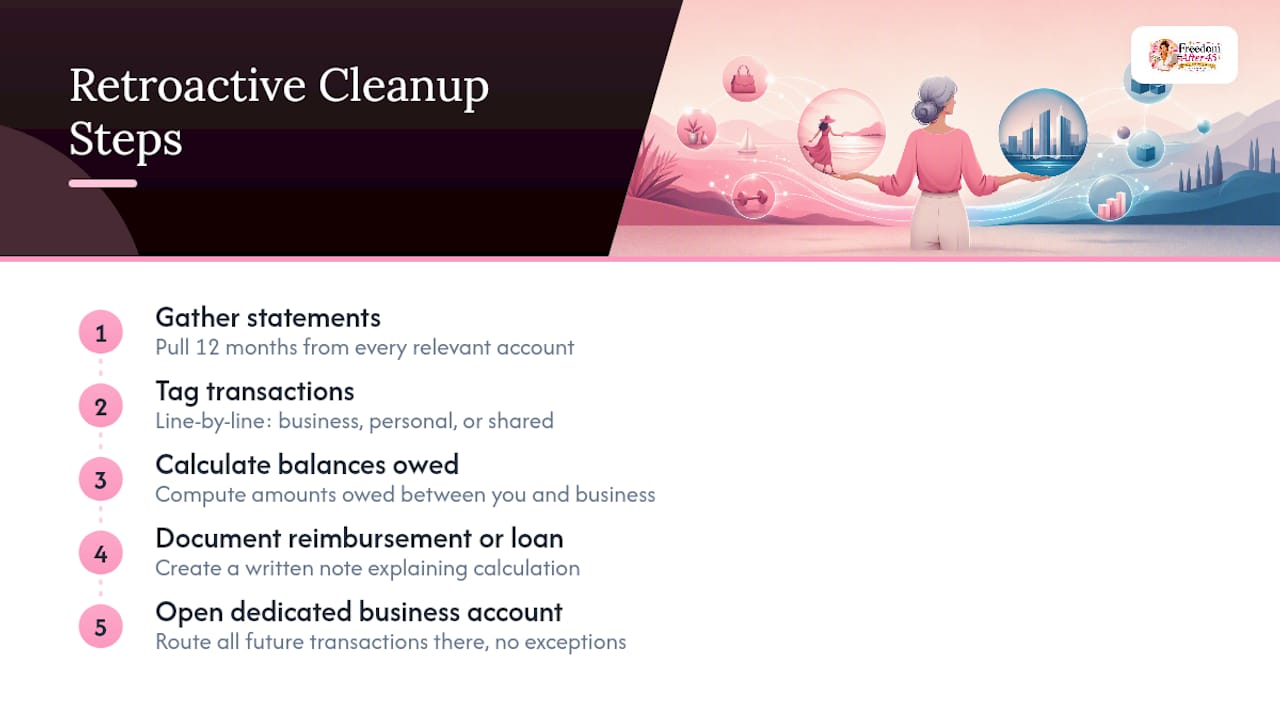
Once transactions are tagged, calculate any amount the business owes you (or you owe the business) and record it as a formal reimbursement or loan, with a written note explaining the calculation. Then open, if you haven’t already, a dedicated business account and start routing everything forward from today with zero exceptions.
Going forward, set a hard rule: no more temporary mixing, ever, even for a single transaction. The BBB notes that short-term use of a personal account only stays safe when every transaction is logged and reconciled immediately; treat that as your minimum standard, not an occasional habit.
Apps and Tools That Make Separation Easier to Maintain
Cloud accounting platforms with automatic bank feeds do most of the heavy lifting once they’re set up correctly. QuickBooks outlines a six-step process built around exactly this: open dedicated accounts, connect them to bookkeeping software, and let monthly routines carry the rest.
Beyond core bookkeeping software, a few tool categories close the remaining gaps. Receipt scanning apps eliminate the shoebox-of-paper problem by photographing and filing receipts the moment a purchase happens. Mileage tracking apps solve the shared-vehicle allocation problem automatically instead of relying on a paper log you’ll forget to fill in.
Simple invoicing tools, even basic ones, keep client payments flowing into the right account with a paper trail attached. And a shared digital folder, whether through cloud storage or your bookkeeping platform’s document feature, keeps formation paperwork, contracts, and statements in one place instead of scattered across drawers and inboxes.
None of these require a technical background to run. The goal is a system simple enough that you’ll actually keep using it in month eight, not just month one.
Freedom After 45’s Take: Why Financial Boundaries Free Up Your Time
A clean finance routine isn’t busywork. It’s what lets you spend your energy on income, not cleanup. Once your bank feed, receipts, and monthly close are running on autopilot, you stop losing hours each week untangling what belongs where.
That’s the real payoff for anyone building a short-hour income system: predictable finances protect predictable time. Freedom After 45 built its 2-Hour Workflow around that same principle, structured daily steps instead of open-ended guesswork. Pair your finance routine with your income activity: a weekly 30 to 60 minute finance check, same day every week, alongside the two hours you’re already committing elsewhere.
— Freedom After 45
Want a Guided System Instead of Building One From Scratch?
Everything above works if you build and stick with it, but not everyone wants to assemble a financial system alone while also building an income stream. That’s a real tradeoff, not a knock on the checklist.

The system offers a structured, step-by-step blueprint designed for women who want a repeatable daily workflow instead of juggling separate tools. It includes video instruction, case studies, and community support to help you avoid troubleshooting alone late at night. The program pairs naturally with the finance habits in this article: once your business account and monthly close are running, the same two hours a day can go entirely toward the workflow itself instead of getting split between income work and financial cleanup. If a done-for-you structure sounds like the better fit for where you are right now, check out the 2-Hour Workflow and see whether it matches how you want to work.
Sources
- SBA guidance on launching your business (entity and finance separation)
- Business bank accounts vs personal bank accounts | Citi
- BBB: How to separate business and personal finances
- How to separate business and personal finances in 6 steps | QuickBooks
- Why and how to keep your personal and business finances separate | Bank of America
FAQ
Do I need an LLC to separate business and personal finances?
No. You can separate finances as a sole proprietor by opening a dedicated business account and tracking expenses consistently, though an LLC adds liability protection an EIN and business account alone don’t provide.
What’s the fastest first step if I’ve never separated anything?
Open a business checking account this week and stop using personal cards for any new business expense starting immediately, then work backward through your existing habits.
How often should I reconcile business and personal accounts?
Monthly, right after your bank statement closes; a short repeatable close beats an occasional marathon bookkeeping session, according to QuickBooks.
Can I fix months of mixed transactions after the fact?
Yes. Pull your statements, tag every transaction as business, personal, or shared, record any owed reimbursement formally, then start a dedicated account going forward with no exceptions.
Does separating finances actually help with taxes?
Yes; separated records make deductible expenses easier to substantiate and reduce the risk of errors that can trigger closer scrutiny during a filing or audit.