

Service Income for New Entrepreneurs: A 2-Hour Blueprint
Service-based income is your cash engine and your market research lab as a new entrepreneur. It converts existing skills into revenue this week, with no audience and no startup capital required. As CEOtudent’s revenue-stack analysis puts it:
That is the role of service-based income for new entrepreneurs in one sentence: it funds your early months and tells you exactly what to build next. The EarningDaily.net 2-Hour Workflow is built on this exact sequence, and Freedom After 45 uses it as the foundation for helping women 45+ reach daily income without starting from scratch.
Table of Contents
- Why service income matters most for women entrepreneurs 45+
- What service income actually is, and the myths that trip people up
- How do you turn active service work into passive income?
- Your 90-day, 2-hours-per-day blueprint
- Startup costs, realistic timelines, and U.S. tax basics
- Which KPIs should you track each week?
- Real examples of women who made the transition
- What to do in the next 2 hours
- Key Takeaways
- What Freedom After 45 wants you to know
- The 2-Hour Workflow: a guided path to daily income
- Useful sources
Why service income matters most for women entrepreneurs 45+
Your decades of work experience are not baggage. They are your fastest path to a paying client.
- Speed to cash. A service offer can go from idea to first invoice in days. No product to build, no inventory, no waiting.
- Near-zero startup cost. Many service businesses launch with a laptop, a free scheduling tool like Calendly, and a simple PayPal or Stripe account.
- Experience as leverage. At 45+, you already have domain knowledge someone else will pay for: writing, bookkeeping, HR, design, coaching, nutrition, project management.
- Immediate client feedback. Every client session tells you what the market actually needs, which is information no survey can replicate.
- Flexible hours. A couple of focused hours daily can be sufficient to serve clients and document your process for later productization.
According to Azgari Foundation’s analysis, service businesses can launch with relatively low startup costs and often reach profitability within a few months. Many niches hit six figures within 12 months.
What service income actually is, and the myths that trip people up
Service-based income is money earned by delivering a skill or outcome directly to a client. The revenue formula is simple: Time × Rate × Capacity. You trade hours for dollars, which means income is capped by how many hours you can work.
That ceiling is the source of the biggest misconceptions.
- Myth: “Service income is passive.” It is not. It is active by design. SelfEmployedIdeas.com’s model guide is clear: passivity requires a deliberate transition through productization, retainers, or delegation.
- Myth: “I need an audience or capital first.” Wrong order. Services fund the audience-building phase.
- Myth: “One good client is enough.” One client supplying more than 30% of your revenue makes your business fragile. Diversify early.
Pro Tip: Design for leverage from day one. Write a simple process document after every client delivery. That document becomes your future course, template, or training, and it costs you nothing extra to create.
How do you turn active service work into passive income?
Client work reveals the exact problems worth solving at scale. Here are three practical paths.
Model A: Productize a repeatable service
Package a recurring service into a fixed-scope, fixed-price offer. A bookkeeper who spends three hours every month on the same cleanup task can sell that as a $297 monthly package instead of billing hourly.
2-hour starter task: Write out every step you take to deliver your most common service. That document is your first Standard Operating Procedure and the skeleton of a future course.
Model B: Turn client sessions into a digital product
Capture the problem you solve most often in client work and build a template, guide, or short video course around it. AI tools now collapse the cost of building digital products, making this path realistic for a solo operator on a tight budget.

2-hour starter task: Record yourself solving a client problem on Loom. That raw video is your first digital product draft.
Model C: Move to recurring retainers or a subscription community
Offer a monthly outcome instead of a one-off project. A career coach who charges $500 per session can offer a $350/month retainer covering two calls and unlimited email support.
2-hour starter task: Write a one-page monthly offer tied to a single measurable outcome. Send it to your two most satisfied clients this week.
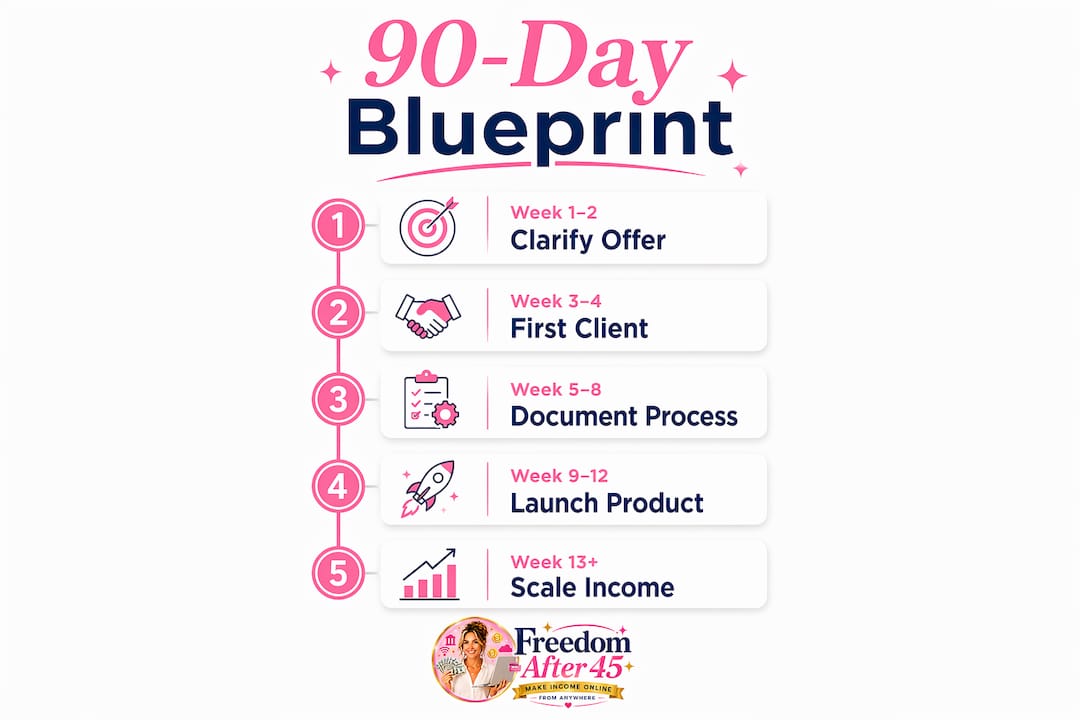
Your 90-day, 2-hours-per-day blueprint
| Week | Focus | Weekly KPI |
|---|---|---|
| 1–2 | Clarify your offer and price it | Offer written and priced |
| 3–4 | Outreach to 10 warm contacts | First paid client signed |
| 5–6 | Deliver and document the process | SOP draft complete |
| — | Raise rate or add a second client | 2 active clients |
| 9–10 | Build first digital asset (template or guide) | MVP product drafted |
| 11–12 | Soft launch product or retainer offer | First non-service dollar earned |
30-day milestone: First paying client, $500–$2,000 earned depending on your rate.
60-day milestone: Two clients, repeatable process documented, $1,500–$4,000 cumulative.
90-day milestone: First passive asset live or retainer signed. Solopreneur benchmarks indicate a broad range of annual earnings with substantial variability; consistent effort can result in meaningful income. Your 90-day slice of that range is realistic with consistent two-hour daily sessions.
The single most important weekly KPI: Did you move one step closer to a paying client or a completed product? Everything else is noise.
Startup costs, realistic timelines, and U.S. tax basics
| Item | Estimated Cost |
|---|---|
| Basic tools (Zoom, Calendly, Google Workspace) | $0–$30/month |
| Simple website or landing page (Carrd, Squarespace) | $0 monthly |
| Total monthly overhead | $0–$100 |
The timeline to first sustainable monthly income is typically a few months for most service niches, according to Azgari Foundation data. Partial passive conversion typically happens in months 6–12 once a repeatable process is documented.
U.S. tax checklist for new solopreneurs:
- Apply for an EIN at IRS.gov (free, takes five minutes).
- Pay estimated quarterly taxes (April, June, September, January) to avoid penalties.
- Track every deductible expense: home office, software, phone, professional development.
- Collect a W-9 from any contractor you pay over $600; issue a 1099-NEC by January 31.
- Consult a CPA or enrolled agent before your first tax filing. State rules vary significantly.
This article is general information, not tax or legal advice. Confirm current rules with a qualified tax professional for your specific situation.
Which KPIs should you track each week?
- New paying clients: Are you adding at least one per month in the first 90 days?
- Client concentration: No single client above 30% of revenue. Exceeding that threshold means prioritizing new outreach immediately.
- Average project value: Track whether your rates are rising over time.
- Utilization rate: Hours billed versus hours available. Above 80% signals you need to raise prices or delegate.
- Conversion rate: How many outreach messages turn into paid work? Below 10% means refining your offer or targeting.
- Recurring revenue ratio: What percentage of income renews automatically each month? Growing this number is the whole game.
Track these six numbers in a simple spreadsheet. A weekly 10-minute review is enough to catch problems before they compound.
Red flag: If one client exceeds 30% of your revenue, stop taking new work from them and send five outreach messages to new prospects that same week.
Real examples of women who made the transition
These are anonymized outcomes based on patterns common to service-to-passive transitions.
The consultant who productized. A 52-year-old HR consultant charged $150/hour for compliance reviews. She documented her 12-step audit process, packaged it as a $497 self-guided toolkit, and sold 11 copies in the first month without a single new client call.
The coach who moved to retainers. A career coach, 48, replaced six one-off sessions per month with three $400/month retainer clients. Her income stayed flat but her hours dropped by 40%, freeing time to build a group program.
The designer who launched a template pack. A 55-year-old graphic designer captured her five most-requested social media layouts, priced the pack at $37 on Gumroad, and averaged $600/month in passive sales within 90 days.
These are not outliers. They are the natural result of applying the productize-retain-delegate sequence deliberately.
What to do in the next 2 hours
- Minutes 0–30: Write one sentence describing who you help, what you help them do, and what result they get. That is your offer.
- Minutes 30–60: Set a price. A reasonable starting rate for most professional services is $75–$150/hour or a fixed project fee of $300–$1,000.
- Minutes 60–90: List 10 people who already know and trust you: former colleagues, neighbors, LinkedIn contacts.
- Minutes 90–120: Send this message to the top three on your list:
That message has no hard sell. It asks for a referral or a conversation, both of which feel easy to say yes to.
Key Takeaways
Service-based income is the fastest, lowest-cost path for new entrepreneurs to generate cash flow and gather the market intelligence needed to build lasting passive assets.
| Point | Details |
|---|---|
| Services fund everything else | Use service income as operating cash to build your first digital product or retainer offer. |
| Active, not passive by default | Passivity requires deliberate productization, retainers, or delegation — it does not happen automatically. |
| 90-day focus | Aim for a first paying client by week 4, a documented process by week 6, and a passive asset launched by week 12. |
| Watch client concentration | Keep any single client below 30% of revenue to avoid fragility. |
| Freedom After 45 path | The 2-Hour Workflow at EarningDaily.net maps directly to this 90-day blueprint for women 45+. |
What Freedom After 45 wants you to know
Your experience is not a liability. At 45+, you have something most new entrepreneurs spend years trying to build: credibility, judgment, and a network that trusts you. The two-hour daily commitment is not a compromise. It is a design choice that protects your energy while building something real.
You do not need a social media following. You do not need a product on day one. You need one paying client and a willingness to document what you do. That is the whole starting point.
Try the 2-hour starter session from Section 9 today. Not tomorrow. The outreach message takes 10 minutes to send, and the first yes changes everything.
The 2-Hour Workflow: a guided path to daily income
Most of what this guide covers, you can do on your own. But if you want a structured, step-by-step system that removes the guesswork and gives you video lessons, fill-in templates, and a community of women doing the same work, the Freedom After 45 program is built for exactly that.

The 2-Hour Workflow at EarningDaily.net walks you through the same 90-day sequence described here, with daily video lessons short enough to complete before your morning coffee is cold. The program targets daily income in the $100–$1,400 range and requires no prior audience, no product, and no technical background. It is designed for women 45+ who are serious about financial independence and have two hours a day to invest in it.
Visit EarningDaily.net and start the first module today.
Useful sources
- CEOtudent: The One-Person Business Revenue Stack — The source for the revenue-stack framework and the rationale for starting with service income. Useful for understanding how to layer income streams.
- SelfEmployedIdeas.com: Service-Based Self-Employment — Covers the active-to-passive transition models and the mechanics of productization and retainers.
- Goal Group: Solopreneur Income Report — Real revenue benchmarks by percentile and the client-concentration risk framework.
- Azgari Foundation: What Is a Service-Based Business? — Startup cost ranges and profitability timelines for service businesses.
- itshifting.co.uk: Service-Based Business Guide — The insight that client work reveals the exact problems worth productizing.
- EarningDaily.net: 2-Hour Workflow — The program this guide is built around; includes video lessons, templates, and community support for women 45+.
For state-specific tax questions, consult a licensed CPA or enrolled agent. Case studies in this guide are anonymized composites reflecting common transition patterns. Program outcomes vary by individual effort and market conditions.