
Reach $1,000/Month: Match Time or Capital to Passive Income 2026
If you have cash sitting in a checking account, start with high-yield savings and dividend ETFs. If you have time or a skill nobody’s paying you for yet, prioritize a digital product or one creator stream. Cash yields are still elevated heading into 2026, which makes the capital route unusually easy for people who have money but no spare hours. The rest comes down to picking one lane and actually finishing it.
TL;DR:Achieving $1,000 in monthly passive income generally requires around $300,000 invested at a 4% yield, making savings and dividend ETFs best as supplements.Building creator streams like digital products or affiliate marketing typically takes six to twelve months of consistent effort before generating steady income.Tax treatment varies: dividend and interest income usually require no Schedule C, while digital sales and courses are considered self-employment income, demanding careful tax planning.Starting with one capital-based stream alongside a creator project helps manage risk and balance effort until each becomes stable.A structured, step-by-step system like the 2-Hour Workflow can streamline the process, especially for women over 45 seeking proven guidance without extensive research.
Table of Contents
- Best Passive Income Ideas for 2026, Ranked by Startup Type
- How to Choose the Stream That Fits Your Capital, Time, and Risk Tolerance
- What It Actually Takes to Reach $1,000 a Month
- Tax Basics That Change How You Plan
- Where a Guided System Fits Into This Plan
- The Honest Take on Passive Income in 2026
- A Guided Path if You’d Rather Not Build the Plan Alone
- Sources
Best Passive Income Ideas for 2026, Ranked by Startup Type
The mistake most people make with passive income ideas for 2026 is trying to chase everything at once. Pick based on what you actually have: money, time, or an audience you can build. Here’s how the strongest options break down.
High-yield savings and cash products. Startup cost is whatever you can deposit, even $500. Money hits your account the same month, since interest posts monthly. Top accounts were paying roughly 4.00 to 4.50% APY going into 2026, which is high by historical standards for a product with zero risk of principal loss. Maintenance is essentially zero. The catch: rates move with the Federal Reserve, so today’s 4.3% could be 3.5% a year from now.
Treasury bills and CD ladders. You need at least a few hundred dollars per rung, and laddering four to six T-bills across different maturities takes an afternoon to set up through TreasuryDirect or a brokerage. First payout depends on the term you pick, often four, thirteen, or twenty-six weeks. Yields track short-term rates closely, similar to savings accounts. Good for money you don’t need for a defined window and want locked away from your own impulse spending.
Dividend stocks and ETFs. Plan on at least $1,000 to $2,000 to make the payouts meaningful, though you can start with less. First dividend check typically lands within one to three months of purchase, depending on the fund’s distribution schedule. Broad dividend ETFs and equity REITs have paid out yields averaging close to 3.98% in early 2026, though individual REIT sectors swing well above or below that. Maintenance is low, review quarterly, rebalance yearly. Market risk is real: your principal moves with the stock market, and a downturn can cut both share value and payout at the same time.
REITs and real estate syndications. Publicly traded REITs work like the dividend ETFs above. Private syndications need more capital, often $10,000 to $25,000 minimum, and lock your money up for three to seven years. First distribution usually arrives quarterly once the property is generating rent. Illiquidity is the trade you’re making for potentially higher yield.
Securities lending programs. Some brokerages let you lend out shares you already own to short sellers and pocket a fee, with payouts varying widely by asset demand. No extra capital required if you already hold the shares. It’s genuinely passive, but the income is unpredictable and concentrated in a handful of heavily shorted stocks.
Digital products. Templates, spreadsheets, Notion packs, and ebooks cost little beyond your time, maybe $50 to $200 for design tools and a sales page. First dollar can come within weeks of launch if you already have any following. Without one, plan on months. This is the lowest-capital entry point on this list, but distribution, not creation, is what actually determines whether it earns anything.
Online courses. Higher upfront time cost than a simple digital product, often four to eight weeks to build a decent course, but higher price points ($50 to $500) mean fewer sales cover more ground. Works best when you already teach or explain something well.
Affiliate marketing and newsletters. Near-zero startup cost. The problem is patience: most affiliate sites and newsletters take six to twelve months of consistent publishing before commissions become noticeable. Once an audience exists, maintenance is light: content updates and link checks.
Licensing creative assets. Photos, music, fonts, or design elements uploaded to marketplaces. Startup cost is your existing creative work; income per license is small but accumulates. Slow to start, genuinely passive once a catalog exists.
Niche content sites and automated YouTube channels. Requires either your own writing/editing time or a budget to pay for both, often $500 to $2,000 to get a channel or site to publishable volume. Ad revenue and affiliate income typically take six months or more to become steady.
Print-on-demand and KDP. Low upfront cost, mostly design and account setup time. First sale can happen within days of listing, but scaling to real income means publishing dozens of designs or books, not one or two.
P2P lending and crowdfunding platforms. A few hundred dollars gets you started. Returns are quoted higher than savings accounts but carry real default risk, and platform risk (the company itself failing) is a factor most beginners underweight.
How to Choose the Stream That Fits Your Capital, Time, and Risk Tolerance
Don’t try to run five of these at once. Three steps get you to a real decision faster than any amount of research will.
- Assess what you actually have. Write down spare capital, spare hours per week, and how soon you’d need that money back if an emergency hit. This single exercise eliminates most of the options above immediately.
- Pick one or two complementary streams. Pair something capital-based (savings, ETFs) with something time-based (a digital product or newsletter) so a slow month in one doesn’t sink your whole plan.
- Set milestones and automate what you can. A recurring transfer into savings, a scheduled newsletter send, an auto-reinvest setting on dividends. Passive income stays passive only when the mechanics run without you.
Before committing, ask yourself: How much capital can I actually risk without touching rent money? How many hours per week can I sustain for six months, not just one excited weekend? Do I need this money liquid, or can it sit for a year? What tax bracket am I in, and does that change which vehicle makes sense?
Watch for red flags on any platform or program: pressure to fund it with a personal loan or credit card, promises of “guaranteed” returns above what savings accounts pay, and fee structures that aren’t disclosed upfront. Ramsey Solutions specifically warns against taking on debt to chase passive income, and that advice holds regardless of how good the opportunity sounds.
Pro Tip: Start the capital-based stream first, even with a small amount, while you build the creator or content stream in parallel. The savings account starts earning the day you open it; the newsletter takes months to earn anything at all.
What It Actually Takes to Reach $1,000 a Month
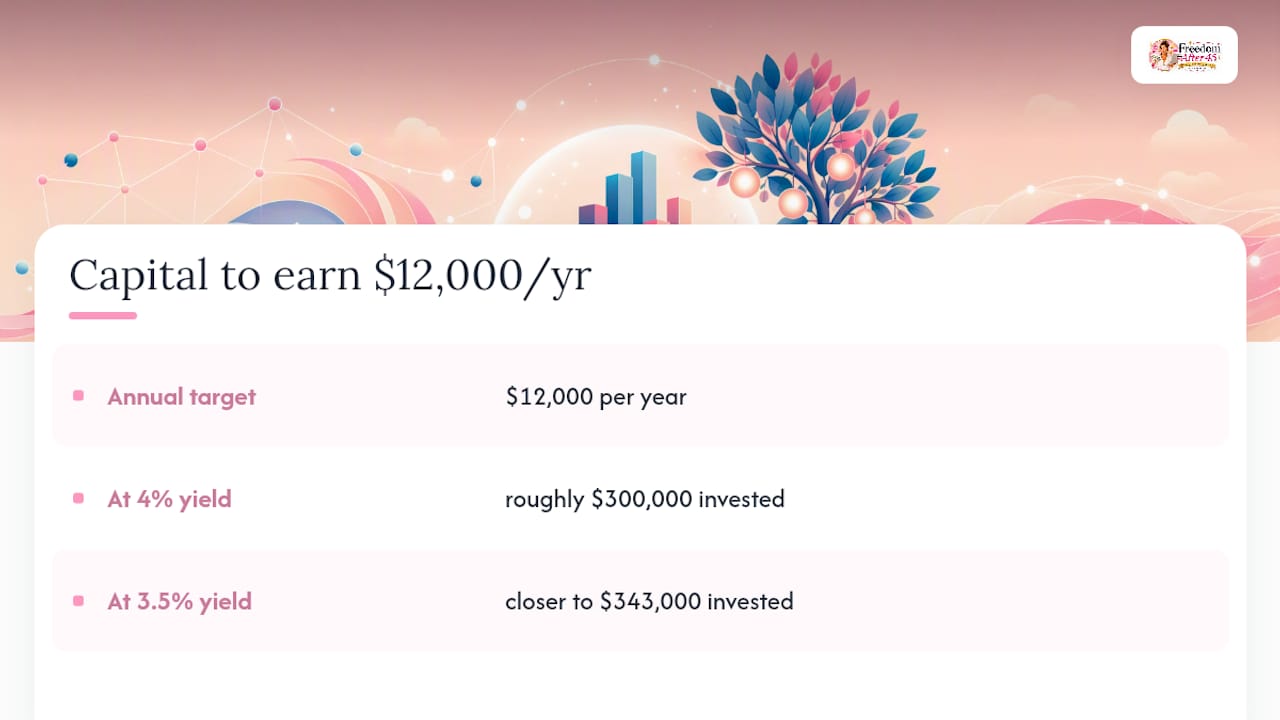
The math on capital-based streams is unforgiving but predictable. At a 4% yield, generating $1,000 a month ($12,000 a year) requires roughly $300,000 invested. At 3.5%, you’d need closer to $343,000. That’s why cash and dividend income work best as a supplement to other income, not a standalone plan, unless you’re already sitting on significant savings.
Creator-based streams follow a different curve. Most people see their first dollar within a few weeks of launching a digital product or affiliate link, but reaching a reliable $500 to $1,000 a month per stream typically takes six to twelve months of consistent publishing or promotion. The gap between “first dollar” and “steady income” is where most people quit, usually right before momentum builds.
Stacking two or three streams and reinvesting the proceeds compounds faster than any single stream alone. A dividend account funded partly by newsletter income grows on two tracks at once instead of one.
Tax Basics That Change How You Plan
The IRS treats passive income differently depending on the source, and getting this wrong creates surprises come April.
- Rental real estate has its own passive-activity rules and exceptions, detailed in IRS Publication 925, including limits on how losses offset other income.
- Dividend and interest income usually arrives on a 1099-DIV or 1099-INT; brokerage-managed accounts rarely require Schedule C.
- Affiliate income, digital product sales, and course revenue are typically self-employment income reported on Schedule C, not passive income in the IRS sense, even though it feels passive to you.
- If you expect to owe more than $1,000 in tax on this income, the IRS requires quarterly estimated tax payments.
- Open a separate bank account for any income-producing side project, track expenses from day one, and get an EIN if you’re selling products under a business name rather than your own.
- A CPA is worth the cost once you’re running more than one income stream or your side income crosses a few thousand dollars a year.
Where a Guided System Fits Into This Plan
Not everyone wants to research eleven options and build a spreadsheet before starting. That’s the gap Freedom After 45 built its 2-Hour Workflow to fill: a step-by-step blueprint for generating income online in roughly two hours a day, without needing an existing following or a product already built.
It suits someone who wants structure more than open-ended research, someone willing to commit focused daily time rather than a single big cash outlay. Results vary by effort and consistency, and the setup work still takes real hours in the first weeks. and round out the program’s track record. The landing page walks through the specifics; the promo section below covers how to get started.
The Honest Take on Passive Income in 2026
Most advice on this topic treats every stream as equally accessible, and that’s the biggest lie in the space. A retiree with $300,000 in savings and a 24-year-old with two free hours a night are not solving the same problem, and pretending otherwise is why so many people quit three weeks into a newsletter that was never going to pay rent anyway.
The conventional wisdom oversells speed. Nobody tells you that six to twelve months of unpaid effort is normal for a creator stream, so people expect month two results and walk away right before the curve bends upward. The math on capital-based income gets skipped too: needing $300,000 to generate $1,000 a month at 4% is a real number, not a footnote, and it should reframe how people think about savings accounts as a “strategy” versus a supplement.
What actually works is smaller and less exciting than most guides admit: pick one stream that fits your actual resources, run it for a full year before judging it, and stack a second one only once the first is stable.
— Freedom After 45
A Guided Path if You’d Rather Not Build the Plan Alone
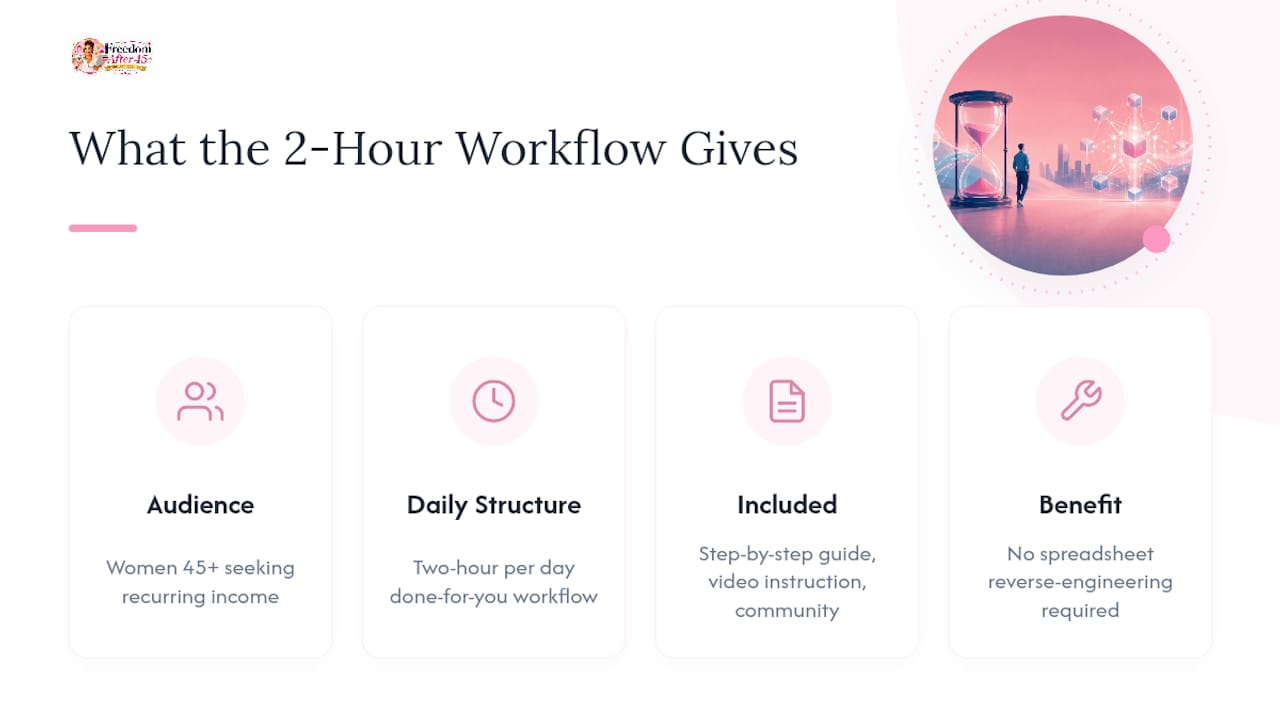
Freedom After 45 exists for exactly the reader who finished this article and thought, “I understand the options now, but I don’t want to build the spreadsheet myself.” The 2-Hour Workflow is a done-for-you system, not another list of options to research: it hands you the daily two-hour structure instead of asking you to reverse-engineer one from scratch.

It fits women over 45 who want a recurring income stream without needing an existing following, a product, or years of trial and error to figure out what works. If the tax rules, yield math, and timeline honesty in this piece felt like a lot to manage solo, that’s precisely the gap the blueprint closes: a step-by-step guide, video instruction, and a community of people running the same system. Get the full 2-Hour Workflow breakdown and see whether the setup fits your two free hours a day.
This article is general information, not a substitute for advice from a qualified financial advisor. Consult a qualified financial professional about your own circumstances before acting on anything here.
Sources
For rules on passive-activity losses and rental income, IRS Publication 925 is the primary reference. Anyone selling products or setting up a side business should review the SBA’s business planning guide before registering anything. If you’re allocating money to ETFs, dividend stocks, or lending programs, FINRA publishes investor-education material on brokerage safety and product risk that’s worth thirty minutes of reading before you commit real capital.
- Publication 925 (Passive Activity and At-Risk Rules) — IRS