

Passive Income for Women Over 45: What Actually Works
The best passive income for women over 45 falls into five practical categories: digital products (printables, templates, e-books), dividend and index fund investing, REIT funds, small online courses, and licensed content like stock photography. Most require a low to moderate startup cost, and a focused two hour daily workflow can produce first sales or dividend payouts within a few weeks to a few months.
Here’s the quick breakdown before you dig into specifics:
- Digital products and printables: $0–$50 to start, first sale in 2–8 weeks
- Dividend stocks and index funds: $100–$1,000+ to start, income begins with your first payout cycle
- REIT funds: $500+ to start, quarterly distributions
- Small online courses or templates: $0–$100 to start, first enrollment in 30–60 days
Pro Tip: The women who succeed fastest pick one idea and commit two focused hours a day to it for 90 days, rather than testing five ideas for two weeks each. Realistic timelines for printables, templates, and marketplace sales tend to run 30 to 90 days to first income, which lines up with what a consistent two hour daily system, like the one Freedom After 45 teaches, is built to deliver.
Key Takeaways
Consistent two-hour daily effort applied to one well-chosen idea, digital products, dividend investing, or a structured system, produces measurable income faster than scattering time across five untested ideas.
| Point | Details |
|---|---|
| Start with low-cost ideas first | Printables, templates, and e-books need $0–$100 and can produce sales in 2–8 weeks. |
| Match the idea to your capital | Save dividend investing and REITs for when you have $500 or more to commit. |
| Automate early | Set up dividend reinvestment, scheduled posts, or email sequences so income keeps flowing without daily input. |
| Know your tax category | Passive and portfolio income are taxed differently under IRS rules, so check with a tax professional before scaling. |
| Follow a structured system | Freedom After 45’s 2-Hour Workflow blueprint gives women 45+ a step-by-step path to $100–$1,400 daily income without needing an existing audience. |
Table of Contents
- Best Passive Income Ideas for Women 45+: A Ranked Starter List
- How to Pick One Idea and Launch It in 90 Days
- Why the 2-Hour Workflow Approach Actually Works
- Passive Income and Taxes: What the IRS Actually Says
- The Financial Gap Women Face and Why It Shapes Strategy
- Where to Find Support and Community
- Fitting Passive Income Around Caregiving and Everything Else
- Common Mistakes Women Entrepreneurs Make (and How to Dodge Them)
- Use What You Already Know
- What I’d Tell a Friend Starting This at 50
- Ready to Follow a Proven Two-Hour System?
- Sources
Best Passive Income Ideas for Women 45+: A Ranked Starter List
Not every idea on this list deserves equal attention. Some fit a woman with $50 and two hours a day. Others fit someone with $5,000 sitting in savings who wants it working harder. Here’s how they stack up.
- Printables and digital templates on marketplaces. Startup cost: $0–$50. First sale: 2–6 weeks. Income band: $50–$500/month once you have 10–20 listings. Best for organized, detail-oriented women who already make planners, checklists, or budget trackers for themselves.
- Dividend-paying stocks and index funds require an initial investment. Income begins with your first dividend payout cycle, which may take a few months. Returns are typically modest initially and can grow over time. Dividend reinvestment plans let payouts buy more shares automatically, which is the closest thing to true “set it and forget it” income on this list. Best for women with existing savings and a five-year-plus horizon.
- REIT funds usually need higher startup investment and often distribute income quarterly. Yields can vary based on market conditions. Best for women who want real estate exposure without landlord duties.
- Low-effort digital products (templates, planners, spreadsheets). Startup cost: $0–$100. First sale: 2–8 weeks. Best for former teachers, project managers, or anyone who’s built a system at work that other people would pay to copy.
- E-books. Startup cost: $0–$200 (cover design, editing). First sale: 30–60 days. Income band: $20–$300/month per title. Best for women with a story, a niche skill, or professional expertise worth writing down.
- A mini online course or workshop. Startup cost: $0–$100. First enrollment: 30–60 days. Best for anyone who’s trained, coached, or mentored others informally, since that experience shortens the learning curve dramatically.
- Stock photography and licensing can start with little to no upfront cost if existing equipment is available. Initial sales may take several weeks to a few months. Best for hobbyist photographers who already have a folder of unused images.
- Affiliate income via a focused blog or Pinterest. Startup cost: $0–$50. First commission: 60–90 days. Best for patient women willing to publish consistently for a few months before seeing any return.
- Membership or micro-subscription communities. Startup cost: $0–$50. First subscriber: 30–90 days. Best for women with an existing audience or a very specific niche they can serve deeply.
- Renting out equipment, space, or items can have minimal startup cost if assets are already owned, with rentals often beginning within days to weeks. Best for anyone with underused assets like a spare room, camera gear, or party supplies.
A few practical notes across the board:
- Price digital products between $7 and $27 to start; test higher once reviews build.
- List on more than one marketplace when possible to double your exposure without doubling your work.
- Dividend and REIT income depends on market conditions and isn’t guaranteed.
How to Pick One Idea and Launch It in 90 Days
Choosing is the hardest part. Run each idea through four filters: how much time you actually have, how much capital you’re willing to risk, which skills you already own, and how much risk feels tolerable. A woman with $50 and two hours a day should not start with REIT research. A woman with $5,000 in savings and a demanding caregiving schedule should not start building a course from scratch.
Once you’ve picked, structure each two hour block like this:
- Block one (validation): Research demand. Search your idea on a marketplace, count competing listings, and check what sells. Spend the full two hours here before creating anything.
- Block two (creation): Build the minimum viable version, one printable, one course outline, or one brokerage account setup, not five.
- Block three (listing/publishing): Get it live somewhere real people can find it.
- Block four (promotion): Share it in one place consistently rather than scattering effort across six platforms.
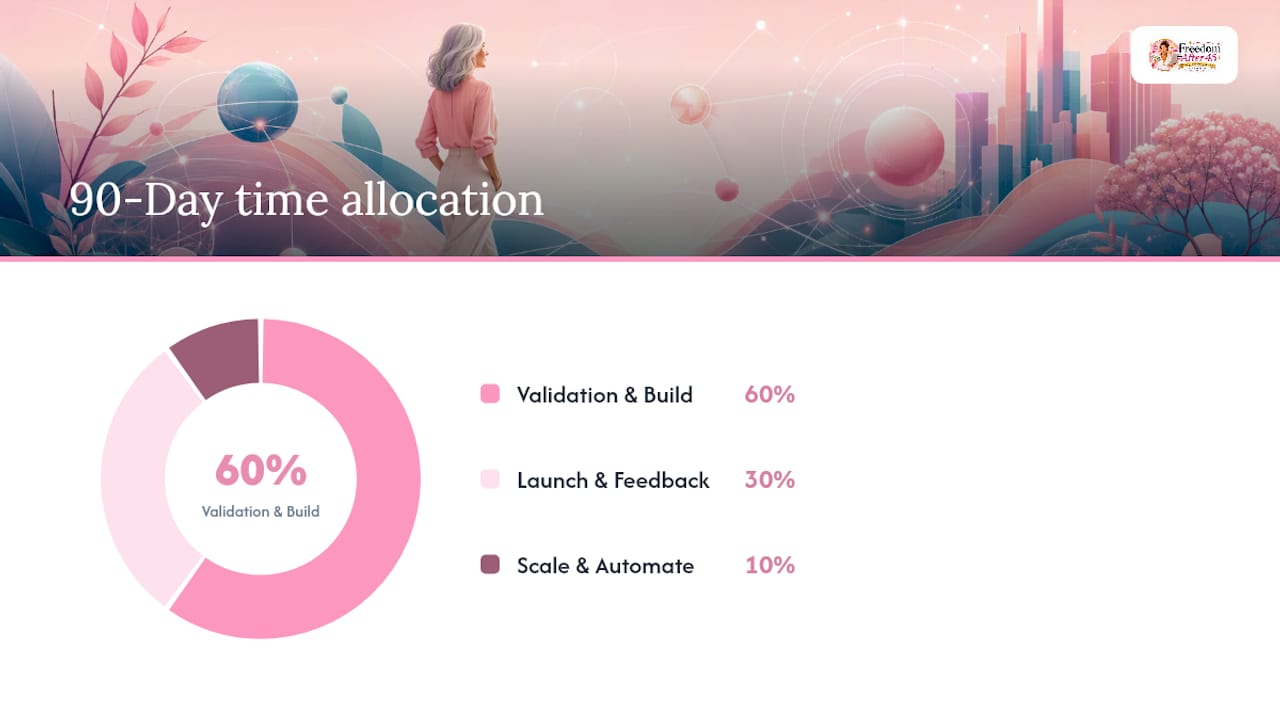
The 90 days break down cleanly. The first 60 percent of your time should go to validating demand and building your first product or investment position. Spend the next 30 percent launching and gathering real feedback. Save the final 10 percent for scaling what worked and automating what you can, whether that’s scheduling social posts, setting up automatic dividend reinvestment, or writing an email sequence that runs without you.
Pro Tip: Outsource the tasks you dread most, cover design, basic editing, or listing photos, to a freelance marketplace for $10 to $30 a task. It buys back hours you’d otherwise burn on frustration instead of progress.
Why the 2-Hour Workflow Approach Actually Works
Most passive income guides hand you a list and wish you luck. Freedom After 45 built something more specific: a step-by-step blueprint targeting daily income between $100 and $1,400, using two hours a day, with no existing social media following or product required.
That last part matters. Most income methods assume you already have an audience or something to sell. This one doesn’t.
The blueprint includes video instructions, real case studies, and access to a community, so you’re not troubleshooting alone at 9 p.m. after a full day of other responsibilities. One anonymized example from the program: a woman starting with zero online experience followed the workflow for eight weeks before seeing her first consistent daily income land in the lower end of that $100 to $1,400 range.
Passive Income and Taxes: What the IRS Actually Says
The IRS treats passive income (rental activity or a business you don’t materially participate in) differently from portfolio income (dividends, interest, capital gains). That distinction affects which losses you can deduct and how income gets taxed, according to Investopedia’s guidance on passive income.
Common early mistakes: expecting month-one profits, underpricing digital products out of fear no one will buy, ignoring tax setup until filing season, and chasing “guaranteed returns” pitches. Get-rich-quick schemes remain a real risk, and realistic first-year earnings are often modest before compounding kicks in. Talk to a tax professional before committing serious capital to investments.
The Financial Gap Women Face and Why It Shapes Strategy
Women over 45 often reach this stage with less saved than men in the same age bracket, a gap built from years of part-time work, career breaks for caregiving, and lower average lifetime earnings. That history doesn’t disappear just because you’re ready to build income now. It shapes which strategies make sense.
It means starting capital is often smaller, which is exactly why low-cost ideas, printables, templates, e-books, deserve top priority over capital-heavy investing for many women in this stage. It also means risk tolerance tends to run lower, understandably, since there’s less time to recover from a bad bet before retirement. Financial advisors recommend blending steady, low-maintenance income sources like dividend stocks and REITs precisely because they don’t require large ongoing time investment or aggressive risk.
There’s also a confidence gap worth naming. Many women were never encouraged to see themselves as investors or business owners, and that history shows up as hesitation, not incapability. The fix isn’t more information. It’s smaller, faster wins that build proof you can do this, which is why starting with a $0 printable often matters more psychologically than it does financially.
Where to Find Support and Community
Building income alone is harder than it needs to be, and isolation is often what causes women to quit three weeks in. Look for a few specific types of support rather than generic “girlboss” content that offers motivation without mechanics.
Women-focused investing groups, often run through brokerage platforms or local financial planning associations, offer a lower-pressure entry point than mixed-gender investing forums, where women report feeling talked over. Small business associations frequently run free or low-cost workshops on digital product sales and basic bookkeeping. Local libraries increasingly host free classes on e-book publishing and small business basics, an underused resource many women over 45 don’t think to check.
Structured programs with built-in community, rather than a course you complete alone, tend to have far higher follow-through rates. That’s part of why Freedom After 45 pairs its video training with an actual community of other women working through the same blueprint. Accountability from people facing the same schedule constraints beats generic encouragement from strangers every time.
Fitting Passive Income Around Caregiving and Everything Else
Caregiving still falls disproportionately on women in their late 40s and 50s, often stacked on top of a job, aging parents, and kids who haven’t quite left the nest. Any income strategy that assumes four uninterrupted hours a day will fail before it starts.

This is exactly why two hours matters more than it sounds like it should. Two hours fits into a lunch break plus an evening pocket, or an early morning before the house wakes up. It doesn’t require rearranging your entire life, which is the real reason most side hustle advice fails caregivers: it’s built for people without competing demands.
Batch similar tasks on the same day. Write five social captions in one sitting instead of one a day. Set up automatic dividend reinvestment once instead of checking your portfolio daily. Automation, not more hours, is what turns effort into something genuinely passive over time.
Common Mistakes Women Entrepreneurs Make (and How to Dodge Them)
The biggest one: underpricing. Many women set prices low out of a fear of asking for too much, then burn out fulfilling high volume at low margin. Price based on the value delivered, not on discomfort with the number.
The second: perfectionism as procrastination. Spending six weeks perfecting a printable nobody’s seen yet delays the only feedback that actually matters, real sales data. Ship the minimum viable version in week one.
Third: treating a side project like a hobby instead of a business, which means skipping the basic bookkeeping and tax setup that would save real money later. Fourth: taking on too much unpaid emotional labor in online communities, answering every question for free instead of pointing to a paid resource. And fifth: comparing your week-two results to someone else’s year-two income, which kills more good ideas than any actual business problem does.
Use What You Already Know
The fastest path to income almost always runs through something you already do well. A former teacher already knows how to build a lesson plan, which is 80 percent of building a mini course. A longtime bookkeeper already understands what a small business owner needs in a budget template.
Packaging existing expertise into a small digital product shortens the learning curve dramatically compared to starting a completely unfamiliar skill from zero. That’s the whole logic behind ranking printables and templates above, say, learning video editing to sell stock footage.
Think about what people already ask you for advice on. That question, more than any market research tool, usually points straight to your first product.
What I’d Tell a Friend Starting This at 50
If you’re waiting to feel “ready” before you start, you’ll wait forever. The women who build real income aren’t the ones with perfect plans, they’re the ones who committed two focused hours and kept showing up. Freedom After 45 exists because that consistency, backed by a clear system, works better than talent or timing ever did.
— Freedom After 45
Ready to Follow a Proven Two-Hour System?
If you’ve read this far, you already know the ideas that work. What’s harder is the structure to actually follow through when you’re juggling caregiving, a job, or just a tired brain at the end of the day. That’s the exact gap Freedom After 45 was built to close: a step-by-step blueprint targeting $100 to $1,400 in daily income using two hours a day, no existing following or product required.

The program includes video walkthroughs, real case studies from women who started exactly where you are, and access to a community that keeps you accountable when motivation dips. Here’s how it maps to what you’re likely looking for:
| What You Need | What the Program Delivers |
|---|---|
| A clear starting point | Step-by-step video blueprint, no guesswork |
| Low time commitment | Built around a 2-hour daily workflow |
| No existing audience | No social following or product required to start |
| Support when you’re stuck | Community access plus documented success stories |
If two hours a day and a real system sound like what’s been missing, see the full 2-Hour Workflow blueprint and find out where you’d start.
Sources
- Best Passive Income Strategies For Women Over 50 Who Want To Retire Rich
- Passive income definition and tax guidance
- 25 Realistic Passive Income Ideas For Women
This article is general information, not a substitute for advice from a qualified financial advisor. Consult a qualified financial professional about your own circumstances before acting on anything here.