

Passive Income Workflow for New Entrepreneurs in 2026
A practical new entrepreneur passive income workflow in 2026 is not about finding a magic shortcut. It’s a structured process: pick a niche, build the right tools around it, automate the repetitive parts, and then stay involved enough to keep quality high. The upfront work is real, and so is the payoff once the system runs.
Before you touch a single tool, clear high-interest debt and build a starter emergency fund. Financial advisors consistently flag this as the step most new entrepreneurs skip, and it’s the one that causes the most damage when an income stream takes three months longer than expected to produce results.
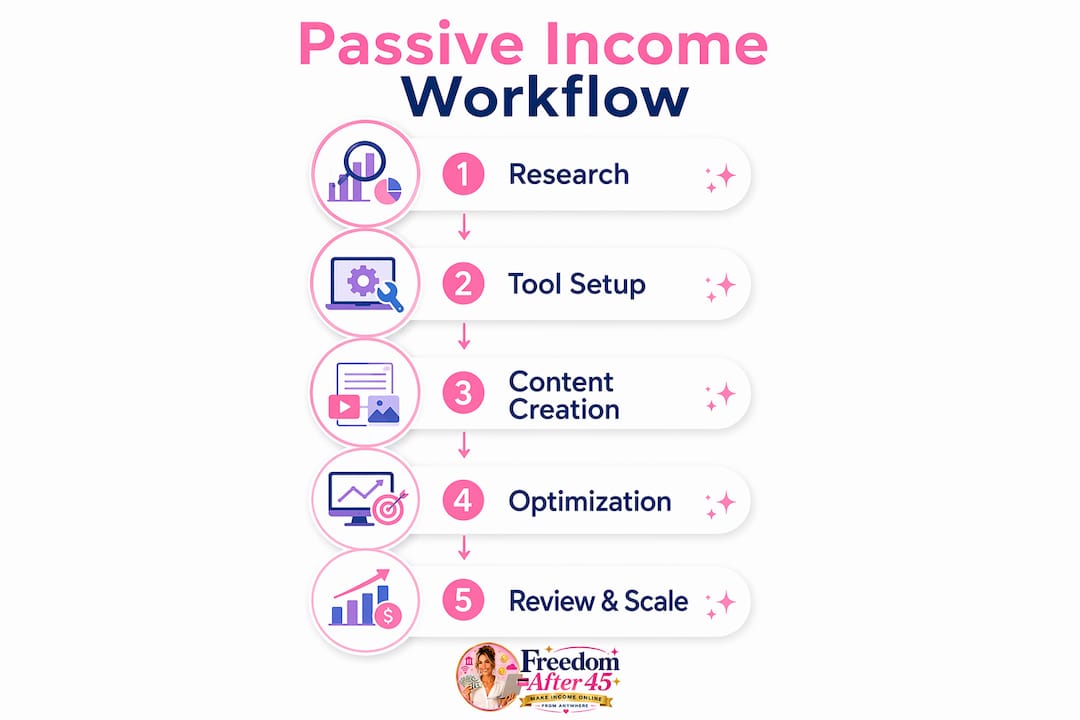
Here’s what a solid passive income workflow looks like at its core:
- Niche selection: Choose a narrow, specific topic with real search demand and manageable competition.
- Research and validation: Confirm the niche has buyers before building anything.
- Tool setup: Connect your automation stack, hosting, and content or product platform.
- Content or product creation: Build the asset once, whether that’s a blog, a digital product, or a micro-SaaS tool.
- Automation: Use tools like ChatGPT, Make (formerly Integromat), Zapier, and Replit to handle repetitive tasks.
- Monetization: Apply for affiliate programs, set up ads, or launch a product from day one.
- Scaling: Track what performs, reinvest in it, and add new streams only after the first one is stable.
Sustainable automated income requires research, tool setup, content creation, and ongoing optimization phases in that order. Skipping phases is the most common reason new entrepreneurs stall out after the first month.
What are the best passive income business ideas for new entrepreneurs?
The strongest passive income models for new entrepreneurs share one trait: they produce an asset you build once and sell or monetize repeatedly. Here are the models worth your attention in 2026.
- AI-powered niche blog: Write articles targeting low-competition keywords in a specific sub-niche. Monetize through display ads, affiliate links, and your own digital products. A blogger running this setup reported earning a consistent daily income from ad revenue on notable monthly sessions.
- Digital products: E-books, templates, spreadsheet dashboards, and short guides sell repeatedly with zero fulfillment cost. A consultant selling a CFO Dashboard Template for Google Sheets reported generating hundreds of passive sales per month once the sales funnel is automated.
- Print-on-demand (POD): Design products using AI image tools, upload them to Merch by Amazon or Redbubble, and collect royalties. No inventory, no shipping.
- Micro-SaaS tools: Use GitHub Copilot or Replit to build a simple web tool that solves one specific problem for a defined audience. A “Local SEO Caption Generator” targeting small businesses in a specific city, priced affordably, reaches a notable monthly revenue with a steady subscriber base.
- Dividend and index fund investing: Once your financial foundation is solid, low-turnover index funds and REITs distribute earnings automatically. Passive income from investments belongs at a later financial stage, after debt is cleared and retirement contributions are consistent.
- Freedom After 45’s 2-Hour Workflow: This program shows how a structured daily workflow, requiring just two hours, can generate $100–$1,400 per day. Thousands of families have used it to build recurring income without needing an existing audience or product.
The key distinction between models that work and models that drain energy is specificity. Broad topics like “smart home devices” are nearly impossible to rank for as a solo creator. A narrow sub-niche like “smart lighting for home offices” gives you a real shot at building topical authority and generating consistent traffic.
How do AI and automation tools actually build passive income?
This is where the workflow gets concrete. AI tools do not replace your judgment. They handle the repetitive, time-consuming parts of production so you can focus on strategy and quality control.

The core automation stack
| Tool | Primary role | Best for |
|---|---|---|
| ChatGPT | Content drafting, ideation, product descriptions | Blogs, digital products, email sequences |
| Jasper AI | Long-form content at scale with brand voice consistency | Niche blogs, affiliate sites |
| Make (Integromat) | Multi-step workflow automation, no code required | Connecting apps, publishing pipelines |
| Zapier | Trigger-based automation between apps | Email sequences, social posting, lead capture |
| Replit | Building and hosting simple web tools and scripts | Micro-SaaS MVPs, automation scripts |
| GitHub Copilot | AI-assisted code generation | SaaS tools, automation scripts |
| Hostinger VPS | Reliable hosting for websites and chatbot backends | Any content or product-based business |
A real automated blogging pipeline, step by step
- A keyword is stored in Airtable with its target topic and status.
- A webhook triggers the Make workflow when you’re ready to produce.
- ChatGPT or Claude generates a full SEO-optimized outline from the keyword.
- The outline converts to structured JSON, keeping headings and meta descriptions organized.
- The AI writes the full article draft using the outline as its guide.
- An image generation tool like DALL-E 3 creates a featured image from the same keyword.
- The draft and image land in Google Docs for human review.
- After approval, the article publishes to WordPress as a live post.
Pro Tip: Never skip the human review step. Mandatory final review in automated content workflows is what separates trustworthy content from the kind that quietly destroys your search rankings over time.
A fully automated digital asset pipeline can run with near-zero daily effort once the architecture is in place. One developer documented a pipeline generating 100 images and 10 products daily through a cron-scheduled script using Python, a Gumroad API, and an image generation service, with roughly four hours of setup and zero hours of daily maintenance. The honest lesson from that project: production is solvable fast. Distribution takes longer.
Starting with simple no-code tools like Zapier or Make is the right move for new entrepreneurs. Complex custom code before you’ve validated your niche is one of the fastest ways to burn out before you see a dollar.
The feedback loop matters as much as the initial setup. A strategy engine that reads performance data before each production run, adjusting which content categories to prioritize and which to retire, is what turns a one-time build into a compounding income system. Analytics are not optional maintenance. They’re the mechanism that makes the whole thing grow.
What legal, tax, and financial steps do new entrepreneurs need to take?
Getting the legal and financial foundation right early costs far less than fixing it later. Here’s what actually matters.
Tax treatment of passive income in the US: The IRS classifies passive income under specific rules. Publication 925 defines passive activity as trade or business activities in which you do not materially participate. Rental income and limited partnership income fall under this classification. Income from a blog, digital products, or a SaaS tool you actively manage typically counts as active self-employment income, not passive under IRS rules, even if it feels hands-off day to day.
Business entity setup: A sole proprietorship is the default for most new entrepreneurs, but an LLC offers liability protection and cleaner separation between personal and business finances. Consult a CPA before choosing, especially if you plan to scale.
Financial practices that protect you:
- Clear high-interest debt before investing time or money in passive income projects.
- Build a three-to-six-month emergency fund before treating any income stream as reliable.
- Never go into debt to chase passive income. Any opportunity requiring a loan or promising fast returns is a trap.
- Keep separate business and personal bank accounts from day one.
- Track all income and expenses with accounting software so tax season does not become a crisis.
Common pitfalls to avoid:
- Launching three income streams at once before any of them are profitable.
- Treating affiliate income as guaranteed before you have consistent traffic.
- Ignoring quarterly estimated tax payments on self-employment income.
- Assuming AI-generated content is automatically compliant with FTC disclosure rules for affiliate marketing.
The affiliate marketing industry has grown substantially, which means the FTC’s disclosure requirements for affiliate links are enforced more actively than they were five years ago. Every affiliate link needs a clear disclosure, and that applies to AI-generated content just as much as anything you write yourself.
How do you build and scale a passive income workflow that actually lasts?
Sustainability comes from discipline about sequencing, not from working harder or adding more tools.

Start with one stream and master it
Financial advisors consistently recommend mastering one passive income source before expanding. The reasoning is practical: splitting attention across three unproven streams means none of them get the focused effort needed to reach profitability. Pick the model that fits your current skills and financial position, build it to a point where it generates consistent revenue, and only then consider adding a second stream.
The metrics that tell you if it’s working
- Monthly recurring revenue (MRR): For subscription-based products or SaaS tools, this is your primary health indicator.
- Organic traffic growth: For content-based models, track monthly sessions and the number of pages ranking in the top 10.
- Conversion rate: What percentage of visitors take the action you want, whether that’s buying, subscribing, or clicking an affiliate link?
- Revenue per article or product: Which specific assets are generating the most income? Double down on those.
- Time investment per dollar earned: As automation matures, this ratio should improve each month.
Overcoming the most common challenges
New entrepreneurs hit the same walls. Traffic takes longer than expected. The first product launch underperforms. The automation breaks and nobody notices for a week. These are normal, not signs that the model is broken.
The goal is not to build one perfect revenue stream. It’s to build several small loops, each generating modest monthly income, that compound into something meaningful over 12–18 months. Timing your governance and automation setup during early planning phases reduces costs and improves long-term workflow success, rather than retrofitting systems after the fact.
Pro Tip: Set a fixed weekly review block of 60–90 minutes to check analytics, review any automation errors, and update your keyword or product pipeline. Treating this as a non-negotiable appointment prevents the slow drift where a broken workflow goes unnoticed for weeks.
Freedom After 45’s 2-Hour Workflow is built around exactly this principle: a defined, repeatable daily commitment that removes the guesswork. Rather than spending hours trying to figure out what to do next, you follow a proven sequence. That structure is what makes the difference between a passive income idea and a passive income system that actually pays out.
Freedom After 45 can help you build your workflow today

If you’re ready to stop researching and start building, Freedom After 45 offers a structured path that has already worked for thousands of families. The 2-Hour Workflow blueprint is designed specifically for people who want real daily income without needing a large following, an existing product, or a technical background. Two hours a day, a clear process, and a system built to generate $100–$1,400 daily.
Key Takeaways
A practical passive income workflow succeeds when it pairs focused niche selection with AI-driven automation, a mandatory human review step, and a single-stream-first approach to scaling.
| Point | Details |
|---|---|
| Build the financial foundation first | Clear high-interest debt and establish an emergency fund before investing in any income stream. |
| Start with one niche and one model | Mastering one stream before expanding prevents burnout and improves resource management. |
| Automate repetition, not judgment | Tools like Make, Zapier, and ChatGPT handle production; human review protects quality and trust. |
| Track five core metrics | Monitor MRR, organic traffic, conversion rate, revenue per asset, and time-per-dollar earned weekly. |
| Distribution beats production | Building the asset is the easy part; getting it in front of buyers is where most workflows stall. |