
Low-Risk Online Business Ideas That Actually Pay Off
The lowest-risk online businesses share three traits: no inventory, no regulatory maze, and a startup cost you can cover without a loan. Digital products (printables, eBooks, templates), online courses, print-on-demand, freelancing, affiliate marketing, and niche content monetization all clear that bar. As a quick selection rule: if you need money within 30 days, start with freelancing or printables on Etsy. If you’re building toward automated income over 6–12 months, an online course or affiliate site is the stronger play.
A word on terminology before diving in. “Passive income” is one of the most misused phrases in personal finance. As Investopedia notes, it more accurately describes income that becomes automated after significant upfront work. Nothing here is effortless. What these models offer is a favorable ratio of effort to long-term return, and the ability to start small without betting your savings.
Top low-risk models at a glance:
- Digital products and printables via Amazon KDP and Etsy
- Online courses on Teachable or Thinkific
- Print-on-demand through Printful or Printify
- Freelancing and consulting using existing expertise
- Affiliate marketing via Amazon Associates and niche content
- Niche blogs and newsletters monetized with Google AdSense
The IRS draws a meaningful line between a hobby and a business. Once you’re generating consistent revenue, you’re expected to report it and pay self-employment tax. Starting with that awareness keeps surprises off the table.
Key Takeaways
The most reliable low-risk online businesses combine low startup costs, no inventory, and a clear path to automated income after an upfront investment of time and effort.
| Point | Details |
|---|---|
| Pick one model first | Choose based on your available hours and whether you need revenue in 30 days or 6–12 months. |
| Keep startup costs low | Most models start under $100; validate demand before spending on ads or premium tools. |
| Run a 30-day test | Set a measurable goal (first sale, 50 listing views) and evaluate before expanding. |
| Follow the legal basics | Report all income to the IRS, disclose affiliate links per FTC rules, and separate business finances. |
| Freedom After 45 | The 2-Hour Workflow provides guided setup for KDP, Etsy, and course platforms for women 45–65. |
Table of Contents
- How these models compare before you commit
- Eight low-risk online business models with 30- and 90-day starter plans
- How to choose the right low-risk idea for your situation
- Startup costs, realistic timelines, and early income ranges
- How to minimize legal and financial risk (U.S.-focused)
- Real-world outcomes and what the 2-Hour Workflow approach shows
- Protecting yourself from common legal and financial risks
- Key metrics and milestones to track for a low-risk online business
- Common pitfalls in low-risk online businesses and how to avoid them
- When to scale and when to pivot your online business
- The case for starting small and staying honest about timelines
- The 2-Hour Workflow: a structured path for women ready to start
- Sources
How these models compare before you commit
The table below maps each model against the six dimensions that matter most when you’re choosing with limited time and money.
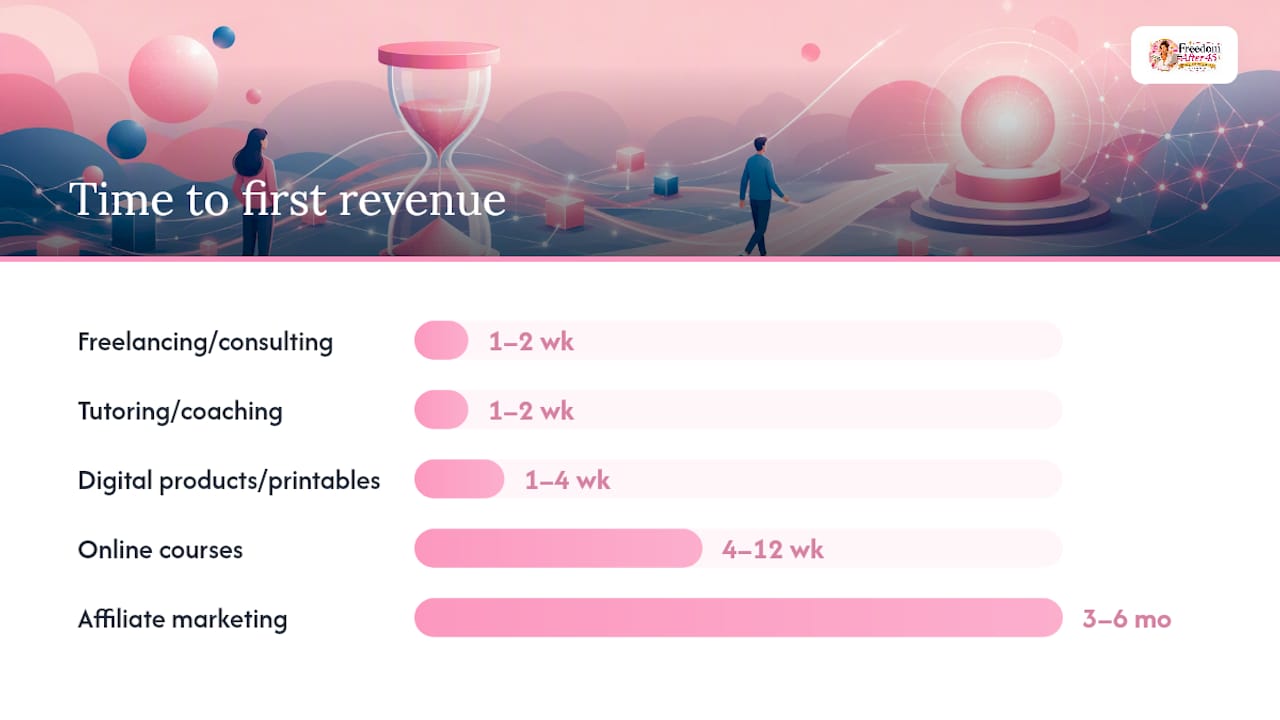
| Model | Startup cost | Time to first revenue | Skills required | Income potential (part-time → scale) | Ongoing maintenance | Automation level |
|---|---|---|---|---|---|---|
| Digital products / printables (Etsy, KDP) | Under $50 | 1–4 weeks | Design or writing basics | $200–$2,000/mo → $5k+ | Low after listing | High |
| Online courses (Teachable, Thinkific) | $50–$300 | 4–12 weeks | Subject expertise, basic video | $500–$1,000/mo → $10k+ | Medium (updates) | High once built |
| Print-on-demand (Printful, Printify + Shopify/Etsy) | $0–$100 | 2–6 weeks | Basic design | $100–$1,000/mo → $5k+ | Low | High |
| Freelancing / consulting (PayPal, Stripe) | Near $0 | 1–2 weeks | Marketable skill | $1,000–$5,000/mo → $15k+ | High (active) | Low |
| Affiliate marketing (Amazon Associates, niche blog) | $50–$200 | 3–6 months | Writing, basic SEO | $200–$1,000/mo → $10k+ | Medium | High |
| Reselling / dropshipping (Shopify) | $100–$500 | 2–8 weeks | Research, customer service | $300–$1,000/mo → variable | Medium | Medium |
| Tutoring / coaching | Near $0 | 1–2 weeks | Domain expertise | $500–$1,000/mo → limited | High (active) | Low |
| Niche content (blog, newsletter + Google AdSense) | $50–$150 | 3–12 months | Writing, SEO | $100–$5,000/mo → $10k+ | Medium | High |
Need money in 30 days? Freelancing, tutoring, or listing printables on Etsy can get you to a first sale quickly. Building toward automated income over 6–12 months? An online course or affiliate content site gives you the better long-term return on each hour invested.
Eight low-risk online business models with 30- and 90-day starter plans
Stripe’s research confirms that low barriers to entry, minimal startup costs, and the ability to run as a side hustle are what make a business genuinely easy to test. Every model below clears those three bars.
1. Digital products: printables, templates, and eBooks
Why it’s low risk: No inventory, instant delivery, and platforms like Etsy and Amazon KDP handle payment and distribution. You create once and sell repeatedly.

Starter budget: Under $50 (Canva free or Pro at $15/month, Etsy listing fees at $0.20 each).
30-day plan:
- Pick one niche (budget planners, resume templates, recipe cards)
- Create 10–15 products in Canva
- Open an Etsy shop and list all products with keyword-rich titles
- Publish one eBook (10–20 pages) to Amazon KDP
90-day growth:
- Expand to 30+ listings based on what’s getting views
- Build a simple Pinterest account pointing to your Etsy shop
- Track listing views and conversion rate weekly; cut what isn’t converting
2. Online courses
Why it’s low risk: You’re selling knowledge you already have. Platforms like Teachable and Thinkific handle hosting, payments via Stripe or PayPal, and student management for a monthly fee that starts under $50.
Starter budget: $50–$150/month for platform hosting; a smartphone camera and free Loom account cover recording.
30-day plan:
- Outline one focused course (5–8 short video modules)
- Record and upload to Teachable or Thinkific
- Set a launch price and email 20 people in your network
90-day growth:
- Collect feedback from first students and improve one module
- Add a simple sales page with a clear outcome statement
- Test one low-cost Pinterest or Facebook ad ($5–$10/day for two weeks)
Metrics to watch: Enrollment rate, completion rate, refund rate.
3. Print-on-demand
Why it’s low risk: Printful and Printify print and ship only after a customer buys. Zero inventory, zero upfront product cost. Connect to Etsy or a Shopify store.

Starter budget: $0–$100 (Shopify starts at $39/month; Etsy is free to open).
30-day plan:
- Create 10 designs (quotes, patterns, niche graphics) in Canva
- Connect Printful or Printify to your Etsy shop
- List each design on 2–3 product types (mugs, tote bags, t-shirts)
90-day growth:
- Identify your top 3 sellers and create design variations
- Add a Shopify store for more control over branding and margins
- Use Google Trends to spot seasonal demand and prep designs 6 weeks ahead
4. Freelancing and consulting
Why it’s low risk: You’re monetizing skills you already have. No product to build, no inventory, and your first client can pay via PayPal or Stripe within days of starting.
Starter budget: Near $0. A LinkedIn profile and a one-page portfolio site (free on Carrd or Notion) are enough to start.
30-day plan:
- List three services you can offer based on current skills
- Message 10 former colleagues or contacts about availability
- Create one portfolio sample for each service
90-day growth:
- Raise rates after two completed projects
- Ask satisfied clients for a written testimonial
- Add a simple booking page using Calendly (free tier)
Metrics to watch: Hourly effective rate, client retention, referral rate.
5. Affiliate marketing via Amazon Associates and niche content
Why it’s low risk: No product to create or fulfill. You earn a commission when someone buys through your link.
Starter budget: $50–$200 (domain + hosting for a niche blog or newsletter).
30-day plan:
- Pick one narrow niche with buying intent (e.g., “kitchen tools for small apartments”)
- Publish 5 comparison or “best of” articles targeting low-competition keywords
- Apply to Amazon Associates once you have content live
90-day growth:
- Publish 3 articles per week consistently
- Add Google AdSense for a secondary revenue layer once traffic reaches 500+ monthly visitors
- Build an email list from day one using a free ConvertKit account
Coursera’s overview of passive income points out that discoverability and marketing are the real constraints for marketplace and content-based sellers, not the product itself.
Metrics to watch: Organic sessions, click-through rate on affiliate links, earnings per click.
6. Reselling and dropshipping
Why it’s low risk (with caveats): Dropshipping through Shopify means you never hold inventory. The risk is margin compression and supplier reliability. Stick to a focused niche rather than a general store.
Starter budget: $100–$500 (Shopify subscription, a few test orders to verify supplier quality).
30-day plan:
- Choose one niche with clear demand and limited local availability
- Source 5–10 products from a vetted supplier
- Build a simple Shopify store with clear product descriptions
90-day growth:
- Run a small paid ad test ($10/day on Facebook or Google) to validate demand
- Drop underperforming products; double down on what converts
- Add customer reviews to product pages
7. Tutoring and coaching
Why it’s low risk: Zero startup cost if you use Zoom and accept payment via PayPal or Stripe. Your expertise is the product.
Starter budget: Near $0.
30-day plan:
- Define one specific outcome you help clients achieve
- Set a rate and create a simple intake form (Google Forms works fine)
- Book 3 discovery calls from your existing network
90-day growth:
- Package sessions into a 4- or 8-week program with a fixed price
- Ask clients for video or written testimonials
- Post short tips on LinkedIn or YouTube to attract inbound interest
8. Niche blog or newsletter with Google AdSense
Why it’s low risk: Content assets compound over time. A well-ranked article keeps generating traffic and ad revenue without additional work. Lilach Bullock’s passive income guide notes that digital products and niche websites are reliable routes but require realistic timelines of months to years to scale meaningfully.
Starter budget: $50–$150 (domain, hosting, and a basic email tool).
30-day plan:
- Choose a niche you know well with clear monetization paths
- Publish 8–10 foundational articles targeting specific search queries
- Apply for Google AdSense once you have consistent content
90-day growth:
- Add a free lead magnet to build an email list
- Introduce one affiliate product relevant to your niche
- Track which articles drive the most traffic and write 3 variations of each
How to choose the right low-risk idea for your situation
The right model depends on four variables: available weekly hours, upfront cash, existing skills, and how quickly you need revenue.
If you have under 5 hours per week and under $100: Printables on Etsy or a print-on-demand shop are your best entry points. Both can run with minimal active management once set up.
If you have 10–15 hours per week and subject-matter expertise: An online course or consulting practice uses what you already know. Stripe’s research on easy businesses to start specifically highlights leveraging existing expertise as the most reliable path for building niche educational assets, particularly for the 45–65 demographic.
If you want income within two weeks: Freelancing or tutoring. Both require zero product development and can generate a paid invoice within days.
If you’re thinking 6–12 months out: Affiliate marketing or a niche blog. These take longer to build but generate income while you sleep once traffic is established.
Red flags to avoid:
- Business models requiring you to buy inventory before testing demand
- “Opportunities” with high upfront fees and vague income claims
- Chasing viral trends without a clear monetization path
- Dropshipping general stores with no niche focus
Five questions to answer before committing:
- How many hours per week can you realistically protect?
- Do you have an audience, or will you need to build one from scratch?
- How will you collect payment (PayPal, Stripe, platform-native checkout)?
- What are your legal exposures (FTC disclosures for affiliates, contract terms for services)?
- What does a successful 30-day test look like, and what’s your exit if it fails?
Startup costs, realistic timelines, and early income ranges
| Cost band | What it buys | Typical time to first revenue |
|---|---|---|
| Low (under $100) | Domain, Etsy listings, Canva free, ConvertKit free tier | 1–6 weeks (freelancing, printables) |
| Medium ($100–$1,000) | Course platform, Shopify, small ad test, email tool | 4–12 weeks (courses, POD, dropshipping) |
| Higher ($1,000+) | Paid ads at scale, professional design, coaching programs | 8–12 weeks (content sites, scaled courses) |
30-day benchmark: A freelancer or tutor can realistically earn $200–$1,000 in month one. A new Etsy printables shop might see $50–$300. An affiliate blog earns close to nothing in month one; that’s expected.
90-day benchmark: A consistent Etsy seller with 30+ listings can reach $300–$800/month. A course creator with a small email list might hit $500–$2,000 after a launch. Affiliate sites are still building traffic.
6–12 month benchmark: Content sites and course businesses that survived the first 90 days often reach $1,000–$5,000/month by month 12, assuming consistent publishing and one reliable traffic source. Side Hustle Nation’s research identifies digital products and content sites among the most commonly cited low-risk options reaching this range.
A simple breakeven example: If you spend $150 setting up a Teachable course and price it at $97, you break even after two sales. Everything after that is margin.
On paid traffic: Don’t run ads until you’ve validated that organic visitors convert. A $10/day Facebook ad test over 14 days ($140 total) is a reasonable first experiment once you have a proven offer. Investment-based passive income (dividends, bonds) carries lower operational risk but typically requires more capital and moves slower for small portfolios, as Fidelity’s passive income guide explains, making business-based models the more accessible starting point for most people.
How to minimize legal and financial risk (U.S.-focused)
Most online businesses can start as a sole proprietor. The IRS expects you to report all business income, regardless of whether you receive a 1099.
When to form an LLC: Once you’re earning consistently or taking on clients with contracts, a single-member LLC provides liability separation at low cost (typically $50–$500 in state filing fees). Pair it with a separate business bank account from day one.
FTC disclosure requirements: If you earn commissions through affiliate links (Amazon Associates, for example), the FTC requires clear disclosure. A simple “This post contains affiliate links” statement at the top of the content satisfies the requirement. Failing to disclose is a real legal risk, not a technicality.
IP basics: Use licensed assets (Canva Pro licenses commercial use) or create original content. Never use copyrighted images, fonts, or music without a license, especially in products you sell on Etsy or KDP.
Risk-mitigation checklist:
- Use written contracts for all service engagements (even simple email agreements)
- Post a clear refund policy on your shop or course platform
- Accept payments through PayPal or Stripe (both offer seller protections and dispute resolution)
- Keep records of all income and expenses monthly, not annually
- Consider a basic business owner’s policy (BOP) once revenue exceeds $1,000/month
Pro Tip: Open a free or low-fee business checking account the day you form your LLC. Mixing personal and business funds is the single most common mistake that creates tax headaches and undermines your liability protection.
Real-world outcomes and what the 2-Hour Workflow approach shows
The women who see the strongest early results from structured online business programs tend to share a profile: they have 10–20 years of professional or life experience, they’re working part-time hours (roughly two hours daily), and they pick one model and stick with it for at least 90 days before evaluating.
Across documented case outcomes from the Freedom After 45 program, participants who followed the 2-Hour Workflow blueprint consistently reported their first revenue within 30–60 days, typically from digital products, printables, or a simple course launch. Conservative 90-day revenue ranges for program participants fall between $300 and $1,400 per month, depending on the model chosen and consistency of effort.
These figures align with public benchmarks. Content-based income (blogs, newsletters) typically takes 6–12 months to reach meaningful scale, while course and digital product sales can generate revenue within weeks when launched to even a small, warm audience.
The 2-Hour Workflow fits best for women aged 45–65 who want a repeatable, part-time system for legit passive income online without needing an existing social media following or a product already in hand. The approach prioritizes validating demand before building, which is the single most reliable way to reduce wasted effort in the early months.
Protecting yourself from common legal and financial risks
Business structure, taxes, FTC compliance, and intellectual property are the four areas where online business owners most often get caught off guard.
Business structure: A sole proprietorship is automatic when you start earning. It’s fine for testing, but it offers no liability protection. An LLC costs $50–$500 to form depending on your state and separates your personal assets from business debts or disputes.
Taxes: Self-employment income is taxable from dollar one. The IRS recommends making quarterly estimated tax payments (due in April, June, September, and January) to avoid underpayment penalties.
FTC disclosures: Required for affiliate marketing, sponsored content, and any paid endorsement. The disclosure must be clear and conspicuous, meaning it appears before the affiliate link, not buried in a footer.
Intellectual property: Register your brand name as a trademark once you’re generating consistent revenue. Until then, at minimum, avoid using names or designs that are already trademarked, and document when you created original work.
Key metrics and milestones to track for a low-risk online business
Tracking the right numbers early prevents you from spending months on something that isn’t working.
Month 1 metrics:
- Listing views or website sessions (are people finding you?)
- Conversion rate (are visitors buying?)
- First revenue date (the single most important milestone)
Month 3 milestones:
- 50+ product listings or 10+ published articles
- Email list of 100+ subscribers
- At least one repeat customer or returning visitor
Month 6–12 milestones:
- Monthly revenue covering at least your platform costs
- One reliable traffic source generating consistent inbound visitors
- Customer acquisition cost (CAC) below your average order value
Pro Tip: Set a 90-day “kill switch” rule. If a model hasn’t generated a single sale after 90 days of consistent effort, either pivot the niche or the platform, not the model itself.
Common pitfalls in low-risk online businesses and how to avoid them
The failure modes for these models are predictable, which means they’re avoidable.
Pitfall 1: Building before validating. Creating a 10-module course before confirming anyone will pay for it is the most expensive mistake in online business. Pre-sell or survey first. Even five people saying “yes, I’d pay $97 for that” is meaningful signal.
Pitfall 2: Spreading across too many platforms. Etsy, Amazon KDP, Shopify, Teachable, and a blog simultaneously is a recipe for mediocre results everywhere. Pick one primary platform for 90 days.
Pitfall 3: Ignoring SEO from day one. Whether you’re listing on Etsy or publishing blog posts, keyword research determines whether anyone finds your work. Free tools like Google Keyword Planner and Etsy’s own search bar autocomplete are enough to start.
Pitfall 4: Underpricing. Digital products and courses are routinely underpriced by new sellers. A $7 printable and a $27 printable require the same creation effort; the $27 version needs to convert at one-third the rate to match revenue.
Pitfall 5: Skipping the email list. Platform algorithms change. An email list is the one asset you own outright. Start building it from your first sale, even if it’s just a simple ConvertKit or Mailchimp free account.
When to scale and when to pivot your online business
Scaling makes sense when one thing is working. Pivoting makes sense when nothing is, after a genuine test.
Signs you’re ready to scale:
- One product or service generates 80% of your revenue
- Your conversion rate is stable and you understand why people buy
- You have a repeatable traffic source (organic search, Pinterest, email)
How to scale without adding risk:
- Increase the number of products in a proven category rather than entering new categories
- Raise prices before adding volume; a 20% price increase on a converting product is lower risk than doubling your ad spend
- Automate delivery and onboarding (Teachable, Thinkific, and Etsy handle this natively)
When to pivot:
- After 90 days of consistent effort with zero sales, the niche or positioning needs to change
- If your cost per acquisition exceeds your average order value after a real ad test
- When a platform changes its algorithm or fee structure in a way that breaks your margin
The pivot should be surgical: change the niche, the price point, or the platform, not all three at once. Changing everything simultaneously makes it impossible to know what fixed the problem.
The case for starting small and staying honest about timelines
The most common mistake people make with online business isn’t choosing the wrong model. It’s expecting the wrong timeline. A printables shop that earns $400 in month three is succeeding. An affiliate blog with 200 monthly visitors at month four is on track. The problem is that most people compare their month-three results to someone else’s month-thirty results and quit.
Low-risk doesn’t mean low-effort. What it means is that the downside is bounded. You’re not taking out a loan, signing a lease, or hiring staff. Your worst-case scenario is a few hundred dollars and a few months of evenings. That’s a reasonable price for learning what works.
Validate before you build. Ship something minimal. Set one traffic source. Measure conversion. That sequence, repeated consistently, is what separates the people who build real income from the ones who stay in the research phase indefinitely.
The 2-Hour Workflow: a structured path for women ready to start
Most of the models in this article are genuinely accessible. The harder part is knowing which one to start with, how to set it up correctly the first time, and how to stay consistent when results are slow in the early weeks.

The Freedom After 45 2-Hour Workflow blueprint was built specifically for women aged 45–65 who want a part-time, repeatable system for generating daily income online without needing an existing audience or a product already built. The program walks through platform setup (including KDP, Teachable, and Etsy), simple monetization funnels, and time-budget alignment so you’re never spending more than two hours a day on the business.
What you get: step-by-step video lessons, a downloadable workflow blueprint, case studies from real participants, and a community for support and accountability. The 30- and 90-day starter plans in this article map directly to the program’s structure. If you want to follow those plans with guided implementation rather than figuring it out alone, the 2-Hour Workflow is the next practical step. Visit Earningdaily to see how the program works and whether it fits your situation.
Sources
- Passive Income Definition | Investopedia
- What’s the easiest business to start? | Stripe
- How to Create Passive Income: The Complete, Honest Guide for 2026 | Lilach Bullock
- Passive income ideas | Coursera
- How to make passive income | Fidelity
This article is general information, not a substitute for advice from a qualified financial advisor. Consult a qualified financial professional about your own circumstances before acting on anything here.